





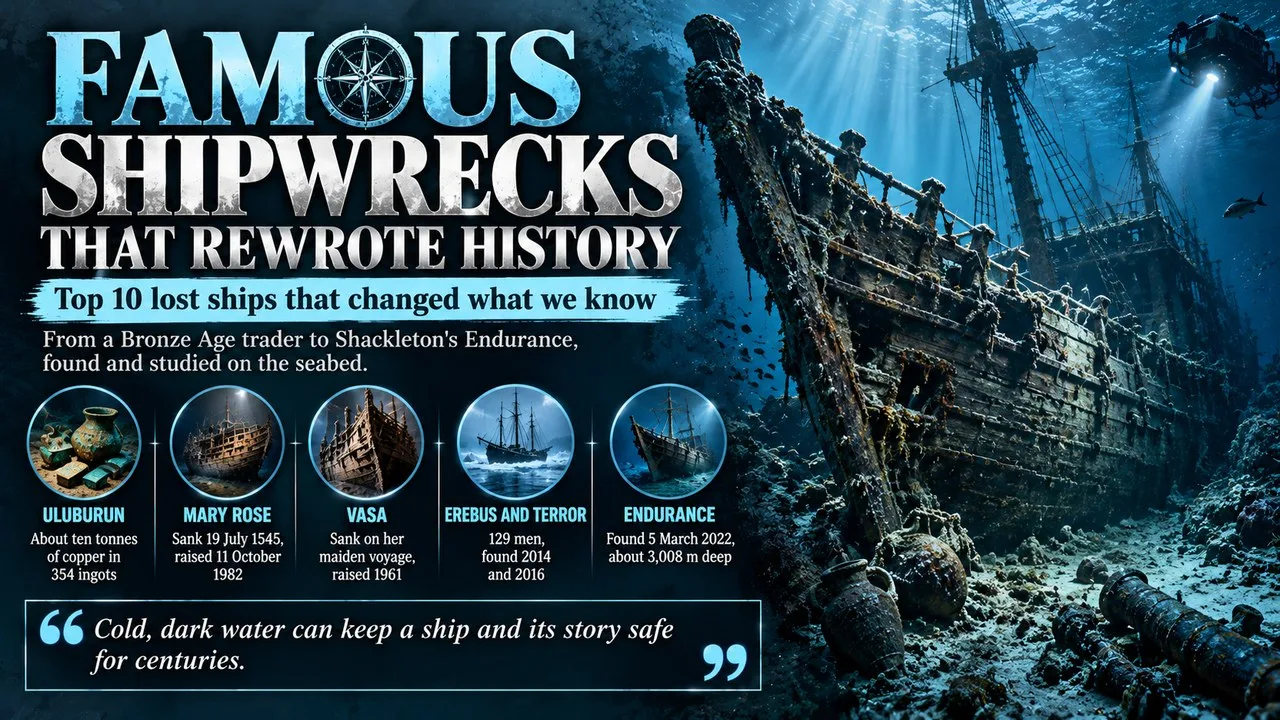
Famous shipwrecks are lost vessels whose discovery, cargo or story changed what we know about the past, from a Bronze Age trader to Shackleton's Endurance.
This Finepedia guide, written in October 2026, gathers 10 of the most important shipwrecks ever found, spanning more than 3,000 years. The facts come from museum records, encyclopaedias and excavation reports, and where numbers such as crew sizes or death tolls are uncertain we say so. We have left out the Titanic, which appears in our guide to engineering disasters. If you like stories of the sea, you may also enjoy Finepedia's guides to phantom islands that fooled mapmakers and the most famous cruise ships in the world.
How We Chose These
Every wreck on this list has been found and studied, and each one is famous for at least one reason: what archaeologists recovered from it, how well it survived, or the drama of its loss. We left out wartime warships, which deserve a list of their own. The ten are in chronological order, by the date each ship sank. For each wreck you will find a short story of the loss and the discovery, four key facts, and a closer look at why it still matters to historians, archaeologists and divers today. Dates for ancient wrecks are estimates based on the cargo and on tree-ring or radiocarbon dating.
The 10 Shipwrecks at a Glance
| No. | Ship | Sank | Where | Found |
|---|---|---|---|---|
| 1 | Uluburun ship | late 14th century BC | off south-west Turkey | 1982 |
| 2 | Antikythera wreck | c. 70 to 60 BC | off Antikythera, Greece | 1900 |
| 3 | Mary Rose | 1545 | the Solent, England | 1971 |
| 4 | Vasa | 1628 | Stockholm harbour, Sweden | 1956 |
| 5 | Batavia | 1629 | Houtman Abrolhos, Western Australia | 1963 |
| 6 | Whydah Gally | 1717 | off Cape Cod, Massachusetts | 1984 |
| 7 | HMS Erebus and HMS Terror | after 1848 | Canadian Arctic | 2014 and 2016 |
| 8 | SS Central America | 1857 | off the Carolinas, USA | 1988 |
| 9 | Endurance | 1915 | Weddell Sea, Antarctica | 2022 |
| 10 | SS Edmund Fitzgerald | 1975 | Lake Superior | 1975 |
1. The Uluburun Ship Carried a Bronze Age Fortune
In the summer of 1982 a Turkish sponge diver, Mehmet Çakır, described seeing "metal biscuits with ears" on the seabed near Uluburun, close to Kaş in south-west Turkey. They were copper ingots from a ship that sank in the late 14th century BC. Over eleven seasons from 1984 to 1994, divers from the Institute of Nautical Archaeology and the museum of underwater archaeology at Bodrum made more than 22,000 dives to excavate it.
Key Facts
- Sank: late 14th century BC
- Found: 1982, by a local sponge diver
- Excavation: 1984 to 1994, over 22,000 dives
- Main cargo: about ten tonnes of copper in 354 ingots
Why It Matters
Along with the copper, the ship carried tin, glass, ivory, gold jewellery and goods from Egypt, Cyprus, the Levant and the Aegean. It is one of the richest Bronze Age finds ever made and shows how far-reaching Mediterranean trade was more than 3,300 years ago.
2. The Antikythera Wreck Held the World's Oldest Known Computer
Around Easter 1900, sponge divers sheltering from bad weather off the Greek island of Antikythera found a Roman-era wreck at about 45 metres. Over the following year, with help from the Greek navy, they raised bronze and marble statues, coins and glass. Among the finds was a lump of corroded bronze that turned out to hold gears: the Antikythera mechanism, a hand-cranked device for predicting the positions of the Sun, Moon and planets and the timing of eclipses.
Key Facts
- Sank: second quarter of the 1st century BC
- Found: 1900, by sponge divers from Symi
- Depth: about 45 m
- Finds: now in the National Archaeological Museum, Athens
Did You Know?
The salvage of 1900 to 1901 was one of the first major underwater archaeology projects, but it came at a cost: one diver died and two were paralysed by decompression sickness. Among the statues recovered was the bronze Youth of Antikythera, one of the finest Greek bronzes to survive.
3. The Mary Rose Sank in Front of Henry VIII
The Mary Rose, a warship of King Henry VIII, served for more than 30 years before she sank on 19 July 1545 while leading an attack on a French invasion fleet in the Solent, off Portsmouth. The king is said to have watched from the shore. She had at least 400 men aboard, and fewer than 35 of them got away, a death rate above 90 per cent. Divers located the wreck in 1971, and after a long and difficult salvage effort the surviving hull was lifted on 11 October 1982, with the raising shown live on television.
Key Facts
- Launched: 1511
- Sank: 19 July 1545
- Raised: 11 October 1982
- Home today: Mary Rose Museum, Portsmouth Historic Dockyard
Why It Matters
Mud preserved one side of the hull and many thousands of objects, from longbows and cannon to combs, shoes and musical instruments. Together they give an unmatched snapshot of everyday Tudor life. The seabed where she lay has legal protection as a designated historic wreck site.
4. The Vasa Sank Less Than a Mile Into Her First Voyage
The Swedish warship Vasa was built in Stockholm between 1626 and 1628 for King Gustavus Adolphus and was one of the most heavily armed ships of her day. On 10 August 1628 she set sail, heeled over in a gust and sank after travelling only about 1,300 metres. She was top-heavy, with too much weight high in the hull. In 1956 the amateur archaeologist Anders Franzén found her, and in 1961 she was lifted almost intact after 333 years under water.
Key Facts
- Built: 1626 to 1628
- Sank: 10 August 1628, on her maiden voyage
- Raised: 1961
- Visitors: more than 45 million since 1961
Why It Matters
Franzén reasoned that the cold, brackish Baltic lacked the shipworms that eat timber in saltier seas, and he was right. Vasa is now the best-preserved 17th-century ship in the world, displayed with most of her carved decorations in the Vasa Museum in Stockholm.
5. The Batavia Wreck Led to a Massacre
Batavia, a brand-new merchant ship owned by the Dutch East India Company, ran aground on a reef in the Houtman Abrolhos islands off Western Australia on 4 June 1629, during her first voyage to the Dutch East Indies. About 300 of the 341 people aboard reached the low islands. The commander, Francisco Pelsaert, sailed about 3,000 kilometres in an open boat to fetch help, and while he was away a company official, Jeronimus Cornelisz, led a mutiny in which about 125 survivors were murdered.
Key Facts
- Owner: Dutch East India Company (VOC)
- Wrecked: 4 June 1629
- Rescue voyage: about 3,000 km in an open boat
- Wreck rediscovered: 1963
Did You Know?
Soldiers under Wiebbe Hayes, sent away to die on another island, found water and held off the mutineers until Pelsaert returned. Many finds, including part of the hull, are displayed at the Shipwrecks Museum in Fremantle, and a full-size replica of the ship, built from 1985 to 1995, is moored at Lelystad in the Netherlands.
6. The Whydah Is the Only Proven Pirate Wreck
The Whydah Gally began life in London in 1715 as a ship in the Atlantic slave trade. In 1717 she was captured by the pirate Samuel Bellamy, known as Black Sam, who made her his flagship. On 26 April 1717 she was wrecked in a violent storm off Cape Cod, and only two of her crew survived. The wreck, buried under sand in shallow water, was found in 1984 by the explorer Barry Clifford.
Key Facts
- Built: London, 1715
- Pirate captain: Samuel Bellamy
- Wrecked: 26 April 1717, off Cape Cod
- Found: 1984
Why It Matters
The ship's bell, raised in 1985 and inscribed with her name and the year 1716, made the Whydah the only fully authenticated wreck of a Golden Age pirate ship. Its finds, including coins, weapons and personal items, give a rare and real picture of pirate life, very different from the legends.
7. Erebus and Terror Were Lost in the Search for the Northwest Passage
In 1845 Sir John Franklin left England with the Royal Navy ships Erebus and Terror and 129 officers and men to chart the last unknown stretch of the Northwest Passage. Both ships became trapped in ice near King William Island in today's Nunavut, Canada. Franklin died in 1847, the crews abandoned the ships in April 1848, and every man later perished. For more than 160 years the ships' fate was one of the great mysteries of exploration.
Key Facts
- Expedition leader: Sir John Franklin
- Crew: 129 men, none survived
- Erebus found: September 2014, by a team led by Parks Canada
- Terror found: September 2016, in Terror Bay
How They Were Found
Inuit oral history, passed down for generations, helped guide the modern search. Drawing partly on those accounts, searchers found Erebus in Queen Maud Gulf in 2014. Two years later Terror was located in Terror Bay, lying in about 24 metres of water and in remarkably good condition.
8. The SS Central America Was the Ship of Gold
The SS Central America, an 85-metre paddle steamer, was carrying passengers and gold from the California Gold Rush from Panama to New York when a hurricane caught her off the Carolinas in September 1857. The storm flooded her boiler, and she sank on 12 September with 425 of the 578 people aboard. She also took down about 13,600 kilograms of gold, and the loss helped trigger a financial crisis known as the Panic of 1857.
Key Facts
- Nickname: the Ship of Gold
- Sank: September 1857, in a hurricane
- Deaths: 425 of 578 aboard
- Found: 1988, by Tommy Thompson's team
Why It Matters
The search team led by Tommy Thompson used a mathematical method called Bayesian search theory to narrow down where the ship lay, then sent a remotely operated vehicle to the deep wreck in 1988. Large amounts of gold were brought up, though years of court battles followed over who owned it.
9. Endurance Was Found 107 Years After She Sank
Endurance carried Sir Ernest Shackleton and 27 men to Antarctica on the Imperial Trans-Antarctic Expedition of 1914 to 1917. In early 1915 she was trapped by pack ice in the Weddell Sea, and on 21 November 1915 she was crushed and sank. Every member of the crew survived, after camping on the ice, sailing small boats to Elephant Island, and an epic open-boat voyage by Shackleton and five others to South Georgia to fetch rescue.
Key Facts
- Built: Sandefjord, Norway, launched 1912
- Sank: 21 November 1915, Weddell Sea
- Found: 5 March 2022, by the Endurance22 expedition
- Depth: about 3,008 m
Why It Matters
When the Endurance22 team found the wreck, the ship's name could still be read clearly on her stern, and her timbers were in excellent condition in the icy water. The wreck is protected as a historic site under the Antarctic Treaty and is being left undisturbed.
10. The Edmund Fitzgerald Became a Great Lakes Legend
When she was launched in 1958, the freighter Edmund Fitzgerald was the biggest vessel sailing the Great Lakes of North America. On 10 November 1975, loaded with iron ore pellets, she sank in a violent storm on Lake Superior with all 29 crew, without sending a distress call. A US Navy aircraft located the wreck, broken in two, a few days later. She remains the largest ship ever lost on the Great Lakes.
Key Facts
- Launched: 7 June 1958
- Sank: 10 November 1975, Lake Superior
- Crew lost: 29
- Cargo: taconite iron ore pellets
Did You Know?
The Canadian singer Gordon Lightfoot made the wreck famous with a 1976 ballad named after the ship, which became a hit in Canada and the United States. The cause of the sinking is still debated, with theories ranging from storm damage and flooding through her hatches to striking a shoal.
Frequently Asked Questions
What is the oldest shipwreck ever found?
The Uluburun ship is one of the oldest well-studied wrecks, but it is not the very oldest. Archaeologists have found remains of a few even earlier vessels in the Mediterranean and the Black Sea, where low-oxygen water preserves wood unusually well.
Why do some shipwrecks survive so well?
Cold water, low oxygen, a lack of wood-boring shipworms and protective mud or sand all slow decay. That is why Vasa in the Baltic, the Mary Rose in Solent mud and Endurance in the Antarctic survive so well.
Conclusion
These ten wrecks span from a Bronze Age trading ship to a modern freighter, yet each one changed how we see its own time. Some, like Uluburun, Antikythera and the Mary Rose, opened windows onto lost worlds of trade, science and daily life, while others, like Batavia and Erebus, preserved stories of survival and tragedy. The sea keeps its secrets well, but patient searchers continue to bring them to light. For more maritime history, read Finepedia's phantom islands that fooled mapmakers and the most famous cruise ships in the world.
- Pulak, Cemal (1998), The Uluburun shipwreck: an overview, International Journal of Nautical Archaeology, vol. 27, no. 3.
- Freeth, Tony and others (2006), Decoding the ancient Greek astronomical calculator known as the Antikythera Mechanism, Nature, vol. 444.
- Marsden, Peter (2003), Sealed by Time: The Loss and Recovery of the Mary Rose, Mary Rose Trust, Portsmouth.
- Vasa Museum (Vasamuseet), Stockholm, official history of the ship.
- Dash, Mike (2002), Batavia's Graveyard, Crown, New York.
- Parks Canada, Wrecks of HMS Erebus and HMS Terror National Historic Site.
- Falklands Maritime Heritage Trust (2022), Endurance22 expedition reports.
- Encyclopaedia Britannica, entries on the Mary Rose, Vasa, Franklin expedition and Ernest Shackleton.
- Wikipedia (accessed October 2026), articles on the Uluburun shipwreck, Antikythera wreck, Mary Rose, Vasa, Batavia, Whydah Gally, Franklin's lost expedition, SS Central America, Endurance and SS Edmund Fitzgerald.
- 10 Most Today, 10 Most Incredible Shipwrecks, 10mosttoday.com (topic reference).
















Log in with