




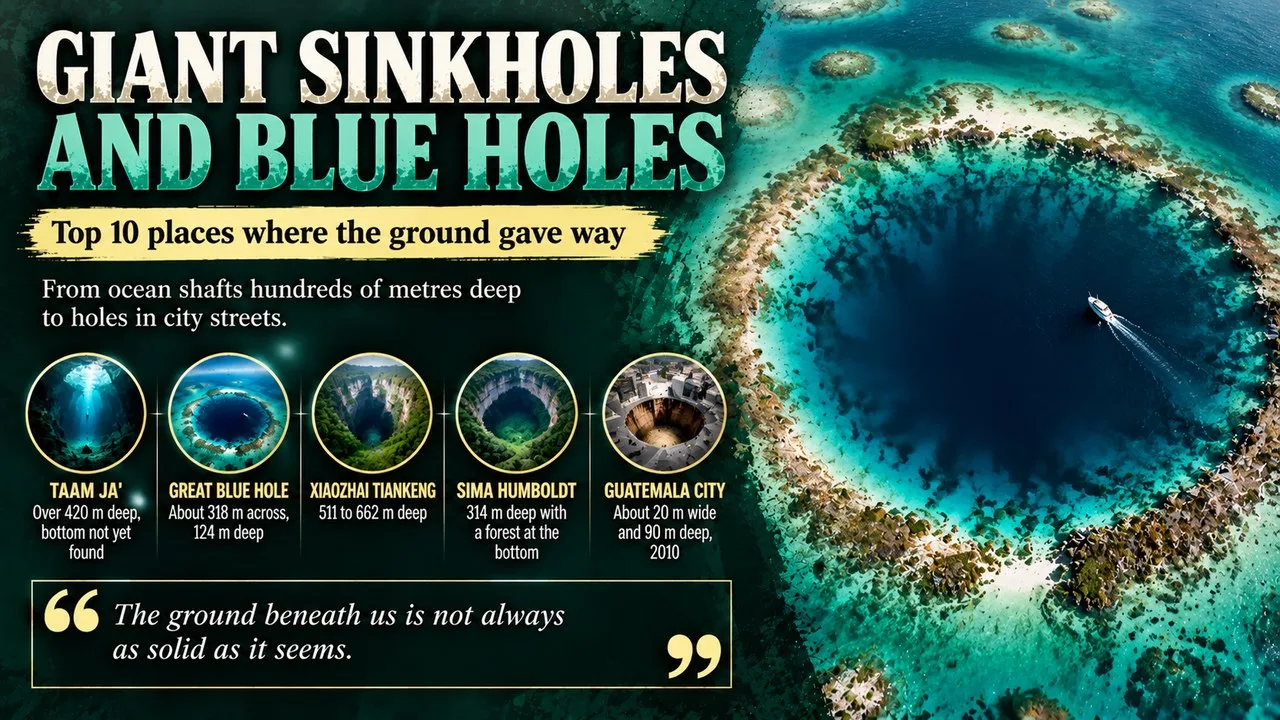
Giant sinkholes and blue holes are places where the ground or seabed collapsed into deep pits, from ocean shafts hundreds of metres deep to city streets.
This Finepedia guide, written in October 2026, looks at 10 of the most remarkable sinkholes and blue holes on Earth, from flooded shafts in tropical seas to pits that opened in the middle of cities. The facts come from geological studies, national parks, encyclopaedias and news reports, and where depths or numbers are still being measured or are disputed we say so. If you like the hidden side of our planet, you may also enjoy Finepedia's guides to the most popular underground caves in the world and the top 10 deepest lakes in the world.
How We Chose These
A sinkhole forms when the ground gives way into a hollow below, usually because water has slowly dissolved soft rock such as limestone, gypsum or salt. A blue hole is a sinkhole that has been flooded by the sea, which gives it its deep blue colour from above. We chose ten that stand out for their depth, their size, their history or the drama of how they appeared. The first four are marine blue holes, the next three are natural sinkholes on land, and the last three were triggered or sped up by human activity. For each you will find a short story, four key facts and a closer look at why it matters.
The 10 Sinkholes at a Glance
| No. | Sinkhole | Country | Type | Depth |
|---|---|---|---|---|
| 1 | Taam Ja' Blue Hole | Mexico | marine blue hole | over 420 m |
| 2 | Dragon Hole | South China Sea | marine blue hole | about 301 m |
| 3 | Dean's Blue Hole | Bahamas | marine blue hole | 202 m |
| 4 | Great Blue Hole | Belize | marine blue hole | about 124 m |
| 5 | Sacred Cenote | Mexico | water-filled sinkhole | about 27 m down to the water |
| 6 | Xiaozhai Tiankeng | China | land sinkhole | 511 to 662 m |
| 7 | Sima Humboldt | Venezuela | land sinkhole | 314 m |
| 8 | Winter Park sinkhole | United States | land collapse, 1981 | shallow, now a lake |
| 9 | Guatemala City sinkhole | Guatemala | urban collapse, 2010 | about 90 m |
| 10 | Dead Sea sinkholes | Israel and Jordan | many small collapses | varies |
1. Taam Ja' Is the Deepest Known Blue Hole
Taam Ja' lies in Chetumal Bay, on the south-east edge of Mexico's Yucatán Peninsula, and in the Maya language its name translates as "deep water". A local diver came across it in the early 2000s, but it was only studied properly from 2021. Echo soundings during expeditions in December 2023 suggested a depth of over 420 metres, which beats every other blue hole on record, and researchers say the true bottom has still not been reached. The echo sounder's cable may have drifted or caught on a ledge, so the real figure could be even greater.
Key Facts
- Location: Chetumal Bay, Mexico
- Depth: over 420 m, bottom not yet found
- Mouth: nearly round, about 152 m across
- Results published: 2024
Why It Matters
Taam Ja' took the record from Dragon Hole and shows how much of the seabed is still unexplored. Its colour is less striking than other blue holes, and it has no islands close by, which helps explain how it went unnoticed by scientists for so long.
2. Dragon Hole Is Linked to the Monkey King
Dragon Hole, also called the Sansha Yongle Blue Hole, lies near Drummond Island in the Paracels, a disputed island group in the South China Sea. In 2016 Chinese researchers measured it at about 301 metres deep, and it held the record for depth among blue holes until Taam Ja' overtook it. Fishermen in the area have a poetic name for it, the sea's eye, and according to local legend the Monkey King, hero of the classic Chinese tale Journey to the West, took his famous golden staff from its depths.
Key Facts
- Location: Paracel Islands, South China Sea
- Depth: about 301 m
- Measured: 2016, with an underwater robot
- Width: up to about 130 m in places
Did You Know?
Below about 90 metres the water holds almost no oxygen, which makes life very hard there. Researchers studying the hole reported over 20 kinds of marine life new to science during their first surveys. A few inland sinkholes filled with fresh water go deeper still, such as Mexico's Zacatón and the Hranice Abyss in Czechia.
3. Dean's Blue Hole Draws the World's Free Divers
The hole known as Dean's sits in a sheltered bay west of Clarence Town, on Long Island in the Bahamas. It is 202 metres deep, the third deepest known blue hole. Its mouth is only about 30 metres wide, but below the surface it opens into a chamber about 100 metres across, so the hole looks like a narrow-necked bottle from the side.
Key Facts
- Location: Long Island, Bahamas
- Depth: 202 m
- Mouth: about 30 m wide
- Known for: free-diving world records
Why It Matters
Calm, clear and very deep water right next to the shore makes it ideal for free diving, where athletes dive on a single breath. The New Zealander William Trubridge set a world record of 92 metres without fins here in April 2010, and he went on to run the Vertical Blue competition at the site. The sport is dangerous, and in November 2013 the American free diver Nicholas Mevoli died after a deep attempt here.
4. Jacques Cousteau Put the Great Blue Hole on the Map
Belize's Great Blue Hole is a nearly perfect circle of dark water in the middle of Lighthouse Reef, an atoll some 70 km from the mainland. It is about 318 metres across and around 124 metres deep. It began as a dry cave during the ice ages, when sea levels were far lower, and was flooded as the ice melted and the oceans rose.
Key Facts
- Location: Lighthouse Reef, Belize
- Diameter: about 318 m
- Depth: about 124 m
- Protection: part of the Belize Barrier Reef World Heritage Site
Why It Matters
The French explorer Jacques Cousteau brought his ship Calypso here in 1971 and ranked the hole among the world's best diving sites. His team found stalactites in its underwater caves, which can only form in air, proving the hole was once above sea level. In December 2018 two submarines went down to map its interior with sonar. They found a layer of hydrogen sulphide about 90 metres down, below which the water is dark and lifeless.
5. The Sacred Cenote Received Offerings to the Rain God
The northern Yucatán has no rivers, and water comes from cenotes, natural sinkholes that reach down to the water table. The Sacred Cenote at the Maya city of Chichen Itza is about 60 metres across, with sheer walls that fall some 27 metres to the water. A raised stone road about 300 metres long links it to the heart of the city.
Key Facts
- Location: Chichen Itza, Yucatán, Mexico
- Diameter: about 60 m
- Height of walls above the water: about 27 m
- Dredged: from 1904, by Edward Herbert Thompson
Why It Matters
Maya and Spanish sources say the Maya threw valuables and people into the cenote as offerings to Chaac, the god of rain. Twentieth-century work bore this out. Thompson's dredging and later dives brought up gold, jade, copper bells, pottery, wood, cloth and human bones, and many of his finds went to Harvard's Peabody Museum in Massachusetts.
6. Xiaozhai Tiankeng Is the Deepest Sinkhole on Land
Xiaozhai Tiankeng, whose name means the Heavenly Pit of the little village, lies in Fengjie County in Chongqing, China. It is about 626 metres long and 537 metres wide, with walls that plunge between 511 and 662 metres depending on where you measure. It is usually described as the deepest sinkhole in the world.
Key Facts
- Location: Fengjie County, Chongqing, China
- Size: about 626 m by 537 m
- Depth: 511 to 662 m
- Visitor access: a staircase of about 2,800 steps
Why It Matters
The pit formed above a powerful underground river that still flows beneath it and carried the dissolved rock away. That river runs for about 8.5 km through the mountain and was explored and mapped by a joint team of cavers in 1994. It has two stacked bowls with a sloping ledge between them, and during heavy summer rains a waterfall pours over the rim. More than 1,200 plant species have been recorded inside, and rare animals such as the clouded leopard have been sighted.
7. Sima Humboldt Has a Forest at the Bottom
Sima Humboldt sits on top of Sarisariñama, a flat-topped mountain called a tepui in southern Venezuela. The pit reaches 314 metres deep and about 352 metres wide at its rim, widening to around 502 metres lower down. A patch of forest grows on its floor, cut off from the forest on the plateau above.
Key Facts
- Location: Sarisariñama tepui, Venezuela
- Depth: 314 m
- Volume: about 18 million cubic metres
- First spotted: 1961, by the pilot Harry Gibson
Did You Know?
The sinkhole is named after the German explorer Alexander von Humboldt. Explorers first went down into it in 1974 and studied it more fully in 1976. A second giant pit, Sima Martel, lies only about 700 metres away.
8. The Winter Park Sinkhole Swallowed a House and Five Porsches
On the evening of 8 May 1981, the ground began to sink near a house in Winter Park, Florida, at a time when the water stored in the limestone below had fallen to record lows. Within a day the hole had swallowed the house of a local resident, Mae Rose Williams, part of the city swimming pool, sections of two streets and five Porsches from a nearby repair shop.
Key Facts
- Location: Winter Park, near Orlando, Florida
- Date: 8 to 9 May 1981
- Earth lost: about 250,000 cubic yards
- Cause: low groundwater in the limestone below
Why It Matters
Florida engineers described it as one of the largest sinkholes ever seen to form. The city even sold photographs of it, and it became a summer tourist attraction, and it pushed Florida to study the sinkhole danger caused by heavy groundwater use and building over limestone. The hole later filled with water and became a small lake.
9. The Guatemala City Sinkhole Swallowed a City Corner
On 30 May 2010, a round hole about 20 metres wide and 90 metres deep opened suddenly in Zona 2 of Guatemala City, reportedly destroying a three-storey building. It came after heavy rain from Tropical Storm Agatha, in the same week as an eruption of the Pacaya volcano nearby, and it looked almost perfectly cylindrical.
Key Facts
- Location: Zona 2, Guatemala City
- Date: 30 May 2010
- Size: about 20 m wide and 90 m deep
- Main causes: storm rain and leaking sewer pipes
Why It Matters
Guatemala City sits on thick layers of loose volcanic pumice, not limestone. Geologists say leaking pipes had washed the pumice away underground for years until the surface gave way. Some argue it should not be called a sinkhole at all, because it was mostly caused by people rather than nature, and they prefer the term piping feature. A similar hole had opened in the city in 2007, also blamed on broken sewer pipes.
10. The Dead Sea Is Opening Thousands of Sinkholes
The Dead Sea, on the border of Israel, Jordan and the West Bank, is shrinking fast. Its shores, now about 440 metres below sea level, are already the lowest dry land on Earth, and they sink lower every year. Its surface area fell from about 1,050 square kilometres in 1930 to around 605 today, mainly because much less water now flows in from the Jordan River. As the shoreline retreats, fresh groundwater moves in and dissolves buried layers of salt, leaving hollows that suddenly collapse.
Key Facts
- Location: shores of the Dead Sea
- Number: thousands, mostly since the 1980s
- Cause: falling sea level and dissolving salt layers
- Worst hit area: around Ein Gedi on the western shore
Why It Matters
The sinkholes have damaged roads, farms and buildings, and most of the beach resorts on the western shore of the northern basin have had to close. They are a clear example of how changes made by people to water can reshape the land itself.
Frequently Asked Questions
What is the difference between a sinkhole and a blue hole?
A sinkhole is any hole made when the ground collapses into a space below, usually after water has dissolved the rock. A blue hole is a sinkhole, often formed on land in the ice ages, that has since been flooded by the sea.
Can sinkholes be predicted?
Not exactly, but geologists can map areas at risk, such as places with limestone, salt or gypsum underground. Warning signs include cracks in walls and the ground, doors that stick and small hollows appearing in the soil.
Conclusion
From the record depths of Taam Ja' to the sudden collapse in Guatemala City, these ten holes show that the ground beneath us is not always as solid as it seems. Some, like the Sacred Cenote and Xiaozhai Tiankeng, took thousands of years to form and became part of human culture, while others opened in a single night. For more of Earth's hidden wonders, read Finepedia's guides to the most popular underground caves in the world and the top 10 deepest lakes in the world.
- Alcérreca-Huerta, J. C. and others (2024), studies of Taam Ja' Blue Hole, Frontiers in Marine Science.
- US Geological Survey, Sinkholes, Water Science School.
- UNESCO World Heritage Centre, Belize Barrier Reef (list no. 764) and Pre-Hispanic City of Chichen-Itza (list no. 483).
- Peabody Museum of Archaeology and Ethnology, Harvard University, Sacred Cenote collections.
- Geological Survey of Israel, research on Dead Sea sinkholes.
- Encyclopaedia Britannica, entries on sinkholes, the Great Blue Hole and the Dead Sea.
- Wikipedia (accessed October 2026), articles on Taam Ja' Blue Hole, Dragon Hole, Dean's Blue Hole, Great Blue Hole, Sacred Cenote, Xiaozhai Tiankeng, Sima Humboldt, Winter Park sinkhole, the 2010 Guatemala City sinkhole and the Dead Sea.
- 10 Most Today, 10 Most Amazing Sinkholes in the World, 10mosttoday.com (topic reference).















Log in with