


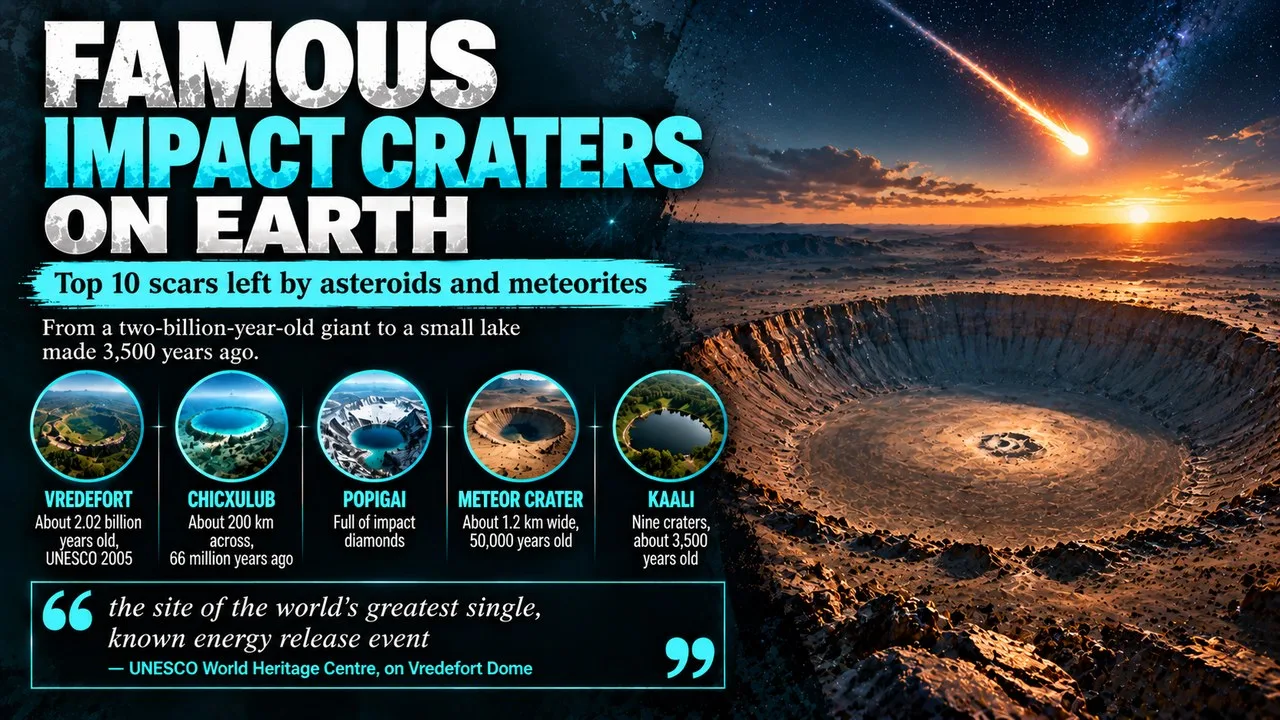
Famous impact craters are scars left where asteroids and meteorites struck the Earth, from a buried giant that ended the dinosaurs to small forest lakes.
This Finepedia guide, written in October 2026, looks at 10 of the most famous impact craters on Earth, from one that formed about two billion years ago to one that formed only about 3,500 years ago. The facts come from geological surveys, UNESCO, encyclopaedias and published studies, and where ages and sizes are estimates or are still debated we say so. If you enjoy the story of our planet, you may also like Finepedia's guides to 25 interesting facts about Earth and the most stunning volcanoes in the world.
How We Chose These
Earth has around 200 confirmed impact craters, far fewer than the Moon, because wind, water, ice and moving plates slowly wipe them away. We picked ten that stand out for their size, their age, how well they are preserved, or what they taught scientists. Each one has strong evidence of an impact, such as shocked minerals or shatter cones. The ten are listed from oldest to youngest, with a short story for each, four key facts and a closer look at why it matters.
The 10 Impact Craters at a Glance
| No. | Crater | Country | Approximate age | Size |
|---|---|---|---|---|
| 1 | Vredefort | South Africa | 2.02 billion years | 170 to 300 km (original) |
| 2 | Sudbury | Canada | 1.85 billion years | about 130 km (original) |
| 3 | Manicouagan | Canada | 214 million years | about 100 km (original) |
| 4 | Chicxulub | Mexico | 66 million years | about 200 km |
| 5 | Popigai | Russia | 35 million years | about 100 km |
| 6 | Nördlinger Ries | Germany | 14.8 million years | about 24 km |
| 7 | Pingualuit | Canada | 1.4 million years | 3.44 km |
| 8 | Lonar | India | disputed, 50,000 to 570,000 years | 1.8 km |
| 9 | Meteor Crater | United States | about 50,000 years | about 1.2 km |
| 10 | Kaali | Estonia | about 3,500 years | 110 m (largest crater) |
1. Vredefort Is the Largest Known Impact Structure
The Vredefort impact structure lies about 120 km south-west of Johannesburg, in South Africa's Free State. An asteroid struck here about 2.02 billion years ago, and the crater it made is thought to have measured somewhere between 170 and 300 kilometres across. Erosion has long since removed the crater itself, but the deformed rock beneath it survives, including a central uplift called the Vredefort Dome.
Key Facts
- Location: Free State, South Africa
- Age: about 2.02 billion years
- Asteroid size: recent estimates of 20 to 25 km
- UNESCO: Vredefort Dome listed in 2005
Why It Matters
Vredefort is one of the oldest impact sites known and the largest confirmed one on Earth. The asteroid that made it ranks among the biggest objects known to have hit our planet. Its origin was settled in 1961, when the American geologists Robert Dietz and Robert Hargraves found shatter cones, rocks with a fan-shaped fracture pattern that forms only under extreme shock.
2. Sudbury Turned an Asteroid Strike Into a Mining Town
The Sudbury Basin in Ontario, Canada, formed about 1.85 billion years ago when an object perhaps 10 to 15 km wide slammed into the ancient crust. The original crater may have been about 130 km wide, but later movements of the Earth's crust squeezed what remains into an oval. Rock thrown out by the blast turns up even in Minnesota in the United States, more than 800 km from the impact.
Key Facts
- Location: Greater Sudbury, Ontario, Canada
- Age: about 1.85 billion years
- Original size: about 130 km across
- Main ores: nickel and copper, with platinum-group metals
Why It Matters
The heat of the impact melted the crust into a huge pool of molten rock, and metals settled out of it as it cooled. In 1883, blasting for a new railway line exposed rich nickel and copper ore, and Sudbury grew into one of the world's great mining centres. The basin is still one of the biggest sources of nickel and copper ore anywhere, and the rocks there also hold gold, silver and platinum.
3. Manicouagan Is the Eye of Quebec
The Manicouagan crater in central Quebec dates from the Late Triassic, around 214 million years ago. At that time an asteroid around 5 km wide struck. Erosion has worn it down, but its outline is easy to spot from space, because a ring-shaped lake about 70 km across now fills its inner ring. In the middle sits René-Levasseur Island, whose highest point is Mount Babel.
Key Facts
- Location: Côte-Nord, Quebec, Canada
- Age: about 214 million years
- Lake area: about 1,942 square km
- Nickname: the Eye of Quebec
Did You Know?
The ring lake as it looks today is partly man-made. In the 1960s, Hydro-Québec built the Daniel-Johnson Dam for a hydroelectric scheme, and the rising water joined two older crescent lakes into one ring. Some scientists have also looked at whether the impact played a part in extinctions in the Late Triassic, though the link is not proven.
4. Chicxulub Is the Crater That Ended the Age of Dinosaurs
The Chicxulub crater lies buried under about a kilometre of younger rock beneath Mexico's Yucatán Peninsula. Just over 66 million years ago, an asteroid about 10 km wide plunged into a shallow sea here, leaving a crater roughly 200 km across. The geophysicists Antonio Camargo and Glen Penfield came across it in the late 1970s while searching for oil, and in the early 1990s samples confirmed that it was an impact crater.
Key Facts
- Location: Yucatán Peninsula, Mexico
- Age: about 66 million years
- Asteroid size: about 10 km
- Crater size: about 200 km across
Why It Matters
In 1980 Luis and Walter Alvarez and their colleagues reported a worldwide layer of clay rich in iridium, a metal that is scarce in Earth's crust but plentiful in many asteroids. They argued that a giant impact had caused a mass extinction. Chicxulub turned out to be that impact, Evidence for the impact includes shocked quartz, a large gravity anomaly and glassy beads called tektites in the surrounding region, and it is now widely accepted as the main cause of the extinction that wiped out about three-quarters of species, including all dinosaurs except birds.
5. Popigai Is Full of Impact Diamonds
The Popigai crater lies in remote northern Siberia and is about 100 km across, making it one of the largest known on Earth. Its age is put at roughly 35 million years, near the end of the Eocene. When the asteroid struck, the shock turned graphite in the ground into tiny diamonds, which are spread through the rocks within about 13.6 km of the point of impact.
Key Facts
- Location: northern Siberia, Russia
- Age: about 35 million years
- Size: about 100 km across
- Diamond sizes: mostly 0.5 to 2 mm
Did You Know?
Because of its diamonds, the area was kept off limits for decades during the Soviet era. A large scientific expedition in 1997 greatly improved what is known about the crater. The diamonds keep the flat shape and fine lines of the graphite grains they grew from, but most industrial diamonds today are made in factories instead.
6. The Nördlinger Ries Has a Town Built From Its Rocks
The Ries is a round basin about 24 km across in Bavaria, southern Germany, created roughly 14.8 million years back, in the Miocene epoch. For a long time people thought it was the remains of a volcano. In 1960 the American scientists Eugene Shoemaker and Edward Chao proved it was an impact crater by finding coesite, a form of quartz that is created only under the immense pressure of an impact.
Key Facts
- Location: Bavaria and Baden-Württemberg, Germany
- Age: about 14.8 million years
- Original rim: about 24 km across
- Key mineral: coesite, found in 1960
Did You Know?
The walled town of Nördlingen sits inside the crater, and many of its stone buildings, including St. George's Church, are made of suevite, a rock formed by the impact. That stone contains millions of microscopic diamonds. Scientists also believe the impact produced moldavite, a green natural glass found in the Czech Republic.
7. Pingualuit Holds Some of the Clearest Water on Earth
Pingualuit sits in the tundra of northern Quebec, near the northern tip of the province. The crater measures 3.44 km across, rises about 160 m above the land around it, and formed about 1.4 million years ago. A round lake 267 m deep fills the crater. With no rivers flowing in or out, it is fed only by rain and snow, which keeps its water among the purest and clearest in the world.
Key Facts
- Location: Nunavik, northern Quebec, Canada
- Age: about 1.4 million years
- Diameter: 3.44 km
- Lake depth: 267 m
Did You Know?
The Inuit of the region had long known the lake and called it the Crystal Eye of Nunavik. The outside world learned of it after aerial photographs taken in 1948 were released in 1950, and a prospector named Fred Chubb, curious about the strange round shape in the pictures, organised an expedition to see it. Today it lies in Pingualuit National Park, and the only fish living in the lake is the Arctic char.
8. Lonar Lake Is an Impact Crater in Volcanic Rock
Lonar Lake lies in the Buldhana district of Maharashtra, India. It fills a crater about 1.8 km wide and 150 m deep, blasted into the dark basalt of the Deccan Plateau. The age is still debated. Earlier studies put it at about 52,000 years, while a later dating method suggested around 570,000 years, a result some scientists question.
Key Facts
- Location: Buldhana district, Maharashtra, India
- Diameter: about 1.8 km
- Depth: about 150 m
- Protection: National Geological Monument and Ramsar site
Why It Matters
Lonar is one of very few impact craters formed in basalt, which makes it a useful comparison for craters on the Moon and Mars. The salty, alkaline lake is ringed by old Hindu temples. In June 2020 its water turned pink within a few days, a change scientists linked to salt-loving microbes. A British officer first recorded the crater in 1823, and a local legend links the name Lonar to a demon called Lonasura.
9. Meteor Crater Is the Best-Preserved Impact Crater
Meteor Crater, also called Barringer Crater, lies on the dry plateau of northern Arizona, about 60 km east of Flagstaff. It formed about 50,000 years ago when a nickel-iron meteorite around 50 m wide struck the plateau. The crater is about 1.2 km across and 170 m deep, and its rim stands about 45 m above the plains. Major scientific bodies, including the Lunar and Planetary Institute, describe it as the best-preserved meteorite crater on Earth.
Key Facts
- Location: near Winslow, Arizona
- Age: about 50,000 years
- Meteorite size: about 50 m
- Status: National Natural Landmark since 1967
Why It Matters
The mining engineer Daniel Barringer argued in the early 1900s that the crater was made by a meteorite and spent years drilling for buried iron that he never found. Shoemaker's later work here helped found the science of impact geology, and in the 1960s and 1970s NASA used the crater to train astronauts before they flew to the Moon on Apollo. It is still owned by the Barringer family.
10. The Kaali Craters Formed When People Lived Nearby
The Kaali field holds nine craters on Saaremaa, an Estonian island in the Baltic. The latest estimates put the impact at around 1500 BC, about 3,500 years ago. A meteorite of perhaps 20 to 80 tonnes broke apart 5 to 10 km above the ground, and the largest fragment made a crater 110 m wide and 22 m deep, now filled by a small lake.
Key Facts
- Location: Saaremaa island, Estonia
- Number of craters: nine
- Age: about 3,500 years
- Largest crater: 110 m wide, 22 m deep
Did You Know?
Kaali is one of the few known impacts that hit an area where people already lived. Scholars think the fiery event may have entered local myths, and the crater lake was long treated as a sacred place.
Frequently Asked Questions
How many impact craters are there on Earth?
About 200 impact structures have been confirmed so far, and new ones are still being found. Many more have been erased by erosion, buried under sediment or destroyed by the movement of tectonic plates.
How do scientists know a crater was made by an impact?
They look for clues that only an impact can create, such as shatter cones, shocked quartz, coesite, tiny diamonds and high levels of metals like iridium or nickel. A round shape alone is not enough, because volcanoes and sinkholes can also make round holes.
Conclusion
From Vredefort's two-billion-year-old scar to the small lake at Kaali, these ten craters show that Earth has been hit again and again throughout its history. Some, like Sudbury, gave us metals, while Chicxulub changed the course of life itself, and Meteor Crater taught scientists how to read the signs. For more about our planet, read Finepedia's 25 interesting facts about Earth and the most stunning volcanoes in the world.
- Earth Impact Database, Planetary and Space Science Centre, University of New Brunswick.
- UNESCO World Heritage Centre, Vredefort Dome (list no. 1162).
- Alvarez, L. W., Alvarez, W., Asaro, F. and Michel, H. V. (1980), Extraterrestrial cause for the Cretaceous-Tertiary extinction, Science, vol. 208.
- Shoemaker, E. M. and Chao, E. C. T. (1961), New evidence for the impact origin of the Ries Basin, Bavaria, Germany, Journal of Geophysical Research, vol. 66.
- Meteor Crater Enterprises and the Lunar and Planetary Institute, Barringer Meteorite Crater.
- Geological Survey of India, Lonar Lake National Geological Monument.
- Encyclopaedia Britannica, entries on the Chicxulub crater, Sudbury Basin and Meteor Crater.
- Wikipedia (accessed October 2026), articles on the Vredefort impact structure, Sudbury Basin, Manicouagan Reservoir, Chicxulub crater, Popigai crater, Nördlinger Ries, Pingualuit crater, Lonar Lake, Meteor Crater and Kaali crater.
- 10 Most Today, 10 Most Incredible Impact Craters, 10mosttoday.com (topic reference).














Log in with