




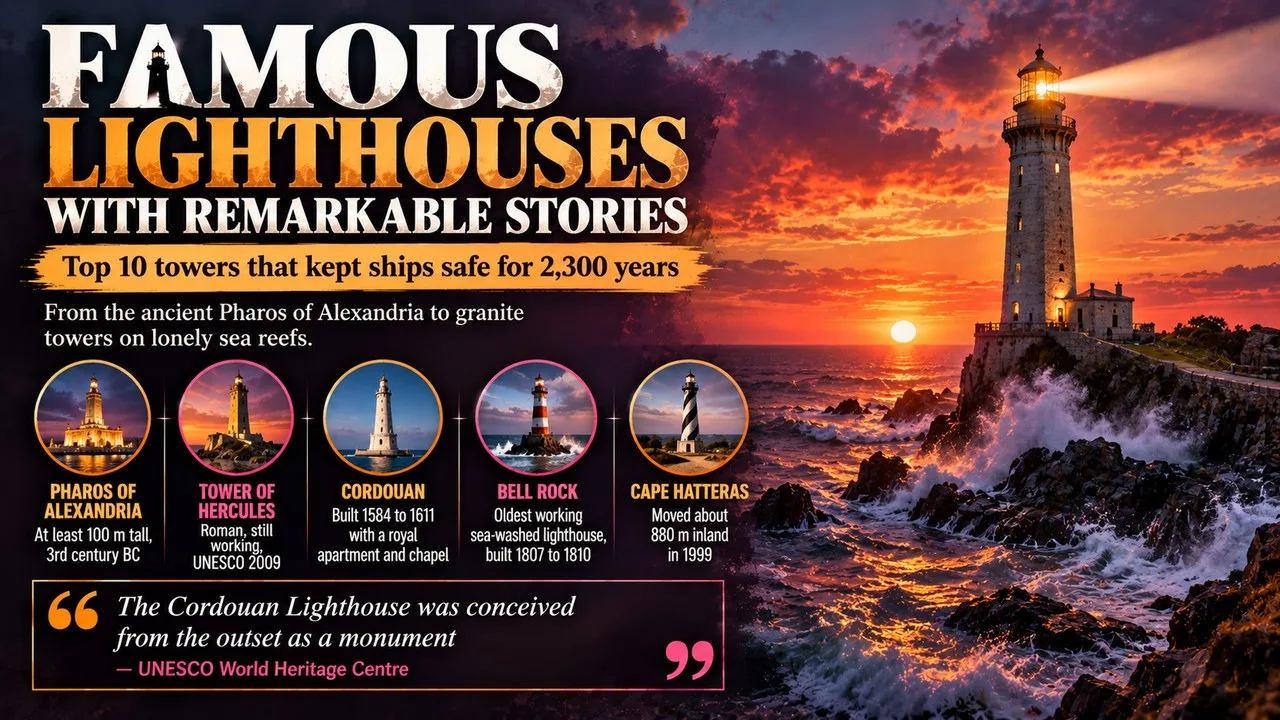
Famous lighthouses are towers that kept ships off deadly rocks for centuries, from the ancient Pharos of Alexandria to granite towers on lonely sea reefs.
This Finepedia guide, written in October 2026, looks at 10 of the most remarkable lighthouses ever built, spanning more than 2,300 years. The facts come from lighthouse authorities, UNESCO, encyclopaedias and local histories, and where heights or dates are estimates we say so. If you enjoy stories of the sea, you may also like Finepedia's guides to phantom islands that fooled mapmakers and the most famous cruise ships in the world.
How We Chose These
We looked for lighthouses that matter for more than their looks. Each one on this list either broke new ground in design, survived against the odds, or played a big part in the history of its coast. Most are still working today, though nearly all now run automatically without keepers. The ten are in chronological order, by the date the tower that made each one famous was first built or lit. For every lighthouse you will find a short history, four key facts, and a closer look at why it still matters.
The 10 Lighthouses at a Glance
| No. | Lighthouse | Country | Built or first lit | Still working? |
|---|---|---|---|---|
| 1 | Pharos of Alexandria | Egypt | 3rd century BC | No, lost by 1480 |
| 2 | Tower of Hercules | Spain | late 1st century AD | Yes |
| 3 | Hook Lighthouse | Ireland | between 1201 and 1240 | Yes |
| 4 | Kõpu Lighthouse | Estonia | 1531 | Yes |
| 5 | Cordouan Lighthouse | France | 1584 to 1611 | Yes |
| 6 | Eddystone Lighthouse | England | 1698, current tower 1882 | Yes |
| 7 | Portland Head Light | United States | 1791 | Yes |
| 8 | Bell Rock Lighthouse | Scotland | 1807 to 1810 | Yes |
| 9 | Cape Hatteras Light | United States | 1870 | Yes |
| 10 | Fastnet Lighthouse | Ireland | 1904 | Yes |
1. The Pharos of Alexandria Was the First Great Lighthouse
The Pharos stood on a small island at the entrance to Alexandria's harbour in Egypt. It was begun under Ptolemy I and completed under his son Ptolemy II Philadelphus in the 3rd century BC, and it is thought to have stood at least 100 metres tall. Arab travellers who saw it in the Middle Ages described three stages, square at the bottom, eight-sided in the middle and round at the top. A fire burned at the summit by night, and some accounts mention a mirror that reflected sunlight by day. A series of earthquakes from the 10th to the early 14th century left it a ruin, and in 1480 the sultan Qaitbay used its last stones for a fortress that still stands on the spot.
Key Facts
- Built: 3rd century BC, under the Ptolemies
- Estimated height: at least 100 m
- Status: listed among the ancient Seven Wonders
- Remains: blocks found on the harbour floor by French divers in 1994
Did You Know?
The name of the island became the word for a lighthouse in many languages. That is why a lighthouse is a phare in French and a faro in Italian and Spanish.
2. The Tower of Hercules Still Guides Ships After 1,900 Years
The Tower of Hercules rises on a headland near A Coruña in north-west Spain. The Romans built it in the late 1st century AD, probably in the reign of Trajan, and an inscription at its base names the architect as Gaius Sevius Lupus from what is now Coimbra in Portugal. In the 18th century it was restored and wrapped in a new stone casing, but the Roman core is still inside. The oldest known written mention of it comes from the historian Paulus Orosius, around AD 415, who described a very tall lighthouse looking out towards Britain.
Key Facts
- Location: A Coruña, Galicia, Spain
- Built: late 1st century AD
- Height today: 55 m, of which 34 m is Roman masonry
- UNESCO: World Heritage Site since 2009
Why It Matters
It is the only Roman lighthouse that survives in full and still guides ships. That makes it nearly 2,000 years of continuous history in one tower, standing at the point where ships turned along the Atlantic coast of Spain. For most of its life it went by its Latin name, Farum Brigantium, and the word farum itself was borrowed from the Greek name of the Pharos.
3. Hook Lighthouse Was Kept by Monks
Hook Lighthouse stands on the end of a narrow peninsula in south-east Ireland's County Wexford, marking the way into Waterford Harbour. The stone tower was built by William Marshal, Earl of Pembroke, sometime between 1201 and 1240, to guide ships to his new port at New Ross. Monks from a small monastery nearby are believed to have been the first keepers, lighting fires to warn sailors of the rocks. Local tradition says a missionary named Dubhán kept a beacon on the headland in the 400s, long before the tower was raised.
Key Facts
- Location: Hook Head, County Wexford, Ireland
- Built: between 1201 and 1240
- Walls: up to 4 m thick
- Operator: the Commissioners of Irish Lights
Why It Matters
The tower has survived largely unchanged for more than 800 years, and it is often described as one of the oldest working lighthouses in the world. Inside, a stairway of 115 steps runs through the thickness of the walls, past rib-vaulted rooms.
4. Kõpu Lighthouse Began as a Landmark Without a Light
Kõpu Lighthouse sits on the highest hill of Hiiumaa, an island off Estonia's west coast, and warns ships away from a dangerous sandbank in the Baltic. Merchants of the Hanseatic League, whose main east-west shipping lane ran past the sandbank, asked for a sea mark here for years, and the stone tower was completed around 1531. At first it was a solid landmark with no light at all; a fire in an iron basket was only added at the top in 1649.
Key Facts
- Location: Hiiumaa island, Estonia
- Completed: about 1531
- First fire: 1649
- Light height: about 104 m above sea level
Did You Know?
The tower is a square block with massive buttresses on four sides, and its body contains about 5,000 cubic metres of stone. It weighs an estimated 12,000 tonnes, and its lamp, which sits higher above the water than any other on the Baltic coast, can be seen around 48 km away.
5. Cordouan Was Built Like a Royal Palace
Cordouan stands on a rocky plateau at sea, about 7 km out to sea where the Gironde estuary meets the Atlantic in south-west France. The architect Louis de Foix began it in 1584 and it was finished in 1611. It was designed to impress as much as to warn, with a royal apartment and a chapel inside, and in the late 18th century the engineer Joseph Teulère made it taller. An earlier tower on the same rock, built when the region was ruled by England, was kept by a hermit, and passing ships paid a small fee for its light.
Key Facts
- Location: Gironde estuary, France
- Built: 1584 to 1611
- Height: about 67.5 m
- UNESCO: World Heritage Site since 2021
Why It Matters
It is the oldest lighthouse in France and still works today. It joined France's official list of protected historic monuments in 1862, more than 150 years before UNESCO recognition. For centuries it protected the ships of the Bordeaux wine trade, and UNESCO praises it as a showpiece of both Renaissance architecture and lighthouse engineering.
6. Eddystone Taught Engineers How to Build at Sea
The Eddystone Rocks lie about 19 km off Plymouth in south-west England and were once feared by every ship entering the English Channel. The first lighthouse, a wooden tower by Henry Winstanley, first shone on 14 November 1698 and was the first known lighthouse on an open-sea rock. The Great Storm of December 1703 swept it away, with Winstanley inside. A second tower burned in 1755. During the building of the first one, a French privateer even carried Winstanley off as a prisoner, and King Louis XIV ordered him freed.
Key Facts
- First lit: 14 November 1698
- Third tower: John Smeaton, completed 1759
- Current tower: lit in 1882
- Memorial: Smeaton's Tower, rebuilt on Plymouth Hoe
Why It Matters
John Smeaton shaped his granite tower like the trunk of an oak, locked the stones together with dovetail joints and used hydraulic lime that set under water. His design worked so well that it guided lighthouse builders for more than a century and helped lead to modern concrete. It stood until 1877, when the rock beneath it began to crack, and its upper part was taken down and rebuilt on shore in Plymouth.
7. Portland Head Light Was Built on George Washington's Orders
Portland Head Light stands on a headland at Cape Elizabeth, Maine, at the entrance to Portland Harbor. Work began in 1787 at the direction of George Washington, using two local masons and stone gathered from nearby fields, and the tower was completed on 10 January 1791. When the masons first finished it, they found it was too short to be seen past the headlands, so they added another 20 feet. Whale oil lamps gave the first light, and a Fresnel lens was fitted in 1855.
Key Facts
- Location: Cape Elizabeth, Maine
- Completed: 10 January 1791
- First lamps: whale oil
- Keeper's house: now a maritime museum
Why It Matters
It was the first lighthouse completed by the young federal government of the United States, and no lighthouse in Maine is older. Today it is one of the most photographed lighthouses in North America.
8. Bell Rock Was Built on a Reef That Vanished at High Tide
The Bell Rock, also called Inchcape, lies in the North Sea off the coast of Angus, roughly 18 km from shore, and is covered by the sea for all but a few hours a day. Before the lighthouse, it is said to have wrecked as many as six ships in a typical winter. The engineer Robert Stevenson built the tower between 1807 and 1810, with his workmen able to reach the rock only at low tide. A legend says a medieval abbot of Arbroath once hung a warning bell on the reef, which a pirate stole, and the poet Robert Southey retold the tale in his poem The Inchcape Rock.
Key Facts
- Location: off Angus, Scotland
- Built: 1807 to 1810
- Height: 35 m
- Automated: 1988
Why It Matters
Bell Rock is the oldest working sea-washed lighthouse in the world. Its stonework has never needed to be replaced in more than 200 years, and the feat of building it has earned it a place on lists of the great wonders of the industrial age.
9. Cape Hatteras Light Was Moved Inland
Cape Hatteras, on the barrier islands of North Carolina, guards the Diamond Shoals, waters so deadly that sailors called them the Graveyard of the Atlantic. The first light here dated from 1802, and the present brick tower, with its black and white spiral stripes, was finished in 1870. As the beach washed away, the sea crept closer to its base for more than a century.
Key Facts
- Location: Hatteras Island, North Carolina
- Current tower: completed 1870
- Height: about 60 m, the tallest brick lighthouse in America
- Moved: 1999, about 880 m inland
Why It Matters
In 1999 engineers lifted the whole tower and rolled it to safer ground, 1,500 feet from the shore. It was one of the largest building moves ever attempted, and the lighthouse still shines today.
10. Fastnet Is Known as Ireland's Teardrop
The Fastnet Rock, the southernmost point of Irish territory, lies off the coast of County Cork. A cast-iron tower was first lit there on 1 January 1854, It was built after the loss of the packet ship Stephen Whitney in fog nearby in 1847, when 92 of the 110 people aboard died. But storms shook the iron tower so hard that crockery fell from the tables. It was replaced by a granite tower of 2,047 interlocking blocks, which was first lit on 27 June 1904 and stands 54 metres tall.
Key Facts
- Location: off County Cork, Ireland
- First light: 1 January 1854
- Current tower: in service from 27 June 1904
- Height: 54 m, the tallest lighthouse in Ireland
Did You Know?
Fastnet was the last piece of Ireland that many 19th-century emigrants saw on their way to North America, which is how it got its nickname. Today it is the turning mark of the famous Fastnet Race for yachts.
Frequently Asked Questions
What is the oldest working lighthouse in the world?
Spain's Tower of Hercules, built by the Romans in the late 1st century AD, is generally accepted as the oldest lighthouse still in use. Hook Lighthouse in Ireland, from the early 1200s, is often named as the second oldest.
Are lighthouses still needed today?
Satellite navigation has taken over most of their work, but many lighthouses still operate, almost all of them automated, as a backup for ships and small boats. Each one has its own pattern of flashes, so sailors can tell which light they are looking at, and many old keepers' houses are now museums or holiday cottages.
Conclusion
From the Pharos of Alexandria to the granite of Fastnet, these ten lighthouses tell the story of how people learned to make the sea safer. Some, like Cordouan and the Tower of Hercules, are monuments as much as working lights, while Eddystone and Bell Rock pushed engineers to build where no one had built before. For more maritime history, read Finepedia's phantom islands that fooled mapmakers and the most famous cruise ships in the world.
- UNESCO World Heritage Centre, Tower of Hercules (list no. 1312) and Cordouan Lighthouse (list no. 1625).
- Commissioners of Irish Lights, histories of Hook Head and Fastnet lighthouses.
- Northern Lighthouse Board, Bell Rock Lighthouse history.
- Bathurst, Bella (1999), The Lighthouse Stevensons, HarperCollins, London.
- US National Park Service, Cape Hatteras Light Station and the 1999 relocation.
- Encyclopaedia Britannica, entries on the Pharos of Alexandria and Eddystone Lighthouse.
- Wikipedia (accessed October 2026), articles on the Lighthouse of Alexandria, Tower of Hercules, Hook Lighthouse, Kõpu Lighthouse, Cordouan Lighthouse, Eddystone Lighthouse, Smeaton's Tower, Portland Head Light, Bell Rock Lighthouse, Cape Hatteras Light and Fastnet Rock.
- 10 Most Today, 10 Most Famous Lighthouses in the World, 10mosttoday.com (topic reference).














Log in with