









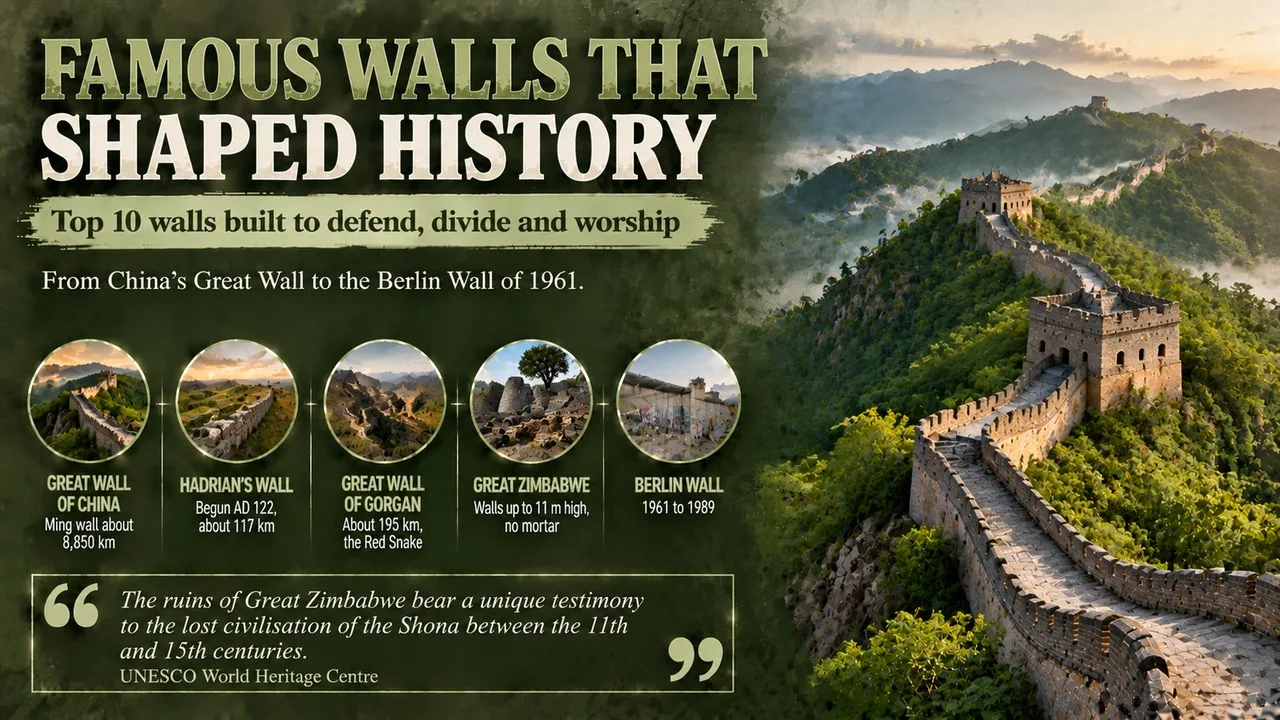
Famous walls that shaped history include the Great Wall of China, Hadrian's Wall in Britain, the stone walls of Great Zimbabwe and the Berlin Wall of 1961.
This Finepedia guide, written in October 2026, looks at 10 famous walls and what they tell us about the people who built them. The facts come from UNESCO, national heritage bodies, archaeological studies and encyclopaedias. Lengths and dates are given as reported by these sources, and where historians disagree we say so. If you enjoy the history of great structures, you may also like Finepedia's guides to the oldest surviving buildings on Earth and the best-preserved medieval towns in Europe.
How We Chose These
We picked ten walls that are famous for their size, their age or their place in history, across Asia, Africa, Europe and South America. Some were built to keep armies out, some to protect trade or holy sites, and one was built to stop people leaving. To avoid repeating our medieval towns guide, we left out the town walls of Ávila, Carcassonne and Visby. The list runs roughly in the order each wall was begun. For each one you will find a short profile, four key facts and one more note on why it matters or a surprising detail.
The 10 Walls at a Glance
| No. | Wall | Country | Begun | Notable size |
|---|---|---|---|---|
| 1 | Great Wall of China | China | from the 7th century BC | Ming wall about 8,850 km |
| 2 | Western Wall | Jerusalem | about 19 BC (Herod) | retaining wall about 488 m long |
| 3 | Hadrian's Wall | United Kingdom | AD 122 | about 117 km |
| 4 | Walls of Constantinople | Turkey (Istanbul) | 4th to 5th century AD | Theodosian land walls about 5.7 km |
| 5 | Great Wall of Gorgan | Iran | around AD 500 | about 195 km |
| 6 | Great Zimbabwe | Zimbabwe | 11th to 15th century | Great Enclosure walls up to 11 m high |
| 7 | Walls of Dubrovnik | Croatia | mainly 13th to 17th century | about 1,940 m around the old city |
| 8 | Kumbhalgarh | India | 15th century | wall about 36 km |
| 9 | Sacsayhuamán | Peru | 15th century | stones of over 100 tonnes |
| 10 | Berlin Wall | Germany | 1961 | encircled West Berlin until 1989 |
1. China's Great Wall Took Over Two Thousand Years to Build
China's Great Wall is not one wall but many, built by different Chinese states and dynasties to guard their northern borders against nomadic peoples from the steppe. The first walls date from the 7th century BC and were linked during the Qin dynasty. The best-known sections, with brick and stone watchtowers, date from Ming rule between the 14th and 17th centuries.
Key Facts
- Location: northern China
- Earliest walls: 7th century BC
- Ming wall: about 8,850 km
- World Heritage Site: since 1987
Did You Know?
A survey in 2012 measured all the walls built over the centuries at more than 21,000 kilometres. A popular claim says astronauts can spot it from orbit without help, but this is a myth: it is long but far too narrow to pick out. Badaling, near Beijing, was the first stretch opened to the public and is still the most visited. Earlier walls were often made of rammed earth, while the Ming builders used fired brick and cut stone, which is why their sections have lasted best. The wall was also a corridor for moving troops and goods, and beacon fires and smoke along it could carry warnings over great distances.
2. The Western Wall Is One of the Holiest Sites in Judaism
The Western Wall in Jerusalem is part of an ancient retaining wall around the hilltop that Jewish and Christian tradition calls the Temple Mount and Muslims call the Haram al-Sharif. Its lowest courses of huge stone blocks date from the late Second Temple period, and most scholars credit Herod the Great with starting them. The full retaining wall runs about 488 metres.
Key Facts
- Location: Old City of Jerusalem
- Begun: around the time of Herod the Great
- Other names: the Kotel, the Wailing Wall, the Buraq Wall
- Length: about 488 m in total
Why It Matters
For Jews, the wall is the closest place of prayer to the site of the ancient Temple, and visitors often push small written prayers into the cracks between the stones. The site is also deeply important in Islamic tradition, which links it to the Prophet Muhammad's night journey, so it remains one of the most sensitive places in the world.
3. Hadrian's Wall Marked the Edge of the Roman Empire
Hadrian's Wall was begun in AD 122 on the orders of the Roman emperor Hadrian. It ran right across northern England, from Wallsend on the Tyne to Bowness-on-Solway on the far western shore, a distance of 80 Roman miles, or about 117 kilometres. Troops lived in big forts along the line, with small milecastles and lookout turrets in between.
Key Facts
- Location: northern England
- Begun: AD 122
- Length: about 117 km (80 Roman miles)
- World Heritage Site: since 1987
Did You Know?
Much of the wall's stone was later taken away to build farms and roads, so no part stands at its original height. Even so, no bigger Roman remain survives anywhere in Britain, and walkers can follow it from coast to coast on the Hadrian's Wall Path. Its gates may also have worked as customs posts, controlling trade as well as defence.
4. The Walls of Constantinople Held Out for a Thousand Years
Constantine the Great gave walls to Constantinople, today's Istanbul, when he made it the empire's new capital. As the city grew, a mighty double line of land walls was built further out in the reign of Theodosius II, with the first phase finished in 413. With a moat, an outer wall and a taller inner wall with towers, they were among the strongest defences of the ancient world.
Key Facts
- Location: Fatih district, Istanbul, Turkey
- Theodosian land walls: first phase finished in 413
- Length of land walls: about 5.7 km
- Fell: to Ottoman forces in 1453
Why It Matters
For centuries the walls saved Constantinople, and so the whole Byzantine state, against attacks by Avars, Arabs, Rus' and Bulgars. In 1453 the Ottoman Sultan Mehmed II besieged the city with huge cannons, and after weeks of fighting his forces broke in, ending the Byzantine Empire. Long stretches of the walls still stand today, and in 1985 they were listed by UNESCO as part of the Historic Areas of Istanbul. Their gates, such as the Golden Gate used for imperial processions, are still landmarks of the old city.
5. Iran's Wall of Gorgan Is Called the Red Snake
Gorgan's Great Wall runs across north-eastern Iran, near the south-eastern corner of the Caspian Sea. It was built by the Sasanian Persian Empire to guard a narrow gap between the sea and the mountains, probably against the White Huns to the north. It is about 195 kilometres long and was lined with more than 30 forts.
Key Facts
- Location: Golestān Province, Iran
- Built: around the late 400s or the 500s AD
- Length: about 195 km
- Nickname: the Red Snake, after its red bricks
Did You Know?
The wall was made of fired bricks baked in kilns along its route, and a canal ran beside it to bring water for brick making. For a long time people believed Alexander the Great had built it, so it was also called Alexander's Barrier. Scientific dating in the 2000s showed it was much later, making it one of the longest and most advanced frontier walls of its time.
6. Great Zimbabwe Built Stone Walls Without Mortar
The ruins of Great Zimbabwe stand in the hills of south-eastern Zimbabwe, near Masvingo. Built by the forebears of today's Shona people between the 11th and 15th centuries, it was the capital of a powerful trading kingdom. Its most famous building, the Great Enclosure, has curving stone walls up to 11 metres high and about 250 metres long, laid without any mortar.
Key Facts
- Location: near Masvingo, Zimbabwe
- Built: 11th to 15th century
- Great Enclosure walls: up to 11 m high
- World Heritage Site: since 1986
Why It Matters
Great Zimbabwe is the largest stone structure from before colonial times in southern Africa. For years, colonial writers wrongly claimed it must have been built by outsiders, but archaeologists proved it was the work of local African builders. The country took its name from the site, and a carved soapstone bird found there appears on Zimbabwe's flag.
7. The Walls of Dubrovnik Wrap Around the Old City
The Walls of Dubrovnik surround the old city of Dubrovnik on the Adriatic coast of southern Croatia. They were built mainly between the 13th and 17th centuries, when the city was the wealthy Republic of Ragusa. The walls run without a break for about 1,940 metres, reach up to about 25 metres high with towers, bastions and the big fort of St John guarding the harbour.
Key Facts
- Location: Dubrovnik, Croatia
- Main building period: 13th to 17th century
- Length: about 1,940 m
- World Heritage Site: the old city since 1979
Did You Know?
Visitors can walk the full circuit along the top of the walls for views over red roofs and the sea. The walls also starred as King's Landing in the TV series Game of Thrones, which brought huge crowds to the city. They were damaged during the siege of 1991 to 1992 and have since been repaired. In the past they were armed with more than 120 cannons, and a moat ran around the landward side.
8. Kumbhalgarh Is Called the Great Wall of India
Kumbhalgarh is a hill fort in the Aravalli Hills of Rajasthan, India, about 84 kilometres from Udaipur. Rana Kumbha, ruler of Mewar, raised it in the 1400s, and its wall winds over hills and valleys for about 36 kilometres. Few unbroken walls anywhere are longer.
Key Facts
- Location: Rajsamand district, Rajasthan
- Built by: Rana Kumbha, 15th century
- Wall length: about 36 km
- World Heritage: 2013, as one of the Hill Forts of Rajasthan
Did You Know?
Inside the walls are more than 360 Hindu and Jain temples. The fort is also the birthplace of Maharana Pratap, the famous warrior king of Mewar, and the walls are lit up in the evenings for visitors. A chain of fortified gates, known as pols, climbs up to the palace of Badal Mahal at the fort's highest point, which looks out over the surrounding hills.
9. Sacsayhuamán Fits Giant Stones Together Perfectly
Sacsayhuamán is an Inca citadel on a hill above Cusco, Peru, the old capital of the Inca Empire, at about 3,700 metres above sea level. According to Inca tradition, it was begun in the reign of Pachacuti in the 15th century. Its zigzag terraces are made of huge limestone blocks cut so precisely that they fit together without mortar.
Key Facts
- Location: Cusco, Peru
- Altitude: about 3,701 m
- Largest block: estimated at 128 to nearly 200 tonnes
- World Heritage Site: since 1983, with Cusco
Why It Matters
How the Inca cut, moved and fitted such enormous stones without iron tools or wheels is still a subject of study. After the Spanish conquest, much of the stone was taken to build Cusco, but the largest blocks were too big to move. Every June the site hosts Inti Raymi, a revived Inca festival of the sun.
10. The Berlin Wall Divided a City for 28 Years
The Berlin Wall was put up by the government of East Germany on 13 August 1961 to stop its citizens fleeing to the West. It encircled West Berlin, with guard towers, a wide area known as the death strip, trenches and other barriers. For 28 years it split families and friends and became the best-known symbol of the Cold War.
Key Facts
- Location: Berlin, Germany
- Built: from 13 August 1961
- Opened: 9 November 1989
- Deaths: at least 136, by most estimates
Why It Matters
More than 5,000 people managed to escape over or under the wall, but many were caught and some were killed. On 9 November 1989 the East German government announced that its citizens could cross, and crowds began to tear the wall down. Germany was reunited on 3 October 1990, and pieces of the wall now stand in museums and memorials around the world.
Frequently Asked Questions
Which is the longest wall in the world?
China's Great Wall wins easily, with the Ming wall alone measuring about 8,850 kilometres. Outside China, two of the longest are the Sasanian wall at Gorgan in Iran and the hill fort wall of Kumbhalgarh in India.
Can you see the Great Wall of China from space?
Not with the naked eye from orbit. Astronauts have said that the wall is very hard to spot because it is narrow and the same colour as the land around it, although it can be seen in some photographs taken with zoom lenses.
Conclusion
From the steppe frontier of China to the streets of Berlin, these ten walls show how people have used stone, brick and concrete to defend, divide and worship. Many outlived the empires that built them and now draw visitors from around the world. For more great structures from the past, read Finepedia's guides to the oldest surviving buildings on Earth and the best-preserved medieval towns in Europe.
- UNESCO World Heritage Centre, The Great Wall, whc.unesco.org/en/list/438.
- UNESCO World Heritage Centre, Frontiers of the Roman Empire, whc.unesco.org/en/list/430.
- UNESCO World Heritage Centre, Great Zimbabwe National Monument, whc.unesco.org/en/list/364.
- UNESCO World Heritage Centre, Hill Forts of Rajasthan, whc.unesco.org/en/list/247.
- Sauer, E. W. and others (2013), Persia's Imperial Power in Late Antiquity: The Great Wall of Gorgan and Frontier Landscapes of Sasanian Iran, Oxbow Books.
- Berlin Wall Memorial (Gedenkstätte Berliner Mauer), victims of the Berlin Wall.
- Wikipedia (accessed October 2026), articles on the Great Wall of China, Western Wall, Hadrian's Wall, Walls of Constantinople, Great Wall of Gorgan, Great Zimbabwe, Walls of Dubrovnik, Kumbhalgarh, Sacsayhuamán and the Berlin Wall.
- 10 Most Today, 10 Most Famous Walls in the World, 10mosttoday.com (topic reference).
















Log in with