



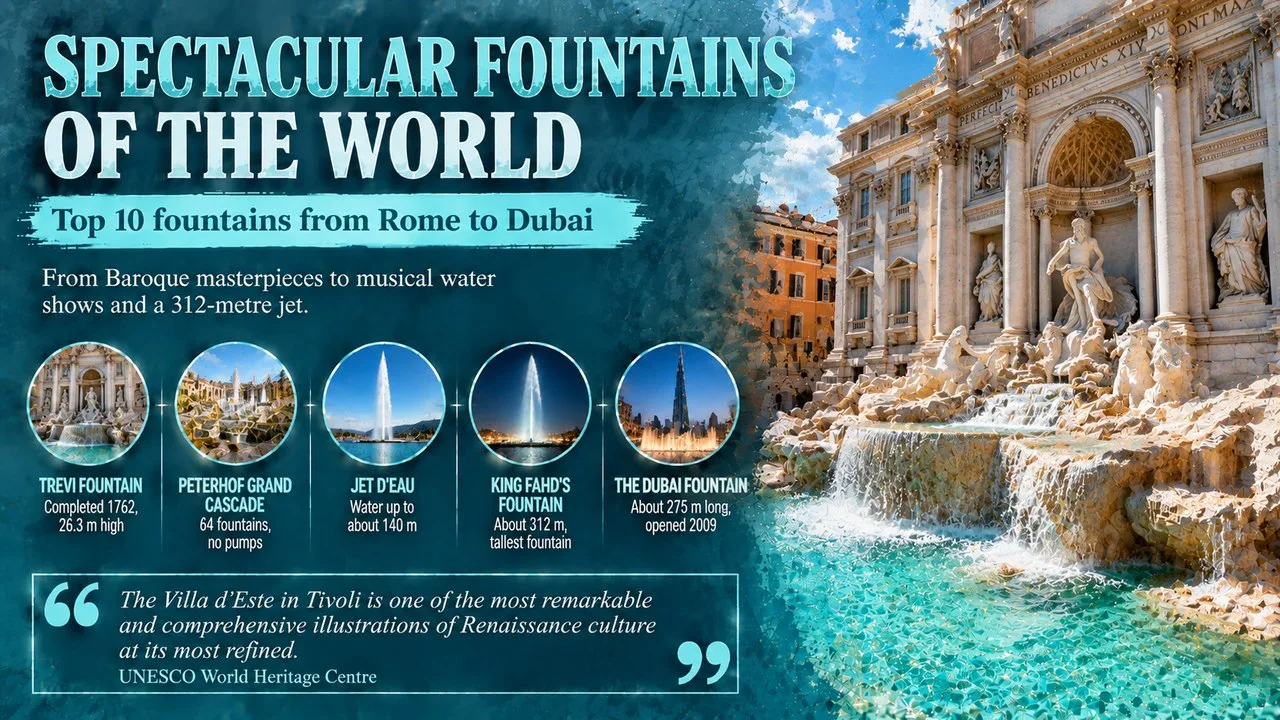
Spectacular fountains range from Baroque masterpieces in Rome to musical water shows in Las Vegas and Dubai and a jet in Jeddah more than 300 m high.
This Finepedia guide, written in October 2026, looks at 10 of the most famous fountains on Earth and the stories behind them. The facts come from city and heritage sources, UNESCO, Guinness World Records, the designers' own figures and encyclopaedias. Heights and other numbers are given as officially reported, and some shows change their programmes from season to season. If you enjoy great landmarks, you may also like Finepedia's guides to Famous Lighthouses With Remarkable Stories and the rarest rock formations in the world.
How We Chose These
We picked ten fountains that are famous for their art, their engineering or the sheer size of their water jets. The list mixes Renaissance gardens, Baroque sculpture, early electric light shows and modern musical displays, so it shows how the idea of a fountain has changed over five centuries. It runs roughly in the order each fountain was built. For each one you will find a short profile, four key facts and one more note on why it matters or a surprising detail.
The 10 Fountains at a Glance
| No. | Fountain | City | Opened | Known for |
|---|---|---|---|---|
| 1 | Villa d'Este fountains | Tivoli, Italy | 16th century | Hundred Fountains and a water organ |
| 2 | Fountain of the Four Rivers | Rome, Italy | 1651 | Bernini's river gods |
| 3 | Peterhof Grand Cascade | Saint Petersburg, Russia | 18th century | 64 fountains and the Samson statue |
| 4 | Trevi Fountain | Rome, Italy | 1762 | largest Baroque fountain, coin tradition |
| 5 | Jet d'Eau | Geneva, Switzerland | 1891 (present jet 1951) | 140 m water jet |
| 6 | Buckingham Fountain | Chicago, United States | 1927 | one of the largest in the world |
| 7 | Magic Fountain of Montjuïc | Barcelona, Spain | 1929 | early light and water shows |
| 8 | King Fahd's Fountain | Jeddah | 1985 | tallest fountain, about 312 m |
| 9 | Fountains of Bellagio | Las Vegas, United States | 1998 | musical show on a lake |
| 10 | The Dubai Fountain | Dubai, UAE | 2009 | largest choreographed fountain |
1. Villa d'Este Turned a Hillside Into a Water Garden
The Villa d'Este in Tivoli, near Rome, was built in the 16th century for Cardinal Ippolito II d'Este, a grandson of Pope Alexander VI. Its terraced Renaissance garden is filled with fountains, pools, cascades and water jets, all fed by gravity from a nearby river. It became one of the most copied gardens in Europe. To feed it, the nearby Aniene River was diverted, and gravity carries water to about 51 fountains, nearly 400 spouts and 64 small waterfalls. Over 250 years the garden decayed, but it was restored in the 20th century and is now a state museum.
Key Facts
- Location: Tivoli, Lazio, Italy
- Built for: Cardinal Ippolito II d'Este
- Highlights: the Hundred Fountains and the Fountain of the Organ
- World Heritage Site: since 2001
Did You Know?
The Fountain of the Organ uses moving water to push air through pipes and play music, an amazing feat for the Renaissance. It fell silent for many years but has been restored and now plays every day. Along the Hundred Fountains, a long terrace of small jets and carved heads, water falls into a channel the length of the garden.
2. Bernini's Fountain of the Four Rivers Fills Piazza Navona
The Fountain of the Four Rivers stands in the middle of Piazza Navona in Rome. The sculptor Gian Lorenzo Bernini designed it in 1651 for Pope Innocent X, whose relatives, the Pamphili, had their palace on the square. Above a basin, carved rocks of travertine support four giant river gods and an ancient obelisk crowned with the Pope's family emblem, a dove holding an olive branch.
Key Facts
- Location: Piazza Navona, Rome
- Designer: Gian Lorenzo Bernini
- Commissioned: 1651, by Pope Innocent X
- Rivers shown: the Nile, Danube, Ganges and Río de la Plata
Why It Matters
Each river god stands for a continent where the Church's influence had spread: Africa, Europe, Asia and the Americas. The figure of the Nile has its head covered, which is usually explained by the fact that the river's source was still unknown at the time. A popular story claims the figures are shielding their eyes from a rival architect's church, but the church was built later, so this tale is not true. The obelisk on top was carved in Roman times in imitation of Egyptian work, and it had lain in pieces outside the city walls before Bernini raised it on his rocks.
3. Peterhof's Grand Cascade Rivals Versailles
Peterhof, on the Gulf of Finland outside Saint Petersburg, was built by Peter the Great as Russia's answer to the Palace of Versailles. Below the Grand Palace, the Grand Cascade sends water down a broad flight of steps lined with gilded statues into a canal that runs to the sea. Its 64 fountains are the centrepiece of the gardens. Peter visited the French court in 1717 and came home determined to outdo it, and the palace was later enlarged for Empress Elizabeth in the mid-18th century. The palace and gardens were badly damaged in the Second World War and have since been carefully rebuilt.
Key Facts
- Location: Petergof, Saint Petersburg, Russia
- Built for: Peter the Great
- Grand Cascade: 64 fountains
- World Heritage: part of the Saint Petersburg historic centre listing
Did You Know?
At the foot of the cascade, a gilded Samson wrestles open a lion's mouth, sending a tall jet of water into the air. It celebrates Russia's victory over Sweden at Poltava in 1709. Remarkably, the fountains run without pumps, using water piped from springs on higher ground some distance away.
4. The Trevi Fountain Is the Most Famous Fountain in Rome
The Trevi Fountain was designed by Nicola Salvi and completed in 1762, at the meeting of three roads, or tre vie, which gave the district its name. Pope Clement XII gave Salvi the commission after a design contest in 1730, and building began in 1732, but Salvi died in 1751 with the work half done, so Giuseppe Pannini completed it. It marks the end of the Acqua Vergine, a revived version of an ancient Roman aqueduct first opened in 19 BC. Standing 26.3 metres tall and roughly 49 metres across, no Baroque fountain anywhere is bigger.
Key Facts
- Location: Trevi district, Rome
- Completed: 1762
- Designers: Nicola Salvi, finished by Giuseppe Pannini
- Size: 26.3 m high, about 49 m wide
Did You Know?
Legend says anyone who throws a coin into the fountain will return to Rome. So many people do it that about 1.4 million euros were collected in 2016, and the money goes to the charity Caritas. The fountain has starred in films such as Roman Holiday and La Dolce Vita, and since early 2026 visitors who are not Rome residents pay a small fee to walk up to the basin.
5. The Jet d'Eau Shoots Water 140 Metres Over Lake Geneva
The Jet d'Eau is Geneva's best-known landmark, a single plume of water rising from the point where Lake Geneva flows into the Rhône. Two powerful pumps push about 500 litres a second out of a nozzle at around 200 kilometres an hour, sending the water up to about 140 metres. The present jet, installed in 1951, pumps water straight from the lake rather than from the city mains, and it is lit up at night. On a clear day it can be seen from aircraft flying high above the city.
Key Facts
- Location: Lake Geneva, Switzerland
- Height: about 140 m
- Flow: about 500 litres a second
- Present jet: installed in 1951
Did You Know?
The first jet, in 1886, was not meant as decoration at all. It was a safety valve that released extra pressure from the city's water power network. People loved it so much that it was moved to the lake in 1891 and made higher. Visitors walking along the stone jetty are often soaked when the wind changes.
6. Buckingham Fountain Represents Lake Michigan
Buckingham Fountain stands in Grant Park, Chicago, often called the city's front door. It was given to the city by the philanthropist Kate S. Buckingham to honour her late brother Clarence, and it opened in 1927. The architect Edward H. Bennett designed it, and the French sculptor Marcel Loyau made its bronze figures. Built of Georgia pink marble in a tiered wedding-cake style, it was modelled on the Latona Fountain in the gardens of Versailles.
Key Facts
- Location: Grant Park, Chicago
- Dedicated: 1927
- Donor: Kate S. Buckingham
- Water held: about 5.7 million litres
Why It Matters
The fountain is a symbol of Lake Michigan. Four pairs of bronze sea horses stand for the four states that border the lake: Illinois, Wisconsin, Michigan and Indiana. From spring to autumn it puts on regular water displays and evening light shows, and it is one of the most photographed sights in Chicago.
7. The Magic Fountain of Montjuïc Pioneered Light Shows
The Magic Fountain sits below the Palau Nacional on Montjuïc hill in Barcelona. Carles Buïgas designed it for the International Exposition held in Barcelona in 1929, and more than 3,000 workers built it in less than a year. The first show was held on 19 May 1929, and it amazed visitors with coloured light and moving water.
Key Facts
- Location: Montjuïc, Barcelona
- Designer: Carles Buïgas
- Opened: May 1929
- Jets: about 3,620
Why It Matters
Montjuïc was among the earliest fountains to combine light, colour and water on a grand scale, and music was added in the 1980s. It inspired many of the modern musical fountains that followed, and its evening shows remain one of Barcelona's most popular free attractions.
8. King Fahd's Fountain Holds the Height Record
Often simply called the Jeddah Fountain, King Fahd's Fountain stands in the Red Sea off the coast of Jeddah, Saudi Arabia. It was given to the city by King Fahd, built between 1980 and 1983 and brought into full operation in 1985. It shoots seawater up to about 312 metres, higher than the Eiffel Tower.
Key Facts
- Location: Jeddah, Saudi Arabia
- Opened: 1985
- Height: about 312 m
- Record: tallest fountain, per Guinness World Records
Did You Know?
The fountain was inspired by Geneva's Jet d'Eau, but it reaches more than twice the height. The water leaves at around 375 kilometres an hour, and at any moment more than 16 tonnes of water can be in the air. At night it is lit up and can be seen from across the city.
9. The Fountains of Bellagio Made Las Vegas Dance
The Fountains of Bellagio is a free show staged on a man-made lake of 8.5 acres beside the Bellagio resort on the Las Vegas Strip. It was dreamed up by the casino owner Steve Wynn, built by the design company WET and opened with the resort on 15 October 1998. More than 1,200 nozzles and about 4,800 lights move in time to music.
Key Facts
- Location: Las Vegas Strip, Nevada
- Opened: 15 October 1998
- Cost: about US$40 million
- Highest jets: about 140 m
Did You Know?
Bellagio held the title of the biggest fountain show on Earth for over a decade, until Dubai built a larger one. It has appeared in many films, most famously in the closing scene of Ocean's Eleven (2001), and it ranks among the most photographed sights in America.
10. The Dubai Fountain Is the Largest Choreographed Fountain
The Dubai Fountain lies on the 12-hectare Burj Khalifa Lake in Downtown Dubai, at the foot of the world's tallest building. It was designed by WET, the company behind the Bellagio fountains, and opened on 8 May 2009 with the Dubai Mall. It stretches about 275 metres, and its tallest jets reach roughly 152 metres.
Key Facts
- Location: Downtown Dubai, UAE
- Opened: 8 May 2009
- Length: about 275 m
- Lights: about 6,600 plus 25 coloured projectors
Why It Matters
The fountain cost about US$218 million to build. Its shows mix Arabic and world music with jets that sway and leap, and they can be seen from the upper floors of the Burj Khalifa. After a five-month renovation in 2025, it reopened that October with new effects, and it remains the largest choreographed fountain in the world.
Frequently Asked Questions
Which fountain shoots water the highest?
The Jeddah fountain named after King Fahd holds the record, with water reaching about 312 metres. The Jet d'Eau in Geneva is one of the best known, reaching about 140 metres.
Why do people throw coins into fountains?
The custom goes back to ancient beliefs that springs and wells were sacred, and people offered coins for luck or a wish. At the Trevi Fountain, the coin is said to guarantee a return to Rome, and the money collected is given to charity. Many cities now clean out their fountains regularly and pass the coins to good causes.
Conclusion
From a Renaissance water organ to a jet that soars higher than the Eiffel Tower, these ten fountains show how water has been used to impress, celebrate and entertain for centuries. Each one combines art and engineering in its own way. For more great landmarks, read Finepedia's guides to Famous Lighthouses With Remarkable Stories and the rarest rock formations in the world.
- UNESCO World Heritage Centre, Villa d'Este, Tivoli, whc.unesco.org/en/list/1025.
- UNESCO World Heritage Centre, Historic Centre of Saint Petersburg and Related Groups of Monuments, whc.unesco.org/en/list/540.
- Guinness World Records, tallest fountain (King Fahd's Fountain).
- Ville de Genève, the Jet d'Eau.
- Chicago Park District, Clarence Buckingham Memorial Fountain.
- Emaar Properties, The Dubai Fountain.
- Wikipedia (accessed October 2026), articles on the Villa d'Este, Fontana dei Quattro Fiumi, Peterhof Palace, Trevi Fountain, Jet d'Eau, Buckingham Fountain, Magic Fountain of Montjuïc, King Fahd's Fountain, Fountains of Bellagio and The Dubai Fountain.
- 10 Most Today, 10 Most Famous Fountains in the World, 10mosttoday.com (topic reference).














Log in with