







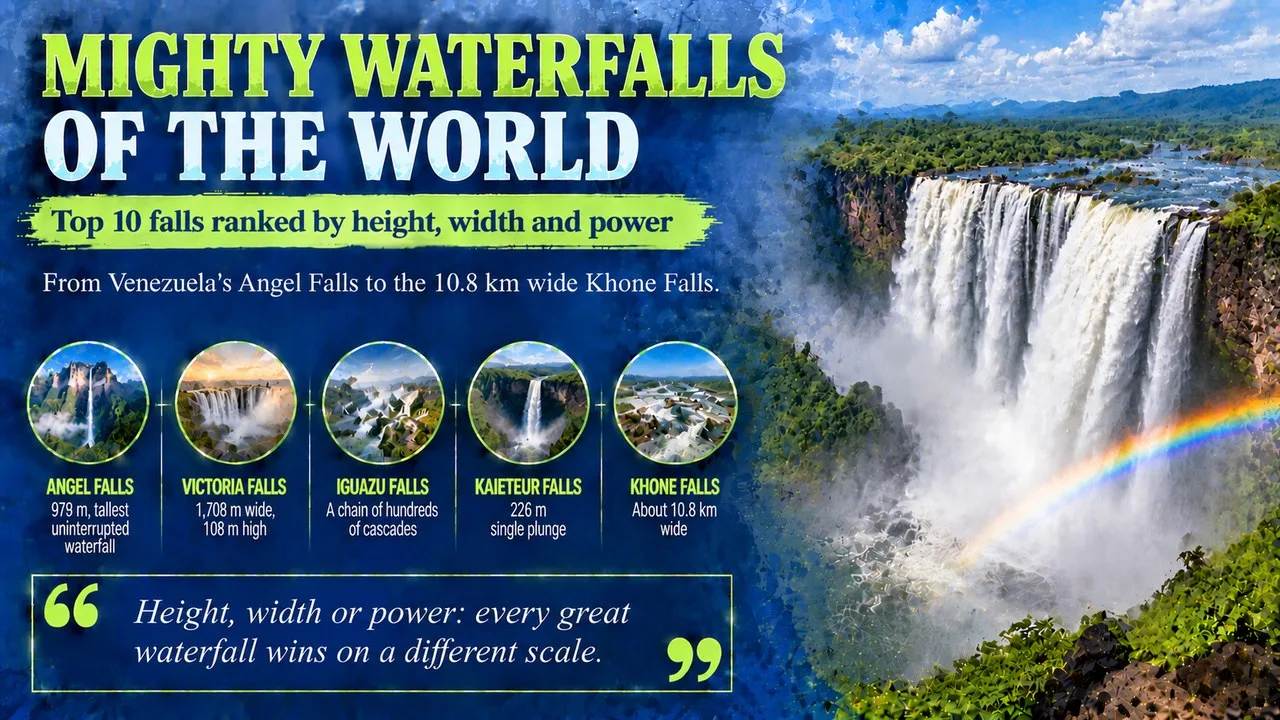
The mighty waterfalls of the world include Angel Falls plunging 979 m in Venezuela, Victoria Falls on the Zambezi and the 10.8 km wide Khone Falls in Laos.
This Finepedia guide, written in October 2026, looks at 10 of the most famous and powerful waterfalls on Earth. The facts come from UNESCO, national park services, the World Waterfall Database and encyclopaedias. Waterfall heights are hard to measure, and some figures are still debated, so we give the most widely accepted numbers and say where experts disagree. If you love the natural world, you may also enjoy Finepedia's guides to the famous glaciers of the world and the longest rivers in the world.
How We Chose These
There is no single way to rank waterfalls. Some are famous for height, some for width and some for the huge volume of water they carry. We picked ten that stand out on at least one of those measures, or for their place in history and travel, across five continents. The list mixes tall plunges, wide curtains and powerful cataracts. For each one you will find a short profile, four key facts and one more note on why it matters or a surprising detail.
The 10 Waterfalls at a Glance
| No. | Waterfall | Country | Best known for | Key figure |
|---|---|---|---|---|
| 1 | Angel Falls | Venezuela | tallest uninterrupted waterfall | 979 m total height |
| 2 | Tugela Falls | South Africa | rival for tallest | 948 m officially |
| 3 | Victoria Falls | Zambia and Zimbabwe | largest sheet of falling water | 1,708 m wide, 108 m high |
| 4 | Iguazu Falls | Argentina and Brazil | largest group of falls | up to 82 m high |
| 5 | Niagara Falls | Canada and the US | highest flow in North America | Horseshoe Falls about 57 m |
| 6 | Kaieteur Falls | Guyana | height plus power | 226 m single plunge |
| 7 | Khone Falls | Laos | widest waterfall | about 10.8 km wide |
| 8 | Rhine Falls | Switzerland | most powerful in Europe | 150 m wide, 23 m high |
| 9 | Gullfoss | Iceland | two-step plunge into a canyon | 32 m deep crevice |
| 10 | Ban Gioc–Detian Falls | Vietnam and China | falls on a national border | about 30 m high |
1. Angel Falls Is the Tallest Uninterrupted Waterfall
Angel Falls tumbles from the edge of Auyán-tepui, a flat-topped table mountain in Canaima National Park, Venezuela. With a total height of 979 metres and a single plunge of 807 metres, it is the tallest uninterrupted waterfall on Earth. The water falls so far that much of it turns to mist before it reaches the bottom. Canaima National Park, which protects the falls and the surrounding table mountains, has been on UNESCO's World Heritage List since 1994, and most visitors reach the base by boat along jungle rivers in the wet season.
Key Facts
- Location: Canaima National Park, Bolívar State, Venezuela
- Total height: 979 m
- Main plunge: 807 m
- Pemon name: Körepakupai Vená
Did You Know?
The falls are named after Jimmie Angel, an American pilot whose plane passed above them on 16 November 1933 while he hunted for a rich ore deposit. In 1937 he tried to land on top of the mountain, but the plane bogged down in the soft, marshy summit and he and his companions had to walk down through the forest for 11 days.
2. Tugela Falls May Be Even Taller
Tugela Falls pours off the Amphitheatre, a giant cliff wall in the Drakensberg, inside South Africa's Royal Natal National Park. Its five separate leaps add up to an official height of 948 metres, making it the second tallest waterfall known. In 2016 a Czech expedition measured it at about 983 metres, which would put it ahead of Angel Falls, though this has not yet been confirmed.
Key Facts
- Location: KwaZulu-Natal, South Africa
- Official height: 948 m, in five leaps
- 2016 measurement: about 983 m (unconfirmed)
- River: the Tugela, meaning sudden in Zulu
Why It Matters
Both Angel Falls and Tugela Falls were measured from a long way off, so the question of which is truly the tallest is still open. Tugela is seasonal and can shrink to a thin ribbon in the dry winter, but after summer storms it becomes a spectacular line of white falls down the dark rock.
3. Victoria Falls Is Called the Smoke That Thunders
Victoria Falls lies on the Zambezi River, where Zambia meets Zimbabwe. Local people call it Mosi-oa-Tunya, the smoke that thunders. It is 1,708 metres wide and up to 108 metres high, which makes it the largest single sheet of falling water in the world.
Key Facts
- Location: Zambezi River, Zambia and Zimbabwe
- Width: 1,708 m
- Height: up to 108 m
- World Heritage Site: since 1989
Did You Know?
The spray usually rises more than 400 metres and can be seen up to 50 kilometres away. The Scottish missionary David Livingstone, the first European known to have seen the falls, viewed them on 16 November 1855 and named them after Queen Victoria, though African people had known them for centuries. In the dry season, swimmers can sit in natural rock pools at the very lip of the falls on the Zambian side, and the nearby Victoria Falls Bridge, opened in 1905, links the two countries over the gorge.
4. Iguazu Falls Is a Chain of Hundreds of Cascades
Iguazu Falls lies where the Iguazu River marks the frontier of Argentina and Brazil. Instead of one single fall, the river spills over a long, curving edge broken up by islands into a string of separate falls, between 60 and 82 metres high. Together they form the largest group of waterfalls in the world.
Key Facts
- Location: Argentina and Brazil border
- Height: 60 to 82 m
- Name: from Guarani or Tupi words for big water
- World Heritage: Argentina's park 1984, Brazil's park 1986
Did You Know?
Roughly half the flow plunges into a slim gorge known as the Devil's Throat, and the national frontier runs right through it. The Spanish explorer Cabeza de Vaca wrote the earliest European account of the falls in 1541. A Guarani legend says a jealous god split the river to trap two fleeing lovers. Walkways on both sides take visitors so close that they are soaked by the spray, and the rainforest around the falls is home to toucans, coatis and jaguars.
5. Niagara Falls Has the Highest Flow in North America
Niagara Falls is made up of three separate falls on the Niagara River, which flows north out of Lake Erie and on into Lake Ontario along the Canada–US frontier. The largest, Horseshoe Falls, is about 57 metres high and lies mostly in Canada. The two smaller falls, the American and the Bridal Veil, are on the New York side.
Key Facts
- Location: Ontario (Canada) and New York (US)
- Number of falls: three
- Horseshoe Falls height: about 57 m
- Formed: about 10,000 years ago, after the last ice age
Did You Know?
At busy times of day, more than 168,000 cubic metres of water go over the falls every minute, and much of the river is also used to make hydroelectric power. In 1901 Annie Edson Taylor, a 63-year-old teacher, rode over the edge inside a barrel and lived, the first person ever to do so. She later warned that no one should ever try it again. The falls are also slowly wearing away the rock beneath them, and engineers have reduced the rate of erosion by diverting part of the river through power stations upstream. In 1969 the American Falls was even turned off for several months so that geologists could study its rock face.
6. Kaieteur Falls Combines Height and Power
Kaieteur Falls lies on the Potaro River in the rainforest of central Guyana. The river plunges 226 metres over a sandstone cliff, and with the cascades below the total height reaches about 251 metres. That is about 4.5 times Niagara's height and roughly double that of Victoria Falls.
Key Facts
- Location: Kaieteur National Park, Guyana
- Single plunge: 226 m
- Total height: about 251 m
- Average flow: about 663 cubic metres a second
Why It Matters
Many waterfalls are taller and many carry more water, but few combine great height with such a heavy flow. That puts Kaieteur among the strongest single-plunge falls anywhere. Because it is remote and reached mainly by small plane, it sees far fewer visitors than the big falls on this list. The park around it is home to golden frogs that live in giant bromeliad plants, and to the brilliant orange cock-of-the-rock bird.
7. Khone Falls Is the Widest Waterfall on Earth
Khone Falls, together with neighbouring Phapheng Falls, sits on the Mekong in the far south of Laos, close to Cambodia. Measured from one side of its many channels to the other, it is about 10,783 metres wide, the widest waterfall on Earth. The highest falls are only about 21 metres, but the rapids stretch for almost 10 kilometres.
Key Facts
- Location: Champasak Province, Laos
- Width: about 10.8 km
- Highest falls: about 21 m
- Average flow: nearly 11,000 cubic metres a second
Did You Know?
The falls are the main reason the Mekong cannot be fully travelled by boat up into China. French colonial officials in the late 19th century tried again and again to get boats past, and in the end they built a short railway across two islands to carry goods around the falls. The area is known as Si Phan Don, the 4,000 islands. The deep pools below the falls are also one of the last homes of the rare Irrawaddy river dolphin in the Mekong.
8. The Rhine Falls Carries the Most Power in Europe
The Rhine Falls lies on the High Rhine in northern Switzerland, a short way downstream of Schaffhausen. It is 150 metres wide and 23 metres high, and in summer around 600 cubic metres of water pour over it every second. No waterfall in Europe carries more power.
Key Facts
- Location: cantons of Schaffhausen and Zurich, Switzerland
- Width: 150 m
- Height: 23 m
- Summer flow: about 600 cubic metres a second
Why It Matters
The falls took shape in the most recent ice age, roughly 15,000 years ago, where tough rock squeezed the river bed. Boats carry visitors out to a rocky islet that stands among the rushing water, and Laufen Castle and Wörth Castle offer close views from both banks.
9. Gullfoss Plunges Into a Deep Icelandic Canyon
Gullfoss, meaning golden falls, is on the Hvítá river in south-west Iceland. The river first tumbles down three curving steps and then plunges in two stages, of 11 and 21 metres, into a crevice 32 metres deep. It is one of Iceland's most visited sights and a stop on the famous Golden Circle route near Reykjavík.
Key Facts
- Location: Hvítá river, south-west Iceland
- Two stages: 11 m and 21 m
- Crevice: about 32 m deep and 2.5 km long
- Protected: as a conservation site since 1979
Did You Know?
In the early 20th century there were plans to use Gullfoss for hydroelectric power. Sigríður Tómasdóttir, the daughter of one of the landowners, is popularly credited with campaigning to save it, and she is remembered today with a memorial at the falls. The state later bought the falls, and they became a protected area in 1979. On average about 141 cubic metres of water a second pass over Gullfoss in summer, falling to about 80 in winter, when parts of it can freeze.
10. Ban Gioc–Detian Falls Straddles Two Countries
Ban Gioc–Detian is the shared name of a pair of falls on the Quây Sơn River, right on the Vietnam–China frontier. It lies among the limestone karst hills of Cao Bằng Province in Vietnam and Guangxi in China, about 272 kilometres north of Hanoi. The water falls about 30 metres in several tiers divided by rocks and trees.
Key Facts
- Location: Vietnam and China border
- River: Quây Sơn (Guichun in Chinese)
- Height: about 30 m
- Names: Bản Giốc in Vietnamese, Détiān in Chinese
Why It Matters
Over thousands of years, the river has worn away the crest of the falls and moved it slowly upstream. Most of the year it looks like two separate falls, but after heavy summer rain it can join into one wide curtain. Visitors from both countries can see it from bamboo rafts in the pool below. The falls are often listed as the fourth largest waterfall on a national border, after Iguazu, Victoria and Niagara.
Frequently Asked Questions
Which waterfall is the tallest?
Angel Falls in Venezuela is usually named the tallest, at 979 metres. Tugela Falls in South Africa is a close rival, and a 2016 measurement suggested it might be slightly taller, but that figure has not been confirmed by the World Waterfall Database.
Which waterfall is the biggest?
It depends on how you measure. Victoria Falls has the largest single sheet of falling water, Khone Falls is the widest and Iguazu is the largest group of falls. Some of the biggest falls of all are hidden under the sea, where cold dense water flows over undersea ridges.
Conclusion
From the misty heights of Angel Falls to the vast width of Khone Falls, these ten waterfalls show the power and beauty of moving water. Each one has shaped the land around it, and many are now protected parks that draw visitors from all over the world. For more natural wonders, read Finepedia's guides to the famous glaciers of the world and the longest rivers in the world.
- UNESCO World Heritage Centre, Mosi-oa-Tunya / Victoria Falls, whc.unesco.org/en/list/509.
- UNESCO World Heritage Centre, Iguazu National Park, whc.unesco.org/en/list/303.
- UNESCO World Heritage Centre, Canaima National Park, whc.unesco.org/en/list/701.
- World Waterfall Database, entries for Angel Falls, Tugela Falls and Kaieteur Falls.
- Niagara Parks Commission, Niagara Falls geology and history.
- Wikipedia (accessed October 2026), articles on Angel Falls, Tugela Falls, Victoria Falls, Iguazu Falls, Niagara Falls, Kaieteur Falls, Khone Phapheng Falls, Rhine Falls, Gullfoss and Detian – Ban Gioc Falls.
- 10 Most Today, 10 Most Amazing Waterfalls in the World, 10mosttoday.com (topic reference).

















Log in with