











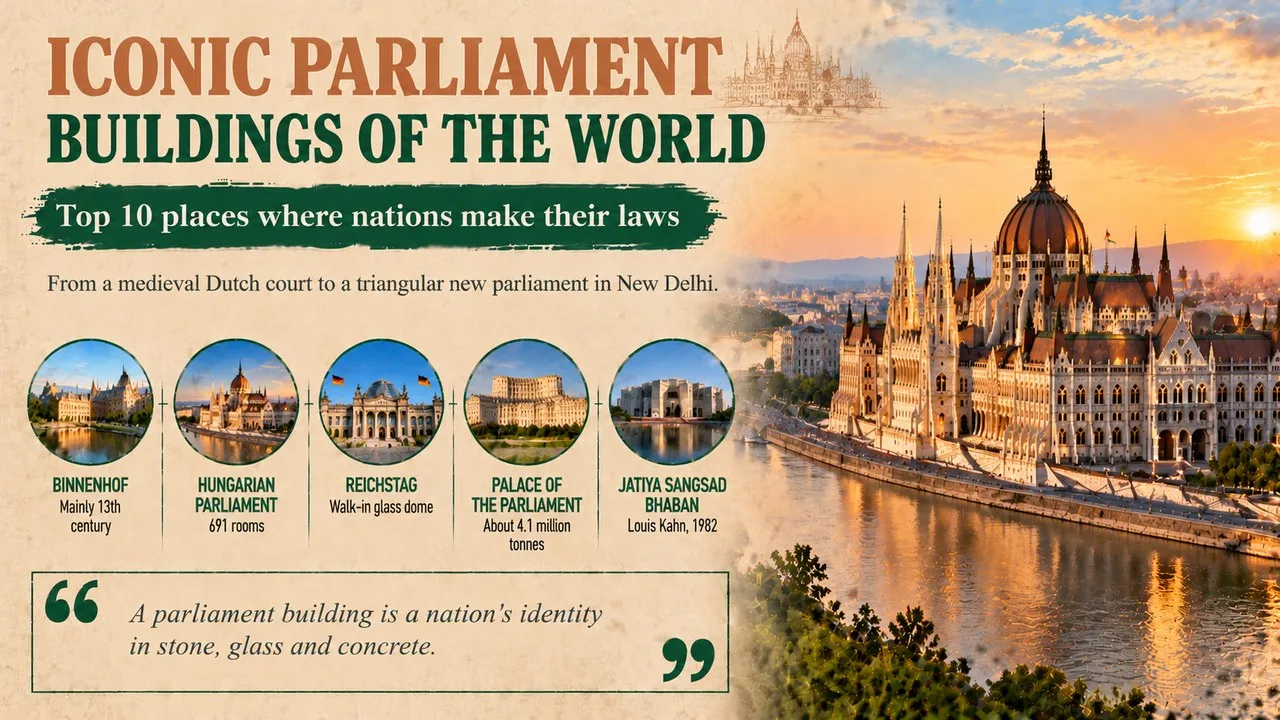
Iconic parliament buildings of the world range from a 13th-century Dutch castle that long housed MPs to a Bucharest palace that is the heaviest on Earth.
This Finepedia guide, written in October 2026, looks at 10 of the most striking buildings where nations make their laws, from Gothic halls and grand domes to bold modern designs. The facts come from parliament and heritage bodies, UNESCO, encyclopaedias and news reports. Several of these buildings are being repaired or renovated, so we give their status as of October 2026. If you enjoy architecture, you may also like the Finepedia guides Famous Clock Towers Around the World: Top 10 and Oldest Surviving Buildings on Earth: Top 10.
How We Chose These
We picked ten parliament buildings from five continents that stand out for their age, size, design or history. We left out London's Palace of Westminster and Ottawa's Centre Block, because their towers already feature in our clock towers guide. The list runs in order of when each building was finished, from the oldest to the newest. Each entry has a short profile, four key facts and one more note on why it matters or a surprising detail.
The 10 Parliament Buildings at a Glance
| No. | Building | City | Completed | Standout fact |
|---|---|---|---|---|
| 1 | Binnenhof | The Hague | mainly 13th century | oldest working parliament home |
| 2 | United States Capitol | Washington, D.C. | first section 1800 | cast-iron dome |
| 3 | Houses of Parliament | Cape Town | 1884 | rebuilding after a 2022 fire |
| 4 | Reichstag | Berlin | 1894 | walk-in glass dome |
| 5 | Hungarian Parliament | Budapest | 1904 | largest building in Hungary |
| 6 | National Congress | Brasília | 1960 | twin towers and two bowls |
| 7 | The Beehive | Wellington | 1981 | shaped like an old straw hive |
| 8 | Jatiya Sangsad Bhaban | Dhaka | 1982 | Louis Kahn's concrete masterpiece |
| 9 | Palace of the Parliament | Bucharest | 1997 | world's heaviest building |
| 10 | Parliament House | New Delhi | 2023 | triangular design |
1. The Binnenhof Has Hosted Dutch Politics for Centuries
The Binnenhof, meaning Inner Court, is a group of buildings around a courtyard beside a pond in the centre of The Hague. It started life as a castle of the counts of Holland, mostly built during the 1200s, and from 1584 it was the political heart of the young Dutch Republic. Both chambers of the Dutch parliament and the prime minister's office are based here, and it is often called the world's oldest parliament building that is still working.
Key Facts
- Location: The Hague, Netherlands
- Origins: land bought by Count Floris IV in 1229
- Centrepiece: the Ridderzaal, or Hall of Knights
- Status: under renovation since 2021, with handover due in summer 2031
Did You Know?
Every year on Prinsjesdag, the third Tuesday of September, the Dutch king gives the Speech from the Throne, which sets out the government's plans for the coming year. The speech is normally given in the Gothic Ridderzaal, the great hall at the centre of the Binnenhof. While the work goes on, the House of Representatives sits in the former foreign ministry building elsewhere in The Hague. The Dutch government expects to hand the restored complex back to its users in summer 2031.
2. The US Capitol Rose Again After Being Burned
The United States Capitol sits on a hill in Washington, D.C., and is home to both houses of Congress, the Senate and the House. George Washington laid its cornerstone in 1793, and Congress first met there in November 1800. Built in the neoclassical style with a white exterior, it is one of the best-known government buildings in the world.
Key Facts
- Cornerstone: laid on 18 September 1793
- First used: by Congress on 17 November 1800
- Dome: finished in about 1866, soon after the Civil War ended
- Dome weight: about 4,000 tonnes of cast iron
Why It Matters
During the War of 1812, British troops set fire to the Capitol in 1814, and it took about five years to restore. The famous dome was added in the mid-19th century, and the Statue of Freedom was placed on top in 1863. Looking up from inside the rotunda, visitors can see a huge painting called The Apotheosis of Washington through an opening in the inner dome.
3. Cape Town's Parliament Is Rising From the Ashes
South Africa's Parliament meets in Cape Town, in a group of three linked buildings. The oldest part, finished in 1884, now holds the National Council of Provinces. An Old Assembly block followed in 1910, and a newer chamber for the National Assembly opened in the mid-1980s.
Key Facts
- Location: Cape Town, South Africa
- First stone: laid on 12 May 1875
- Heritage: Grade 1 National Heritage Site since 2014
- Fire: badly damaged in January 2022
Why It Matters
In January 2022, a fire destroyed much of the National Assembly chamber and damaged the Old Assembly building. A rebuilding project costing about 4.6 billion rand is under way, aiming to modernise the complex while protecting its heritage, with completion planned for June 2027. Until then, members of the National Assembly meet in other venues.
4. The Reichstag Wears a Glass Crown
The Reichstag in Berlin is the home of the Bundestag, Germany's federal parliament. It was built between 1884 and 1894 in a grand Neo-Renaissance style, designed by Paul Wallot, on the bank of the River Spree. A fire in 1933 and heavy fighting in 1945 left it badly damaged.
Key Facts
- Architect: Paul Wallot, with the 1990s rebuild by Norman Foster
- Opened: 1894
- Rebuild: 1995 to 1999
- Landmark: a glass dome that visitors can climb inside
Why It Matters
After German reunification, the British architect Norman Foster rebuilt the Reichstag for the Bundestag, which moved in in 1999. The new glass dome lets visitors walk up a spiral ramp above the debating chamber, a symbol of open government. Just before the rebuild, in 1995, the artists Christo and Jeanne-Claude wrapped the whole building in fabric, drawing millions of visitors.
5. The Hungarian Parliament Mirrors the Danube
Standing on the east bank of the Danube in Budapest, the Hungarian Parliament Building is a vast neo-Gothic palace with a central dome and many spires. It was designed by Imre Steindl, who won an international competition, and work started in 1885. It is the largest building in Hungary and one of the most photographed parliaments in the world.
Key Facts
- Size: 268 m long and 123 m wide
- Height: 96 m, a reference to the year 896, when the Hungarian state is said to have been founded
- Rooms: 691
- Materials: about 40 million bricks and 40 kg of gold
Did You Know?
The building was opened in 1896 to mark 1,000 years of Hungary, but it was not fully finished until 1904. Sadly, Steindl went blind and died shortly before the building was completed. Since 2000, the Holy Crown of Hungary, the country's most treasured royal symbol, has been on display under the central dome.
6. Brazil's National Congress Is a Modernist Icon
Brazil's National Congress was designed by Oscar Niemeyer and built for the new capital, Brasília, which opened in 1960. It has two 28-storey office towers, linked by a bridge, and a long low base topped by two bowls. One bowl faces up and holds the Chamber of Deputies, while the other is turned down like a dome and holds the Senate.
Key Facts
- Architect: Oscar Niemeyer, with engineer Joaquim Cardozo
- Opened: 1960
- Towers: two, each 28 storeys high
- Heritage: part of Brasília's UNESCO World Heritage Site since 1987
Why It Matters
The building stands at the end of Brasília's Monumental Axis, the city's main avenue, facing the Three Powers Plaza, which it shares with the presidential palace and Brazil's top court. UNESCO calls Brasília a landmark of 20th-century modernist city planning, and the Congress, with its simple shapes and bold curves, is the clearest symbol of that vision.
7. Wellington's Beehive Looks Like a Straw Hive
The Beehive is the round, stepped building at the heart of New Zealand's Parliament Buildings in Wellington. Its shape recalls a skep, the old-fashioned woven straw beehive. It serves as the government wing, where the prime minister and other cabinet ministers have their offices, so its name is often used to mean the New Zealand government.
Key Facts
- Designer: concept by the Scottish architect Basil Spence in 1964
- Built: 1969 to 1981
- Height: 72 m, with 10 storeys above ground and 4 below
- Heritage: Category I listed by Heritage New Zealand
Did You Know?
A popular story claims Spence sketched the design on a napkin over dinner with Prime Minister Keith Holyoake. Because Wellington lies in an earthquake zone, the building rests on 417 special bearings made of rubber and steel, designed to soak up shaking.
8. Dhaka's Parliament Is a Concrete Masterpiece
The Jatiya Sangsad Bhaban, the parliament of Bangladesh, stands in Dhaka and was designed by the American architect Louis Kahn. It was first planned in the 1960s for Pakistan, when Dhaka was in East Pakistan, but work halted during the 1971 Liberation War. The government of independent Bangladesh decided to finish it to the original design.
Key Facts
- Architect: Louis Kahn
- Completed: 28 January 1982
- Site: about 840,000 square metres, among the biggest parliament complexes anywhere
- Award: Aga Khan Award for Architecture, 1989
Why It Matters
Kahn died in 1974 when the project was about three-quarters done, and his colleague David Wisdom saw it through. The main building is made of nine blocks, with a central eight-sided chamber rising to about 47 m, set beside an artificial lake. Critics such as the author Robert McCarter rank it among the most important buildings of the 20th century, and it features in My Architect, a 2003 documentary about Kahn's life.
9. Bucharest's Palace of the Parliament Outweighs Every Other Building
The Palace of the Parliament in Bucharest is one of the largest buildings in the world. It was ordered by the communist leader Nicolae Ceaușescu and designed by Anca Petrescu, who led roughly 700 architects. Work began in 1984 and lasted until 1997, long after Ceaușescu fell from power in 1989.
Key Facts
- Weight: about 4.1 million tonnes, more than any other building
- Floor area: about 365,000 square metres
- Height: 84 m above ground, reaching 92 m below
- Users: both chambers of Romania's parliament and the Constitutional Court
Why It Matters
To make room for the palace and its new civic centre, around 7 square km of old Bucharest was demolished and about 40,000 people were moved from their homes. Today no civilian office building anywhere is larger, and it is valued at around €4 billion, yet roughly 70% of it stands empty.
10. India's New Parliament House Opened in 2023
India's new Parliament House in New Delhi was opened on 28 May 2023, next to the old circular Parliament House of 1927. The architect Bimal Patel designed it within the wider Central Vista redevelopment. The triangular building is home to both houses of India's parliament, the Lok Sabha (lower house) and the Rajya Sabha (upper house).
Key Facts
- Opened: 28 May 2023, with the first sitting on 19 September 2023
- Shape: triangular, with four floors
- Seats: 888 in the Lok Sabha and 384 in the Rajya Sabha
- Joint sessions: the Lok Sabha chamber can hold up to 1,272 members
Did You Know?
The designs of the main areas draw on India's national symbols, including the peacock, the lotus and the banyan tree. The Lok Sabha chamber uses a blue-green colour scheme, while the Rajya Sabha chamber is red. The old Parliament House, designed by Edwin Lutyens and Herbert Baker, still stands next door.
Frequently Asked Questions
Which parliament building is the biggest?
By weight and floor space, the Palace of the Parliament in Bucharest is usually listed as the biggest. By the size of its whole site, the Jatiya Sangsad Bhaban complex in Dhaka is also one of the largest.
Which working parliament building is the oldest?
The Binnenhof in The Hague, mostly built in the 1200s, usually takes this title. It is closed for renovation until about 2031, though, so the Dutch parliament is meeting elsewhere for now.
Conclusion
From a medieval Dutch castle to a triangular new building in New Delhi, these ten parliaments show how nations express their identity in stone, glass and concrete. Some are centuries old, others are barely a few years old, and several are being rebuilt for the future. For more on great buildings, read the Finepedia guides Famous Clock Towers Around the World: Top 10 and Oldest Surviving Buildings on Earth: Top 10.
- UNESCO World Heritage Centre, Brasilia, whc.unesco.org/en/list/445.
- UNESCO World Heritage Centre, Budapest, including the Banks of the Danube, the Buda Castle Quarter and Andrássy Avenue, whc.unesco.org/en/list/400.
- Parliament of the Republic of South Africa, parliament.gov.za.
- German Bundestag, The Reichstag Building, bundestag.de.
- Wikipedia (accessed October 2026), articles on Binnenhof, United States Capitol, Houses of Parliament (Cape Town), Reichstag building, Hungarian Parliament Building, Palace of the National Congress, Beehive (New Zealand), Jatiya Sangsad Bhaban, Palace of the Parliament and Parliament House (New Delhi).
- 10 Most Today, 10 Most Beautiful Parliament Buildings, 10mosttoday.com (topic reference).















Log in with