





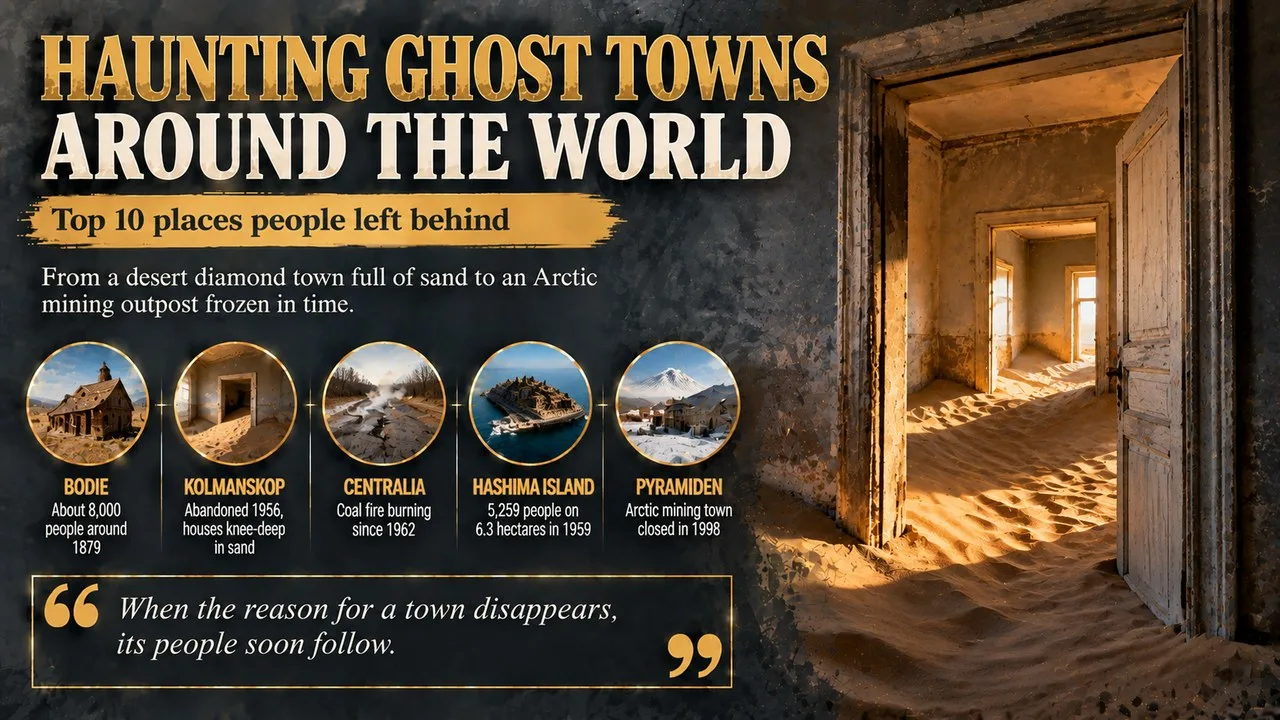
Ghost towns around the world tell stories of boom and bust, from a Namibian diamond town filling with sand to an Arctic mining settlement frozen in time.
This Finepedia guide, written in October 2026, looks at 10 haunting ghost towns and the reasons people left them. The facts come from heritage bodies such as UNESCO and the World Monuments Fund, state park records and encyclopaedias. Some of these places are sensitive, linked to war, forced labour or displacement, so we describe them plainly and with respect. If you enjoy places with a past, you may also like Finepedia's guides to the best-preserved medieval towns in Europe and Engineering Disasters That Changed the Rules.
How We Chose These
A ghost town is a settlement that has been mostly or completely abandoned but still has buildings standing. We picked ten from six continents that show the main ways towns die: a mine or industry closing, a natural hazard, a failed business dream and political conflict. We left out places whose story is mainly about one wartime massacre or nuclear accident, as those deserve their own treatment. The list runs roughly in the order each town was emptied. For each one you will find a short profile, four key facts and one more note on why it matters or a surprising detail.
The 10 Ghost Towns at a Glance
| No. | Ghost town | Country | Why people left | Mostly empty since |
|---|---|---|---|---|
| 1 | Bodie | United States | gold ran out | about 1915 (state park 1962) |
| 2 | Kayaköy | Turkey | population exchange | 1923 |
| 3 | Fordlândia | Brazil | rubber plantation failed | 1934 (Ford left) |
| 4 | Kolmanskop | Namibia | richer diamonds found elsewhere | 1956 |
| 5 | Humberstone | Chile | saltpetre industry collapsed | 1960 |
| 6 | Craco | Italy | landslides and an earthquake | 1963 to 1980 |
| 7 | Centralia | United States | underground coal fire | 1980s |
| 8 | Hashima Island | Japan | coal mine closed | 1974 |
| 9 | Varosha | Cyprus | conflict and fencing off | 1974 |
| 10 | Pyramiden | Norway (Svalbard) | coal mine closed | 1998 |
1. Bodie Is Frozen in Arrested Decay
Bodie sits in high, dry hills on the eastern side of the Sierra Nevada in Mono County, California, at about 2,550 metres above sea level. It began as a small mining camp after gold was found in 1859, and it boomed from 1876 when a rich vein was struck. By 1879 the town had about 2,000 buildings and some 8,000 people, with banks, newspapers, a railway and a jail.
Key Facts
- Location: Mono County, California
- Peak population: about 8,000 (around 1879)
- Named after: the prospector W. S. Bodey
- Status: Bodie State Historic Park since 1962
Why It Matters
As the gold ran out, people drifted away, and Bodie was being called a ghost town by 1915. Today the state keeps it in arrested decay, which means the buildings are protected from collapse but not restored, with goods still on shelves and desks still in the school. About 200,000 people visit each year. Bodie also had a wild reputation in its heyday, with dozens of saloons and frequent shootings, and a fire in 1932 destroyed much of the business district, leaving the buildings that survive today.
2. Kayaköy Was Emptied by a Population Exchange
Kayaköy, once known in Greek as Livissi, lies about 8 kilometres south of Fethiye in south-west Turkey. For centuries Greek-speaking Orthodox Christians lived there alongside their Muslim neighbours. After the Greco-Turkish War ended and the two countries agreed a population exchange in 1923, its remaining Greek residents were forced to leave for Greece, and the town on the hillside was never fully resettled.
Key Facts
- Location: near Fethiye, Muğla Province, Turkey
- Old Greek name: Livissi
- Emptied: 1923
- Today: a museum village and historic monument
Did You Know?
Hundreds of roofless stone houses and several churches still cover the slope, making it one of the most striking ghost towns in the Mediterranean. The town's story inspired the novel Birds Without Wings by Louis de Bernières, and a few houses nearby have been restored and lived in again.
3. Fordlândia Was Henry Ford's Failed Rubber Town
In 1928 the American carmaker Henry Ford set up a prefabricated town in the Amazon rainforest of Brazil, on the banks of the Tapajós River. He wanted his own supply of rubber for car tyres, and he planned a neat Midwest-style town for about 10,000 people. The plan failed badly, and in 1934 Ford moved the project about 40 kilometres from Santarém to a new site called Belterra, where conditions for rubber were better. Fordlândia was left with its water tower, sawmill, hospital and rows of American-style houses slowly being reclaimed by the forest.
Key Facts
- Location: Pará state, Brazil
- Founded: 1928
- Purpose: rubber for the Ford Motor Company
- Sold back to Brazil: 1945, costing Ford more than US$20 million
Why It Matters
The rubber trees were planted close together, so pests and leaf blight spread easily through them. Workers also disliked the strict rules and American-style food. When synthetic rubber arrived in the 1940s, the dream was over. Henry Ford never visited the town, which has since partly come back to life with a few thousand residents.
4. Kolmanskop Is Filling Up With Desert Sand
Kolmanskop stands in the Namib Desert of southern Namibia, about 10 kilometres inland from the port of Lüderitz. In 1908, when the area was a German colony, a railway worker found a diamond nearby, and a rush followed. The miners grew rich quickly and built a little German town in the desert, with a hospital, ballroom, theatre, school and casino.
Key Facts
- Location: near Lüderitz, Namibia
- Founded: after a diamond find in 1908
- Abandoned: 1956
- Firsts: an early X-ray station and Africa's first tram, as often reported
Did You Know?
After richer diamond fields were found farther south, people moved away, and the town was finally abandoned in 1956. Sand dunes have since crept into the houses, so visitors now wade knee-deep through rooms. The site is run as a tourist attraction by Namdeb, a company owned jointly by Namibia's government and the diamond firm De Beers.
5. Humberstone Was a Busy Saltpetre Town in the Desert
Humberstone and its neighbour Santa Laura lie in the Atacama Desert of northern Chile, about 48 kilometres inland from the port of Iquique. They were among hundreds of works that refined saltpetre, a nitrate used in fertiliser and explosives. Founded in 1872, when the area still belonged to Peru, they grew into lively towns with English-style buildings, a large theatre, a church and a company store.
Key Facts
- Location: Tarapacá Region, Chile
- Founded: 1872
- Abandoned: 1960
- World Heritage Site: since 2005
Why It Matters
When German chemists found a way to make nitrates artificially in the early 20th century, the natural saltpetre trade slowly collapsed, and both works closed in 1960. UNESCO listed them in 2005 and put them on its in-danger list the same year because the wooden buildings were so fragile. After restoration work they were removed from that list in 2019.
6. Craco Clings to a Crumbling Hilltop
Craco is a medieval hill town in the Basilicata region of southern Italy, built on a steep summit above the Cavone River valley for defence. People lived there for many centuries, but in 1963 a series of landslides began to make the ground unstable, and residents were moved to the valley below. The 1980 Irpinia earthquake completed the emptying of the old town. Tombs found in the area date back to the 8th century BC, and the name Graculum, meaning little ploughed field in Latin, is recorded from 1060.
Key Facts
- Location: province of Matera, Basilicata, Italy
- Setting: a hilltop above a 400 m cliff
- Evacuation began: 1963
- Watch list: World Monuments Fund, 2010
Did You Know?
With its stone houses and tower against a bare landscape of eroded clay hills, Craco has become a favourite filming location. Mel Gibson shot scenes for his 2004 film The Passion of the Christ there, and guided tours now take visitors along safe routes through the old streets.
7. Centralia Sits Above a Fire That Has Burned Since 1962
Centralia is a small borough in the coal country of north-eastern Pennsylvania. In 1962 a fire started in a coal seam beneath the town, most likely linked to the burning of rubbish at a landfill, and it has been burning underground ever since. Smoke and gas began to seep from the ground, and roads cracked as the land subsided.
Key Facts
- Location: Columbia County, Pennsylvania
- Fire began: 1962
- Population: about 1,000 in 1980, five by 2020
- ZIP code: withdrawn in 2002
Why It Matters
National attention came in February 1981, when the ground suddenly opened under a boy of 12 in a back garden. He clung to a tree root until his teenage cousin pulled him out. Most residents later took buyouts, and the state claimed the land in 1992. A handful were allowed to stay for life, and the fire may burn for many more decades.
8. Hashima Island Was Once the Most Crowded Place on Earth
Hashima, nicknamed Gunkanjima or Battleship Island for its shape, lies about 15 kilometres from Nagasaki in Japan. Coal was mined under the sea there from 1887, and the tiny island was ringed by a high seawall and packed with concrete apartment blocks. In 1959 about 5,259 people lived on just 6.3 hectares, one of the highest population densities ever recorded. Land reclamation had already made the island roughly three times its original size, and the mine company Mitsubishi had run it since 1890.
Key Facts
- Location: off Nagasaki, Japan
- Nickname: Gunkanjima (Battleship Island)
- Mine closed: 1974
- World Heritage: 2015, as part of Japan's Meiji industrial sites
Why It Matters
When the coal ran low in 1974, everyone left within a short time. Tourists have been allowed to land since 2009. The island is also a painful reminder of the forced labour of Korean and Chinese workers before and during the Second World War, which made its UNESCO listing controversial.
9. Varosha Has Been Fenced Off Since 1974
Varosha is the southern quarter of the city of Famagusta in Cyprus. In the early 1970s it was one of the most fashionable beach resorts in the Mediterranean, with high-rise hotels visited by film stars. During the Turkish military intervention of 1974 its Greek Cypriot residents fled, and the area was fenced off and left empty for decades.
Key Facts
- Location: Famagusta, Cyprus
- Area: about 6 square km
- Emptied: August 1974
- United Nations: a 1984 resolution called for it to be handed to UN control
Did You Know?
For more than 40 years the hotels and shops stood empty behind fences, slowly decaying by the sea. A beach was opened in 2017, and parts of the town were later opened to visitors, but its future remains a central and sensitive issue in talks over Cyprus. Former residents and their families still hope to return to the homes they left.
10. Pyramiden Is an Arctic Town Left Almost Intact
Pyramiden lies at the foot of a pyramid-shaped mountain on Spitsbergen, in Norway's Svalbard archipelago. Swedish miners started it in 1910 as a coal settlement, and sold to the USSR in 1927. In the 1950s about 2,500 people lived there, with a cultural centre, library, sports hall and canteen open around the clock.
Key Facts
- Location: Billefjorden, Svalbard, Norway
- Founded: 1910, by Sweden
- Closed: 1998
- Today: a hotel and a handful of caretakers in summer
Did You Know?
Because of the cold, dry air, the buildings, furniture and even a grand piano have survived in remarkable condition. The town is home to the world's northernmost statue of Lenin and once had the northernmost swimming pool. Visitors now arrive by boat from Longyearbyen, about 50 kilometres away. Work to welcome tourists started in 2007, and the old hotel was renovated and reopened to guests in 2013.
Frequently Asked Questions
Why do towns become ghost towns?
Most are abandoned when the business that kept them alive fails, such as a mine running out or an industry being replaced. Others are emptied by natural hazards like landslides and fires, or by war and political conflict. A few, like Fordlândia, later come back to life.
Can you visit ghost towns?
Many of the towns in this list welcome visitors, often on guided tours or with marked paths, as at Bodie, Kolmanskop, Hashima and Pyramiden. Some areas are unsafe or restricted, so always follow local rules and never enter fenced-off buildings.
Conclusion
From a Californian gold town to an Arctic outpost, these ten places show how quickly a busy town can empty when its reason for being disappears. Their silent streets keep memories of booms, failures and hard times, and many now draw more visitors than they ever had residents. For more places shaped by history, read Finepedia's guides to the best-preserved medieval towns in Europe and Engineering Disasters That Changed the Rules.
- California State Parks, Bodie State Historic Park.
- UNESCO World Heritage Centre, Humberstone and Santa Laura Saltpeter Works, whc.unesco.org/en/list/1178.
- UNESCO World Heritage Centre, Sites of Japan's Meiji Industrial Revolution, whc.unesco.org/en/list/1484.
- World Monuments Fund, 2010 World Monuments Watch (Craco).
- Grandin, Greg (2009), Fordlandia: The Rise and Fall of Henry Ford's Forgotten Jungle City, Metropolitan Books.
- United Nations Security Council, Resolution 550 (1984) on Varosha.
- Wikipedia (accessed October 2026), articles on Bodie, Kayaköy, Fordlândia, Kolmanskop, Humberstone and Santa Laura Saltpeter Works, Craco, Centralia, Hashima Island, Varosha and Pyramiden.
- 10 Most Today, 10 Most Amazing Ghost Towns, 10mosttoday.com (topic reference).
















Log in with