



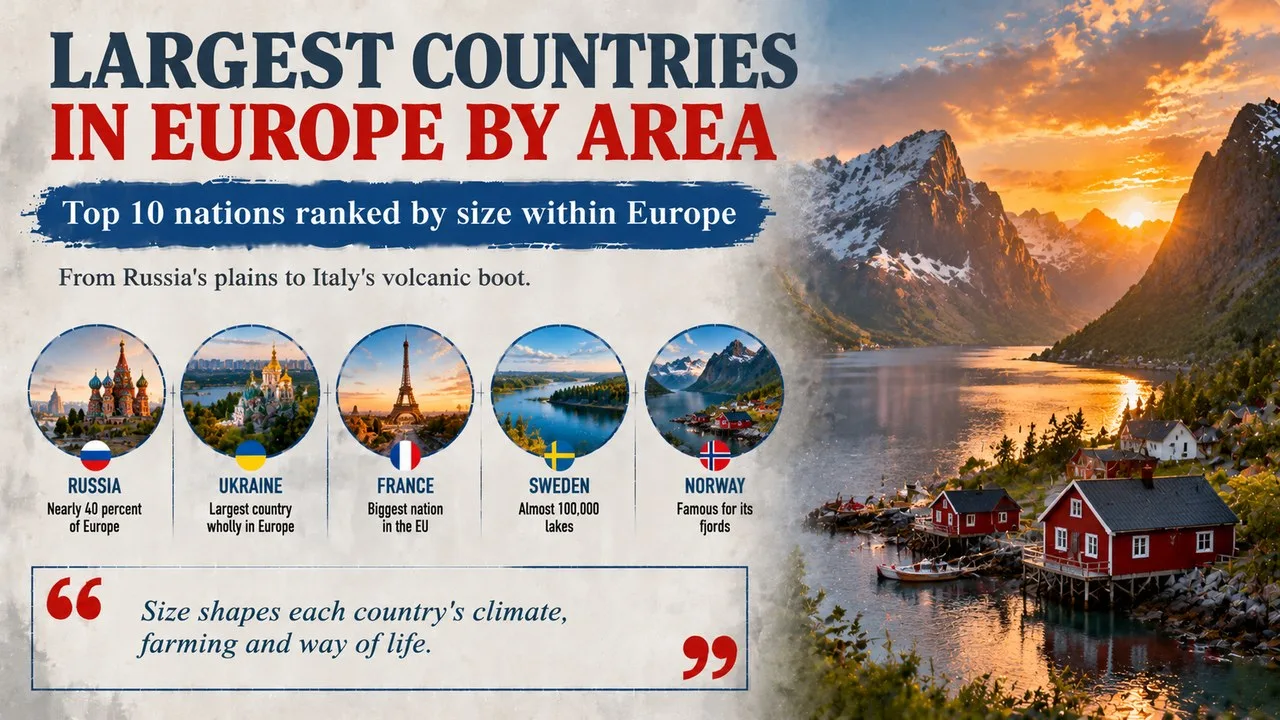
Largest countries in Europe by area are led by Russia, whose European part alone is bigger than the next nine countries combined, then Ukraine and France.
This Finepedia guide, written in October 2026, ranks the 10 biggest countries in Europe by the area they cover inside the continent, using United Nations figures as compiled in standard reference lists. For each country we give its European area, its share of the continent and a landscape fact worth knowing. To explore further, see the Finepedia guides Largest Countries in the World: Top 10 by Area and Best-Preserved Medieval Towns in Europe: Top 10.
How We Chose These
Countries that stretch across two continents, such as Russia and Kazakhstan, are ranked only by the part that lies in Europe. Areas include lakes and rivers, and France is measured without its overseas regions. Norway's figure includes the Arctic islands of Svalbard and Jan Mayen; without them it would rank below Germany and Finland. Europe as a whole covers about 10 million square kilometres. Each entry has a short profile, four key facts and a note on why it matters or a surprising detail.
The 10 Largest European Countries at a Glance
| Rank | Country | Area in Europe (km²) | Share of Europe | Highest point |
|---|---|---|---|---|
| 1 | Russia | 3,952,550 | 39.5% | Mount Elbrus, 5,642 m |
| 2 | Ukraine | 603,549 | 6.0% | Hoverla, 2,061 m |
| 3 | France | 543,941 | 5.4% | Mont Blanc, about 4,810 m |
| 4 | Spain | 498,485 | 5.0% | Mulhacén, 3,479 m |
| 5 | Sweden | 438,574 | 4.4% | Kebnekaise, 2,097 m |
| 6 | Norway | 385,207 | 3.8% | Galdhøpiggen, 2,469 m |
| 7 | Germany | 357,581 | 3.6% | Zugspitze, 2,962 m |
| 8 | Finland | 336,884 | 3.4% | Halti, 1,324 m (Finnish side) |
| 9 | Poland | 312,679 | 3.1% | Rysy, 2,500 m |
| 10 | Italy | 301,958 | 3.0% | Mont Blanc, about 4,810 m |
1. Russia Covers Nearly 40 Percent of Europe
The European part of Russia stretches from the Baltic Sea and the Arctic Ocean to the Caucasus Mountains and the Ural Mountains, which mark the usual border with Asia. This area alone is far larger than any other European country, and it holds most of Russia's people, including the cities of Moscow and Saint Petersburg.
Key Facts
- Area in Europe: about 3.95 million km²
- Total area of Russia: about 17.1 million km²
- Highest point: Mount Elbrus, 5,642 m, in the Caucasus
- Longest river: the Volga, the longest river in all of Europe
Why It Matters
Russia leads Europe in both land and population, even though about three quarters of its land lies in Asia. The Volga ends in a vast delta on the Caspian Sea, the biggest river delta on the continent, and Lake Ladoga and Lake Onega near Saint Petersburg are the two largest lakes in Europe.
2. Ukraine Is the Largest Country Wholly in Europe
After Russia, Ukraine is Europe's next biggest nation, and the biggest whose land lies entirely within the continent. Most of it is flat, made up of fertile plains and steppe, crossed by the Dnipro River. Its only true mountains are the Carpathians in the west and the Crimean Mountains on the southern coast.
Key Facts
- Area: about 603,500 km², including Crimea
- Capital: Kyiv, on the Dnipro
- Highest point: Hoverla, 2,061 m, in the Carpathians
- Coasts: the Black Sea and the shallow Azov Sea
Did You Know?
Ukraine's dark, rich soil, known as chernozem or black earth, is among the most fertile on Earth and has made the country a major grower of wheat, maize and sunflowers. Its figure includes Crimea and other land held by Russia since 2014 and 2022, which most countries still recognise as part of Ukraine.
3. France Is the Biggest Nation in the EU
Metropolitan France, the part of the country in Europe including the island of Corsica, is often described as a hexagon because of its six-sided shape. It has coasts on the English Channel, the Atlantic Ocean and the Mediterranean Sea, and mountains along its borders with Spain, Switzerland and Italy.
Key Facts
- European area: about 543,900 km²
- Area with overseas regions: about 633,000 km²
- Highest point: Mont Blanc in the Alps, shared with Italy
- Main rivers: the Loire, Seine, Rhône and Garonne
Why It Matters
France is the largest member of the EU by area. Mont Blanc, at around 4,810 m, is the highest peak in Western Europe, and the border between France and Italy runs across its summit area. France also governs overseas regions such as French Guiana, on the South American mainland, and Réunion in the Indian Ocean.
4. Spain Is a Land of High Plateaus
Spain fills most of the Iberian Peninsula, in Europe's south-west corner. Its heart is the Meseta Central, a wide, high plateau ringed and crossed by mountain ranges, which gives Spain an average height of about 650 m, among the loftiest in Europe.
Key Facts
- European area: about 498,500 km²
- Total area, with islands and cities in Africa: about 506,000 km²
- Highest point in mainland Spain: Mulhacén, 3,479 m
- Capital: Madrid, close to the centre of the plateau
Did You Know?
Spain's tallest mountain is not in Europe at all. Mount Teide, a 3,715 m volcano on Tenerife in the Canary Islands, lies off the coast of Africa, so Spain's European area does not count the Canaries or the small North African cities of Ceuta and Melilla.
5. Sweden Has Almost 100,000 Lakes
No country in Northern Europe is bigger than Sweden. It stretches more than 1,500 km from the farms of Scania in the south to Arctic Lapland in the north, with a long coast on the Baltic Sea and mountains along its border with Norway. Much of the land is covered by forest.
Key Facts
- Area: about 438,600 km²
- Lakes: around 95,700
- Highest point: Kebnekaise, 2,097 m
- Biggest lake: Vänern, Europe's third biggest lake
Why It Matters
Lake Vänern is the largest lake in the EU and is beaten in Europe only by Ladoga and Onega in Russia. Farmland makes up only a small share of Sweden's land, while forests cover most of the north and centre, supporting a large timber and paper industry.
6. Norway Is Famous for Its Fjords
Norway runs along the western edge of the Scandinavian Peninsula, with a coastline that ranks among the longest and most jagged on Earth. During the ice ages, glaciers gouged deep valleys, and when the ice melted, seawater filled them to form fjords. Its ranking includes the Arctic islands of Svalbard and Jan Mayen.
Key Facts
- Area with Svalbard and Jan Mayen: about 385,200 km²
- Mainland area: about 324,200 km²
- Highest point: Galdhøpiggen, 2,469 m
- Islands and islets: more than 300,000 along the coast
Did You Know?
Sognefjord is the longest fjord in Norway and the second deepest in the world, while Hornindalsvatnet holds the record as Europe's deepest lake. On Svalbard, far to the north, the town of Longyearbyen sees the midnight sun for months each summer.
7. Germany Is the EU's Most Populous Country
Germany sits in the middle of Europe, with the North Sea and Baltic Sea on its northern shore and the Alps along its southern edge. It is crossed by some of Europe's great rivers, including the Rhine, the Danube and the Elbe, and has forested uplands in its centre.
Key Facts
- Area: about 357,600 km²
- Population: more than 83 million
- Highest point: the Zugspitze, 2,962 m
- Neighbours: nine countries share its land borders
Why It Matters
Germany has more people than any other EU member and more neighbours than any European country except Russia. Its lowest point, Neuendorf-Sachsenbande in Schleswig-Holstein, lies more than 3 m below sea level.
8. Finland Is a Land of Forests and Lakes
Finland lies between Sweden and Russia, with the Baltic Sea to the south and west. Most of the country is low and gently rolling, covered by boreal forest and dotted with lakes left by the last ice age. Only the far north, in Lapland, has mountain-like fells.
Key Facts
- Area: about 336,900 km², not counting the Åland Islands
- Lakes: more than 180,000 recorded
- Highest point: the slope of Halti fell, 1,324 m
- Capital: Helsinki, on the south coast
Did You Know?
The summit of Halti lies just over the border in Norway, so Finland's highest point is on the mountain's shoulder rather than its top. Saimaa, in the east, is Finland's largest lake and home to the Saimaa ringed seal, one of the rarest seals in the world.
9. Poland Stretches From the Baltic to the Mountains
Poland lies in central Europe and runs from sandy Baltic beaches down to the Tatra and Carpathian ranges on its southern border. Most of the land between is flat, shaped by ice-age glaciers, and the Masurian Lake District in the north-east has more than a thousand lakes.
Key Facts
- Area: about 312,700 km²
- Highest point: Rysy, 2,500 m, in the Tatras
- Longest river: the Vistula, 1,047 km
- Coastline: about 770 km on the Baltic Sea
Why It Matters
The ancient Białowieża Forest, on the border with Belarus, is one of the last large primeval forests in Europe and a home of the European bison, or wisent, which died out across most of Europe but survives here. Brown bears, wolves and lynx still live in Poland's mountains and forests.
10. Italy Is a Boot in the Mediterranean
Italy is made up of a long, boot-shaped peninsula running into the Mediterranean Sea, the large islands of Sicily and Sardinia, and the southern slopes of the Alps. The Apennine Mountains run down the length of the peninsula, while the wide Po Valley in the north is its main farming region.
Key Facts
- Area in Europe: about 302,000 km²
- Highest point: Mont Blanc, shared with France
- Highest volcano: Etna on Sicily, about 3,343 m
- Lowest point: about 3.4 m below sea level, near Ferrara
Did You Know?
Italy is famous for its volcanoes, including Vesuvius near Naples, Etna on Sicily and Stromboli in the Aeolian Islands. Etna is the tallest active volcano in Europe. Two tiny Italian islands, Lampedusa and Lampione, sit on the African continental shelf, so they are left out of Italy's European area.
Frequently Asked Questions
Which is the biggest country lying wholly in Europe?
Ukraine is the biggest nation whose whole territory lies in Europe. Russia is much larger, but most of its land is in Asia. France is the largest country in Western Europe and in the EU.
Why is Kazakhstan not on the list?
Kazakhstan has land on each bank of the Ural River, but only about 5 percent of it, around 148,000 km², lies in Europe. That would place it 14th, behind the United Kingdom, Romania and Belarus.
Conclusion
From Russia's vast plains to Italy's volcanic boot, Europe's largest countries hold a remarkable mix of steppe, fjords, forests and mountains. Size alone does not tell the whole story, but it shapes each country's climate, farming and way of life. To explore further, read the Finepedia guides Largest Countries in the World: Top 10 by Area and Best-Preserved Medieval Towns in Europe: Top 10.
- United Nations Statistics Division, Demographic Yearbook, surface area tables.
- National statistics offices of France (INSEE), Spain (INE) and Italy (ISTAT), area figures.
- Encyclopaedia Britannica, country articles on Russia, Ukraine, France, Spain, Sweden, Norway, Germany, Finland, Poland and Italy.
- Wikipedia (accessed October 2026), List of European countries by area and the geography articles for each country.
- 10 Most Today, 10 Largest Countries in Europe by Area, 10mosttoday.com (topic reference).














Log in with