











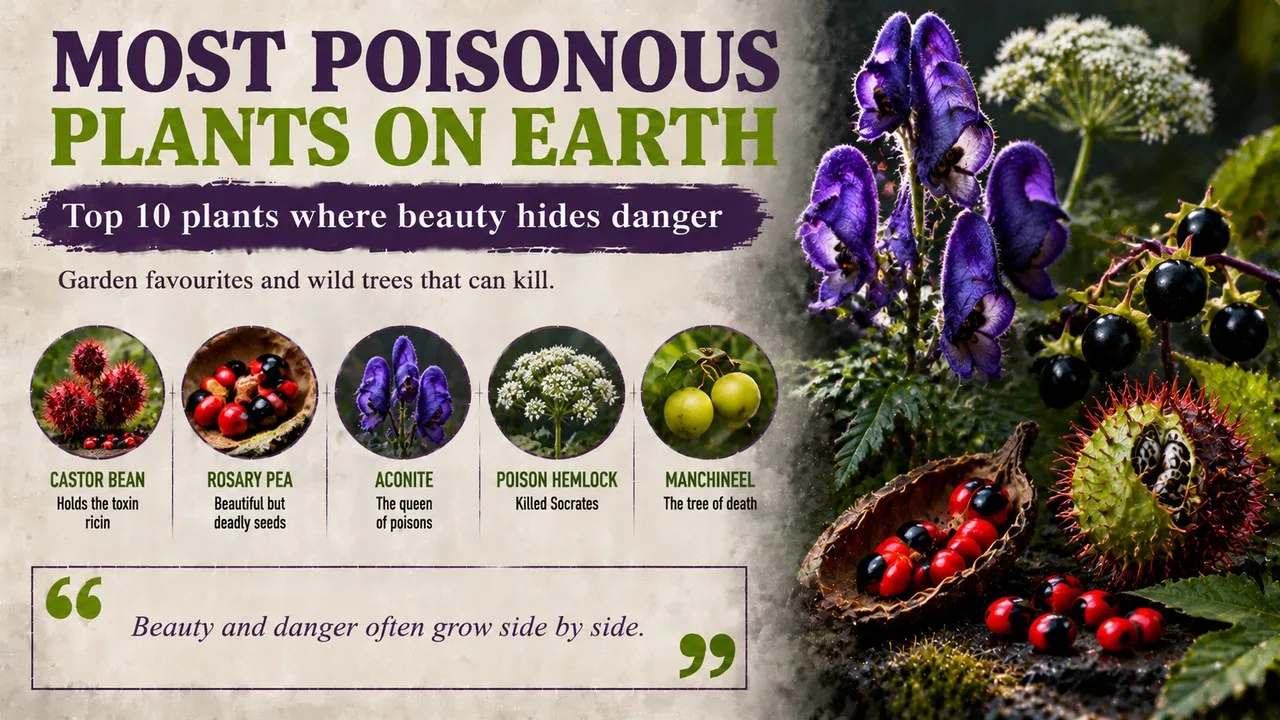
Most poisonous plants on Earth include the castor bean, source of the toxin ricin, and the rosary pea, whose bright red seeds can kill if they are chewed.
This Finepedia guide, written in October 2026, profiles 10 of the most poisonous plants in the world, from garden favourites to a tropical beach tree that blisters the skin. Many of them are grown in parks and gardens, so knowing them can prevent accidents. We checked the facts with poison centres, botanical gardens, medical studies and reference books. For more about plants and safety, see the Finepedia guides Houseplants Toxic to Dogs: Top 10 to Keep Out of Reach and Most Beautiful Flowers in the World: Top 10.
How We Chose These
We ranked plants by how strong their poison is, how little is needed to cause harm and how likely people are to meet them. We left out common houseplants such as dieffenbachia and sago palm, which our pet guide covers, and plants that are only mildly harmful. This guide is for general knowledge only: if anyone swallows part of a plant on this list, contact a poison centre or emergency services at once. Each entry has a short profile, four key facts and a note on why it matters or a surprising detail.
The 10 Poisonous Plants at a Glance
| No. | Plant | Main toxin | Most dangerous part | Native range |
|---|---|---|---|---|
| 1 | Castor bean | ricin | seeds | Horn of Africa |
| 2 | Rosary pea | abrin | seeds | Asia and Australia |
| 3 | Aconite (monkshood) | aconitine | roots and all parts | northern mountains |
| 4 | Poison hemlock | coniine | all parts, mostly seeds and roots | Europe and North Africa |
| 5 | Suicide tree | cerberin | seed kernels | South and South-East Asia |
| 6 | Yellow oleander | heart toxins | seeds and all parts | Mexico and Central America |
| 7 | Oleander | heart toxins | all parts | Mediterranean to Asia |
| 8 | European yew | taxines | needles and seeds | Europe and West Asia |
| 9 | Deadly nightshade | atropine | berries and roots | Europe and West Asia |
| 10 | Manchineel | sap toxins | sap and fruit | Caribbean and the tropical Americas |
1. The Castor Bean Holds the Toxin Ricin
The castor oil plant is a fast-growing shrub with large, glossy, star-shaped leaves, often grown in gardens for its bold red or purple foliage. Its spotted seeds, called castor beans, are pressed to make castor oil, which is safe once processed. But the seeds themselves contain ricin, one of the strongest natural poisons known.
Key Facts
- Species: Ricinus communis
- Toxin: ricin, a protein
- Danger: four to eight well-chewed seeds may kill an adult
- Record: the most poisonous common plant, says Guinness World Records
Why It Matters
Swallowed whole, castor beans often pass through the body without harm, because the hard seed coat keeps the ricin locked inside. Chewed seeds are far more dangerous. In 1978, the Bulgarian writer Georgi Markov died in London after a tiny ricin pellet was shot into his leg on a street, later found to have come from an adapted umbrella.
2. The Rosary Pea Has Beautiful but Deadly Seeds
The rosary pea is a slender climbing vine of the bean family that comes from Asia and Australia. It is known for its shiny seeds, bright scarlet with a black spot, which have long been used as beads in jewellery, rosaries and musical shakers. It has spread as a weed in Florida, the Caribbean and other warm places.
Key Facts
- Species: Abrus precatorius
- Toxin: abrin, related to ricin
- Danger: a single well-chewed seed can be fatal
- Other names: jequirity, crab's eye, ratti in Hindi
Did You Know?
In India, the seeds gave their name to the ratti, an old unit for weighing gold and gems, because they are so even in size. Abrin is even stronger than ricin, but like the castor bean, an unbroken seed often passes through the gut without releasing it. Jewellery made by piercing the seeds can be a risk to the people who make it.
3. Aconite Is the Queen of Poisons
Aconite, also called monkshood or wolfsbane, is a group of more than 250 species of tall, flowering plants that grow in mountain meadows across the Northern Hemisphere. Their deep blue or purple flowers are shaped like a monk's hood, and they are often planted in cottage gardens.
Key Facts
- Genus: Aconitum
- Toxin: aconitine, mainly in the roots and tubers
- Danger: just a few milligrams of aconitine, or about a gram of the plant, may be deadly
- Skin: handling the plant can cause numbness and tingling
Why It Matters
The name wolfsbane recalls how hunters once smeared its juice on arrows and baits meant for wolves. In Greek myth, the goddess Hecate was said to have created aconite. Gardeners are advised to wear gloves when touching it, because the poison can be absorbed through the skin, and to never confuse its roots with edible ones.
4. Poison Hemlock Killed Socrates
Poison hemlock is a tall plant of the carrot family that can reach about 2.4 m, with lacy white flower heads and smooth stems blotched with purple. It comes from Europe and North Africa but has spread as a weed around the world. It has a musty smell that many people find unpleasant.
Key Facts
- Species: Conium maculatum
- Toxin: coniine and related alkaloids
- Effect: paralysis that spreads until breathing stops
- Lookalikes: wild carrot, parsnip and parsley
Did You Know?
Hemlock is best known as the poison given to the Greek philosopher Socrates in 399 BC, after he was sentenced to death in Athens. Today most cases happen when people pick the plant by mistake, thinking it is wild carrot or parsley. Plants grown in sunny places can be about twice as toxic as those in shade.
5. The Suicide Tree Has a Deadly Kernel
Cerbera odollam is a small coastal tree of South and South-East Asia, the Pacific Islands and northern Australia, found along sandy shores, riverbanks and mangroves. It has glossy leaves, white flowers and a green fruit that looks like a small mango, with a poisonous kernel inside.
Key Facts
- Species: Cerbera odollam
- Toxin: cerberin, which upsets the heartbeat
- Danger: one kernel can cause a fatal heart rhythm
- Other names: pong-pong and othalanga
Why It Matters
The tree's grim common name reflects its sad history: studies in Kerala, India, have linked it to many deaths. In Madagascar, its kernels were once used in trials by ordeal, which killed more than 3,000 people a year during the 1700s and 1800s. Its bitter taste is easily hidden in spicy food, which makes poisoning hard to detect.
6. Yellow Oleander Is a Lucky Nut With a Dark Side
Yellow oleander is an evergreen shrub or small tree from Mexico and Central America, now grown in warm countries around the world for its bell-shaped yellow or apricot flowers. Its fruit holds a large seed that people compare to a lucky nut, which gave the plant one of its common names.
Key Facts
- Species: Cascabela thevetia
- Toxin: heart-affecting glycosides
- Family: the dogbane family, with oleander
- Name: cascabel, Spanish for a small bell or rattlesnake
Did You Know?
The name may hint that the plant's poison is as dangerous as a rattlesnake's venom. Swallowing yellow oleander seeds is a serious public health problem in rural Sri Lanka and South India, where the shrub grows wild by roads and villages. Doctors there have studied antidotes used for heart-drug overdoses.
7. Oleander Is a Pretty but Toxic Shrub
Oleander is a tough evergreen shrub with pink, red or white flowers, native from the Mediterranean to India and Myanmar. It is planted widely along roads and in gardens because it copes with drought and floods. Every part of it holds heart toxins.
Key Facts
- Species: Nerium oleander
- Height: about 2 to 6 m
- Effects: vomiting, pain and an irregular heartbeat
- Skin: contact with the sap may cause irritation
Why It Matters
Oleander leaves taste so bitter that serious poisonings in people are rare, but pets and farm animals are often at risk. Burning oleander clippings is also unsafe, because the smoke can irritate the lungs. In Japan, oleander is the city flower of Hiroshima, as it was among the first plants to bloom after the atomic bombing of 1945.
8. The European Yew Is a Poisonous Churchyard Tree
The European yew is a slow-growing evergreen conifer with dark needles and bright red, berry-like cups around its seeds. It is native to much of Europe, West Asia and North-West Africa, and is often planted in churchyards and as hedges. Some British yews are thought to be many hundreds or even thousands of years old.
Key Facts
- Species: Taxus baccata
- Toxin: taxine alkaloids, which harm the heart
- Danger: about 50 g of needles may be fatal to an adult
- Safe part: only the red fleshy cup, not the seed inside
Did You Know?
Every part of the yew is poisonous except the red flesh around the seed, and there is no known antidote. Horses and cattle that eat yew clippings can die quickly. Yew wood was prized in the Middle Ages for longbows, and a related tree, the Pacific yew, gave the cancer drug paclitaxel.
9. Deadly Nightshade Has Sweet, Dangerous Berries
Also called belladonna, deadly nightshade is a bushy relative of tomatoes and potatoes. It grows wild in Europe and West Asia and has shiny black berries and bell-shaped purple flowers. Its leaves, roots and berries contain atropine and other alkaloids that can cause hallucinations and death.
Key Facts
- Species: Atropa belladonna
- Toxins: atropine, scopolamine and hyoscyamine
- Most at risk: children, who may eat the sweet berries
- Name: bella donna means beautiful lady in Italian
Why It Matters
In past centuries, women used belladonna drops to widen their pupils, which was thought to look attractive. A Roman rumour claimed the empress Livia used the berries to poison her husband, Augustus. Today, atropine from the plant family is a vital medicine, used by doctors to treat a slow heartbeat and to widen pupils for eye tests.
10. The Manchineel Is the Tree of Death
The manchineel is a tropical tree of Caribbean coasts, Florida, Central America and the north of South America, reaching heights of about 15 m. Its small green fruits look like crab apples, which explains its Spanish name, manzanilla de la muerte, or little apple of death. Every part of the tree holds a milky, burning sap.
Key Facts
- Species: Hippomane mancinella
- Record: the most dangerous tree, according to Guinness World Records
- Danger: sap blisters the skin, and the fruit burns the mouth and throat
- Warning: many trees are marked with signs or a red X
Did You Know?
Sheltering under a manchineel during rain is dangerous, because raindrops carrying sap can blister the skin, and smoke from burning wood can harm the eyes. Spain's Juan Ponce de León, the explorer, died in 1521 after being hit in Florida by an arrow said to have been tipped with its sap.
Frequently Asked Questions
Which plant is the deadliest in the world?
The castor bean is often named the most poisonous common plant, because its seeds hold ricin. The rosary pea's toxin, abrin, is even stronger by weight, and the manchineel is recorded as the most dangerous tree.
What should I do if someone swallows a poisonous plant?
Call a poison centre or emergency services straight away, and keep a sample or photo of the plant to help doctors identify it. Do not wait for symptoms to appear, and do not try to make the person vomit unless a medical expert tells you to.
Conclusion
From the ricin-rich castor bean to the blistering manchineel, these ten plants show that beauty and danger often grow side by side. Learning to recognise them, wearing gloves in the garden and teaching children not to eat wild berries can prevent most accidents. For more about plants and safety, read the Finepedia guides Houseplants Toxic to Dogs: Top 10 to Keep Out of Reach and Most Beautiful Flowers in the World: Top 10.
- Royal Horticultural Society, Potentially harmful garden plants.
- National Capital Poison Center (Poison Control, US), plant fact sheets on castor bean, oleander, yew and hemlock.
- Gaillard, Y. and others, Cerbera odollam: a suicide tree and cause of death in the state of Kerala, India, Journal of Ethnopharmacology, 2004.
- Guinness World Records, Most poisonous common plant and Most dangerous tree.
- Wikipedia (accessed October 2026), articles on Ricinus communis, Ricin, Abrus precatorius, Aconitum, Conium maculatum, Cerbera odollam, Cascabela thevetia, Nerium, Taxus baccata, Atropa belladonna and Hippomane mancinella.
- 10 Most Today, 10 Most Poisonous Plants on Earth, 10mosttoday.com (topic reference).

















Log in with