












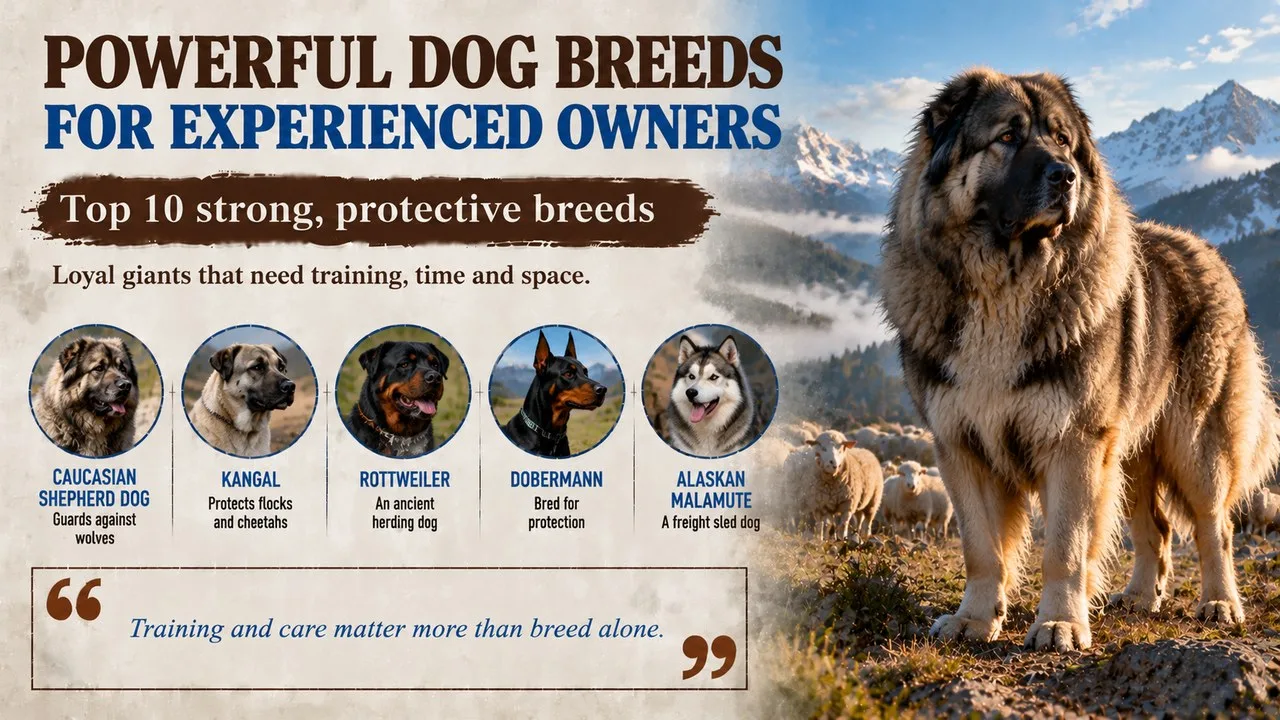
Powerful dog breeds for experienced owners include giant flock guardians that face down wolves, plus mastiffs, pit bulls and wolfdogs that need training.
This Finepedia guide, written in October 2026, profiles 10 strong, protective dog breeds and types that are best kept by owners with experience, time and space. Some are banned or restricted in certain countries, and all of them can be loyal companions when they are well bred, trained and socialised. Facts were checked against kennel club standards, government rules, veterinary bodies and published studies. For more about dog breeds, see the Finepedia guides Most Expensive Dog Breeds in the World: Top 10 and Fastest Dog Breeds in the World: Top 10.
How We Chose These
We chose breeds known for great size, strength, guarding instinct or wild ancestry, which means mistakes in handling can have serious results. Experts stress that any dog can bite, and that a dog's upbringing, training and the owner's care matter more than breed alone. We avoided breeds already covered as main entries in our other dog guides. Each entry has a short profile, four key facts and a note on why it matters or a surprising detail.
The 10 Powerful Dog Breeds at a Glance
| No. | Breed | Origin | Typical weight | Original job |
|---|---|---|---|---|
| 1 | Caucasian Shepherd Dog | Caucasus region | 45 to 70 kg | guarding flocks from wolves |
| 2 | Kangal Shepherd Dog | Turkey | 40 to 60 kg | guarding sheep |
| 3 | Presa Canario | Canary Islands, Spain | 40 to 57 kg | guarding and cattle work |
| 4 | Fila Brasileiro | Brazil | 40 kg or more | guarding and cattle herding |
| 5 | American Pit Bull Terrier | United States | 15 to 27 kg (males) | fighting, later farm and family dog |
| 6 | Rottweiler | Germany | 35 to 60 kg | herding and pulling carts |
| 7 | Wolfdog | worldwide | varies widely | wolf and dog hybrid |
| 8 | Dobermann | Germany | 32 to 45 kg | personal protection |
| 9 | Bullmastiff | England | 41 to 59 kg | catching poachers |
| 10 | Alaskan Malamute | Alaska, US | about 34 to 39 kg | hauling heavy sleds |
1. The Caucasian Shepherd Dog Guards Against Wolves
Also known as the Ovcharka, the Caucasian Shepherd Dog is a huge livestock guardian from the mountains of Georgia, Armenia, Azerbaijan and Dagestan. For centuries, dogs of this type protected sheep from wolves and thieves. Soviet breeders turned the local mountain dogs into a standard breed from about the 1920s.
Key Facts
- Weight: usually 45 to 70 kg
- Height: about 72 to 75 cm at the shoulder for males
- Coat: thick and weatherproof, often grey, fawn or white
- Recognised: by the international kennel federation, the FCI, in 1984
Why It Matters
Bred to make decisions alone on remote hillsides, the Caucasian Shepherd is fiercely territorial and suspicious of strangers. It needs early socialisation, firm and patient training and a secure property. In a small flat or with a first-time owner, its size and guarding drive can quickly become a problem.
2. The Kangal Protects Flocks and Cheetahs
The Kangal Shepherd Dog is a traditional flock guardian from the Sivas region of central Turkey, named after the town of Kangal. It has a short, pale fawn to grey coat and a black mask, and for centuries it has lived among sheep to keep wolves away.
Key Facts
- Weight: about 48 to 60 kg for males
- Height: about 72 to 78 cm at the shoulder for males
- Old name: Karabash, meaning black head
- Coat: short and dense, with a black mask
Did You Know?
Conservation groups have sent Kangals to farmers in Namibia, Kenya and Tanzania to guard livestock from cheetahs. Because the dogs scare the cats away, farmers no longer need to shoot them, which helps protect this endangered big cat. A Kangal's calm, watchful nature can turn into serious force against any threat to its flock.
3. The Presa Canario Is a Canary Islands Mastiff
This large mastiff-type dog comes from the Canary Islands, mostly Gran Canaria and Tenerife. Islanders traditionally used it to guard farms and handle cattle, and also for dog fighting, which Spain allowed until 1936. It had almost vanished by the 1960s before fans revived it.
Key Facts
- Weight: about 45 to 57 kg for males
- Height: about 61 to 66 cm for males
- Former name: Dogo Canario
- Symbol: an official emblem of Gran Canaria since 1991
Why It Matters
The Presa Canario is powerful, confident and strongly protective, so it needs consistent training from a young age. It became widely known in 2001, when two Presa Canarios killed a woman in a San Francisco apartment building, a case that ended with an owner convicted of murder.
4. The Fila Brasileiro Is Banned in the UK
The Fila Brasileiro is a big Brazilian mastiff that looks a little like a bloodhound, with loose skin and a rolling, camel-like walk. Its ancestors were European dogs taken to Brazil in colonial times and was used to guard plantations, herd cattle and hunt big game such as jaguars.
Key Facts
- Weight: at least 50 kg for males
- Height: about 65 to 75 cm for males
- Name: from the Portuguese filar, to hold or grab
- Law: one of the dog types banned under the UK Dangerous Dogs Act
Did You Know?
The breed standard describes the Fila's natural dislike of strangers with a special term, ojeriza. This makes it an outstanding guard dog but a hard one to manage in busy places. Its dark history includes use in the 1700s to chase down people who had escaped slavery.
5. The American Pit Bull Terrier Has a Strong Grip
This medium-sized, muscular dog with a short coat and a broad head. It descends from British bull and terrier dogs that came to America in the mid-1800s, and it was first registered by the United Kennel Club in 1898. Many pit bulls today live as affectionate family pets.
Key Facts
- Weight: about 15 to 27 kg for males
- Height: about 45 to 53 cm for males
- Recognition: registered by the UKC, though the AKC does not list it
- Law: banned in the UK since 1991 as the pit bull terrier type
Why It Matters
Pit bull-type dogs feature heavily in serious bite reports, which has led to bans and restrictions in many countries and cities. However, breed labels in bite data are often unreliable, and the Netherlands ended its pit bull ban in 2008 after finding it ineffective. Responsible breeding and training remain the keys to safety.
6. The Rottweiler Is an Ancient Herding Dog
The Rottweiler is a large, powerful dog from the German town of Rottweil. Its ancestors are said to have marched with Roman legions, driving cattle across the Alps. Later, butchers used it to drive cattle and haul carts of meat to market, giving it the old name Rottweil butchers' dog.
Key Facts
- Weight: about 50 to 60 kg for males
- Height: about 61 to 69 cm for males
- Coat: black with rust or mahogany markings
- Jobs today: police, guarding, and search and rescue
Did You Know?
When railways replaced cattle drives in the 1800s, the Rottweiler nearly died out, but its strength and intelligence won it new work with the police. A 2000 CDC study of 20 years of fatal dog attacks in the US found that pit bulls and Rottweilers between them accounted for over half of the deaths, though the authors warned against judging breeds on this alone.
7. The Wolfdog Is Part Wild
A wolfdog is a hybrid born from mating a domestic dog with a wolf. Wolfdogs vary hugely in looks and behaviour, depending on how much wolf they carry, and their traits are hard to predict. Some keep the shyness and strong instincts of wild wolves, which makes them very hard to train and contain.
Key Facts
- Parents: a domestic dog and a wolf
- Size: varies widely
- Law: banned or restricted in most European countries
- Related breeds: the Czechoslovakian and Saarloos wolfdogs
Why It Matters
Wolfdogs often need large, escape-proof enclosures and expert care, and many end up in rescue centres when owners cannot cope. Because standard rabies vaccines are not officially approved for wolf hybrids in some places, a bite can lead to serious legal problems. They are best left to specialists.
8. The Dobermann Was Bred for Protection
The Dobermann is a sleek, athletic dog from Germany, called the Doberman Pinscher in North America. Louis Dobermann, who collected taxes in the town of Apolda, created it in the 1880s as a dog to protect him on his rounds. It is known for its long muzzle and elegant, smooth gait.
Key Facts
- Weight: about 40 to 45 kg for males
- Height: about 68 to 72 cm for males
- Coat: black or brown, with rust markings
- War service: used by the US Marine Corps in World War II
Did You Know?
Dobermanns are very intelligent and loyal, and they are often used as police and guard dogs. Their reputation for toughness comes from their guarding work, but well-socialised Dobermanns are usually gentle with their families. They need plenty of exercise and mental activity.
9. The Bullmastiff Caught Poachers at Night
The Bullmastiff was developed in 19th-century England from crosses between mastiffs and the old bulldog type, which has since died out. Gamekeepers used it to catch and pin down poachers on country estates at night, without mauling them. The Kennel Club recognised it as a breed in 1924.
Key Facts
- Weight: about 41 to 59 kg
- Height: about 61 to 69 cm
- Nickname: the night dog of gamekeepers
- Mines: brought to South Africa by De Beers in 1928 to guard diamond mines
Why It Matters
The Bullmastiff is usually calm and quiet at home, but it has the strength to knock down an adult and a strong guarding instinct. Training must start early, before the dog grows too big to control. Its short muzzle also means it can struggle in hot weather.
10. The Alaskan Malamute Is a Freight Sled Dog
This large, strong Arctic breed was developed to haul heavy loads over long distances, unlike the faster, lighter racing huskies. It is named after the Mahlemut people of north-west Alaska. Malamutes helped gold miners in the 1890s and Admiral Richard Byrd on his journeys to the South Pole.
Key Facts
- Weight: about 34 to 39 kg, often more
- Height: about 58 to 64 cm
- Coat: thick double coat in grey, black, sable or red with white
- Honour: Alaska's state dog since 2010
Did You Know?
Malamutes are usually friendly with people and make poor guard dogs, but their great strength, independence and strong urge to chase small animals make them a challenge. They need lots of exercise, firm training and secure fences, as they are skilled diggers and escape artists.
Frequently Asked Questions
Which dog breed is the most dangerous?
There is no single answer. Large, powerful breeds can cause more serious injuries, and pit bulls and Rottweilers appear often in reports of fatal attacks. But veterinary groups stress that training, socialisation, supervision and the owner's behaviour play a bigger part than breed.
Which dogs are banned in the UK?
The UK Dangerous Dogs Act bans four dog types, the pit bull terrier, Fila Brasileiro, Dogo Argentino and Japanese Tosa, and the XL Bully was added in England and Wales from 31 December 2023. Owning one is only allowed with an exemption certificate and strict conditions.
Conclusion
From the wolf-fighting Caucasian Shepherd to the freight-hauling Malamute, these ten breeds show how dogs were shaped for tough jobs. In the right hands they can be loyal, gentle companions, but they need owners with experience, time and patience. For more about dog breeds, read the Finepedia guides Most Expensive Dog Breeds in the World: Top 10 and Fastest Dog Breeds in the World: Top 10.
- Fédération Cynologique Internationale (FCI), breed standards for the Caucasian Shepherd Dog, Dogo Canario, Fila Brasileiro, Rottweiler, Dobermann and Bullmastiff.
- UK Government, Dangerous Dogs Act 1991 and guidance on banned dogs, including the XL Bully.
- Sacks, J. J. and others, Breeds of dogs involved in fatal human attacks in the United States between 1979 and 1998, Journal of the American Veterinary Medical Association, 2000.
- American Veterinary Medical Association, Dog bite risk and prevention: the role of breed, literature review.
- Wikipedia (accessed October 2026), articles on each breed, Wolfdog, Dog bite and Breed-specific legislation.
- 10 Most Today, 10 Most Dangerous Dog Breeds in the World, Ranked, 10mosttoday.com (topic reference).


















Log in with