



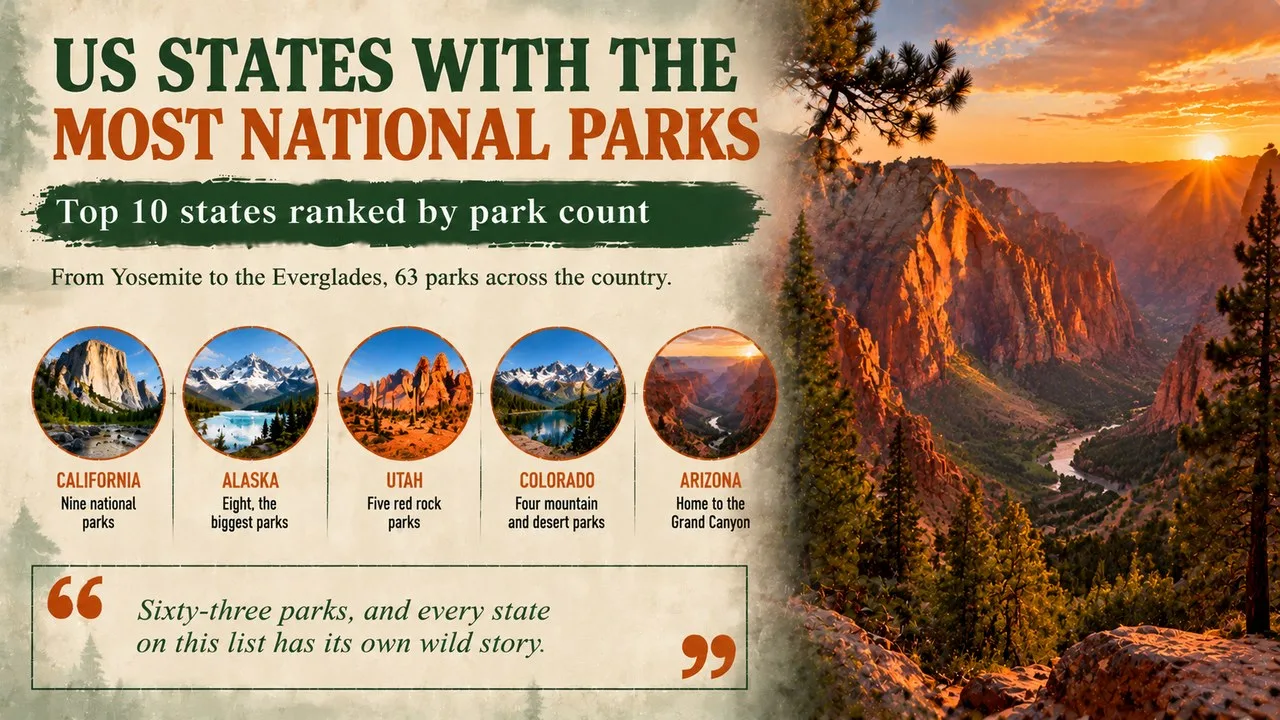
US states with the most national parks are led by California with nine and Alaska with eight, followed by Utah, home to five red rock parks in one state.
This Finepedia guide, written in October 2026, ranks the 10 states that hold the largest number of national parks, using the official National Park Service list of 63 national parks. For each state we name every park, pick out a highlight and add a fact worth knowing. Park counts and dates are as of October 2026. For more about the country and its landscapes, see the Finepedia guides The United States: A Federal Republic of 50 States and Beyond and Most Breathtaking Desert Landscapes: Top 10.
How We Chose These
The National Park Service looks after more than 430 sites, but only 63 carry the title of national park. Thirty states have at least one, along with American Samoa and the US Virgin Islands. We counted every park in each state, so a park that crosses a state line, such as Yellowstone or Death Valley, counts for each state it touches. Seven states tie on two parks each, so for places 8 to 10 we picked Wyoming, Texas and South Dakota and list the others in the questions at the end.
The 10 States at a Glance
| Rank | State | National parks | Best-known park | Standout fact |
|---|---|---|---|---|
| 1 | California | 9 | Yosemite | hottest temperature on record, in Death Valley |
| 2 | Alaska | 8 | Denali | largest park in the country |
| 3 | Utah | 5 | Zion | all five are red rock parks |
| 4 | Colorado | 4 | Rocky Mountain | tallest dunes in North America |
| 5 | Arizona | 3 | Grand Canyon | giant saguaro cactus forests |
| 6 | Florida | 3 | Everglades | two parks are mostly water |
| 7 | Washington | 3 | Mount Rainier | a temperate rainforest |
| 8 | Wyoming | 2 | Yellowstone | the first national park |
| 9 | Texas | 2 | Big Bend | tallest peak in Texas |
| 10 | South Dakota | 2 | Badlands | first cave named a national park |
1. California Has Nine National Parks
California leads the country with nine national parks, ranging from snowy granite peaks to the hottest desert in North America. They are Yosemite, Sequoia, Kings Canyon, Death Valley, Joshua Tree, Redwood, Channel Islands, Lassen Volcanic and Pinnacles, which became the newest of the nine in 2013.
Key Facts
- Number of parks: 9
- Oldest: Sequoia and Yosemite, both from 1890
- Highest point: Mount Whitney, 4,421 m, in Sequoia
- Lowest point: Badwater Basin, 86 m below sea level, in Death Valley
Why It Matters
California's parks hold several world records. Death Valley recorded 56.7 °C on 10 July 1913, which still stands as the hottest air reading on record anywhere on Earth. Redwood protects coast redwoods, the tallest trees on the planet, and Sequoia holds giant sequoias, some of the largest trees by volume. Yosemite's protection began with a grant signed by Abraham Lincoln in 1864.
2. Alaska Has the Biggest Parks
Alaska has eight national parks, and they are huge. They are Denali, Wrangell–St. Elias, Gates of the Arctic, Glacier Bay, Katmai, Kenai Fjords, Kobuk Valley and Lake Clark. Several have no roads at all and can only be reached by small plane, boat or on foot.
Key Facts
- Number of parks: 8
- Largest: Wrangell–St. Elias, about 53,000 square km with its preserve
- Highest peak: Denali, 6,190 m, the tallest mountain in North America
- Least visited: Gates of the Arctic, with about 7,400 visitors in 2021
Did You Know?
Wrangell–St. Elias, together with its preserve, is bigger than nine US states and about the size of Croatia. Katmai is famous for its brown bears, which gather at Brooks Falls to catch leaping salmon, and for its Valley of Ten Thousand Smokes, buried in ash by a huge eruption in 1912.
3. Utah Has Five Red Rock Parks
Utah's five national parks, often marketed together as the Mighty 5, all lie in the south of the state on the Colorado Plateau. They are Zion, Bryce Canyon, Arches, Canyonlands and Capitol Reef, each carved from layers of red, orange and white sandstone.
Key Facts
- Number of parks: 5
- Busiest: Zion, with nearly 5 million visitors in 2025
- Bryce Canyon: famous for tall rock spires called hoodoos
- Arches: more than 2,000 natural stone arches
Why It Matters
Zion became Utah's first national park in 1919, after its earlier name, Mukuntuweap, was changed to one thought more appealing to visitors. Bryce Canyon is not really a canyon but a row of huge natural amphitheatres, filled with hoodoos shaped by frost and running water. Together the five parks make southern Utah one of the most popular road trip regions in the US.
4. Colorado Has Four Mountain and Desert Parks
Colorado's four national parks are Rocky Mountain, Mesa Verde, Great Sand Dunes and Black Canyon of the Gunnison. They range from alpine tundra high in the Rockies to ancient cliff villages and a field of giant sand dunes beneath snowy peaks.
Key Facts
- Number of parks: 4
- Rocky Mountain: peaks up to 4,346 m at Longs Peak
- Mesa Verde: over 5,000 archaeological sites, about 600 of them cliff dwellings
- Great Sand Dunes: North America's highest sand dunes
Did You Know?
Mesa Verde, set up in 1906, was the first national park meant to protect the works of people rather than natural scenery. Its best-known structure, Cliff Palace, ranks among the biggest cliff dwellings on the continent and was built by Ancestral Puebloans. It is also the only UNESCO World Heritage Site in Colorado.
5. Arizona Is Home to the Grand Canyon
Arizona has three national parks: Grand Canyon, Petrified Forest and Saguaro. The Grand Canyon ranks among the best-known natural sights on Earth, carved by the Colorado River, and gained national park status in 1919, the same year as Zion.
Key Facts
- Number of parks: 3
- Grand Canyon: more than 4.9 million visitors in 2024
- Petrified Forest: large deposits of fossil wood
- Saguaro: protects the giant saguaro cactus of the Sonoran Desert
Why It Matters
The Grand Canyon joined UNESCO's World Heritage List in 1979. Petrified Forest preserves logs that turned to stone over millions of years, and historic Route 66 crosses the park. Saguaro National Park, split into two areas on either side of Tucson, protects forests of the tall cactus that stands as an icon of the American West.
6. Florida Has Parks That Are Mostly Water
Florida's three national parks are Everglades, Biscayne and Dry Tortugas. All three protect wetlands, islands and coral reefs around the southern end of Florida, and two of the three lie almost wholly under water.
Key Facts
- Number of parks: 3
- Everglades: more than 1.5 million acres, a national park since 1947
- Biscayne: only about 5 percent is land
- Dry Tortugas: more than 99 percent water, roughly 110 km beyond Key West
Did You Know?
The Everglades is the only place in the world where American alligators and American crocodiles live side by side, and it shelters the rare Florida panther and the West Indian manatee. Dry Tortugas protects Fort Jefferson, a huge 19th-century brick fort on a tiny island, which visitors reach by ferry or seaplane.
7. Washington Has Volcanoes and Rainforest
Washington's three national parks are Mount Rainier, Olympic and North Cascades. Mount Rainier, which in 1899 became the country's fourth national park, protects a glacier-covered volcano that towers over the Seattle area.
Key Facts
- Number of parks: 3
- Mount Rainier: 4,391 m, the tallest peak of the Cascades
- Olympic: Pacific coast, mountains and temperate rainforest
- North Cascades: rugged peaks near the Canadian border
Why It Matters
Covering much of the Olympic Peninsula, Olympic National Park contains one of the largest temperate rainforests in the US, where moss hangs from huge spruce and fir trees. It gained World Heritage status from UNESCO in 1981. North Cascades is among the wildest parks in the lower 48, with hundreds of glaciers and few roads.
8. Wyoming Is Home to the Original National Park
Wyoming has two national parks: Yellowstone and Grand Teton. Yellowstone, which also reaches into Montana and Idaho, became law on 1 March 1872 with the signature of President Ulysses S. Grant. It was America's first national park and is widely seen as the world's first too.
Key Facts
- Number of parks: 2
- Yellowstone: established in 1872
- Grand Teton: established in 1929
- Grand Teton peak: 4,199 m above sea level
Did You Know?
Yellowstone holds well over half of all the geysers and hot springs on Earth, which sits on top of the caldera of a huge, dormant volcano. Its most famous geyser, Old Faithful, erupts many times a day. Just to the south, the jagged Teton Range rises more than 2,100 m above the valley of Jackson Hole.
9. Texas Has Desert Mountains on the Rio Grande
Texas has two national parks, Big Bend and Guadalupe Mountains, both in the far west of the state. Big Bend is named after a large curve of the Rio Grande, the river that forms the border with Mexico, and opened to visitors in 1944.
Key Facts
- Number of parks: 2
- Big Bend: over 450 bird species recorded
- Guadalupe Mountains: home to Guadalupe Peak, at 2,667 m the top of Texas
- Big Bend: the biggest stretch of protected Chihuahuan Desert in the country
Why It Matters
Big Bend is one of the most remote and least visited big parks in the lower 48, which makes it a superb spot for watching the night sky. Its rocks hold dinosaur bones and fossil sea creatures. The Guadalupe Mountains are part of an ancient fossil reef, formed under a shallow sea about 260 million years ago.
10. South Dakota Has Badlands and a Breathing Cave
South Dakota has two national parks, Badlands and Wind Cave, both in the west of the state. Badlands protects a maze of eroded buttes and spires striped in colourful layers, while Wind Cave protects one of the longest caves in the world beneath rolling prairie.
Key Facts
- Number of parks: 2
- Wind Cave: established in 1903 as the sixth US national park
- Badlands: a national park since 1978
- Wildlife: bison, prairie dogs and reintroduced black-footed ferrets
Did You Know?
Wind Cave was the first cave on Earth given national park status. It is known as a breathing cave, because air rushes in or out of its entrance as the air pressure outside changes. Roughly 95 percent of all known boxwork, a rare honeycomb-like rock formation, is found inside it.
Frequently Asked Questions
Which states tie with two national parks?
Seven states have two national parks each: Wyoming, Texas and South Dakota, featured above, plus Hawaii (Haleakalā and Hawaiʻi Volcanoes), Montana (Glacier and part of Yellowstone), Nevada (Great Basin and part of Death Valley) and New Mexico (Carlsbad Caverns and White Sands).
What is the newest US national park?
New River Gorge in West Virginia became a national park in December 2020, after being protected as a national river. The most recent park created from entirely new land is the National Park of American Samoa.
Conclusion
From California's giant trees to South Dakota's breathing cave, the states richest in national parks offer an incredible range of landscapes. Many parks are busiest in summer, so visiting in spring or autumn often means smaller crowds. For more about the country and its landscapes, read the Finepedia guides The United States: A Federal Republic of 50 States and Beyond and Most Breathtaking Desert Landscapes: Top 10.
- US National Park Service, list of national parks and park pages (nps.gov).
- US National Park Service, visitor use statistics (irma.nps.gov).
- UNESCO World Heritage Centre, listings for Grand Canyon, Everglades, Olympic, Yellowstone and Mesa Verde.
- Wikipedia (accessed October 2026), List of national parks of the United States, and articles on the parks named above.
- 10 Most Today, 10 States With the Most National Parks, 10mosttoday.com (topic reference).














Log in with