





 By
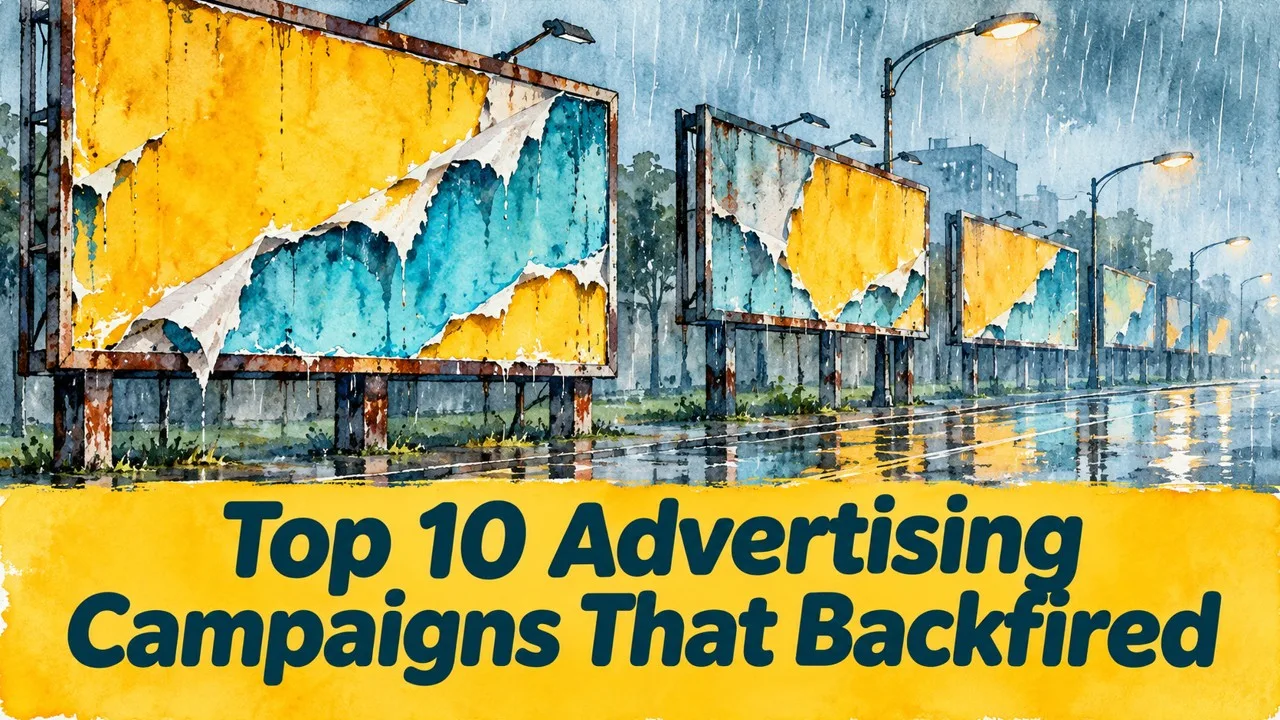
Some marketing ideas went badly wrong, from free flights that cost a fortune and a bottle cap that sparked riots to a giant ice pop that flooded a park. Advertising is meant to win attention, but attention can turn against the company that seeks it. A promotion can be too generous, a joke can be taken literally, a stunt can frighten a city or a carefully planned message can strike the public as tone-deaf. Some of the most expensive lessons in business history came from campaigns that worked too well or in the wrong way.
The ten examples below are the Hoover free flights promotion, Pepsi's Number Fever in the Philippines, the Pepsi Stuff Harrier jet, the Snapple giant frozen treat, the Boston Mooninite scare, McDonald's Twitter hashtag, Pepsi's 2017 protest advertisement, Peloton's holiday advertisement, the launch of the Edsel and the arrival of New Coke.
These cases are described from public reporting and court records. They are not meant to mock the people involved. Most of the companies recovered, and several of the stories are now taught in business schools as examples of what can happen when a promotion's risks are not fully thought through.
Key Facts
| # | Campaign | Company and year | What went wrong |
|---|---|---|---|
| 1 | The Hoover free flights promotion | Hoover, United Kingdom, 1992 | Far more people claimed flights than expected |
| 2 | Number Fever | Pepsi, Philippines, 1992 | A printing error produced hundreds of thousands of winning caps |
| 3 | The Pepsi Stuff Harrier jet | PepsiCo, United States, 1996 | A joke prize was treated as a real offer |
| 4 | A record-breaking frozen treat | Snapple, New York City, 2005 | The treat melted and flooded a park |
| 5 | The Mooninite devices | Cartoon Network, Boston, 2007 | Light-up signs were mistaken for bombs |
| 6 | McDStories | McDonald's, 2012 | Users posted negative stories instead of positive ones |
| 7 | Live for Now | Pepsi, 2017 | Criticized for trivializing protest movements |
| 8 | The Gift That Gives Back | Peloton, 2019 | Many viewers found the message uncomfortable |
| 9 | The Edsel | Ford, 1957 | Heavy pre-launch publicity raised expectations too high |
| 10 | New Coke | Coca-Cola, 1985 | Customers demanded the original formula back |
1. Free Flights That Cost a Fortune
In 1992, the British arm of the appliance maker Hoover launched a promotion offering two free return flights to Europe to anyone who bought at least 100 pounds of Hoover products. The offer was soon extended to flights to the United States [1].
The flights were worth far more than the products, and many people bought vacuum cleaners simply to get the tickets. Demand was enormous, and the company struggled to provide the flights. Customers who did not receive them complained, formed a pressure group and took legal action, with cases continuing for years [1].
The promotion is estimated to have cost Hoover about 48 million pounds. Several senior executives in the European business were dismissed, and the parent company, Maytag, later sold Hoover's European operations. The episode is widely cited as one of the worst sales promotions in British history.
2. A Bottle Cap That Sparked Riots
In 1992, Pepsi-Cola Products Philippines ran a promotion called Number Fever. Numbers printed under bottle caps could win cash prizes, with the top prize of one million pesos, a very large sum at the time. The promotion was initially a big success and greatly increased sales [2].
The problem began when the winning number 349 was announced. Because of an error, the number had been printed on hundreds of thousands of caps that were not meant to be winners. Many people believed they had won and demanded payment. Pepsi offered a small goodwill payment instead of the full prize [2].
Protests and boycotts followed, and the dispute turned violent, with attacks on Pepsi trucks and facilities and incidents in which people were killed. Thousands of lawsuits were filed. The case lasted for years in Philippine courts, and it remains a cautionary example of how a simple error can have very serious consequences.
Related: Top 10 Most Popular Fonts for Professional Logo Design
3. A Fighter Jet for Pepsi Points
In 1996, PepsiCo ran a promotion called Pepsi Stuff, in which customers collected points from drinks to exchange for merchandise. A television advertisement showed a teenager arriving at school in a Harrier jump jet, priced at seven million Pepsi Points [3].
The advertisement was meant as a joke, but a business student named John Leonard noticed that the promotion allowed people to buy extra points for ten cents each. He raised about 700,000 dollars from investors and sent a check to claim the jet, which was worth tens of millions of dollars [3].
PepsiCo refused, and the case went to court. In 1999, a federal judge ruled in Leonard v. PepsiCo that the advertisement was not a real offer, because no reasonable person would believe it. Pepsi later changed the advertisement to raise the points needed. The case is now taught in contract law classes, and it was the subject of a 2022 documentary.
4. A Giant Ice Pop That Melted
In June 2005, the drinks company Snapple attempted to set a world record by erecting a giant frozen juice treat in Union Square in New York City. The treat was about 25 feet tall and weighed more than 17 tons [4].
The stunt took place on a hot summer day. The frozen treat began to melt faster than expected, before it could be raised to its full position. Sticky liquid flowed across the area, forcing firefighters to close streets and hose down the pavement. People in the area had to move to higher ground to avoid the flood [4].
No one was seriously hurt, and the stunt became a widely shared news story. It did attract attention, but not in the way Snapple intended. It is often cited as an example of how a publicity stunt can be undone by a failure to plan for basic physical conditions.
5. A Cartoon Advertisement That Looked Like a Bomb
In January 2007, a marketing campaign for the animated television show Aqua Teen Hunger Force placed small battery-powered signs with lights in several American cities. The signs showed a cartoon character, one of the Mooninites, making a rude gesture [5].
Related: Top 10 Most Bizarre Phobias: Strange Fears That Exist
In Boston, people reported the devices as suspicious, and authorities treated them as possible explosives. Bridges, roads and parts of the Charles River were closed while police removed the devices. The event caused widespread disruption and public anger [5].
Turner Broadcasting, the owner of Cartoon Network, and the marketing firm involved agreed to pay two million dollars to cover costs and goodwill. The head of Cartoon Network resigned. The campaign showed how guerrilla marketing, which relies on surprise, can cause alarm when people are already worried about security.
6. A Hashtag That Was Hijacked
In January 2012, McDonald's launched a promoted Twitter campaign using the hashtag McDStories. The company hoped customers would share happy memories of its restaurants and its food suppliers [6].
Instead, many users posted complaints, jokes and negative stories about the company. The hashtag quickly became a vehicle for criticism. McDonald's withdrew the promotion within a couple of hours, but the posts continued to spread and were widely covered by the news media [6].
The episode became a classic example of hashtag hijacking, in which a brand loses control of an online conversation. It taught marketers that an open invitation on social media can be used in unexpected ways, and that companies should consider how critics might respond before launching such campaigns.
7. An Advertisement Pulled in a Day
In April 2017, Pepsi released a video advertisement featuring the model Kendall Jenner joining a street protest and handing a can of Pepsi to a police officer. The advertisement was part of a campaign called Live for Now [7].
Many viewers criticized the advertisement for appearing to trivialize serious protest movements, particularly those about racial justice and police conduct. The criticism spread rapidly on social media and in the press [7].
Related: Top 10 Oldest Buildings in the World
Pepsi withdrew the advertisement within about a day and issued an apology, saying it had missed the mark. The episode became a widely discussed example of a brand trying to associate itself with social issues without understanding how people would react, and it is often used in marketing courses on brand purpose.
8. A Holiday Gift That Drew Criticism
In late 2019, the exercise company Peloton released a holiday television advertisement showing a woman who receives an exercise bike from her husband and records a video diary of her progress over the following year [8].
Many viewers found the advertisement uncomfortable, interpreting it as suggesting that the woman needed to change her body to please her husband. The advertisement was widely mocked and parodied on social media. Peloton defended it, saying it was meant to show a fitness journey [8].
The company's share price fell in the days after the controversy, though the long-term effect on sales is debated. An actor parodied the advertisement in a commercial for a gin brand. The case showed how quickly a single advertisement can become a cultural joke in the age of social media.
9. A Car Launched With Too Much Hype
In 1957, the Ford Motor Company launched the Edsel, a new brand of car aimed at the middle of the market. Before the launch, Ford ran an extensive publicity campaign, keeping the car's appearance secret and promising something entirely new [9].
When the Edsel was revealed, many people were disappointed. Its styling, especially the vertical grille, was widely criticized, and it arrived during an economic recession that hurt sales of mid-priced cars. Quality problems in early models added to its difficulties [9].
Related: 10 Sikh Gurus: The Pillars of Sikhism Who Shaped Faith, Equality, Courage, and Humanity
Ford ended the Edsel brand after only a few model years, with losses estimated at hundreds of millions of dollars. The name became a byword for a commercial failure. Marketing historians often note that the problem was partly the campaign itself, which built expectations the product could not meet.
10. A New Formula That Lasted 79 Days
In April 1985, the Coca-Cola Company replaced its original formula with a new, sweeter version, later known as New Coke. The company had conducted taste tests suggesting that people preferred the new flavor, partly in response to competition from Pepsi [10].
The public reaction was intense. Many customers felt that the company had taken away something familiar and meaningful. The company received huge numbers of letters and phone calls, and some people stockpiled the old drink [10].
After 79 days, Coca-Cola announced that the original formula would return as Coca-Cola Classic. Sales of the original drink then recovered strongly. Some have suggested the episode was a clever marketing plan, but the company has denied this. It is often used to show that brand loyalty depends on emotion as well as taste.
Conclusion
The ten campaigns above failed for different reasons. Some offered too much, like the Hoover flights and the Pepsi bottle caps. Some created unintended meanings, like the Pepsi protest advertisement and the Peloton holiday commercial. Others ran into physical reality, like Snapple's melting treat, or public fear, like the Mooninite signs.
The common lesson is that marketing does not happen in a vacuum. Customers, critics and courts all respond in ways that companies cannot fully control. The best campaigns are tested not only for how they might succeed, but for how they might go wrong.
- ^ [1] Accounts of the Hoover promotion and its costs. Wikipedia: Hoover free flights promotion Wikipedia: Hoover Company
- ^ [2] Accounts of the Number Fever promotion and its aftermath. Wikipedia: Pepsi Number Fever Wikipedia: Pepsi
- ^ [3] Accounts of the Harrier jet case. Wikipedia: Leonard v. Pepsico Wikipedia: Pepsi Stuff
- ^ [4] Accounts of the 2005 Snapple stunt in Union Square. Wikipedia: Snapple Wikipedia: Union Square
- ^ [5] Accounts of the 2007 Boston scare and the settlement. Wikipedia: 2007 Boston Mooninite panic Wikipedia: Aqua Teen Hunger Force
- ^ [6] Accounts of the McDStories hashtag campaign. Wikipedia: McDonald's Wikipedia: hashtag
- ^ [7] Accounts of the 2017 Pepsi advertisement and its withdrawal. Wikipedia: Live for Now Wikipedia: Pepsi
- ^ [8] Accounts of the Peloton holiday advertisement. Wikipedia: Peloton Interactive Wikipedia: Aviation Gin
- ^ [9] Accounts of the Edsel launch and its failure. Wikipedia: Edsel Wikipedia: Ford Motor Company
- ^ [10] Accounts of New Coke and the return of the original formula. Wikipedia: New Coke Wikipedia: Coca-Cola




















Discussion
Log in with