





 By
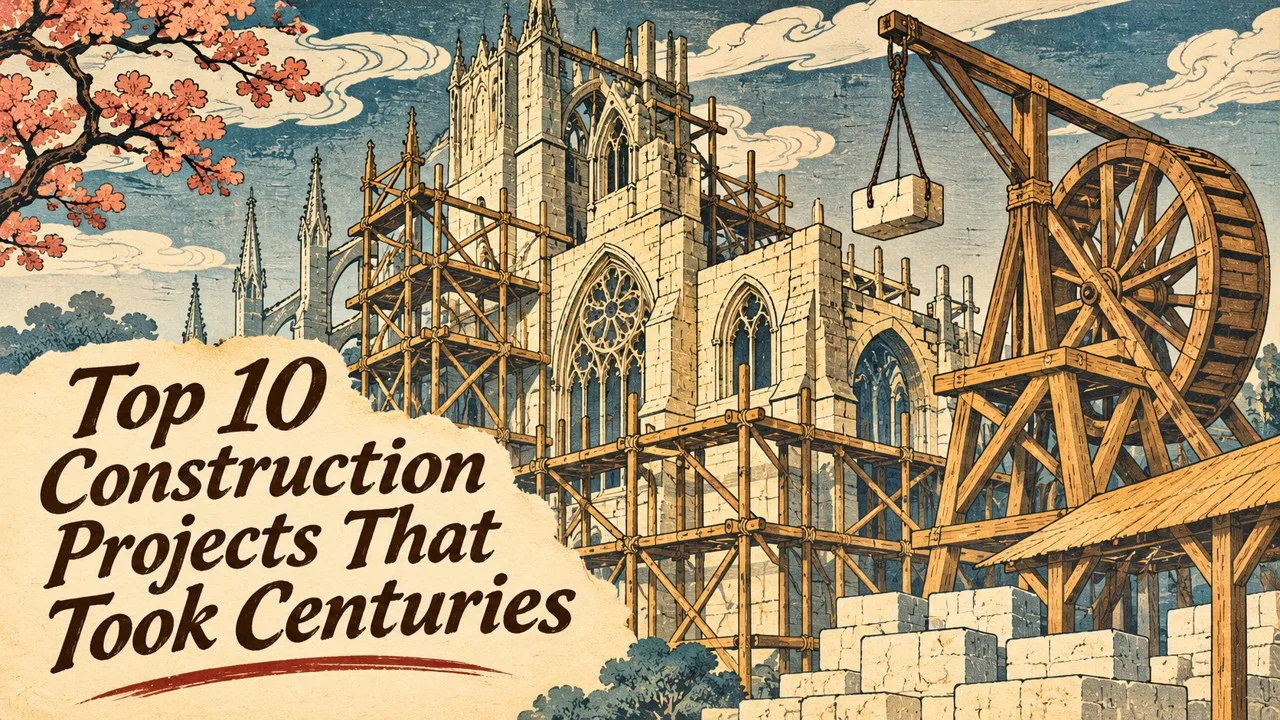
Some buildings outlived their builders by centuries, from a cathedral left with a crane on its tower for 400 years to a church still rising today. Most modern buildings go up in a few years. A skyscraper may take three or four, and even a large bridge or stadium rarely takes more than a decade. Yet some of the world's most famous structures took centuries to complete.
In the Middle Ages and early modern period, large projects depended on money, labor and political stability, all of which could vanish suddenly. Wars, plagues, religious upheavals and simple lack of funds could halt work for generations. Sometimes the original plans were lost, and sometimes tastes changed so much that later builders altered the design.
The people who laid the foundations of these buildings knew they would never see them finished. They worked for their descendants, for their faith or for the glory of their cities, trusting that others would carry on the task.
The ten projects below took more than a century to build, or have been under construction for more than a century. Most are cathedrals, but the list also includes a famous wall and one of the longest canals ever built.
Their histories show how buildings can become records of changing times, with each generation adding its own layer of stone and ideas.
They also show the remarkable patience and persistence of people who started something they knew would outlast them.
Medieval building sites were organized around master masons, who passed their knowledge to apprentices and often traveled from project to project. Stone had to be quarried, carved and hauled by hand or with simple machines such as treadwheel cranes. Work was usually seasonal, since mortar could be damaged by frost, so building often paused each winter. Under those conditions, even a well-funded cathedral could take several generations to finish.
Key Facts
| # | Project | Where | How long it took |
|---|---|---|---|
| 1 | Cologne Cathedral | Cologne, Germany | 1248 to 1880 |
| 2 | Sagrada Familia | Barcelona, Spain | 1882 to present |
| 3 | Great Wall of China | Northern China | Seventh century BC to seventeenth century AD |
| 4 | Grand Canal | Eastern China | Fifth century BC to seventh century AD and later |
| 5 | Milan Cathedral | Milan, Italy | 1386 to 1965 |
| 6 | St. Vitus Cathedral | Prague, Czech Republic | 1344 to 1929 |
| 7 | Ulm Minster | Ulm, Germany | 1377 to 1890 |
| 8 | Notre-Dame de Paris | Paris, France | 1163 to 1345 |
| 9 | St. Peter's Basilica | Vatican City | 1506 to 1626 |
| 10 | Cathedral of St. John the Divine | New York City, United States | 1892 to present |
1. A Crane on the Skyline for Centuries
Construction of Cologne Cathedral began in 1248, with the aim of creating a magnificent home for relics believed to be those of the Three Kings. Work went on for more than two hundred years, but by the late fifteenth century it had largely stopped, leaving the building incomplete [1].
For around four hundred years, a medieval wooden crane stood on top of the unfinished south tower, becoming a familiar part of the city's skyline. Then, in the nineteenth century, enthusiasm for Gothic architecture revived, and original plans for the facade were rediscovered [1].
Construction resumed in 1842 and was completed in 1880, more than six hundred years after the foundation stone was laid. For a few years, the cathedral was the tallest building in the world.
Related: Top 10 Tallest Church Buildings in the World
2. The Church Still Being Built
The Basilica of the Sagrada Familia was begun in 1882, and the architect Antoni Gaudi took over the project the following year. He devoted much of the rest of his life to it, famously saying that his client, meaning God, was not in a hurry [2].
When Gaudi died in 1926, only a small part of the church was complete. During the Spanish Civil War, his workshop was damaged and many of his plans and models were destroyed, forcing later architects to reconstruct his intentions from fragments and photographs [2].
Work continued for decades, funded largely by donations and ticket sales. Modern technology, including computer modeling, sped up construction, and builders aimed to complete the main towers around the centenary of Gaudi's death, with decorative work expected to continue beyond that date.
3. A Wall Built Over Two Thousand Years
The Great Wall of China is not a single wall but a series of walls and fortifications built by different states and dynasties over many centuries. The earliest walls were built around the seventh century BC by rival states in northern China [3].
After the Qin dynasty unified China in the third century BC, earlier walls were linked and extended. Later dynasties built and rebuilt sections to defend against northern peoples, often using rammed earth, stone and brick [3].
Much of the wall that tourists visit today was built during the Ming dynasty, which ruled from 1368 to 1644. The whole project, spanning around two thousand years, involved millions of workers.
4. The World's Longest Canal
The Grand Canal of China is the longest artificial waterway in the world, linking Beijing in the north with Hangzhou in the south. Its oldest sections were dug around the fifth century BC [4].
In the early seventh century AD, the Sui dynasty connected existing canals and built new ones to create a vast network linking the Yellow River and the Yangtze. The canal carried grain and other goods, helping to unite the empire [4].
Later dynasties, including the Yuan, extended and rerouted the canal. Work on the canal continued, in one form or another, for well over a thousand years. Parts of it are still in use today.
Related: Top 10 Medieval Cathedrals in Europe
5. Six Centuries of Marble
Construction of Milan Cathedral began in 1386, and it is one of the largest churches in the world. Its builders used pink and white marble from quarries near Lake Maggiore, transported to the city by canal [5].
Work progressed slowly over the centuries, as architects and patrons changed. The facade was not completed until the early nineteenth century, when Napoleon ordered it finished before his coronation as King of Italy [5].
Smaller details continued to be added, and the last bronze gate was inaugurated in 1965. The cathedral's countless statues and spires make it one of the most elaborate Gothic buildings anywhere.
6. Interrupted by War
St. Vitus Cathedral, inside Prague Castle, was founded in 1344. Its first architects included Matthias of Arras and Peter Parler, who designed much of the eastern part of the building [6].
Construction was halted in the fifteenth century by the Hussite Wars, a series of religious conflicts in Bohemia, and the cathedral remained unfinished for centuries. A temporary wall closed off the completed part of the building [6].
In the nineteenth century, a society was formed to complete the cathedral in the Gothic style. Work finally ended in 1929, nearly six centuries after it began, in time for the thousandth anniversary of the death of Saint Wenceslas.
7. The World's Tallest Church Steeple
The people of Ulm began building their great church in 1377. The project was funded by the citizens themselves, rather than by a bishop, and they wanted a building large enough to hold the entire population of the city [7].
After the Protestant Reformation, work stopped in the sixteenth century, partly due to a lack of funds and partly to structural problems. The tower remained unfinished for more than three centuries [7].
Related: Top 10 Temporary Structures That Became Permanent
Construction resumed in the nineteenth century, and the steeple was completed in 1890. At around 161 meters, it is the tallest church steeple in the world, and visitors can climb hundreds of steps to the top.
8. Nearly Two Centuries of Gothic Building
Notre-Dame de Paris was begun in 1163 under the direction of Bishop Maurice de Sully. Building a cathedral of its size and ambition was a huge undertaking, and work continued in stages for nearly two centuries [8].
During that time, new techniques such as flying buttresses were added, and the design evolved as Gothic architecture developed. The cathedral was largely finished by around 1260, but further changes continued until the mid-fourteenth century [8].
The cathedral suffered a devastating fire in 2019 and was restored over the following five years, reopening in December 2024. The restoration was another chapter in its long history of building and rebuilding.
9. A Basilica for the Ages
St. Peter's Basilica was rebuilt starting in 1506, replacing an older church built in the fourth century. Pope Julius II laid the foundation stone, with plans by the architect Donato Bramante [9].
Over the next century, many of the greatest artists and architects of the Renaissance worked on the project, including Raphael, Michelangelo, who designed the great dome, Carlo Maderno and Gian Lorenzo Bernini. Each brought new ideas, and the design changed several times [9].
The basilica was consecrated in 1626, about 120 years after work began. The cost of the project also contributed to controversies within the church, including the sale of indulgences criticized during the Reformation.
10. St. John the Unfinished
The Cathedral of St. John the Divine in New York City had its cornerstone laid in 1892. It was planned as one of the largest cathedrals in the world, and its design changed from Romanesque to Gothic during construction [10].
Related: Top 10 Most Spiritual Sites in the World
Work has been interrupted many times by wars, economic crises and debates over the design. Because of the long delays, the cathedral has earned the nickname St. John the Unfinished [10].
A fire in 2001 damaged part of the building, and restoration took years. The cathedral remains incomplete today, more than a century after construction began, but it is still used for services, concerts and community events.
Conclusion
These projects show that some of humanity's greatest buildings were the work of many generations. Builders came and went, styles changed and wars interrupted their work, yet the projects continued.
Each structure carries traces of its long history. Different stones, styles and techniques reveal the periods when they were added, making the buildings records of the changing times.
The stories also show the importance of shared purpose. Communities, rulers and churches kept these projects alive over centuries because they believed in what they were building.
Today, when buildings are often expected to go up quickly, these projects remind us of the value of patience and long-term thinking.
Some of these projects also became symbols of identity. The completion of Cologne Cathedral in the nineteenth century was celebrated as a national achievement in Germany, and the long construction of the Sagrada Familia has become part of Barcelona's character. Unfinished buildings can inspire as much affection as finished ones, perhaps because they invite every generation to take part in the work and to imagine how it will one day look.
Great things, as these builders knew, are rarely built in a hurry.
- ^ [1] Accounts of Cologne Cathedral. Wikipedia: Cologne Cathedral Wikipedia: Gothic Revival architecture
- ^ [2] Accounts of the Sagrada Familia. Wikipedia: Sagrada Familia Wikipedia: Antoni Gaudi
- ^ [3] Accounts of the Great Wall. Wikipedia: Great Wall of China Wikipedia: Ming dynasty
- ^ [4] Accounts of the Grand Canal. Wikipedia: Grand Canal (China) Wikipedia: Sui dynasty
- ^ [5] Accounts of Milan Cathedral. Wikipedia: Milan Cathedral Wikipedia: Gothic architecture
- ^ [6] Accounts of St. Vitus Cathedral. Wikipedia: St. Vitus Cathedral Wikipedia: Hussite Wars
- ^ [7] Accounts of Ulm Minster. Wikipedia: Ulm Minster Wikipedia: Reformation
- ^ [8] Accounts of Notre-Dame de Paris. Wikipedia: Notre-Dame de Paris Wikipedia: flying buttress
- ^ [9] Accounts of St. Peter's Basilica. Wikipedia: St. Peter's Basilica Wikipedia: Michelangelo
- ^ [10] Accounts of St. John the Divine. Wikipedia: Cathedral of St. John the Divine Wikipedia: cathedral



















Discussion
Log in with