






 By
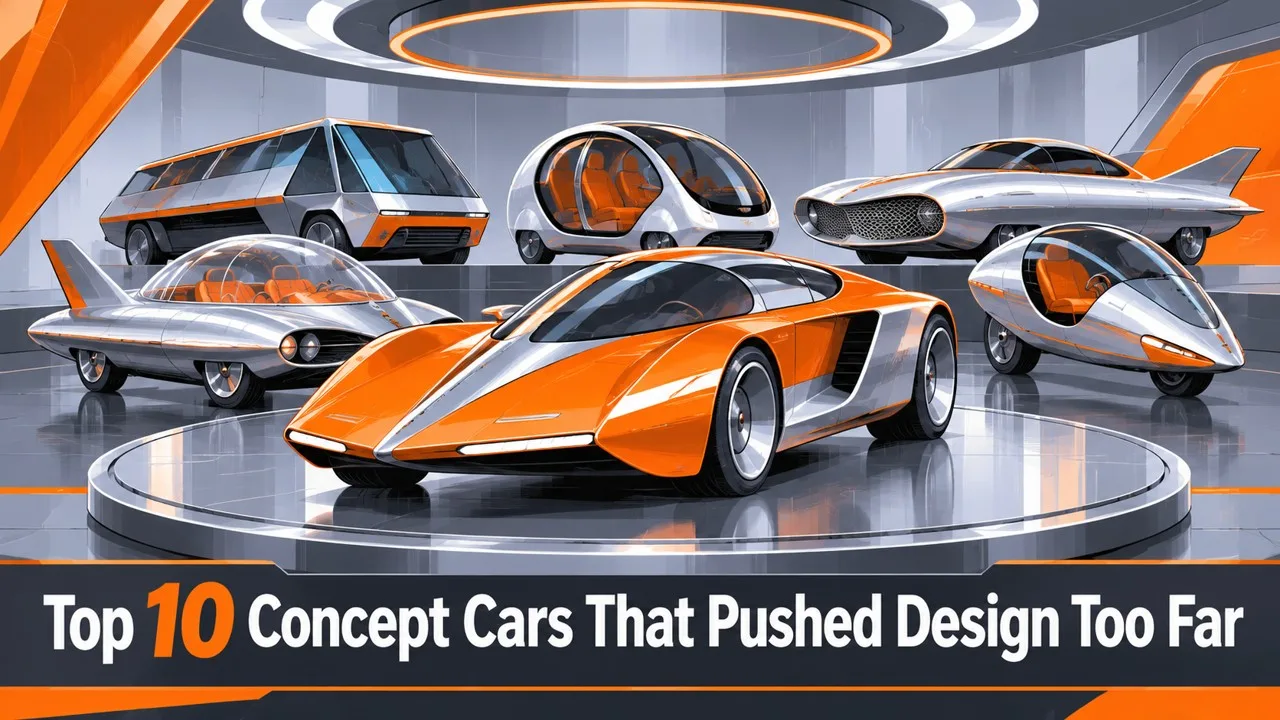
Some concept cars were never meant to be sold, and their jet fins, atomic engines and wedge shapes show what designers dared when practicality stepped aside. A concept car is a vehicle built to show an idea rather than to be sold. Carmakers use concepts to test public reaction, to show off engineering or simply to attract crowds at motor shows. Freed from cost and regulation, designers have sometimes produced shapes and technologies that look like science fiction even decades later.
The ten cars below are the Dymaxion car, the Buick Y-Job, the Alfa Romeo BAT cars, the General Motors Firebird I, the Ford Nucleon, the Ford Seattle-ite XXI, the Chrysler Turbine Car, the Lancia Stratos Zero, the Ferrari Modulo and the Citroën Karin. Some were full working cars and others only models, and the descriptions make that distinction clear.
Key Facts
| # | Car | Year and maker | What pushed the limits |
|---|---|---|---|
| 1 | Dymaxion car | 1933, Buckminster Fuller | Three wheels, rear steering and a teardrop body |
| 2 | Buick Y-Job | 1938, General Motors | A styling exercise used to test ideas |
| 3 | Alfa Romeo BAT cars | 1953 to 1955, Bertone | Extreme aerodynamics with curved tail fins |
| 4 | General Motors Firebird I | 1953, General Motors | Gas turbine power and aircraft styling |
| 5 | Ford Nucleon | 1958, Ford | A proposed nuclear-powered car, built only as a scale model |
| 6 | Ford Seattle-ite XXI | 1962, Ford | Six wheels, four of them steering, and interchangeable power |
| 7 | Chrysler Turbine Car | 1963, Chrysler | A real trial with ordinary drivers |
| 8 | Lancia Stratos Zero | 1970, Bertone | An extremely low wedge with a windscreen door |
| 9 | Ferrari Modulo | 1970, Pininfarina | A low, flat body and a canopy that slides forward |
| 10 | Citroën Karin | 1980, Citroën | A pyramid-like profile and three seats in a row |
1. A Three-Wheeled Teardrop
The inventor and designer Buckminster Fuller built the Dymaxion car in 1933 with the yacht designer Starling Burgess. It had a long teardrop-shaped body, seating for many passengers, two wheels at the front and a single steering wheel at the rear. Fuller claimed high speed and good fuel economy for its size [1].
The rear-wheel steering made the car highly maneuverable at low speed, allowing it to turn almost in its own length, but it also made it unstable at higher speeds and in crosswinds. Three prototypes were built [1].
In 1933, one of the cars was involved in a fatal crash near the Chicago World's Fair, after a collision with another vehicle. Investigations did not clearly blame the design, but the publicity damaged the project and investors withdrew. The Dymaxion remains an early example of streamlined design and of a radical layout that the mainstream car industry did not follow.
2. The Car Often Called the First Concept
The Buick Y-Job, built in 1938 under the direction of the General Motors designer Harley Earl, is widely described as the first true concept car. It was designed to test styling ideas rather than to go into production [2].
The Y-Job was long and low, with features such as hidden headlights, power-operated windows, flush door handles and a convertible top that disappeared under a metal cover. Many of its ideas appeared later on production cars. Its grille design influenced Buick models for years [2].
Earl drove the Y-Job himself for several years, and it became a mobile showcase for his ideas. His department at General Motors, originally called Art and Colour, made styling central to how American cars were sold. The Y-Job established the model of a car built to be seen and talked about, which became a standard part of motor-show culture.
3. Three Cars Shaped by the Wind
Between 1953 and 1955, the Italian coachbuilder Bertone, with the designer Franco Scaglione, produced three concept cars on Alfa Romeo chassis: the BAT 5, BAT 7 and BAT 9. BAT stood for Berlinetta Aerodinamica Tecnica, or aerodynamic technical coupe [3].
Related: Top 10 Most Bizarre Phobias: Strange Fears That Exist
The cars were designed to reduce air resistance as much as possible. They had smooth, tapering noses, covered wheels and large, curved rear fins. The BAT 7 is often reported to have had an exceptionally low drag coefficient for its time, around 0.19, though measurement methods of the period make exact comparisons difficult [3].
The three cars were later reunited and have been shown together at concours events. They are often cited as some of the most beautiful concept cars ever made. Their fins were not just decoration but part of an aerodynamic idea, which separates them from the purely stylistic fins that became fashionable on American cars later in the decade.
4. A Jet Fighter on Wheels
The Firebird I, built by General Motors in 1953 and shown at the company's Motorama exhibitions, looked like a jet fighter. It had a narrow fuselage, small wings, a vertical tail fin and a bubble canopy over a single seat [4].
It was powered by a gas turbine engine, called the Whirlfire, rather than a piston engine. Turbines promised smooth power and the ability to run on various fuels, but they had problems with heat, fuel consumption and slow throttle response. The Firebird I was tested on a track but was never intended for the road [4].
General Motors followed it with the Firebird II in 1956, a four-seat family car concept, and the Firebird III in 1958, with even more fins and experimental controls. The series captured the jet-age optimism of the 1950s. No turbine car from General Motors reached production, but the Firebirds showed how aviation shaped car design in the period.
5. An Atomic Car That Stayed a Model
In 1958, Ford displayed the Nucleon, a concept for a car powered by a small nuclear reactor at the rear. The idea reflected the optimism of the early atomic age, when nuclear power was expected to transform many areas of life [5].
The Nucleon was never built as a full-size working car. It existed as a scale model. The concept imagined a reactor that would be replaced at service stations after a long driving range. No reactor small and safe enough existed, and the problems of shielding, accidents and radioactive waste would have been enormous [5].
Related: Top 10 Oldest Buildings in the World
The model is held by The Henry Ford museum in Michigan. The Nucleon is often cited as an example of how far concept design could go when it ignored practicality. It also shows how corporate design reflected the technological hopes of the day, even when those hopes were not realistic for a family car.
6. Six Wheels for the Future
Ford showed the Seattle-ite XXI at the Seattle World's Fair in 1962. It was a scale model of a car imagined for the twenty-first century, with six wheels, four of them at the front and all four of those steering [6].
The concept included ideas such as interchangeable power units, which could include fuel cells, and an onboard computer for navigation. These ideas were speculative in 1962, but some, such as computer navigation and interest in fuel cells, later became real topics in the car industry [6].
The six-wheel layout did not catch on for passenger cars, although six-wheeled racing cars, such as the Tyrrell P34, appeared in Formula One in the 1970s. The Seattle-ite XXI shows how concept cars can mix serious forecasting with designs that were never likely to be built, and it remains a striking example of futurism at a world's fair.
7. A Turbine Car Lent to the Public
Unlike most concept cars, the Chrysler Turbine Car was driven by members of the public. In 1963, Chrysler built 55 cars with gas turbine engines and bodies built by Ghia in Italy. Between 1963 and 1966, it lent them to 203 drivers across the United States, each for about three months [7].
The turbine could run on many fuels, and the cars were smooth and quiet, with a distinctive whooshing sound. However, users reported slow acceleration from a standstill, high fuel consumption and other problems. Emissions regulations and costs also counted against the technology [7].
Related: 10 Sikh Gurus: The Pillars of Sikhism Who Shaped Faith, Equality, Courage, and Humanity
After the program ended, Chrysler destroyed most of the cars, partly to avoid import duties on the Italian bodies. A small number were kept and are now in museums and private collections. The program was one of the boldest consumer tests in automotive history and is still studied as an example of a technology that worked but did not make commercial sense.
8. A Wedge Lower Than a Person's Hip
The Lancia Stratos Zero, shown by Bertone at the Turin Motor Show in 1970 and designed by Marcello Gandini, was an extreme wedge shape. It stood only about 84 centimeters tall, lower than the hip of an average adult [8].
The driver entered by lifting the windscreen, which was hinged at the front, and stepping in. The front was so low that the car could reportedly be driven under a barrier at a toll gate. It was powered by a Lancia engine mounted in the middle [8].
The Stratos Zero was a styling exercise, but it influenced the later Lancia Stratos HF, which became a successful rally car in the 1970s, though with a very different body. The concept became famous through photographs and film, and it is often cited as one of the defining wedge designs of the 1970s.
9. A Car With a Sliding Canopy
The Ferrari Modulo, designed by Paolo Martin at Pininfarina and shown at the Geneva Motor Show in 1970, was another radical wedge. It was extremely low, under a meter tall, with partly covered wheels and a flat, smooth body [9].
Entry was through a canopy that slid forward. The rear deck had a pattern of round holes over the engine. The car was built on a Ferrari racing chassis, though it was a design study rather than a functional road car when first shown [9].
Related: Top 10 Tallest Buildings in the World
The Modulo won many design awards and was later restored to running condition by a private owner, the American collector James Glickenhaus, who bought it in 2014. It is one of the most extreme designs associated with Ferrari and shows how Italian design houses competed with each other in the 1970s to produce ever more futuristic shapes.
10. A Pyramid With a Central Driver
Citroën showed the Karin at the Paris Motor Show in 1980. Designed under Trevor Fiore, it had an unusual profile shaped like a truncated pyramid, with a roof much smaller than its base [10].
Inside, it had three seats side by side, with the driver in the center. The controls were grouped around the steering wheel so that the driver could reach them without moving the hands far. The car also included audio speakers built into the headrests, an unusual feature at the time [10].
The Karin was never intended for production, but it reflected Citroën's long tradition of unconventional design. Its central driving position foreshadowed later cars such as the McLaren F1 supercar of the 1990s. The Karin is a good example of a concept that challenged the basic geometry of the car rather than just its surface styling.
Conclusion
The ten cars above show how concept cars have been used to test ideas that ordinary production could not afford. Some, like the Y-Job and the BAT cars, influenced styling. Others, like the Firebird and Chrysler turbine cars, tested engines that never went mainstream. A few, like the Nucleon, were more statement than engineering.
Concept cars are a kind of public sketchbook. Many of their ideas failed, but some, from power windows to computer navigation, became ordinary. Looking back at them shows not only what designers imagined, but also what the public of each era hoped the future would look like.
- ^ [1] Accounts of Buckminster Fuller's Dymaxion car and the 1933 crash. Wikipedia: Dymaxion car Wikipedia: Buckminster Fuller
- ^ [2] Histories of the Buick Y-Job and Harley Earl. Wikipedia: Buick Y-Job Wikipedia: Harley Earl
- ^ [3] Accounts of the Bertone BAT cars and Franco Scaglione. Wikipedia: Alfa Romeo BAT Wikipedia: Franco Scaglione
- ^ [4] Histories of the General Motors Firebird concepts. Wikipedia: General Motors Firebird Wikipedia: Motorama
- ^ [5] Accounts of the Ford Nucleon scale model. Wikipedia: Ford Nucleon Wikipedia: concept car
- ^ [6] Accounts of the Ford Seattle-ite XXI. Wikipedia: Ford Seattle-ite XXI Wikipedia: Tyrrell P34
- ^ [7] Histories of the Chrysler Turbine Car user program. Wikipedia: Chrysler Turbine Car Wikipedia: gas turbine
- ^ [8] Accounts of the Lancia Stratos Zero and Marcello Gandini. Wikipedia: Lancia Stratos Zero Wikipedia: Marcello Gandini
- ^ [9] Accounts of the Ferrari Modulo and its restoration. Wikipedia: Ferrari Modulo Wikipedia: Pininfarina
- ^ [10] Accounts of the Citroën Karin. Wikipedia: Citroën Karin Wikipedia: McLaren F1





















Discussion
Log in with