





 By
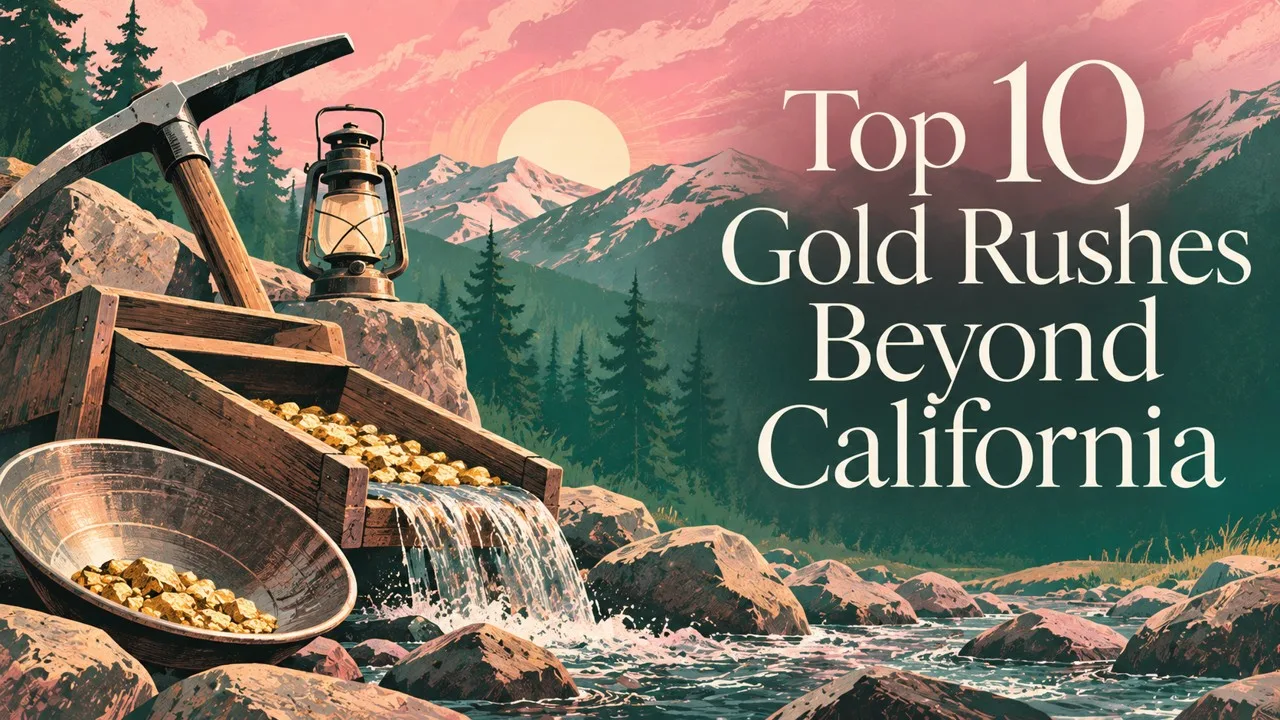
California's 1849 rush is the famous one, but gold rushes also remade Australia, South Africa, Canada and Brazil, often at heavy cost to Indigenous peoples. The California gold rush of 1848 and 1849 is so famous that it can seem like the only one. In fact, the nineteenth century saw a chain of rushes, often driven by the same prospectors moving from one field to the next, and the twentieth century added more. Each drew huge numbers of people in a short time, built towns almost overnight and changed politics and borders.
The ten rushes below are Georgia, New South Wales, Victoria, Fraser Canyon, Otago, the Black Hills, the Witwatersrand, Kalgoorlie, the Klondike and Serra Pelada. Dates and population figures are approximate, because rushes were chaotic and record-keeping was uneven. Many of them also involved the seizure of Indigenous land, and that part of the story is included rather than left out.
Key Facts
| # | Rush | Where and when | Lasting effect |
|---|---|---|---|
| 1 | Georgia | North Georgia, from 1829 | Accelerated the removal of the Cherokee |
| 2 | New South Wales | Near Bathurst, 1851 | Started the Australian gold rushes |
| 3 | Victoria | Ballarat and Bendigo, from 1851 | Led to the Eureka Rebellion |
| 4 | Fraser Canyon | British Columbia, 1858 | Led directly to the creation of a British colony |
| 5 | Otago | New Zealand, 1861 | Made Dunedin New Zealand's largest town |
| 6 | The Black Hills | Dakota Territory, 1874 onward | Led to war and a long legal dispute |
| 7 | The Witwatersrand | South Africa, 1886 | Led to the founding of Johannesburg |
| 8 | Kalgoorlie | Western Australia, 1893 | Created a lasting mining center and a water pipeline |
| 9 | The Klondike | Yukon, Canada, 1896 to 1899 | A famous journey with a supplies rule |
| 10 | Serra Pelada | Pará, Brazil, from 1980 | A huge hand-dug mine |
1. An Earlier American Rush
Two decades before California, gold was found in north Georgia in 1828 and 1829, near the town that became Dahlonega. Thousands of prospectors arrived, and the rush is often described as the first major gold rush in the United States [1].
The goldfields lay on land belonging to the Cherokee Nation. Georgia passed laws to seize the land and distributed it by lottery to white settlers. The federal Indian Removal Act of 1830 and later actions led to the forced removal of the Cherokee in 1838 and 1839, known as the Trail of Tears, in which thousands died [1].
A federal mint operated at Dahlonega from 1838 to 1861. Many Georgia miners later went west to California, and some accounts link Georgia veterans to early California mining techniques. The rush is a reminder that gold seeking in the United States began earlier than 1849 and was tied closely to dispossession from the start.
2. A Returning Prospector in Australia
Edward Hargraves had worked in the California goldfields, and he noticed that some landscapes in New South Wales resembled them. In 1851, he and his companions found gold near Bathurst, at a place named Ophir, and Hargraves publicized the find widely [2].
The announcement triggered a rush in New South Wales. The colonial government introduced licenses for diggers, a system that would cause friction in neighboring Victoria. Hargraves received a reward and public honors, though later inquiries suggested that his companions, John Lister and the Tom brothers, did much of the actual finding [2].
The New South Wales rush was soon overshadowed by larger finds in Victoria, but it began a period that transformed Australia. The population grew rapidly, immigration surged, including from China, and colonial economies boomed. The debate over who deserved credit for the first find has continued among historians.
3. The Rush That Changed Australian Politics
Within months of the New South Wales finds, very rich goldfields were found in Victoria, notably at Ballarat and Bendigo. Victoria's population rose from about 77,000 in 1851 to more than 500,000 by 1861, and Melbourne grew into one of the wealthiest cities in the British Empire [3].
Related: Top 10 Biggest Open-Pit Mines on Earth
Miners resented the license fees and the heavy-handed enforcement of license checks. In 1854, at Ballarat, diggers built a stockade at Eureka and swore allegiance to their own flag. On 3 December 1854, government troops attacked the stockade, and around thirty people were killed, most of them miners [3].
Public sympathy for the miners led to reforms, including the replacement of the license with a cheaper miner's right and the extension of voting rights. The Eureka Rebellion is often cited as an important moment in the development of Australian democracy. The goldfields also saw serious hostility toward Chinese miners, including discriminatory taxes.
4. A Rush That Created a Colony
In 1858, news of gold on the Fraser River drew tens of thousands of prospectors, many of them Americans from the declining California fields, to the mainland of what is now British Columbia. The area was then a fur-trading region with no formal colonial government [4].
Worried that the influx could lead to American annexation, the British government created the Colony of British Columbia in 1858, with James Douglas as its first governor. Royal Engineers were sent to build roads and maintain order. The rush thus shaped the political map of western North America [4].
The rush also brought conflict with the Nlaka'pamux and other First Nations whose territory the miners entered. Fighting in the Fraser Canyon in 1858 is sometimes called the Fraser Canyon War. Later finds in the Cariboo region extended the rush into the 1860s, and the road built to reach it, the Cariboo Road, became an important route.
5. A Find by a Veteran of Two Rushes
In 1861, Gabriel Read, a Tasmanian prospector who had experience of the Californian and Victorian fields, found gold in a gully near the Tuapeka River in Otago, in New Zealand's South Island. The area became known as Gabriel's Gully [5].
The discovery set off a rush that brought thousands of miners, many from Australia, into Otago. Dunedin, the main port for the goldfields, grew rapidly and became for a time New Zealand's largest and wealthiest town. Further finds in the Dunstan and other areas followed [5].
Related: Top 10 Most Bizarre Phobias: Strange Fears That Exist
From the mid-1860s, the provincial government invited Chinese miners to rework older fields, and a Chinese community became established in Otago, though it faced discrimination. Gold mining helped fund institutions such as the University of Otago, founded in 1869. The rush shows how experience and people moved around the Pacific from one goldfield to the next.
6. Gold on Treaty Land
The Black Hills, sacred to the Lakota, were guaranteed to them under the Treaty of Fort Laramie of 1868. In 1874, a U.S. Army expedition led by George Armstrong Custer reported gold in the region, and prospectors began to pour in, in violation of the treaty [6].
The government tried to buy the Black Hills, and when the Lakota refused, conflict followed. The Great Sioux War of 1876 and 1877 included the Battle of the Little Bighorn. In 1877, Congress passed an act taking the Black Hills. Deadwood grew as a mining town, and the Homestake Mine, opened in 1876, became one of the largest and deepest gold mines in North America [6].
In 1980, the U.S. Supreme Court ruled in United States v. Sioux Nation of Indians that the Black Hills had been taken illegally and awarded compensation. The Sioux nations have refused the money, which has grown with interest, and continue to seek the return of the land.
7. A City Founded on a Reef
In 1886, gold was found on the Witwatersrand, a ridge in the South African Republic, also called the Transvaal. Unlike many earlier rushes, the gold here was in deep reefs of low-grade ore, which required large-scale industrial mining and heavy capital investment [7].
Johannesburg was founded the same year and grew into a major city within a few decades. The Witwatersrand became the source of a large share of the world's gold production. Mining companies relied on migrant African labor under harsh conditions, and the system of controlled labor helped lay foundations for later segregation policies [7].
Related: Top 10 Oldest Buildings in the World
The influx of foreign workers, known as Uitlanders, and disputes over their rights contributed to tensions between the Boer republic and Britain, culminating in the Second Anglo-Boer War from 1899 to 1902. The Witwatersrand rush thus shaped both the economy and the politics of southern Africa for the following century.
8. A Desert Find in Western Australia
In 1893, Paddy Hannan and his companions found gold near what became Kalgoorlie, in the dry interior of Western Australia. Their find drew thousands of prospectors to a remote region, and the nearby area soon became known as the Golden Mile because of its rich reefs [8].
Water was a serious problem in the dry goldfields. The engineer C. Y. O'Connor designed the Goldfields Water Supply Scheme, a pipeline of more than 500 kilometers that carried water from near Perth. The pipeline was completed in 1903, but O'Connor, under intense public criticism, died by suicide in 1902, before it opened [8].
Kalgoorlie has remained a major mining center, and the Super Pit, an enormous open-cut mine, has operated there for decades. The rush helped push Western Australia toward joining the Australian federation in 1901, partly because many miners came from the eastern colonies and favored union.
9. A Rush to the Edge of the Arctic
In August 1896, gold was found on Bonanza Creek, a tributary of the Klondike River in the Yukon. The discovery is credited to George Carmack, Skookum Jim Mason and Dawson Charlie, with Robert Henderson often mentioned as having pointed them toward the area. When news reached the outside world in 1897, a stampede began [9].
Tens of thousands of people set off for the Klondike, many traveling through Alaska and over the Chilkoot or White Passes. Because of the risk of starvation, the North-West Mounted Police required each prospector entering Canada to bring roughly a year's supply of goods, often summarized as a ton. Hauling it over the passes took many trips [9].
Related: 10 Sikh Gurus: The Pillars of Sikhism Who Shaped Faith, Equality, Courage, and Humanity
Dawson City grew to tens of thousands of people at its peak. Most stampeders found little or no gold, and the rush faded by 1899, when gold was found at Nome, Alaska. The Klondike also had serious effects on the Hän people, whose land and fishing grounds were disrupted.
10. A Modern Rush in an Open Pit
In 1980, gold was found at Serra Pelada in the Brazilian state of Pará. Within months, tens of thousands of informal miners, called garimpeiros, had arrived. Estimates of the number at the peak vary, but figures of around 80,000 to 100,000 are often given [10].
The miners dug an enormous open pit by hand, carrying sacks of earth up ladders and slopes. Photographs of the site, especially those by the photographer Sebastião Salgado, became world famous and showed the scale of human labor involved. The Brazilian government took control of the site and regulated it [10].
Production declined through the 1980s, and the pit later flooded. Disputes over mining rights continued for decades. Serra Pelada showed that the gold rush was not only a nineteenth-century phenomenon, and that informal mining by large numbers of people still occurs today, often with serious environmental and social effects.
Conclusion
The ten rushes above share a pattern. A find was announced, people arrived in huge numbers, towns sprang up and governments scrambled to regulate them. Several rushes created new cities, including Johannesburg, and some created new political units, such as British Columbia.
They also share a darker pattern. Many rushes took place on Indigenous land, from Cherokee territory to the Black Hills and the Yukon, and the wealth they produced was distributed unevenly. Remembering the rushes beyond California means remembering both the excitement and the costs.
- ^ [1] Accounts of the Georgia rush, Dahlonega and Cherokee removal. Wikipedia: Georgia gold rush Wikipedia: Trail of Tears
- ^ [2] Histories of Hargraves and the 1851 finds near Bathurst. Wikipedia: New South Wales gold rush Wikipedia: Edward Hargraves
- ^ [3] Accounts of the Victorian goldfields and the Eureka Rebellion. Wikipedia: Victorian gold rush Wikipedia: Eureka Rebellion
- ^ [4] Histories of the 1858 rush and the founding of the Colony of British Columbia. Wikipedia: Fraser Canyon gold rush Wikipedia: Colony of British Columbia
- ^ [5] Accounts of Gabriel Read and the Otago goldfields. Wikipedia: Otago gold rush Te Ara: gold and gold mining
- ^ [6] Histories of the Black Hills rush, the 1868 treaty and the 1980 Supreme Court case. Wikipedia: Black Hills gold rush Wikipedia: United States v. Sioux Nation of Indians
- ^ [7] Accounts of the 1886 discovery and the founding of Johannesburg. Wikipedia: Witwatersrand gold rush Wikipedia: Johannesburg
- ^ [8] Histories of Kalgoorlie and the Goldfields Water Supply Scheme. Wikipedia: Kalgoorlie Wikipedia: Goldfields Water Supply Scheme
- ^ [9] Accounts of the Klondike discovery, the stampede and the supplies rule. Wikipedia: Klondike gold rush Parks Canada: Klondike
- ^ [10] Accounts of Serra Pelada and its garimpeiros. Wikipedia: Serra Pelada Wikipedia: Sebastião Salgado




















Discussion
Log in with