




 By
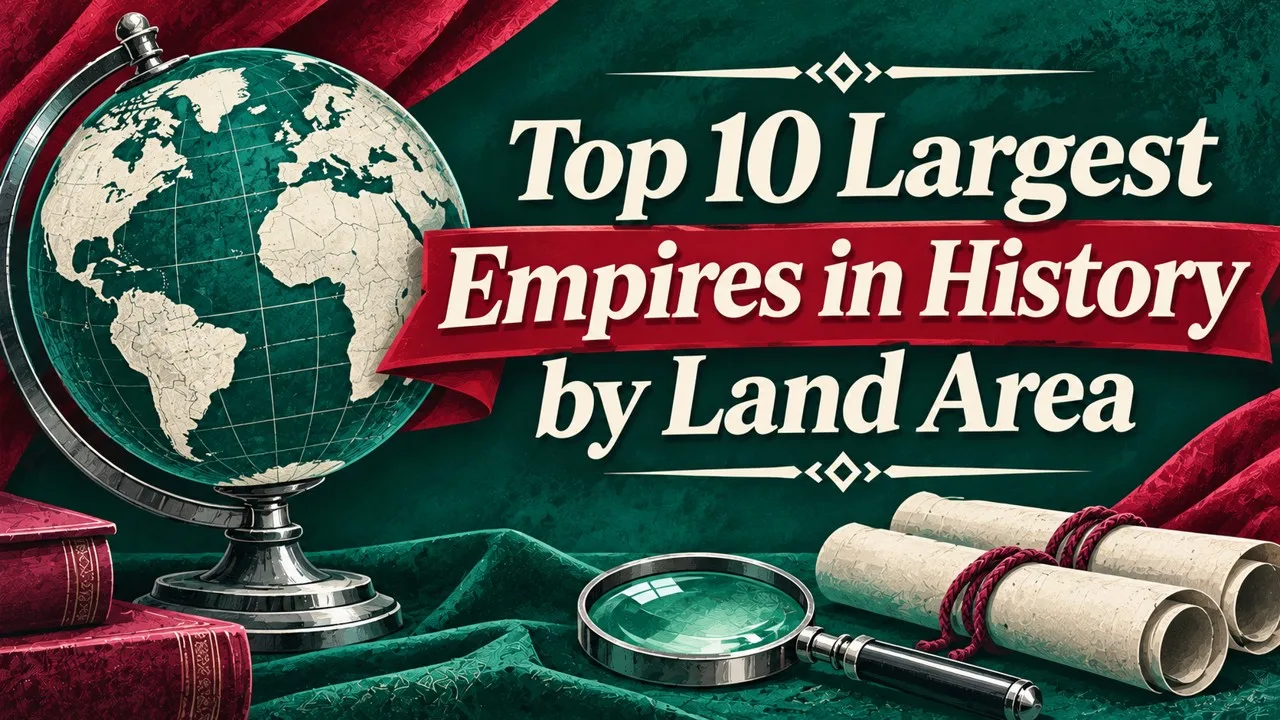
From the British and Mongol empires to the Qing and the caliphates, these ten largest empires in history by land area ruled huge parts of the planet. Throughout history, a few states have grown into vast empires that ruled many peoples across huge territories. Some expanded over land with fast-moving armies, while others built networks of colonies across the oceans.
This list ranks ten of the largest empires by their maximum land area, using estimates compiled by historians such as Rein Taagepera and Peter Turchin. Figures are approximate, since borders were often unclear and some areas were only loosely controlled.
Key Facts
The ten empires below each controlled at least 9 million square kilometres at their peak.
Largest Empires at a Glance
| # | Empire | Peak area | Peak year | Capital or centre |
|---|---|---|---|---|
| 1 | British Empire | 35.5 million square km | 1920 | London |
| 2 | Mongol Empire | 24 million square km | 13th century | Karakorum |
| 3 | Russian Empire | 22.8 million square km | 1895 | St Petersburg |
| 4 | Qing Dynasty | 14.7 million square km | 1790 | Beijing |
| 5 | Spanish Empire | 13.7 million square km | 1810 | Madrid |
| 6 | French Colonial Empire | 11.5 million square km | 1920 | Paris |
| 7 | Abbasid Caliphate | 11.1 million square km | 750 | Baghdad |
| 8 | Umayyad Caliphate | 11.1 million square km | 720 | Damascus |
| 9 | Yuan Dynasty | 11 million square km | 1310 | Khanbaliq |
| 10 | Xiongnu Empire | 9 million square km | 176 BC | Mongolian steppe |
1. British Empire
The British Empire was the largest empire in history. At its peak around 1920 it covered about 35.5 million square kilometres, roughly a quarter of the world's land surface. [1]
It grew over three centuries through trade, settlement and conquest. Its territories included India, Canada, Australia, New Zealand, large parts of Africa and many islands in the Caribbean and Pacific. [1]
Around 1913 the empire held more than 400 million people, about a fifth of the world's population. Because its lands lay in every time zone, it was described as the empire on which the sun never set.
The empire spread the English language, legal systems, railways and sports such as cricket, but it was also built on exploitation, the slave trade and violent suppression of resistance.
Decolonisation accelerated after India's independence in 1947. The handover of Hong Kong in 1997 is often seen as the empire's final chapter, and many former territories joined the Commonwealth.
Key Figures
- Peak area: about 35.5 million square km
- Peak year: about 1920
- Population around 1913: over 400 million
- Share of world land: about a quarter
Why It Made the List
The British Empire was the largest empire ever. Its influence on language, law and politics is still felt worldwide.
2. Mongol Empire
The Mongol Empire was the largest contiguous land empire in history. Founded by Genghis Khan in 1206, it grew rapidly through conquest across Asia and into Eastern Europe. [2]
At its height in the late thirteenth century, it covered about 24 million square kilometres, stretching from Korea and China to Iran, Russia and the edge of Central Europe. [2]
The Mongols were superb horsemen and used speed, discipline and clever tactics. They built a relay postal system called the yam, with stations where messengers could change horses.
The empire's unity encouraged trade and travel along the Silk Road, a period sometimes called the Pax Mongolica.
After the death of Mongke Khan in 1259, the empire split into four khanates: the Golden Horde, the Chagatai Khanate, the Ilkhanate and the Yuan dynasty.
Key Figures
- Founder: Genghis Khan, 1206
- Peak area: about 24 million square km
- Postal system: the yam
- Split: four khanates
Why It Made the List
The Mongol Empire was the largest land empire ever. It connected East and West as never before.
Related: Top 10 Largest Countries in the World by Area
3. Russian Empire
The Russian Empire was proclaimed by Peter the Great in 1721. It grew from the Grand Duchy of Moscow into a state that stretched from the Baltic Sea to the Pacific Ocean. [3]
Russian explorers and traders pushed across Siberia in the seventeenth century, reaching the Pacific. The empire later expanded into the Caucasus and Central Asia. [3]
Russia even held territory in North America, but it sold Alaska to the United States in 1867 for 7.2 million dollars.
At its peak around 1895, the empire covered about 22.8 million square kilometres. It was ruled by emperors called tsars from the Romanov dynasty.
The Russian Empire ended with the revolutions of 1917. Its successor, the Soviet Union, controlled a similar area until 1991.
Key Figures
- Proclaimed: 1721 by Peter the Great
- Peak area: about 22.8 million square km
- Alaska sold: 1867
- Ended: 1917
Why It Made the List
The Russian Empire was one of the largest states ever to exist. Its borders still shape the map of Eurasia.
4. Qing Dynasty
The Qing dynasty was founded by the Manchus, a people from north-east of China, who captured Beijing in 1644. It was China's last imperial dynasty. [4]
Under emperors such as Kangxi and Qianlong, the Qing expanded into Mongolia, Xinjiang, Tibet and Taiwan. Around 1790 the empire covered about 14.7 million square kilometres. [4]
The Qing ruled a huge and growing population, which reached more than 300 million in the late eighteenth century.
In the nineteenth century the Qing were weakened by rebellions, such as the Taiping Rebellion, and by wars with Western powers and Japan, including the Opium Wars.
The last emperor, Puyi, abdicated in 1912 after the Xinhai Revolution, ending more than two thousand years of imperial rule in China.
Key Figures
- Founders: the Manchus
- Capture of Beijing: 1644
- Peak area: about 14.7 million square km
- Ended: 1912
Why It Made the List
The Qing created the largest Chinese state in history. Much of modern China's territory reflects Qing borders.
5. Spanish Empire
The Spanish Empire began after Christopher Columbus's voyage of 1492 and grew to include most of South and Central America, Mexico, parts of North America, the Philippines and territories in Europe and Africa. [5]
Related: Top 10 Largest Islands in the World
Silver from mines such as Potosi in present-day Bolivia made Spain one of the richest powers in Europe in the sixteenth century. [5]
The Manila galleons sailed between the Philippines and Mexico from 1565 to 1815, linking Asia and the Americas in one of the first global trade routes.
Around 1810 the empire covered about 13.7 million square kilometres.
Wars of independence in Latin America in the 1810s and 1820s ended most of Spain's American empire, and it lost Cuba, Puerto Rico and the Philippines in 1898.
Key Figures
- Began: after 1492
- Peak area: about 13.7 million square km
- Trade link: Manila galleons, 1565 to 1815
- Major losses: 1810s to 1820s and 1898
Why It Made the List
The Spanish Empire spread the Spanish language across the Americas. It created the first truly global trade network.
6. French Colonial Empire
France built two overseas empires. The first, in North America, India and the Caribbean, was largely lost by the early nineteenth century. [6]
The second French colonial empire began with the conquest of Algeria in 1830. It grew to include much of West and North Africa, Madagascar, Indochina and islands across the world. [6]
Around 1920 it covered about 11.5 million square kilometres, making it the second largest colonial empire after Britain's.
France promoted its language and culture in its colonies through what it called a civilising mission, a policy now widely criticised.
The empire largely ended between the 1950s and 1960s, after wars in Indochina and Algeria. The Algerian War lasted from 1954 to 1962.
Key Figures
- Second empire began: 1830, Algeria
- Peak area: about 11.5 million square km
- Key regions: West Africa, Indochina, Madagascar
- Ended: mostly by the 1960s
Why It Made the List
The French colonial empire spread the French language across Africa and beyond. French remains an official language in many former colonies.
7. Abbasid Caliphate
The Abbasid Caliphate took power in 750 after overthrowing the Umayyads. At the start of its rule, it controlled about 11.1 million square kilometres, from North Africa to Central Asia. [7]
In 762 the caliph al-Mansur founded Baghdad as the new capital. It was designed as a round city and soon became one of the largest cities in the world. [7]
Related: Top 10 Largest US States by Area
Under caliphs such as Harun al-Rashid and al-Ma'mun, Baghdad became a centre of learning. Scholars at the House of Wisdom translated Greek, Persian and Indian works and made advances in mathematics, astronomy and medicine.
Over time, regional rulers gained independence and the caliphs lost real power.
The Abbasid Caliphate in Baghdad ended when the Mongols sacked the city in 1258.
Key Figures
- Took power: 750
- Capital founded: Baghdad, 762
- Centre of learning: the House of Wisdom
- Ended in Baghdad: 1258
Why It Made the List
The Abbasids presided over the Islamic Golden Age. Their scholarship preserved and advanced ancient knowledge.
8. Umayyad Caliphate
The Umayyad Caliphate ruled from Damascus between 661 and 750. It was the first hereditary dynasty of Islamic caliphs. [8]
Under the Umayyads, Muslim armies expanded rapidly. In 711 they crossed into Spain, and in the same period they reached Sindh in South Asia. Around 720, the caliphate covered about 11.1 million square kilometres. [8]
The caliph Abd al-Malik made Arabic the language of government and introduced Islamic coins. The Dome of the Rock in Jerusalem was completed under his rule around 691.
The Umayyads were overthrown by the Abbasids in 750, and most of the family was killed.
One survivor, Abd al-Rahman, fled to Spain and founded an emirate at Cordoba in 756, which later became a famous centre of culture.
Key Figures
- Ruled: 661 to 750
- Capital: Damascus
- Peak area: about 11.1 million square km
- Reached: Spain and Sindh
Why It Made the List
The Umayyads built one of the fastest-growing empires in history. They spread Arabic and Islam from Spain to South Asia.
9. Yuan Dynasty
The Yuan dynasty was founded by Kublai Khan, a grandson of Genghis Khan, who proclaimed it in 1271. It was the largest of the four khanates that emerged from the Mongol Empire. [9]
Kublai built a new capital called Khanbaliq, or Dadu, on the site of modern Beijing. In 1279 the Yuan completed the conquest of the Song dynasty, uniting China under Mongol rule. [9]
Around 1310 the Yuan controlled about 11 million square kilometres, including China, Mongolia and Korea as a vassal.
Related: Top 10 Phantom Islands That Never Existed
The Yuan used paper money widely, and travellers such as Marco Polo described the wealth of Kublai's court.
Rebellions, floods and economic problems weakened the dynasty, and it was overthrown by the Ming in 1368.
Key Figures
- Founder: Kublai Khan, 1271
- Capital: Khanbaliq, modern Beijing
- Peak area: about 11 million square km
- Ended: 1368
Why It Made the List
The Yuan was the first foreign dynasty to rule all of China. It made Beijing the capital, which it remains today.
10. Xiongnu Empire
The Xiongnu were a confederation of nomadic peoples who dominated the eastern steppe of Asia from the third century BC. Around 176 BC their empire covered about 9 million square kilometres. [10]
Their great leader Modu Chanyu united the tribes and built a powerful cavalry state. In 200 BC he trapped the Han emperor Gaozu at Baideng. [10]
After this defeat, the Han dynasty agreed to the heqin policy, sending princesses in marriage and gifts of silk, grain and wine to the Xiongnu to keep peace.
The Xiongnu threat encouraged Chinese rulers to strengthen walls on their northern frontier, which later became parts of the Great Wall.
Later Han emperors fought back, and the Xiongnu split into northern and southern groups in AD 48.
Key Figures
- Region: Mongolian steppe
- Great leader: Modu Chanyu
- Peak area: about 9 million square km
- Split: AD 48
Why It Made the List
The Xiongnu were the first great steppe empire. Their rivalry with the Han shaped Chinese history for centuries.
Conclusion
The largest empires in history grew through conquest, trade and settlement, but none lasted forever. Many broke apart through rebellion, war or independence movements.
Their legacies remain in the languages people speak, the borders of modern countries and the cultures that mixed under their rule.
- ^ [1] "British Empire". Wikipedia. Wikipedia: British Empire Wikipedia: Decolonisation of Asia
- ^ [2] "Mongol Empire". Wikipedia. Wikipedia: Mongol Empire Wikipedia: Genghis Khan
- ^ [3] "Russian Empire". Wikipedia. Wikipedia: Russian Empire Wikipedia: Alaska Purchase
- ^ [4] "Qing Dynasty". Wikipedia. Wikipedia: Qing dynasty Wikipedia: Qianlong Emperor
- ^ [5] "Spanish Empire". Wikipedia. Wikipedia: Spanish Empire Wikipedia: Manila galleon
- ^ [6] "French Colonial Empire". Wikipedia. Wikipedia: French colonial empire Wikipedia: Algerian War
- ^ [7] "Abbasid Caliphate". Wikipedia. Wikipedia: Abbasid Caliphate Wikipedia: House of Wisdom
- ^ [8] "Umayyad Caliphate". Wikipedia. Wikipedia: Umayyad Caliphate Wikipedia: Abd al-Malik ibn Marwan
- ^ [9] "Yuan Dynasty". Wikipedia. Wikipedia: Yuan dynasty Wikipedia: Khanbaliq
- ^ [10] "Xiongnu Empire". Wikipedia. Wikipedia: Xiongnu Wikipedia: Modu Chanyu


















Discussion
Log in with