






Top 10 Facts About the Underground City of Derinkuyu
 By Dhiraj Sharma · Published
Share Post
Loading…
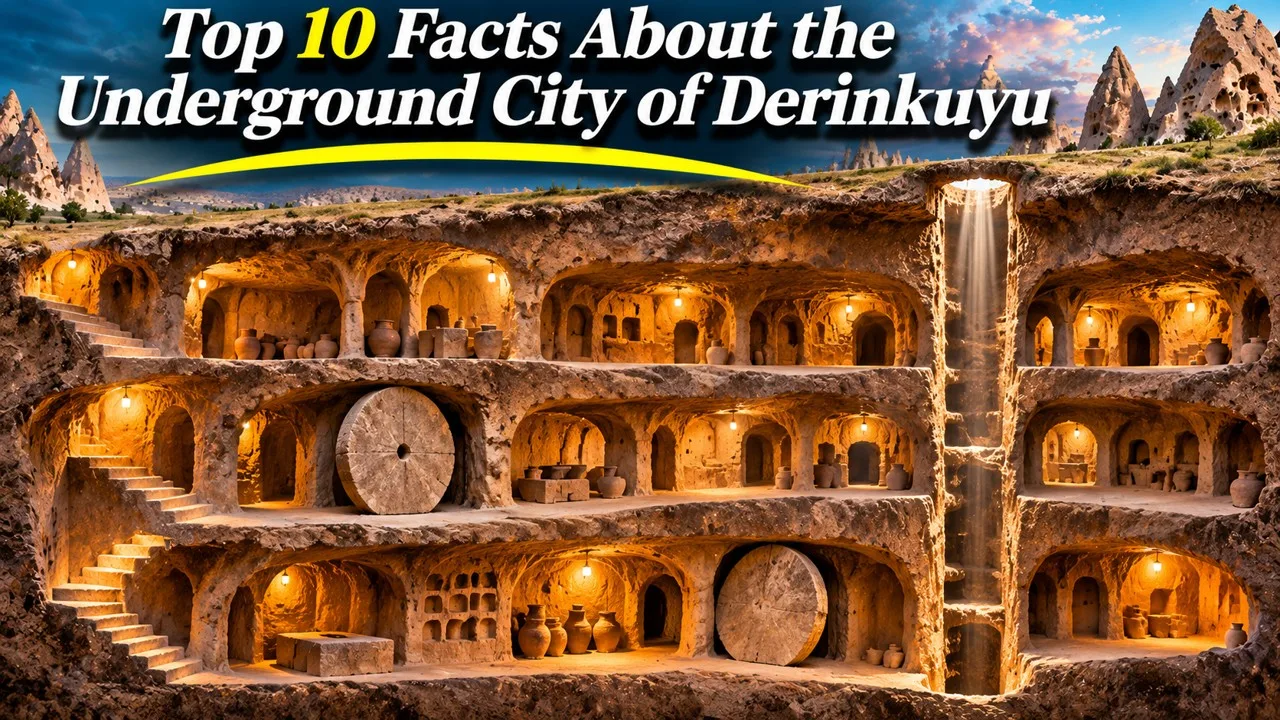
Derinkuyu is a real multi-level refuge under Cappadocia, with stone doors and ventilation shafts; tourist dates and size claims still need a careful standard. The site, in Nevşehir Province in central Turkey, is one of a cluster of underground settlements cut into the region's soft tuff, and it is extraordinary enough without a second layer of folklore [1][6]. It was not a mythic capital, it was not built in a single prehistoric burst, and it is not a "lost city" in the sense of a place no one locally remembered. It is a large, habitable underground complex that could be closed, ventilated, and supplied with water, and that was used, in different centuries, as a place to wait out danger [3][5].
The ten facts below stay with what archaeology and on-site documentation can support.
Key Facts
Derinkuyu is the best-known of Cappadocia's underground cities, not a unique invention in an empty landscape.
Ten Facts at a Glance
| Rank | Fact | What is fairly established | What is softer |
|---|---|---|---|
| 1 | A modern rediscovery by accident | A local opening in the 1960s brought the complex to official attention | Older residents already knew that spaces existed under the village |
| 2 | A long, layered history | Use and enlargement span many centuries | A single "more than 2,000 years old" date for the whole city is too neat |
| 3 | A hiding place | The plan suits refuge during raids and unrest | Not every room was only a bunker |
| 4 | A regional type | Kaymaklı and other sites are related underground towns | Derinkuyu is not a lone marvel |
| 5 | Among the largest | It is one of the deepest and most extensive in the region | Superlatives in guidebooks should be checked |
| 6 | Designed to be secured | Rolling stone doors and narrow passages control access | "Impregnable" is a tourist word |
| 7 | Air and water were engineered | Shafts and wells reach many levels | The original capacity of every well is not fully reconstructed |
| 8 | Vaulted rooms | Some spaces, including a possible missionary school or church, have barrel vaults | Every vaulted room is not automatically a cathedral |
| 9 | Later abandonment as a residence | The complex was not a modern apartment town | The 1923 population exchange is part of the last chapter, not the whole story |
| 10 | Not automatically the record holder | Other Cappadocian cities compete on area, depth, or room count | "The biggest" depends on the measure |
1. Found Again, Not Invented
In 1963, a man in the town of Derinkuyu, often described in later accounts as having been renovating his house, opened a wall and found a passage into a wider underground system [1]. The event is the standard starting point for the site's modern archaeological and touristic career. Officials were notified, rooms were cleared, and a portion of the complex was prepared for visitors [1]. The story is charming, and it is also incomplete if it is told as if no one had ever noticed a cellar, a stable, or a passage in a landscape riddled with rock-cut rooms.
Accident explains the official rediscovery. It does not mean the ground was a blank until that afternoon. In a town already sitting on cut rooms, a "discovery" is often a new official map of a space that had been private, blocked, or only partly used.
2. Older Than a Tour, Younger Than a Slogan
Guidebooks often say the city is more than 2,000 years old [2]. Parts of the Cappadocian underground system may reach into the first millennium BCE, and scholars have discussed Phrygian, Persian, Hellenistic, Roman, and especially Byzantine phases of use and enlargement [2]. Much of what a visitor walks through is most securely tied to medieval refuge, including the period of Arab-Byzantine conflict, when a population already skilled at cutting tuff had reason to go lower and to add doors [2]. A single birthday for every level is not what the evidence currently gives.
The honest fact is a long life, in layers, not a carved date over the first stair.
Related: Top 10 Oldest Surviving Buildings on Earth
3. A Place to Wait Out Trouble
The plan of Derinkuyu, with its bottlenecks, rolling doors, stores, and deep levels, is the plan of a refuge [3]. In a raid, or in a season of unrest, a community could move underground with food and animals, close the stone disks behind them, and remain for a time that a surface village could not have survived in the open [3]. That is the use most often, and most fairly, emphasized. It was not the only use. Stables, wineries, and living rooms suggest that parts of the system were also ordinary underground space in a region where digging into rock was a normal way to make a room.
Hiding is the headline because the engineering is so clearly made for it. Daily life is the footnote that keeps the headline from becoming a siege movie.
4. Not the Only City under the Ground
Derinkuyu sits in a family of Cappadocian underground settlements, of which Kaymaklı is the other name most visitors learn, with further complexes at Özkonak, Mazı, and elsewhere [4]. Some were linked, or were said to have been linked, by tunnels over distances that popular accounts like to stretch [4]. The regional pattern matters. A unique underground metropolis would be one kind of wonder. A culture that repeatedly cut habitable, closable towns into tuff is a more interesting one, because it is a way of living, not a one-off stunt.
The "similar cities" are not copies in a franchise. They are neighbors in the same soft rock.
5. Large, and Still a Measured Large
Derinkuyu is commonly described as one of the largest underground cities in the region, with a stack of levels often rounded to eight in official visitor material, and with popular counts that go higher [5]. Depth figures of tens of metres are cited, and estimates of how many people could have sheltered there vary widely, which is a warning by itself [5]. Capacity depends on time, stores, air, and how much of the system was open in a given century. A guidebook number should not be treated as a census.
Related: Top 10 Most Visited Countries in the World
It is large enough that the visitor sees only a fraction. That fraction is already a city in scale, if not in the legal sense.
6. Built to Be Closed
Half-ton, or at least very heavy, circular stone doors can be rolled across passages from the inside, sealing a level or a corridor behind a disk that cannot be shoved easily from the stair [6]. Passages are narrow, ceilings can be low, and the route is easier to defend than to storm [6]. Ventilation and wells, treated below, complete a system that can be closed without immediately suffocating or drying out. "Secure" is a fair word. "Impregnable" is a word from a poster.
The security is architectural. It assumes a threat that arrives by the stair, not a fantasy of a city that could hold out forever.
7. Air and Water, Taken Downward
A deep room is useless if it cannot breathe or drink. Derinkuyu has ventilation shafts that rise through the levels and wells that could be used from inside, so that a closed community was not obviously cut off from air or from water by the first act of sealing a door [7]. Some wells were arranged so that they could be denied to people on the surface, a detail that belongs with the refuge reading [7]. The engineering is one of the strongest arguments that the complex was meant to be occupied, not merely stored in.
Related: Top 10 Legendary Pyramids Around the World
A shaft is less photogenic than a stone wheel. It is more of the reason the wheel could be used.
8. Vaults in the Tuff
Not every room is a low-cut cell. Some spaces were given barrel-vaulted ceilings, a more formal cut that has been identified, in official descriptions, with a missionary school, a church, or other communal rooms [8]. The vault is a structural and a social fact: it takes more care, and it marks a room that was meant to be seen as a room, not only as a tunnel [8]. Calling every large chamber a cathedral is a temptation the site does not need.
The ceilings are part of why Derinkuyu feels like a town, not a mine.
9. When the City Ceased to Be a Home
The underground city was not a going residential concern in the late twentieth century, which is why a house renovation could "discover" it [9]. Cappadocia's last long chapter as a mixed, including Greek-speaking, Christian and Muslim landscape ended in the population exchange of 1923, after which many rock-cut houses and churches lost the communities that had used them [9]. Derinkuyu's abandonment as a living system is therefore not a sudden curse and not a single medieval night. It is the end of a use, after many uses, in a region whose people moved, or were moved, on.
Tourism is a new use. It should not be mistaken for a resurrection of the old one, and it is why the cleared route is both a gift and a narrowing of a much larger, still partly closed, system.
Related: Top 10 Lost Cities That Were Rediscovered
10. The Biggest, Depending on the Ruler
The same literature that calls Derinkuyu the largest underground city in Cappadocia, or in Turkey, also has to live beside measurements of rivals, new surveys, and the simple problem of what "biggest" means: depth, area, number of rooms, or number of levels [10]. A later visitor-center claim can drift from a careful inventory. The useful fact is not a trophy. It is that Derinkuyu is among a small group of very large underground towns, and that "not necessarily the record holder on every measure" is a more adult sentence than a souvenir superlative [10].
The site does not get smaller when the trophy is shared. It gets more real, which is a better souvenir than a superlative that has to be walked back when the next survey is published.
Conclusion
Derinkuyu is impressive in the way a well-made refuge is impressive: doors that close from inside, air that still arrives, water that can be reached, rooms that were lived in, and a landscape of similar cities rather than a unique miracle. The 1960s rediscovery is a good story. The longer story is a tuff plateau whose people, over many centuries, knew how to go underground and wait.
What the site does not need is a rounded age for every corridor, a population figure quoted as a count, or a claim to be the biggest underground city on Earth. Those are the soft edges. The stone disks and the shafts are the rest, and they are enough to explain why the place is famous without asking the visitor to believe a rounded legend.
- ^ [1] Turkish cultural and tourism accounts of Derinkuyu's modern clearing and opening after a 1960s discovery in the town. Republic of Türkiye Ministry of Culture and Tourism
- ^ [2] Archaeological and historical discussions of Cappadocian underground settlements and their multi-period use, including Byzantine refuge. Britannica: Cappadocia
- ^ [3] Site interpretations of Derinkuyu as a refuge with stores, stables, and closable passages. UNESCO: Göreme National Park and the Rock Sites of Cappadocia
- ^ [4] Descriptions of related underground cities, including Kaymaklı, in the same volcanic region. UNESCO: Cappadocia
- ^ [5] Official visitor figures for levels and extent, treated here as approximate. Republic of Türkiye Ministry of Culture and Tourism
- ^ [6] On-site documentation of circular rolling stone doors and defensive narrow passages. Britannica: Cappadocia
- ^ [7] Accounts of ventilation shafts and internal wells in Derinkuyu and comparable Cappadocian complexes. UNESCO: Cappadocia
- ^ [8] Official descriptions of barrel-vaulted rooms, including a space identified as a missionary school or church. Republic of Türkiye Ministry of Culture and Tourism
- ^ [9] Historical context for the end of long-term local use, including the 1923 population exchange in Anatolia. Britannica: Population Exchange
- ^ [10] Comparative notes on size claims among Cappadocian underground cities, and the problem of a single "largest" measure. UNESCO: Cappadocia





















Discussion
Log in with