






 By
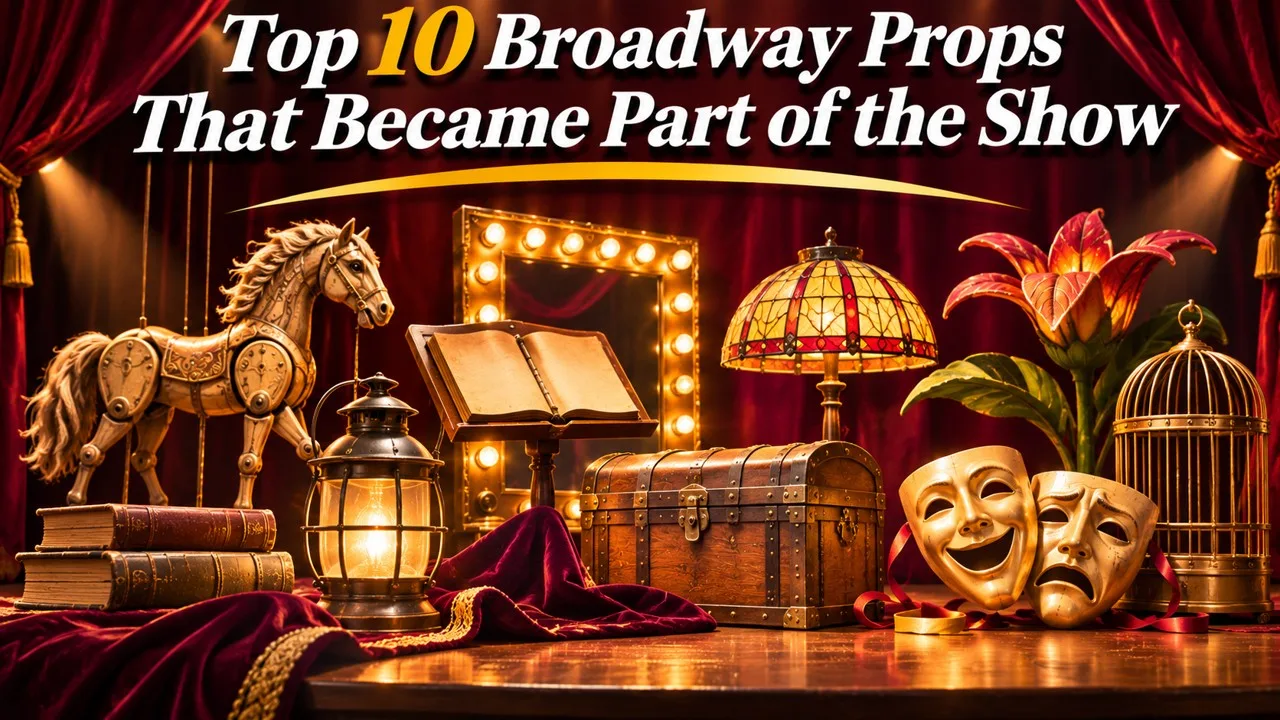
Stage props can steal a scene, from a puppet cow to a hanging light; this list is theatre history, without a licensed silhouette or a firearm lesson. A Broadway musical is often remembered for a song, and sometimes it is remembered for an object that has to work eight times a week: a hanging light, a puppet horse, a plant that has to seem to grow, a vehicle that has to arrive on cue [3][8][10]. The ten items below are those objects, described as design and stage history [1][6][9]. This article will not offer a licensed look to copy, will not restage a copyrighted creature, and will not explain how a firearm works [5][6][7]. A prop can be discussed as labor, carpentry, and cueing. That is the method here.
A famous object is still, on a Tuesday night, a piece of equipment. The interest is how it became part of the show, not how to draw it.
Key Facts
These are documented stage objects, told as production history rather than as a catalog of protected designs.
Ten Props at a Glance
| Rank | Object | Careful version |
|---|---|---|
| 1 | A stainless-steel car in a musical | A later stage version of a 1980s time-travel film uses a DeLorean-style vehicle as a finale object; the car is a licensed stage effect, not restaged here |
| 2 | Hwaboon | The musical Maybe Happy Ending makes potted plants, hwaboon, part of the story of two household robots; the plants are character props, not scenery only |
| 3 | Milky White | In Into the Woods, a cow, often a puppet, becomes a comic and then a tender object, a reminder that a fairy-tale animal can be a role |
| 4 | A sandworm | A later musical drawn from a 1980s film asks a graveyard creature to appear on a stage; the effect is described as a cue, not as a creature design |
| 5 | A talking plant | In Little Shop of Horrors, a plant-like figure becomes a lead; the puppetry is the fact, and the licensed look is left alone |
| 6 | Stage guns in Assassins | Stephen Sondheim and John Weidman's Assassins uses firearms as historical and theatrical objects; this entry is history, not a handling guide |
| 7 | A broom in Wicked | A flying broom is one of the show's practical tricks, among a much larger set of aerial and scenic effects |
| 8 | A hanging chandelier | The Phantom of the Opera made a falling, or swooping, house light a signature cue; the object is a moving light, not a souvenir to copy |
| 9 | A horse puppet | War Horse brought life-sized horse puppets, developed with Handspring, into a First World War story; the labor is the fact |
| 10 | A helicopter effect | Miss Saigon is famous for a late-show evacuation effect involving a helicopter; the mechanics are theatre, and the show's casting controversies are noted, not erased |
1. A Car, as a Finale Cue
A later stage musical drawn from the 1980s time-travel films uses a DeLorean-style car as a visible, and heavily licensed, finale object, a machine that has to appear, light, and, in the logic of the story, depart [1]. The unexpected fact is the transfer of weight. An object that was already a film trademark becomes, in a theatre, a piece of nightly engineering, with cues, safety, and a crew. This article will not describe the car in a way that reconstructs a trademarked body, and it will not borrow a film still. The careful fact is only that a musical can decide that the machine, not only the song, is what the audience came to see close.
A licensed vehicle on a stage is still a prop. The license is why it will not be drawn here.
2. Potted Plants, and a Quiet Lead
Maybe Happy Ending, a musical that reached Broadway in the mid-2020s, follows two helper robots and gives a large emotional job to hwaboon, ordinary potted plants that one of the characters tends [2]. The plants are not a spectacle in the chandelier sense; they are a domestic fact that the show asks the audience to take seriously [2]. The unexpected fact is scale. A season can be remembered for a flying machine, and also, in the same season, for a pot of leaves. The careful fact is the typography of the credit: a plant can be part of the story without being turned, in an article, into a licensed robot design.
A small object can still be a lead, if the writing says it is. The writing, in this case, said so.
Related: Top 10 Most Bizarre Phobias: Strange Fears That Exist
3. A Cow that Has to Act
In Into the Woods, the cow Milky White is a plot device, a joke, and, in many productions, a puppet that has to limp, collapse, and then return, a range that makes the animal a part rather than a leftover from a nursery rhyme [3]. The unexpected fact is sympathy. A fairytale cow can, by the second act, be a figure the audience is sorry for, which is a lot to ask of a constructed body. This article will not borrow a particular production's cow as a design. The history is the role, and the role can be stated without a pattern to copy.
A puppet can steal a scene by being humble. The humility is a craft, not an accident.
4. A Creature, Reduced to a Cue
A musical drawn from a 1980s film set partly in a painted afterlife asks, at intervals, for a graveyard creature to appear, an effect that has to be funny, alarming, and repeatable [4]. The unexpected fact is constraint. A film can cut away; a musical has to solve the same joke in real time, every night, without endangering a dancer. This article will not restage a copyrighted worm, or describe a head, a mouth, or a trademarked silhouette. The careful fact is the job: a crew has to make an entrance that audiences already think they know, and then make it land as theatre.
A famous creature can be, on a stage, only a cue and a safety plan. That is as much as a list of props needs.
5. A Plant that Takes Over a Show
Little Shop of Horrors is, in one sense, a puppet show about a plant that grows from a small pot into a figure that dominates the stage, with singers often inside or under the later versions [5]. The plant is both a character and a machine, which is why it belongs on a list of props, even though it also has lines [5]. The unexpected fact is the overlap. An object can become a lead without ceasing to be plywood, foam, and timing. This article will not reconstruct a licensed plant, and it will not offer a build guide. The history is that a low-budget off-Broadway idea became, through puppetry, a standard of the musical theatre.
Related: The Evolution of Stranger Things: Seasons, Themes, and Characters
A voice can come from a puppet. The puppet, here, is the fact we can name without drawing it.
6. Objects in a Revue about History
Assassins, the musical by Stephen Sondheim and John Weidman, is a revue about people who killed, or tried to kill, American presidents, and it places firearms on the stage as historical and theatrical objects [6]. The unexpected fact is the seriousness of the prop as idea: the show is, in part, about how those objects entered public life, not about how they are built or used [6]. This article will not describe mechanisms, loading, aim, or any other handling instruction. It will not become a catalogue of weapons. The careful fact is only that a controversial musical made the prop part of the argument, and that the argument can be mentioned as theatre history.
A show can be about a dangerous object without an article becoming a lesson in the object. This one will not.
7. A Broom, among other Flying Things
Wicked is often remembered for a broom, because a broom is what a familiar story says a witch should have, and because the musical has to make flight a practical problem [7]. In production terms the broom is one effect among others, in a set that also includes large scenic pieces and aerial work [7]. The unexpected fact is proportion. An object that looks like the whole advertisement can be, backstage, a smaller part of a much heavier machine. This article will not restage a licensed costume or a trademarked face. The history is the cue, and the cue is that a performer leaves the floor, on a schedule, eight times a week.
Related: Top 10 Oldest Buildings in the World
A broom can be a symbol and a harness. The harness is the part a prop list should not pretend is magic.
8. A House Light that Learned a Cue
The Phantom of the Opera, which ran in New York for thirty-five years until 2023, is bound, in public memory, to a hanging chandelier that moves, or seems to fall, on a famous cue [8]. The unexpected fact is durability. An effect that looks like a disaster has to be, for decades, a reliable piece of theatrical machinery, inspected, rehearsed, and reset [8]. This article will not reconstruct a particular chandelier, or treat a hanging light as a souvenir design. The careful fact is the job of a moving light in a long run: it became, for a generation of ticket buyers, the show's signature, even though the show is also a score, a pit, and a great many quieter scenes.
A light can be a character. It is still, between shows, a weight hanging over seats, which is why the crew's work is the real interest.
9. A Horse Built by a Team
When War Horse was adapted from Michael Morpurgo's novel, the central practical question was how to put a horse, or several horses, on a stage without using a live animal for the lead, and the answer, developed with the Handspring Puppet Company, was a life-sized puppet worked by a visible team [9]. The unexpected fact is honesty. The operators are not hidden, and the audience is asked to complete the animal, which is a different contract from a film close-up [9]. This article will not offer a pattern for the puppet, and it will not borrow a still. The history is that a First World War story became, in the theatre, a demonstration of jointed labor, breath, and timing.
Related: Chernobyl Miniseries: Stories of Tragedy of a Nuclear Catastrophe, Heroism and Sacrifice
A horse can be a team. The team is the prop, as much as the frame is.
10. An Evacuation, Solved as Theatre
Miss Saigon, a musical that has been criticized for its plot and for a history of casting controversies, is also famous for a late-show evacuation effect in which a helicopter, or a convincing theatrical version of one, has to arrive, hover in the logic of the scene, and depart [10]. The unexpected fact is the split in the reputation. A show can be argued over, sharply, and still contain a piece of staging that even some of its critics will admit is a feat of nightly engineering [10]. This article will not ignore the arguments, will not reconstruct a licensed aircraft, and will not treat the effect as a reason to skip the rest of the conversation.
A spectacular cue does not settle a political argument. It is still, as a prop, a real piece of theatre history, and that is all this list is asking it to be.
Conclusion
The ten objects above are a car, a pot of plants, a cow, a creature reduced to a cue, a plant that became a lead, a set of theatrical firearms described only as history, a broom, a hanging light, a horse made by a team, and a helicopter effect in a disputed musical. They became part of their shows because a night of theatre had to solve a problem in front of an audience, again and again. They can be listed as labor and as design history, without a licensed silhouette, and without a lesson no encyclopedia should give.
A prop is a solution that has to work tomorrow. The decent way to admire it is to leave the solution, as a picture, in the theatre that owns it.
- ^ [1] Production histories of a stage musical drawn from the 1980s time-travel films, including the licensed vehicle used as a finale object. Britannica: musical
- ^ [2] Accounts of Maybe Happy Ending and of the role of potted plants, hwaboon, in the story. Britannica: musical
- ^ [3] Histories of Into the Woods and of the cow Milky White as a puppet role. Britannica: Stephen Sondheim
- ^ [4] Production notes on a later musical drawn from a 1980s film, including a creature effect described only as a cue. Britannica: musical
- ^ [5] Histories of Little Shop of Horrors and of the plant figure as a puppet lead, without a licensed reconstruction. Britannica: musical
- ^ [6] Accounts of Assassins as a musical about political violence, with stage firearms treated as historical objects, not as a handling guide. Britannica: Stephen Sondheim
- ^ [7] Production histories of Wicked, including practical flying effects. Britannica: musical
- ^ [8] Histories of The Phantom of the Opera and of the moving-chandelier cue in its long New York run, which ended in 2023. Britannica: Andrew Lloyd Webber
- ^ [9] Accounts of the National Theatre's War Horse and of the Handspring life-sized horse puppets. Britannica: War Horse Britannica: puppetry
- ^ [10] Histories of Miss Saigon, including the evacuation effect and documented debates over plot and casting. Britannica: musical





















Discussion
Log in with