





 By
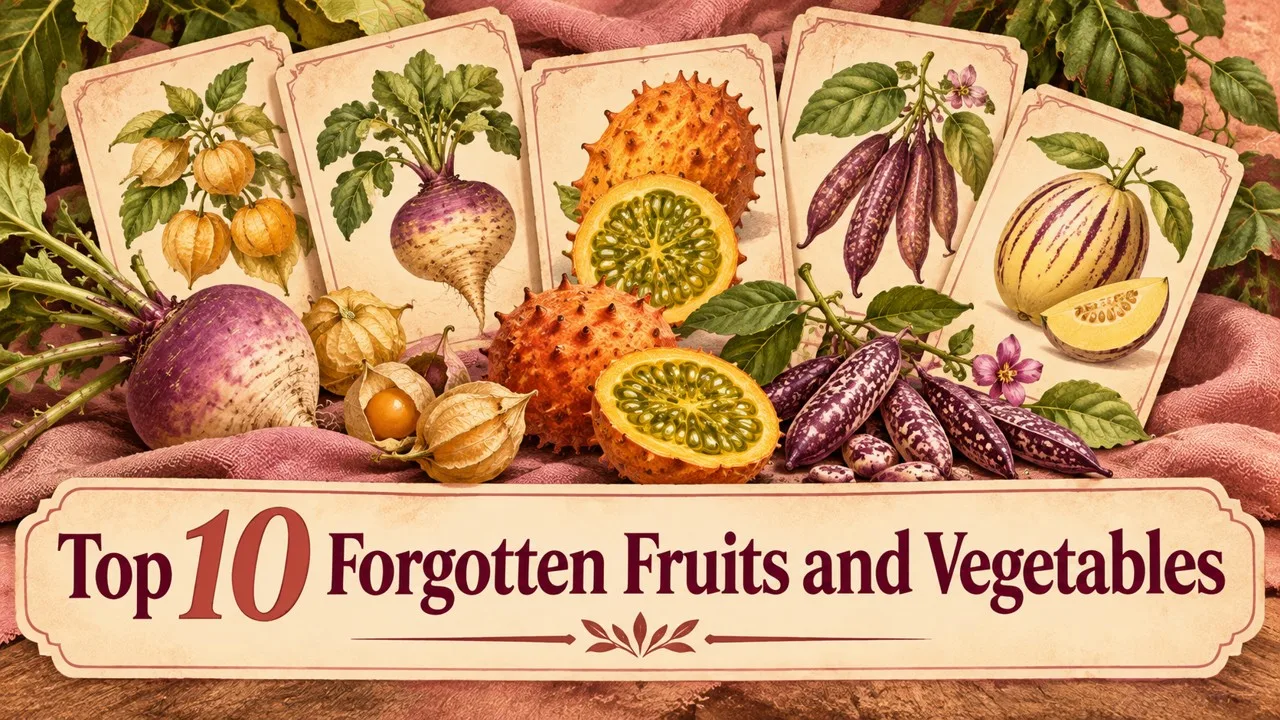
Forgotten fruits and vegetables are mostly a story of orchards, trade, and changing farms, not a list of foods anyone is told to eat.
A cultivar can vanish because a market moved, a pest arrived, or a more reliable crop took the field. The ten plants below are treated as agricultural history: a lost cider apple, a fruit that had to blett, a tuber that was never the potato, a rare Texas plum, a common weed that was once a potherb, a palm nut used as ivory, a praised nineteenth-century pear, a medieval root, a Pacific fruit that is only "forgotten" in some markets, and a classical herb that is not the North American plant now given the same genus name. This article is not diet advice, and it is not medicine.
Key Facts
| Item | Agricultural fact | Caution |
|---|---|---|
| 1 | The Taliaferro apple, praised by Thomas Jefferson at Monticello, is a lost or unidentified cider variety | Identity claims are speculation unless a tree can be matched |
| 2 | The medlar, Mespilus germanica, was a familiar European fruit that is eaten after bletting | A historical taste, not a recommendation |
| 3 | The earthnut pea, Lathyrus tuberosus, is a European and Mediterranean plant with edible tubers in older records | A different species from grass pea; this is history, not a menu |
| 4 | Murray's plum, Prunus murrayana, is a rare Texas endemic whose fruit is almost undocumented in recent times | A conservation story, not a crop to seek |
| 5 | Fat hen, Chenopodium album, is still a common weed and was widely eaten as a potherb | "Forgotten" as a crop, not as a plant |
| 6 | Tagua, the hard seed of Phytelephas palms, was and still is used as vegetable ivory | Craft and forest history, not a snack guide |
| 7 | The Ansault pear, recorded from a French nursery in the 1860s, was highly praised and later nearly or entirely lost | Later sightings should be treated as unconfirmed until documented |
| 8 | Skirret, Sium sisarum, was a European garden root before the potato dominated | A crop history, not a cooking lesson |
| 9 | Tava, or Pometia pinnata, is still eaten across a wide Indo-Pacific range | Forgotten only from some supermarket shelves, not from its home orchards |
| 10 | Classical silphium was a lost Mediterranean plant, probably a relative of giant fennel, not the living North American Silphium integrifolium | Ancient medical and contraceptive claims are historical reports, not advice |
1. A Cider Apple That Lost Its Name
Thomas Jefferson grew, and praised, a cider apple he called the Taliaferro at Monticello, in Virginia, and he thought its cider unusually good [1]. Nineteenth-century notes and later orchard histories treat the variety as lost. No firmly identified tree is in commercial circulation under a settled identity, and attempts to match the name to a surviving cider apple remain unproven [1].
The unexpected fact is how little of a famous fruit has to survive for the fame to continue. A president's orchard list can outlast the cultivar [1]. This article will not announce a rediscovery on the basis of a hopeful resemblance, and it will not tell anyone to plant or drink a substitute. The careful fact is a documented historical variety, a gap in the living collection, and a reminder that pomological names are only as solid as the trees that still bear them.
A lost apple is a record in a garden book. It is not a recipe, and it is not a detective novel with a guaranteed ending.
2. A Fruit That Had to Soften First
The medlar, Mespilus germanica, is a small Eurasian tree whose fruit was familiar in Greek, Roman, medieval, and early modern European eating, then faded from most markets [2]. The fruit is generally used after bletting, a softening that happens with frost or storage, when the flesh turns brown and sweet. Before cheap sugar was common, a fruit that could hang or hold into the cold months had a seasonal point [2].
The unexpected fact is not that the medlar disappeared from the planet. It did not. Specialist growers still keep it. It disappeared from ordinary baskets [2]. This article will not advise anyone to eat bletted fruit, and it will not treat an old orchard practice as a health claim. The careful fact is a well-documented historic crop, a processing step that explains some of its modern oddity, and a decline that followed changing tastes and changing winters in the larder, not a mysterious extinction of the species.
A medlar is easy to grow and hard to market. That is a history of shops, not a verdict on the tree.
3. A Tuber That Was Never the Potato
The earthnut pea, Lathyrus tuberosus, is a perennial pea relative native to parts of Europe and adjacent regions, with small underground tubers that older agricultural and foraged-food records describe as edible [3]. It can still be found as a wild or naturalized plant, and it has occasionally been grown as a curiosity. It did not become a staple on the scale of the potato, and it should not be confused with grass pea, Lathyrus sativus, a different species with its own, more complicated food history [3].
Related: Top 10 Most Bizarre Phobias: Strange Fears That Exist
The unexpected fact is how many European "roots" were in play before one Andean tuber reorganized the field [3]. This article will not offer a foraging guide, a cooking method, or a safety ranking. The careful fact is a named plant with a documented older use as a tuber, a modest place in agricultural history, and a need to keep species names straight. A pea that makes a nut-like root is a botanical footnote with a past in kitchens. It is not a hidden superfood in this list.
A forgotten tuber can be real and still be a poor candidate for a comeback poster. The point here is the record, not the plate.
4. A Texas Plum That Barely Fruits in the Record
Murray's plum, Prunus murrayana, was described from the Davis Mountains of Texas in the early twentieth century and remains a narrowly distributed, rare shrub [4]. Conservation assessments have long treated it as critically imperiled. Reliable modern reports of ripe fruit are scarce, which is why a list of "forgotten fruits" can sound more abundant than the plant is [4].
The unexpected fact is that a named fruit can be almost a rumor in the field, not because of a lost recipe, but because the population is small and reproduction is poorly documented [4]. This article will not encourage collection, and it will not treat the plum as a flavor to chase. The careful fact is a rare endemic, a thin fruiting record, and a conservation problem. Agricultural nostalgia is the wrong frame when the living plants are the story.
A plum that almost no one sees in fruit is a botanical emergency, or at least a watch list, not a farmers' market headline.
5. A Weed That Was Once a Potherb
Fat hen, Chenopodium album, also widely called lambsquarters, is a common annual of farms and disturbed ground across a huge range [5]. It is not extinct, and it is not rare. What faded, in many regions, is its routine use as a leafy potherb and a seed plant, a use that older European and other agricultural traditions recorded as ordinary. It belongs to the same goosefoot group as quinoa, which later took a very different market path [5].
The unexpected fact is the mismatch between abundance and memory. A plant can be everywhere in a field and nowhere in a cookbook [5]. This article will not advise anyone to pick a weed, and it will not compare nutrients as a diet tip. The careful fact is a still-common species with a documented history as food, a modern status as a weed, and a "forgotten" label that applies to the habit, not to the flora. Related crop species, including quinoa, show how a goosefoot can also be a global commodity when breeding and trade go another way.
Related: Top 10 Oldest Buildings in the World
A forgotten vegetable is sometimes just a plant that kept growing after people stopped setting a place for it.
6. A Palm Seed Used as Ivory
Tagua, the hard, pale endosperm of South American palms in the genus Phytelephas, became a major nineteenth- and early twentieth-century substitute for animal ivory, especially in buttons and small carved goods [6]. The palms are long-lived forest trees of northwestern South America. After cheaper plastics arrived, the trade shrank, though artisans and some conservation projects still work with the nut [6].
The unexpected fact is that a "forgotten fruit" in this case is barely a fruit in the kitchen sense. The seed's value was as a material, a vegetable ivory, in a global button and carving trade [6]. This article will not treat tagua as a snack, and it will not announce that it saved elephants, a claim that should be kept more modest than a slogan. The careful fact is a documented forest product, a boom and a decline, and a remaining craft use. Agricultural history includes things that were harvested and shipped without ever being dinner.
A nut can change a trade and still vanish from ordinary talk once a cheaper solid arrives.
7. A Praised Pear That Slipped Out of the Catalogs
The Ansault pear was raised in a French nursery and began to be noticed in the 1860s, then entered nineteenth-century pomological catalogs as a fruit of unusual quality, often described as large, soft, and richly flavored [7]. Unlike the medlar, it does not seem to have held even a specialist market. Modern orchard lists treat it as extremely rare or lost, and casual claims of a surviving tree should be treated as unconfirmed until a documented accession says otherwise [7].
The unexpected fact is how quickly a "best of its kind" variety can leave the living record when it is hard to ship, hard to store, or simply unlucky in the nurseries that keep older pears [7]. This article will not rank flavors, and it will not offer a substitute as if the name were a brand still on sale. The careful fact is a historically praised cultivar with a thin or empty modern inventory. Pear history is full of names that were once in every good catalog and are now only in the catalog.
Related: 10 Sikh Gurus: The Pillars of Sikhism Who Shaped Faith, Equality, Courage, and Humanity
A famous pear can die of ordinary commercial causes. That is still a loss, just not a mysterious one.
8. A Garden Root Before the Potato Won
Skirret, Sium sisarum, is a sweetish, clustered root that European gardens grew for centuries as a potherb and a table root [8]. Classical and medieval sources already knew a plant of this kind, and early modern kitchen gardens kept it until the potato, and a narrower set of roots, took most of the ground. The species is probably of Asian origin and was never, in Europe, a wild staple on the scale of later potatoes [8].
The unexpected fact is how complete the potato's victory can make earlier roots look eccentric, even when they were once ordinary [8]. This article will not tell anyone how to cook skirret, and it will not claim a nutritional prize. The careful fact is a documented historic crop, a decline after a more productive tuber arrived, and a modest survival among specialist growers. Crop history is often a story of replacement, not of a fruit that simply forgot how to exist.
A root can be forgotten because something else was easier to harvest, store, and sell. That sentence is the whole plot.
9. A Pacific Fruit That Is Only Forgotten in Some Markets
Tava, Pometia pinnata, sometimes called island lychee or by many local names, is a sizeable tree of South and Southeast Asia and the Pacific, grown and eaten in a wide home range [9]. The fruit is still a familiar food in parts of that range, and the tree has also been used for timber and shade. Calling it forgotten is a statement about some export markets and some encyclopedias of "odd fruits," not about Tonga, or Fiji, or the orchards where it is still ordinary [9].
The unexpected fact is the geography of neglect. A fruit can be invisible in one supermarket belt and seasonal in another [9]. This article will not describe how to eat it as a guide, and it will not treat a Pacific crop as a novelty imported for a list. The careful fact is a widely distributed, still-used species, a cluster of regional names, and a reminder that "forgotten" is often a view from elsewhere. Agricultural memory is local before it is global.
Related: Top 10 Tallest Buildings in the World
A fruit that is still in season somewhere has not been lost. It has only been left off someone else's shelf.
10. A Lost Classical Herb, and a Name That Moved
Classical silphium, the famous seasoning and medicinal plant of Cyrene, in what is now Libya, was a major export of the Greek and Roman world and appears on Cyrenaic coins [10]. By late antiquity the supply had failed, and the plant is generally treated as extinct or at least unidentifiable in the field. Many botanists have compared it to a giant fennel, in the genus Ferula, not to the North American prairie plants now placed in the genus Silphium [10]. The living rosinweed Silphium integrifolium is a different plant, still present on the North American plains, and it is not the lost Cyrenaic herb.
The unexpected fact is how easily a Latin genus name can be taken for a resurrection. A list that identifies classical silphium as Silphium integrifolium is mixing a lost Mediterranean crop with a living American wildflower [10]. Ancient writers also attributed medical and contraceptive uses to silphium; those are historical claims, they are not clinical advice, and they are not a reason to take any modern plant as a drug. This article will not discuss doses, and it will not treat a coin, or a Roman cookbook, as a pharmacy. The careful fact is a documented classical trade plant, a genuine loss, and a naming confusion that should be corrected in the open.
A forgotten herb can be famous and still be gone. The decent correction is to leave the American rosinweed out of Cyrene, and to leave medicine out of a food-history list.
Conclusion
The ten plants above are a lost Monticello cider apple, a bletted medlar, an earthnut pea that was never the potato, a rare Texas plum, a common goosefoot once used as a potherb, a palm seed used as ivory, a vanished or nearly vanished French pear, a medieval garden root, a Pacific fruit still eaten at home, and a classical silphium that is not a living prairie rosinweed. None of them is offered here as a meal, a supplement, or a drug.
A crop can be forgotten for ordinary reasons: trade, storage, a better rival, or a true extinction. The decent way to list those reasons is to keep the history, correct the names, and leave the menu off the page.
- ^ [1] Monticello and pomological accounts of the Taliaferro apple as a cider variety praised by Thomas Jefferson and later lost or unidentified. Thomas Jefferson Encyclopedia: Taliaferro apple Britannica: apple
- ^ [2] Botanical and historical accounts of the medlar, Mespilus germanica, including bletting and its former place in European diets. Britannica: medlar Wikipedia: Mespilus germanica
- ^ [3] Botanical accounts of Lathyrus tuberosus, the earthnut pea, as a European tuber plant distinct from grass pea. Britannica: Lathyrus Wikipedia: Lathyrus tuberosus
- ^ [4] Conservation and botanical records of Murray's plum, Prunus murrayana, as a rare Texas endemic with a thin modern fruiting record. Wikipedia: Prunus murrayana Britannica: Prunus
- ^ [5] Botanical and ethnobotanical accounts of Chenopodium album, fat hen or lambsquarters, as a common weed and a historic potherb, in the same group as quinoa. Britannica: Chenopodium Wikipedia: Chenopodium album
- ^ [6] Historical accounts of tagua, or vegetable ivory, from Phytelephas palms, as a craft and button material rather than a kitchen fruit. Britannica: ivory, including vegetable ivory Wikipedia: Phytelephas
- ^ [7] Nineteenth-century pomological notices of the Ansault pear and later treatments of the cultivar as rare or lost. Britannica: pear Wikipedia: pear cultivars
- ^ [8] Historical and botanical accounts of skirret, Sium sisarum, as a European garden root that receded after the potato became dominant. Britannica: skirret Wikipedia: Sium sisarum
- ^ [9] Botanical and regional accounts of Pometia pinnata, tava or island lychee, as a still-used Indo-Pacific fruit tree. Wikipedia: Pometia pinnata Britannica: Pacific Islands
- ^ [10] Classical and botanical discussions of silphium as a lost Cyrenaic trade plant, probably a Ferula, distinct from North American Silphium, with ancient medical claims treated as history, not advice. Britannica: Cyrene Wikipedia: silphium






















Discussion
Log in with