



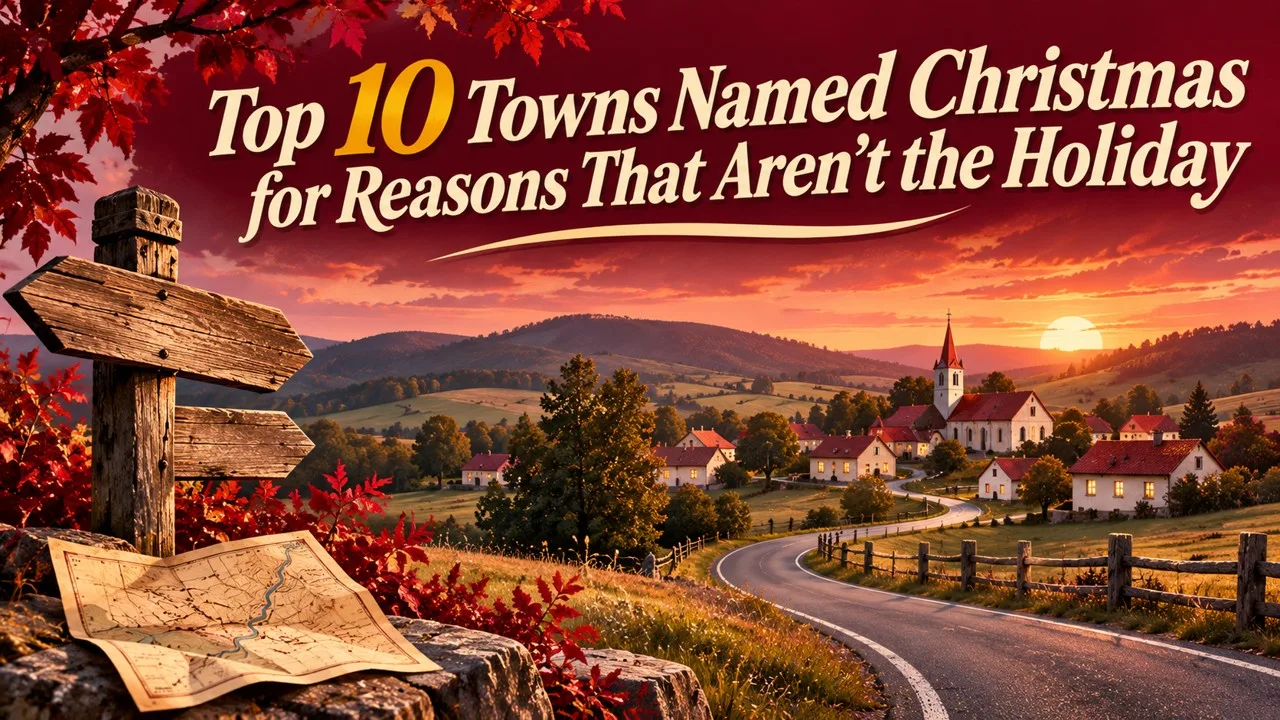
Top 10 Towns Named Christmas for Reasons That Aren't the Holiday
 By Dhiraj Sharma · Published
Share Post
Loading…
Snowflake, Arizona, joins two settlers' names, and an Oregon river called Blitzen after thunder, not a reindeer; festive spellings can have ordinary roots. A map of the United States is full of places that look, on a December card, as if they were founded for a holiday [2][8]. Many were not. They were named for a neighbor, a lawyer, a canal official, a river after a storm, or a fort whose construction happened to begin on a certain date [2][3][6]. This list is toponymy, not a tour of light displays, and it is distinct from any catalog of towns that exist to celebrate the season [6][8]. Where a name later acquired a festive postmark or a themed street, that afterthought is labeled as such [3].
One substitute appears on purpose. A Georgia community actually called Santa Claus is, unlike most of the others, a holiday brand. It does not belong in a list of unrelated etymologies, and it is not used here [6].
Key Facts
These are documented place-name origins, or, where the file is thin, a stated uncertainty. None of the entries needs a copyrighted character, a carol lyric, or a brand logo.
Ten Place Names at a Glance
| Rank | Place | Careful origin |
|---|---|---|
| 1 | Rudolph, Wisconsin | Named for a nineteenth-century settler, Rudolph Heckel, well before a later famous reindeer |
| 2 | Snowflake, Arizona | A compound of two 1878 founders' surnames, Snow and Flake, not a weather report |
| 3 | Garland, Texas | Named for Attorney General Augustus H. Garland after two rival railroad settlements needed a post office |
| 4 | Noel, Missouri | Named for the Noel brothers and said "Nole"; a later Christmas postmark was publicity, not the etymology |
| 5 | Christmas, Florida | Takes its name from Fort Christmas, a Second Seminole War post whose construction began on 25 December 1837 |
| 6 | Shepherd, Montana | A farming hamlet whose name is tied to a person in the settlement's early irrigation period, not to a nativity scene |
| 7 | Snowball, Arkansas | A late-nineteenth-century community and lodge name in Calf Creek Valley, not a documented holiday christening |
| 8 | Christmas Valley, Oregon | Named from Christmas Lake and the surrounding valley; the lake's own name is uncertain and is not a proven civic festival |
| 9 | Blitzen, Oregon | Named from the Donner und Blitzen River, German for thunder and lightning after a difficult 1864 crossing |
| 10 | Eggnog, Utah | A small Garfield County place whose name is reported to come from the drink served to workers, not from a holiday-town plan |
1. A Settler's Given Name
Rudolph, in Wood County, Wisconsin, is a small village in dairy country, and its name is older than the mid-century incorporation papers that sometimes get cited as a founding date [1]. Standard local accounts trace it to Rudolph Heckel, a nineteenth-century settler, a ordinary way to label a post office and a depot [1]. A later reindeer of radio and film is a coincidence of a common Central European given name, and this article will not borrow that character or any of his licensed look. The unexpected fact is only the calendar. The place-name was already on the map before the later pop-culture animal made the word feel seasonal to outsiders.
A grotto and garden later built in the community are a local landmark with their own history. They do not explain the name, and they do not have to.
2. Snow, Flake, and a High Town
Snowflake, Arizona, sits in the White Mountains, a place that does get some winter, though not the blizzard its name seems to advertise [2]. In 1878, families sent to settle the area included Erastus Snow and William J. Flake. The town's name is a straightforward compound of those two surnames, a compact that is still one of the cleanest "not what you think" etymologies in American toponymy [2]. It is not a Christmas christening, and it is not a tourist board's joke about weather, even if later writers have had fun with the pairing. The unexpected fact is bureaucratic and almost tender: two last names, stacked, became a word that children now meet first as a weather noun.
A desert state can have a Snowflake that is about people. The snow, such as it is, arrived as a pun after the fact.
Related: Top 10 Most Bizarre Phobias: Strange Fears That Exist
3. A Post Office, and a Cabinet Officer
Garland, Texas, now a large suburb in the Dallas area, did not take its name from a mantel decoration [3]. In the late 1880s, the neighboring settlements of Duck Creek and Embree, each with a railroad, were competing after fire and after the usual small-town politics of depots and mail [3]. The new post office was named for Augustus H. Garland, then attorney general of the United States, a conventional honorific choice of the period. The festive noun "garland" is an accident of English. The unexpected fact is how official the real origin is. A future city of hundreds of thousands can begin as a mail-name borrowed from a lawyer in Washington.
A decoration can wait until December. A post office cannot, and that is the name that stuck.
4. A Surname, Later a Postmark
Noel, Missouri, near the southwestern corner of the state, was named for early residents, including the brothers Clark Wallace Noel and William Jasper Noel, who farmed and ran a sawmill [4]. Locals have long insisted on the pronunciation "Nole," a small act of resistance against the French Christmas greeting that visitors hear in the spelling [4]. During the Depression, a postmaster and later publicity, including a mention by the popular singer Kate Smith, helped turn the post office into a place that would cancel holiday mail with a special mark. That is a second story, and it should not be allowed to rewrite the first. The unexpected fact is the sequence. The family name came first. The festive industry arrived as an afterthought, because the spelling was sitting there, tempting.
This article will not quote a carol to complete the joke. The postmark is already enough of a punch line.
5. A Fort, Begun on a December Date
Christmas, Florida, in Orange County, takes its name from Fort Christmas, a Second Seminole War post whose construction began on 25 December 1837 [5]. The name marks a construction date in a military campaign, not a decision to invent a year-round holiday village [5]. A community later grew in the vicinity of the fort site, and a reconstruction of the stockade now stands as a local historical park, which is a different kind of seasonal visit than a theme street. The unexpected fact is the calendar used as a field label. Soldiers needed a name for a work camp that happened to start on a feast day, and the map kept the word after the war moved on.
Related: Top 10 Oldest Buildings in the World
A date on a rise of dirt can outlive the palisade. That is how a war becomes, generations later, a town name that looks festive and is not, in origin, a festival.
6. A Hamlet on an Irrigation Canal
Shepherd, Montana, grew in the early twentieth century after an irrigation canal, the Billings Bench Water Association project, made it possible to turn cattle country along the Yellowstone into farms, attracting European and American settlers [6]. The name is the sort that looks biblical on a Christmas list and local on a plat: it is tied to a person in that settlement period, commonly identified with R. E. Shepherd, not to a nativity shepherd in a pageant [6]. The unexpected fact is irrigation. The hamlet exists because of a canal and a land boom, and the surname rode along with the post office, as surnames do.
A farming suburb of Billings does not have to be a Christmas town in order to be called Shepherd. The English language did that work by accident.
7. A Lodge, a Valley, and an Odd Noun
Snowball, in what is now Searcy County, Arkansas, sits in the Calf Creek country where settlers had been arriving since the 1830s, with a mill and, later, a cotton gin [7]. In the mid-1880s a Masonic lodge was organized, and a building that also served church and school went up; the name Snowball attaches to that late-nineteenth-century naming of the lodge and the community, not to a documented ceremony about the holiday [7]. The exact joke or proposer behind the noun is thinner in the surviving record than the fact of the name itself, and this article will not invent a snowball fight to fill the gap. The unexpected fact is simply that a southern valley, not famous for blizzards, still accepted a winter word as a place-name and kept it.
Two American post offices have used the word, which is a curiosity, not a proof of a seasonal founding myth.
Related: The Science Behind Auroras: How Solar Winds Create Colorful Skies
8. A Lake Name, then a Valley Town
Christmas Valley, in Oregon's high desert, is a dry, sparsely populated country of sagebrush and alfalfa, hot in summer and cold in winter, with a few festive-looking road names that arrived later and do not rewrite the climate [8]. The community takes its name from the valley of Christmas Lake. The lake's own name is not securely documented as a civic decision to honor the religious holiday; explanations in circulation include a seasonal date and other, weaker guesses, and the honest entry is that the chain of names is older than the town plat and not fully explained [8]. The unexpected fact is the gap. A festive word can sit on a dry basin for years without the basin becoming a Christmas product.
Uncertainty is part of toponymy. It is better than a made-up night of carols on the playa.
9. Thunder, Lightning, and a Hard Crossing
Blitzen, in Oregon's Catlow Valley, was a short-lived homestead-era place, and its name came off the Donner und Blitzen River nearby [9]. In 1864, an Army officer, Captain George Currey, had to cross the swollen stream in a storm and used the German for thunder and lightning, Donner und Blitzen, as a field name that then stuck to the river [9]. The later reindeer in a famous poem borrowed the same German word for lightning; the river did not borrow the reindeer. This article will not quote that poem, and it will not restage a licensed animal. The unexpected fact is linguistic and military. A difficult ford, named in a language some of the soldiers knew, is the whole origin.
A homestead that later faded can still leave a word on the map. The word, here, is weather, not a sleigh.
Related: 10 Sikh Gurus: The Pillars of Sikhism Who Shaped Faith, Equality, Courage, and Humanity
10. A Drink, a Crew, and a Thin File
Eggnog, sometimes written as two words in casual lists, is a small place-name in Garfield County, Utah, in the country southeast of Capitol Reef [10]. Local explanation, such as it is, ties the name to the drink being served to laborers as a dense, restorative mixture, not to a plan to found a Christmas village [10]. The file is thinner than for Snowflake or Garland, and it should be read that way. The drink itself has a holiday reputation in American culture, which is how the word ended up on a list like this; the place-name, if the work-crew story holds, is about calories on a job, not about a pageant. This article will not supply a recipe.
A reported origin can be ordinary and still be only reported. The unexpected fact is that a custardy noun made it onto a map at all.
Conclusion
The ten names above are a defense of checking the gazetteer. A settler, two surnames, a cabinet officer, a pair of brothers, a fort's first day of work, an irrigation-era surname, a lodge, an uncertain desert lake, a thunder-and-lightning river, and, perhaps, a drink for a work crew: those are the roots. Later postmarks, themed street signs, and tourist jokes can grow on the spelling, as they did in Noel, without being allowed to invent the christening. A community that truly did name itself as a holiday brand is a different species of place, and it was left off on purpose.
The map is allowed to be funny. It is funnier, and more useful, when the joke is in the coincidence, not in a story that was never in the minutes.
- ^ [1] Local and state place-name accounts of Rudolph, Wisconsin, including the attribution to the settler Rudolph Heckel. Britannica: Wisconsin, and standard Wisconsin toponym references
- ^ [2] Histories of Snowflake, Arizona, as a compound of the surnames Snow and Flake in 1878. Britannica: Arizona
- ^ [3] Accounts of Garland, Texas, named for Attorney General Augustus H. Garland after the Duck Creek and Embree rivalry. Britannica: Garland
- ^ [4] Local histories of Noel, Missouri, named for the Noel family, and later holiday-mail publicity. Britannica: Missouri
- ^ [5] Histories of Fort Christmas and the community of Christmas, Florida, in the Second Seminole War. Britannica: Seminole Wars
- ^ [6] Settlement histories of Shepherd, Montana, after the Billings Bench irrigation project, and the name's association with a local figure. Britannica: Montana
- ^ [7] Local accounts of Snowball, Arkansas, in Calf Creek Valley and the 1880s lodge and community naming. Britannica: Arkansas
- ^ [8] Oregon high-desert place-name discussions of Christmas Lake and Christmas Valley, including the uncertain origin of the lake's name. Britannica: Oregon
- ^ [9] The 1864 naming of the Donner und Blitzen River for thunder and lightning, and the later homestead name Blitzen. Britannica: Oregon
- ^ [10] Local explanations of the Eggnog place-name in Garfield County, Utah, treated as a thin, reported origin. Britannica: Capitol Reef National Park




















Discussion
Log in with