




 By
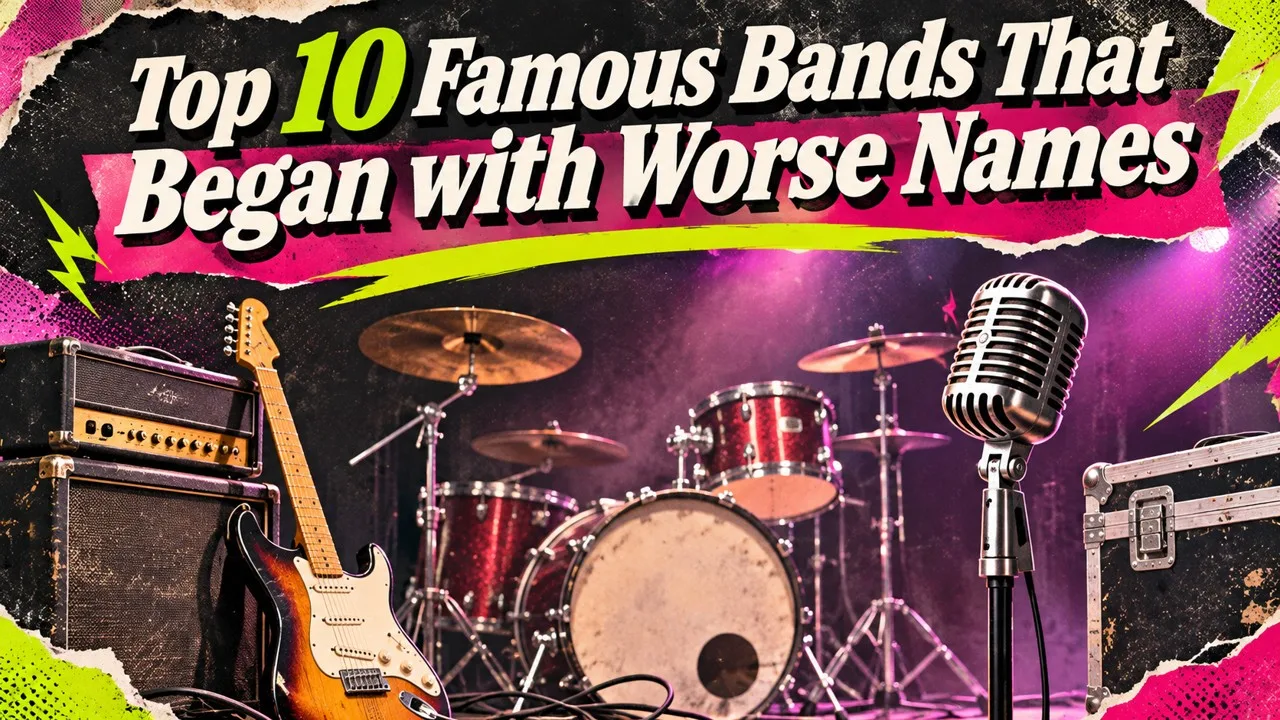
Several well-known groups reached the charts only after abandoning early names that were awkward, already taken or, in one case, drawn from a racist caricature. A band name is a piece of legal and commercial furniture, not a personality, and it can be replaced when it is hard to print, already owned, or later recognized as indefensible [5][10]. The ten cases below are documented changes, told as history: first names, reasons for leaving them, and the labels that stuck [1][4][8]. This article will not quote lyrics, reprint sleeves, or borrow a likeness from a video or a press photo [4][10].
A worse name is not always a joke. Sometimes it is a name that was already in use. Sometimes it is a name a group would rather not have to explain.
Key Facts
These are well-known recording acts whose earliest working names were later dropped. The entries are naming history, not a discography in disguise.
Ten Name Changes at a Glance
| Rank | Act | Earlier name, carefully put |
|---|---|---|
| 1 | The Cranberries | Began as the Cranberry Saw Us, a pun later shortened |
| 2 | Nickelback | Played early dates as Village Idiot; the later name came from a coffee-counter phrase |
| 3 | Red Hot Chili Peppers | An early show was billed under a long, theatrical name that did not survive the first year |
| 4 | Sugar Ray | Started as Shrinky Dinx and changed after a conflict with a trademarked toy name |
| 5 | New Kids on the Block | Were briefly called Nynuk, a label the members did not want to keep |
| 6 | Creedence Clearwater Revival | Passed through the Blue Velvets and then a mid-1960s name taken from a racist caricature, which they left behind |
| 7 | Pink Floyd | Used a string of school-band and club names before a two-bluesmen compound stuck |
| 8 | Black Sabbath | Worked as Earth until another group of the same name, and a better-fitting title, forced a change |
| 9 | Creed | An early, deliberately ugly name was dropped almost at once |
| 10 | Nirvana | Tried several already-taken or throwaway names before settling on a word with a longer history than the group |
1. A Pun that Needed Shortening
The Limerick group later famous as the Cranberries began, in 1989 and 1990, under the name the Cranberry Saw Us, a labored pun that looked clever on a local poster and cumbersome on a record label [1]. The lineup that included Dolores O'Riordan soon shortened the phrase to the Cranberries, a word that was easier to say on radio and easier to print on a ticket [1]. The change is a small lesson in how bands edit themselves. A joke name can get a room's attention once. It is a poor object to carry across countries. This article will not borrow a portrait from the later album cycle, and it will not quote a lyric to prove the point.
The unexpected fact is only the first version of the sign. A group can outgrow a pun without outgrowing the town that heard it first.
2. A Coffee-Counter Word, after a Worse One
Before the Canadian group became Nickelback, early performances went out under the name Village Idiot, a label that advertised a joke more than a catalog [2]. The later name, according to the members' own accounts, came from a coffee-shop habit of Mike Kroeger, who made change and would mention a nickel back across the counter [2]. Whether or not every listener finds the second name inspired, it was at least a name that could be printed without explaining a slight. Village Idiot was the worse of the two, and it was left behind before the records that made the later name a public argument of its own.
A working title can come from a till. The earlier title can still be the one that looks, in retrospect, like a dare the band was right to walk away from.
Related: Top 10 Best-Selling Albums of All Time
3. A First Billing that Would Not Fit a Spine
The Los Angeles group later known as the Red Hot Chili Peppers played an early 1983 date under a long, theatrical billing, Tony Flow and the Miraculously Majestic Masters of Mayhem, a string of words that belonged to a single party more than to a touring career [3]. The shorter name, taken in the same season, was already a mouthful, but it could be abbreviated, typeset, and remembered [3]. The abandoned billing is a reminder that many groups begin as a joke among friends, and that the joke, if it is long enough, becomes a problem for the printer. This article will not restage a stage costume or a sleeve from the years that followed.
The unlikely survival is the shorter name, not the first one. A poster has only so much width.
4. A Toy, a Letter, and a New Word
Sugar Ray, the California group that later had pop-radio hits, began as Shrinky Dinx, a spelling variation on a trademarked craft toy [4]. The toy's owners had a stronger legal claim to the sound of the name than a local band did, and the group changed it, taking Sugar Ray as a new label rather than fighting a company whose product had been on shelves for years [4]. "Worse," in this case, does not only mean ugly. It means already owned. A band can love a childhood reference and still be forced, by ordinary trademark law, to find a word that is free to use.
The unexpected fact is procedural. A name can fail not because it is silly, but because someone else filed it first, and filed it for a toy.
5. A Label the Singers Would Not Wear
The Boston vocal group later marketed as New Kids on the Block was, at an early point in Maurice Starr's project, called Nynuk, a name the young members reportedly disliked and that did not last [5]. The later phrase, New Kids on the Block, was plain American English and easy to print on a lunchbox, for better or worse [5]. This article is not a defense of the later marketing machine. It is only a record of a first name that failed an internal test: the people who had to answer to it did not want to. A name imposed from outside can be rejected even when the project continues.
Related: Top 10 Unlikely Songs That Reached Number One
The worse name, here, is the one that never had a chance to become familiar, because the singers themselves would not carry it.
6. A Mid-1960s Name that Had to Be Left Behind
John Fogerty and his bandmates, in and around El Cerrito, first worked as the Blue Velvets, later as Tommy Fogerty and the Blue Velvets, a tidy early-sixties phrasing [6]. When they signed with Fantasy Records they were given, and for a few years recorded under, the name the Golliwogs, taken from a racist children's caricature that was still being merchandised in that period [6]. The group later dropped it, and in 1967 and 1968 took the name Creedence Clearwater Revival, a compound stitched from a friend's name, a phrase associated with a beer advertisement's "clear water," and the word revival [6]. This article will not reproduce the caricature, in words beyond the historical name, or in any accompanying picture. The important fact is the abandonment. A worse name, in this entry, is not merely awkward. It is a name built on a racial cartoon, and leaving it was the minimum decent act, as well as a commercial reset.
The later three-word title has its own oddness. It is still a name the band chose, rather than a stereotype they were told to wear.
7. A Compound of Two Bluesmen's Names
The Cambridge musicians who became Pink Floyd passed through a run of school and club names, including Sigma 6, the Tea Set, and variations on the Abdabs, as lineups and jokes changed [7]. The name that stuck, first as the Pink Floyd Sound and then as Pink Floyd, was assembled by Syd Barrett from the given names of two African American blues musicians, Pink Anderson and Floyd Council, records Barrett had in his collection [7]. That origin is a citation, not a claim that the British group invented those players, and this article will not treat the later sleeve designs as material to be redrawn. The earlier names were worse mainly in the sense that they were temporary, already half-comic, and easy to outgrow. The compound that remained is still a borrowed pair of first names.
A band can be a sequence of signs. The one that lasts is not always the first that got a laugh in a college room.
Related: Top 10 Albums That Were Panned and Later Became Classics
8. Earth, then a Title that Stuck
The Birmingham group later known as Black Sabbath worked, in 1968 and 1969, under the name Earth, after an even earlier billing as the Polka Tulk Blues Band [8]. Earth was already in use by at least one other act, which made posters and bookings a nuisance, and the members took a new name from a phrase already in the air around a horror film and a song they had built from that atmosphere [8]. This article will not describe that film's characters or restage its advertising. The change was practical as well as aesthetic: a name that could be confused with another band is a worse name on a Friday-night bill. Black Sabbath, whatever one thinks of it, could be printed once and recognized.
The unexpected part is only how ordinary the problem was. Two groups cannot share a short English word without someone losing the dressing room.
9. A First Name Dropped on Purpose
The Florida group later called Creed used, very briefly, an early name, Naked Toddler, that was meant to shock and that the members themselves soon treated as a mistake [9]. They replaced it with Creed, a short word that could be printed without a wince at a club door [9]. This entry will not linger on the abandoned phrase or treat it as a joke worth retelling in detail. "Worse" is enough. A young band can test a deliberately ugly billing and then, to its credit, decide that a career should not have to keep explaining it.
The later name has its own afterlife in popular argument. The earlier one is useful only as evidence that even a group with a taste for blunt words can decide a line has been crossed.
Related: Top 10 Most Bizarre Phobias: Strange Fears That Exist
10. Several Signs, then a Word that Was Free Enough
The group later known as Nirvana, formed in and around Aberdeen and Olympia, Washington, tried a run of names, including Skid Row, Pen Cap Chew, Bliss, and Ted Ed Fred, before settling on Nirvana [10]. Skid Row was already a poor long-term choice, and it later belonged, in the public mind, to a different band. The other early labels were jokes or placeholders. Nirvana, a word with a long religious and philosophical history, was still available enough, in American independent music, to be taken, even though a British group had already used it and a later discussion of rights had to be had [10]. This article will not quote a lyric or redraw a sleeve. The unexpected fact is the discarded list. A famous name can be the last in a series of worse ideas, some of them already taken, some of them merely disposable.
A good name, in this sense, is a word that can travel. The earlier ones could not.
Conclusion
The ten changes above are a modest catalog of how groups edit their own signs. A pun can be shortened. A coffee-counter phrase can replace a cheap joke. A theatrical billing can be cut to a length that fits a spine. A toy's trademark can force a new word, and a name the singers hate can be dropped before the first real campaign. A racist caricature can, and should, be abandoned. A string of school-band titles can give way to a compound of older musicians' names, and a clash with another Earth can end in a darker, clearer billing. A deliberately ugly first name can be taken down almost at once, and a famous last name can be the survivor of a list of placeholders.
None of these facts requires a chorus, a photograph of a face, or a copy of a sleeve. The record is in the names themselves, and in the reasons they were left behind.
- ^ [1] Standard biographical accounts of the Cranberries' early billing as the Cranberry Saw Us and the later shortened name. Britannica: The Cranberries
- ^ [2] Interviews and profiles describing Nickelback's early use of Village Idiot and the later coffee-counter origin of the name. Britannica: Nickelback
- ^ [3] Histories of the Red Hot Chili Peppers' first 1983 billing and the adoption of the shorter name. Britannica: Red Hot Chili Peppers
- ^ [4] Accounts of Sugar Ray's change from Shrinky Dinx after a trademark conflict with the Shrinky Dinks toy. Britannica: Trademark, and contemporaneous band histories
- ^ [5] Profiles of New Kids on the Block, including the brief use of the name Nynuk. Britannica: New Kids on the Block
- ^ [6] Histories of Creedence Clearwater Revival's early names, including the mid-1960s Fantasy Records billing later abandoned because of its origin in a racist caricature. Britannica: Creedence Clearwater Revival
- ^ [7] Accounts of Pink Floyd's school-band names and the later compound taken from Pink Anderson and Floyd Council. Britannica: Pink Floyd
- ^ [8] Histories of Black Sabbath's period as Earth and the later name change. Britannica: Black Sabbath
- ^ [9] Profiles of Creed that record a briefly used early name, noted here without lingering on the phrase. Britannica: Rock music, and contemporaneous band histories
- ^ [10] Biographical accounts of Nirvana's discarded early names and the later choice of Nirvana. https://www.britannica.com/topic/Nirvana-American-rock-group




















Discussion
Log in with