






 By
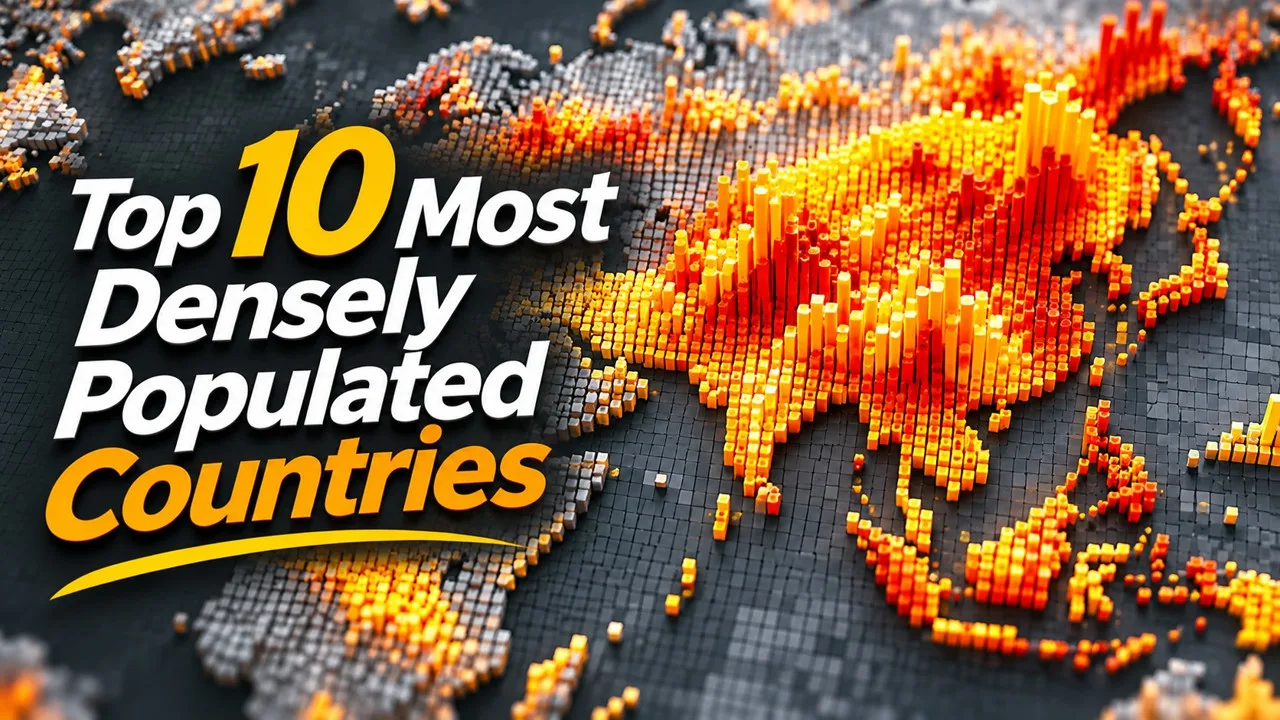
The ten most densely populated UN member countries are ranked by people per square kilometre, from Monaco and Singapore to Rwanda, excluding dependencies. Density is population divided by land area, not a measure of how crowded a single city feels, and it is sensitive to whether microstates are included. This article includes UN member states of any size and leaves out dependent territories such as Macau, Hong Kong and Gibraltar, which would otherwise fill several of the top places [1][2].
The figures follow a compiled table of population densities that draws on official population and area statistics [1]. Different agencies update population and land area on different cycles, so a 2026 reading should be treated as the current compiled value, not as a census-day constant. Vatican City, Taiwan and Palestine appear in some density tables but are not UN member states in the same sense, so they are omitted from the ranked ten and mentioned only where a comparison helps [1][2].
Key Facts
Ranks are by people per square kilometre for UN member states. Dependent territories are excluded. Land area, not total area including large water bodies, is the usual denominator in these compilations.
Most Densely Populated Countries at a Glance
| Rank | Country | Density (per km2) | Density (per sq mi) | Population (compiled) | Land area (km2) |
|---|---|---|---|---|---|
| 1 | Monaco | 19,428 | 50,320 | 38,857 | 2 |
| 2 | Singapore | 8,290 | 21,500 | 6,110,200 | 737 |
| 3 | Bahrain | 2,034 | 5,270 | 1,607,049 | 790 |
| 4 | Maldives | 1,759 | 4,560 | 527,799 | 298 |
| 5 | Malta | 1,686 | 4,370 | 539,607 | 320 |
| 6 | Bangladesh | 1,362 | 3,530 | 178,562,364 | 130,170 |
| 7 | Barbados | 657 | 1,700 | 282,468 | 430 |
| 8 | Mauritius | 637 | 1,650 | 1,271,169 | 1,997 |
| 9 | Nauru | 597 | 1,550 | 11,947 | 20 |
| 10 | Rwanda | 578 | 1,500 | 14,256,567 | 24,670 |
1. Monaco
Monaco is first by a very large margin among UN members, at about 19,428 people per square kilometre, or about 50,320 per square mile, on a land area of only about two square kilometres [1]. The compiled population is a few tens of thousands. No other UN member is even close. Macau, a Chinese special administrative region, is denser still in the same table, but it is not a country for this ranking [1].
The principality is a built-up coastal state. Its density is a consequence of a tiny official area, not of a population that would look large in a bigger country. First place is stable unless the land area used in the official statistics changes [1][2].
Monaco is also a useful warning about the metric. A visitor sees a continuous urban waterfront and may assume that every dense country looks the same. The later ranks show that this is not true. First place here means only that the official population, divided by the official land area, is the highest among UN members [1].
2. Singapore
Singapore is second, at about 8,290 people per square kilometre, or 21,500 per square mile, with a compiled population of about 6.11 million on about 737 square kilometres [1]. That is less than half of Monaco’s density and still four times Bahrain’s.
Singapore is a sovereign city-state and an island country. Reclaimed land has enlarged the official area over time, which slightly lowers density compared with older figures, but not enough to threaten second place among UN members. Hong Kong is in the same density range in the compiled table, but it is a Chinese special administrative region and is excluded here [1][2].
Related: Top 10 Most Bizarre Phobias: Strange Fears That Exist
Second place is the highest rank available to a country with a population in the millions rather than in the tens of thousands. That is the comparison that usually matters in public debate, and it is why Singapore is often treated as the practical first example even though Monaco is denser [1].
3. Bahrain
Bahrain is third, at about 2,034 people per square kilometre, or 5,270 per square mile, with a compiled population of about 1.61 million on about 790 square kilometres [1]. It is the densest UN member that is not a European or Southeast Asian city-state of the Monaco or Singapore type.
The country is an archipelago in the Persian Gulf. Third place sits well below Singapore and well above the Maldives and Malta, which cluster in the 1,600 to 1,800 range. Vatican City, if it were admitted as a UN member, would sit between Singapore and Bahrain on the same table, at about 2,205 people per square kilometre, but it is omitted from the ranked ten [1].
Bahrain’s area, like Singapore’s, has been affected by reclamation. The density used here is the compiled land-area figure in the same table as the population, so the rank stays tied to those published numbers [1].
4. Maldives
The Maldives are fourth, at about 1,759 people per square kilometre, or 4,560 per square mile, with a compiled population of about 528,000 on about 298 square kilometres of land [1]. The country’s total territory includes a much larger sea area; density is calculated on land.
Fourth place is close to Malta. A small revision of either land area or population could swap the two. On the compiled figures, the Maldives remain ahead [1].
Related: Top 10 Oldest Buildings in the World
5. Malta
Malta is fifth, at about 1,686 people per square kilometre, or 4,370 per square mile, with a compiled population of about 540,000 on about 320 square kilometres [1]. It is the densest UN member in the European Union.
Fifth place is a few tens of people per square kilometre behind the Maldives and clearly ahead of Bangladesh. Malta’s density is that of a small, fully settled island state, not of a large agricultural country [1][2].
6. Bangladesh
Bangladesh is sixth, at about 1,362 people per square kilometre, or 3,530 per square mile [1]. The compiled population is about 178.6 million on about 130,170 square kilometres. It is the only country in the ten with a population well into the hundreds of millions, and it is the densest large country on the list.
Sixth place is in a different class from the island microstates above it, but the density figure is still more than twice Barbados’s. For comparisons of how many people live on a large, mostly rural and urban floodplain, Bangladesh is the usual first example, even though Monaco and Singapore are denser as states [1][2].
The compiled land area of about 130,170 square kilometres is what makes this rank notable. Many countries have dense capital regions. Few combine a national population above 170 million with a national density still above 1,300 people per square kilometre [1].
Related: The Science Behind Auroras: How Solar Winds Create Colorful Skies
7. Barbados
Barbados is seventh, at about 657 people per square kilometre, or 1,700 per square mile, with a compiled population of about 282,000 on about 430 square kilometres [1]. The drop from Bangladesh is sharp.
Seventh place opens a tight cluster of island states and one African mainland country. Barbados is ahead of Mauritius on the compiled figures, and both are far below the first six [1].
8. Mauritius
Mauritius is eighth, at about 637 people per square kilometre, or 1,650 per square mile, with a compiled population of about 1.27 million on about 1,997 square kilometres [1]. It is an Indian Ocean island state. Eighth place is close to Barbados and a little ahead of Nauru. The compiled table’s companion land-area and population figures should be read from the same row as the density, because agencies sometimes publish slightly different official areas for island states [1].
9. Nauru
Nauru is ninth, at about 597 people per square kilometre, or 1,550 per square mile, with a compiled population of about 11,950 on about 20 square kilometres [1]. It is one of the smallest UN members by area, a raised coral island in the Pacific. Ninth place is close to Rwanda and Mauritius. A small population change moves the figure quickly, because the denominator is tiny [1].
10. Rwanda
Rwanda is tenth, at about 578 people per square kilometre, or 1,500 per square mile, with a compiled population of about 14.3 million on about 24,670 square kilometres [1]. It is the densest mainland country in Africa on this compiled list, and the only landlocked country in the ten. Lebanon and San Marino sit just below it in the same table and would be next if the list were extended [1].
Related: 10 Sikh Gurus: The Pillars of Sikhism Who Shaped Faith, Equality, Courage, and Humanity
Tenth place is not a microstate result. Rwanda’s density comes from a large population on a modest, hilly land area. That is a different path to a high figure from Monaco’s, and it is why a density list that excluded city-states would still have Rwanda near the top of the remaining countries [1][2].
Density figures for the smallest states move when a census or a mid-year estimate is revised, and they also move when official land area is restated after reclamation or a new survey. That is why this article quotes the compiled table rather than a single unlabelled integer, and why Monaco and Singapore can be described as first and second with more confidence than Nauru can be described as ninth to the last person [1]. For Bangladesh and Rwanda, the area is large enough that ordinary annual population change shifts the density only a little, so their ranks are more stable than those of the tiniest islands.
A practical reading of the ten is therefore in two groups. The first group, Monaco through Bangladesh, is a set of clear steps from a city-state of two square kilometres down to a large, densely settled country of more than 130,000 square kilometres. The second group, Barbados through Rwanda, is a narrower band around 600 people per square kilometre, where several island states and one mainland African country sit close together. Anyone using the list to talk about “overcrowding” should keep that split in view: a high national density does not by itself say whether people live in high-rise housing, on small farms, or both [1][2].
Conclusion
The ten densest UN member countries on the compiled people-per-square-kilometre figures are Monaco, Singapore, Bahrain, the Maldives, Malta, Bangladesh, Barbados, Mauritius, Nauru and Rwanda [1]. The first six are separated by large steps; the last four form a closer cluster around 600 people per square kilometre. Dependencies such as Macau, Hong Kong and Gibraltar are denser than most of these states, but they are not countries for this ranking. Vatican City would stand among the first four if it were treated as a UN member, and Taiwan would stand near Barbados; both are left out of the ranked ten for the membership rule stated at the top [1][2]. Density will move as new population estimates appear, especially for the smallest states, so the 2026 use of this list is the compiled rank and the method, not a claim that each integer is fixed.
- ^ [1] "List of countries and dependencies by population density", compiled density, population and land area. Wikipedia. Wikipedia: countries by population density
- ^ [2] United Nations and national statistical series underlying standard density tables, summarized in the same compilation. Wikipedia compilation and sources






















Discussion
Log in with