






Top 10 Abandoned Transport Projects That Could Have Changed America
 By Dhiraj Sharma · Published
Share Post
Loading…
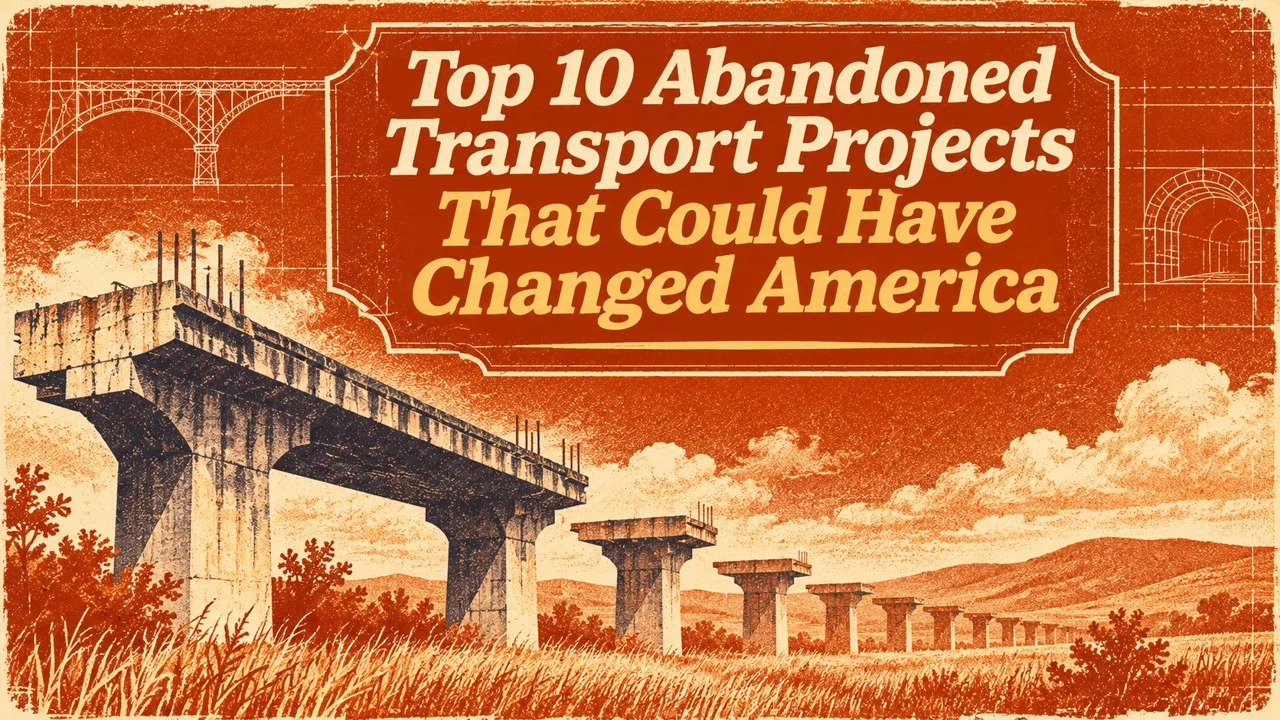
America has a long list of transport dreams that never happened, from a secret pneumatic subway to nuclear planes, supersonic jets and a canal across Florida. The United States is full of roads, railways and airports, but it is also full of transport projects that were planned, started or even partly built and then abandoned. Some were stopped by cost, some by public opposition and some because the technology never worked as hoped.
Looking at these projects shows how different American cities and travel might have been. Some would have improved transport, while others would probably have caused great harm, cutting through neighborhoods or damaging the environment. Their stories reveal the competing forces that shape infrastructure, including money, politics, technology and the voices of local communities.
The ten projects below are the Beach Pneumatic Transit, the long-delayed Second Avenue Subway, the Lower Manhattan Expressway, the Cross Florida Barge Canal, the Boeing 2707 supersonic airliner, the nuclear-powered aircraft program, Chicago's Crosstown Expressway, Washington's Three Sisters Bridge, the Seattle Monorail Project and Hyperloop One.
Key Facts
| # | Project | Place and years | Why it stopped |
|---|---|---|---|
| 1 | Beach Pneumatic Transit | New York City, 1870 to 1873 | Never extended beyond a single block |
| 2 | The Second Avenue Subway | New York City, planned 1920s | Delayed for decades by depression, war and fiscal crisis |
| 3 | The Lower Manhattan Expressway | New York City, 1940s to 1971 | Defeated by community opposition |
| 4 | The Cross Florida Barge Canal | Florida, 1930s to 1990 | Halted over environmental concerns |
| 5 | The Boeing 2707 | United States, 1960s to 1971 | Funding cut over cost and noise concerns |
| 6 | Aircraft Nuclear Propulsion | United States, 1946 to 1961 | Cancelled because of cost and radiation risks |
| 7 | The Crosstown Expressway | Chicago, 1960s to 1979 | Cancelled over community opposition and funding priorities |
| 8 | The Three Sisters Bridge | Washington, D.C., 1960s to 1977 | Stopped by protests and court cases |
| 9 | The Seattle Monorail Project | Seattle, 1997 to 2005 | Cancelled by voters over financing |
| 10 | Hyperloop One | United States, 2014 to 2023 | Shut down without a commercial route |
1. A Secret Subway Pushed by Air
In 1870, the inventor and publisher Alfred Ely Beach opened a demonstration subway under Broadway in Manhattan. A single car ran through a tunnel about one block long, pushed by air from a giant fan, in a system known as pneumatic transit [1].
Beach had built the tunnel with limited permission, officially for a mail tube, and its elegant waiting room became a popular attraction. He hoped to extend the line, but he faced political opposition, including from the powerful Tammany Hall organization, and a financial panic in 1873 ended investment [1].
The tunnel was sealed and largely forgotten. It was rediscovered during the construction of the BMT subway in 1912. Beach's system was too limited to serve a whole city, but it was New York's first experiment with a subway, decades before the first underground line opened in 1904.
2. A Subway Line That Waited a Century
The Second Avenue Subway was proposed in the 1920s to serve Manhattan's East Side. Elevated railways on Second and Third Avenues were torn down in the 1940s and 1950s, partly on the promise that a subway would replace them [2].
Construction began several times but was halted by the Great Depression, the Second World War and New York's fiscal crisis of the 1970s. Short sections of tunnel built in the 1970s sat unused for decades. Residents of the East Side relied on crowded lines along Lexington Avenue [2].
The first phase finally opened on 1 January 2017, with three stations on the Upper East Side, almost a century after the line was first planned. Further phases are under construction. The project became a symbol of how difficult and expensive large transit projects can be in American cities.
Related: Top 10 Longest Vehicle-Carrying Sea Bridges
3. An Expressway Across Lower Manhattan
The Lower Manhattan Expressway was a highway planned to cross lower Manhattan, connecting the Holland Tunnel with the Manhattan and Williamsburg Bridges. It was strongly promoted by the urban planner Robert Moses [3].
The road would have required demolishing large parts of neighborhoods now known as SoHo and Little Italy, including many cast-iron buildings. The writer and activist Jane Jacobs helped lead community opposition, arguing that the highway would destroy lively, mixed-use streets [3].
The project was officially cancelled in 1971. The neighborhoods it would have destroyed later became some of the most desirable and valuable in New York. The defeat of the expressway is often seen as a turning point in American urban planning, encouraging cities to value existing communities over highway building.
4. A Canal Across Florida
The idea of a canal across northern Florida, linking the Atlantic Ocean with the Gulf of Mexico, dates back centuries. Work began in the 1930s as a Depression jobs project but was stopped. In the 1960s, construction of a barge canal started again, with locks and dams [4].
The project faced growing opposition from environmentalists, led by Marjorie Harris Carr, who argued that it would damage the Ocklawaha River and threaten Florida's water supply. In 1971, President Richard Nixon halted construction, and Congress formally deauthorized the canal in 1990 [4].
The land acquired for the canal became the Marjorie Harris Carr Cross Florida Greenway, a long corridor of parks and trails. The canal's story is one of the first major victories of the modern environmental movement in the United States.
5. An American Supersonic Airliner
In the 1960s, the United States government sponsored the development of a supersonic airliner to compete with the Anglo-French Concorde and the Soviet Tu-144. Boeing won the competition with a design known as the 2707, which was larger and faster than Concorde [5].
Related: Top 10 Expensive Infrastructure Projects That Failed
The project faced technical problems, rising costs and growing concerns about sonic booms, noise near airports and possible effects on the upper atmosphere. In 1971, Congress voted to end federal funding, and the program was cancelled before a prototype was built [5].
Concorde went on to fly commercially from 1976 to 2003, but it was never a financial success. Supersonic passenger flight has not returned since. Several companies are developing new supersonic aircraft, aiming to reduce noise and fuel use, but none has yet entered passenger service.
6. Planes Powered by Atoms
After the Second World War, the United States began researching aircraft powered by nuclear reactors. In theory, such planes could fly for weeks without refueling, which appealed to military planners during the Cold War [6].
The program produced experimental reactors and tested a reactor on board a modified B-36 bomber, which flew dozens of times carrying a working reactor, though the plane was not powered by it. Engineers struggled with the weight of shielding needed to protect crews and with the danger of radiation in a crash [6].
President John F. Kennedy cancelled the program in 1961, after more than a billion dollars had been spent. Intercontinental missiles had made long-range nuclear bombers less important. The project is now seen as one of the most ambitious and risky ideas of the atomic age.
7. An Expressway That Was Never Built
The Crosstown Expressway was a planned highway along the western and southern sides of Chicago, intended to connect several major expressways without passing through downtown. It was supported by Mayor Richard J. Daley [7].
The route would have required demolishing thousands of homes and businesses, and community groups opposed it. After Daley's death in 1976, political support weakened. In 1979, the project was cancelled, and much of the federal money set aside for it was redirected to other transport projects [7].
Related: Top 25 Interesting Facts About the Solar System
Some of that money helped fund the Chicago Transit Authority's Orange Line to Midway Airport, which opened in 1993. The decision illustrates a broader shift in the 1970s, when many American cities began to cancel urban highways in favor of transit and neighborhood preservation.
8. A Bridge Across the Potomac
The Three Sisters Bridge was a planned highway bridge across the Potomac River, named after a group of small islands near the proposed site. It was part of a larger plan for freeways through Washington, D.C [8].
The project became the focus of fierce opposition from residents and activists, who argued that freeways would damage neighborhoods and parkland. Construction began, but protests and lawsuits repeatedly stopped work, and the bridge became a national symbol of the so-called freeway revolts [8].
The bridge was finally abandoned in the 1970s, and Washington built the Metrorail system instead of many of the planned freeways. The city's relative lack of urban freeways compared with many other American cities is partly a result of these battles.
9. A Monorail Voted Away
Seattle has had a short monorail since the 1962 World's Fair. In 1997, voters approved a plan to build a much larger monorail network across the city, and later votes supported funding for a first line [9].
The project ran into financial trouble. Its financing plan relied on a car tax and long-term bonds, and estimates showed that the total cost, including interest, would be far higher than expected. Public support collapsed [9].
Related: Top 25 Interesting Facts About the Universe
In 2005, voters approved a measure to end the project, after more than 100 million dollars had been spent on planning and property. Seattle later expanded its light rail system instead. The monorail project is often cited as a lesson in the importance of realistic financing for public transport.
10. A Tube That Went Nowhere
In 2013, the entrepreneur Elon Musk published a proposal for a hyperloop, a system in which pods would travel through low-pressure tubes at very high speeds. Several companies were founded to develop the idea, including Hyperloop One, later known as Virgin Hyperloop [10].
Hyperloop One built a test track in the Nevada desert and in 2020 carried passengers in a test pod for the first time, at a modest speed. The company signed agreements to study routes in several countries, but none moved to construction [10].
Facing high costs and technical challenges, the company shifted its focus to cargo and then shut down at the end of 2023. Critics had long argued that the system's costs and safety issues were underestimated. Its story shows how a new transport idea can attract attention and investment without becoming practical.
Conclusion
The ten projects above show the many reasons transport plans fail. Some, like Beach's subway and the Boeing 2707, were ahead of their time or limited by technology. Others, like the urban expressways and the Florida canal, were stopped by communities and environmentalists who saw their costs more clearly than their planners did.
Not every abandoned project is a loss. Some cities are better places because certain highways were never built. But together, these stories show that transport decisions shape cities for generations, and that what is not built can matter as much as what is.
- ^ [1] Accounts of Beach's pneumatic subway. Wikipedia: Beach Pneumatic Transit Wikipedia: Alfred Ely Beach
- ^ [2] Accounts of the Second Avenue Subway. Wikipedia: Second Avenue Subway Wikipedia: IRT Second Avenue Line
- ^ [3] Accounts of the Lower Manhattan Expressway. Wikipedia: Lower Manhattan Expressway Wikipedia: Jane Jacobs
- ^ [4] Accounts of the Cross Florida Barge Canal. Wikipedia: Cross Florida Barge Canal Wikipedia: Marjorie Harris Carr
- ^ [5] Accounts of the Boeing 2707 program. Wikipedia: Boeing 2707 Wikipedia: Concorde
- ^ [6] Accounts of nuclear aircraft research. Wikipedia: Aircraft Nuclear Propulsion Wikipedia: Convair NB-36H
- ^ [7] Accounts of the Crosstown Expressway. Wikipedia: Crosstown Expressway Wikipedia: Orange Line (CTA)
- ^ [8] Accounts of the Three Sisters Bridge and freeway revolts. Wikipedia: Three Sisters Bridge Wikipedia: freeway revolts
- ^ [9] Accounts of the Seattle Monorail Project. Wikipedia: Seattle Monorail Project Wikipedia: Seattle Center Monorail
- ^ [10] Accounts of Hyperloop One. Wikipedia: Hyperloop One Wikipedia: hyperloop





















Discussion
Log in with