






Top 10 Hidden Facts About America's Interstate Highways
 By Dhiraj Sharma · Published
Share Post
Loading…
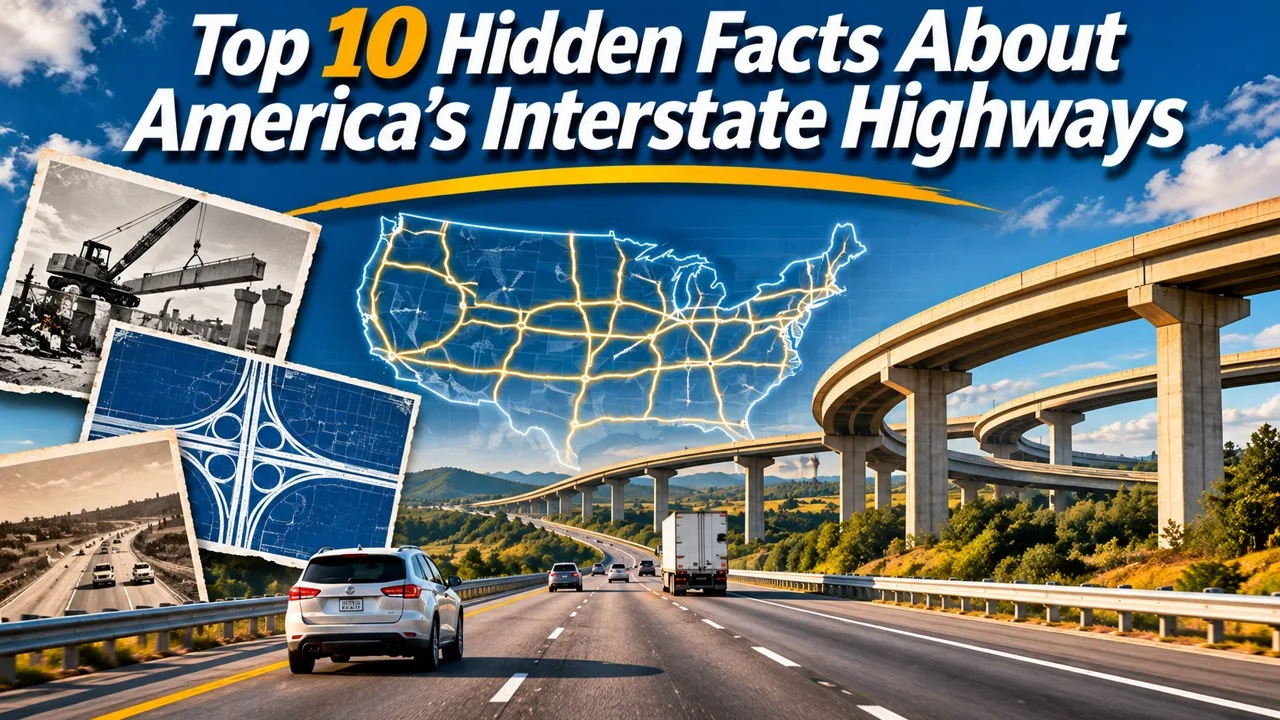
The 1919 military convoy that helped inspire the interstates is real; the story that one mile in five was built as a secret runway is not. The Interstate Highway System is so familiar that it has grown a folklore: secret airstrips, finished maps, perfectly neutral routes [2][5][7]. The ten facts below are the version that survives a check against official rules, engineering histories, and the record of what was actually built, and through whose streets [1][3][7]. A numbering scheme can be a quiet navigational code. A rest area can be a piece of mid-century design. A corridor can also be a demolition plan [3][7][8]. None of those facts needs a government shield drawn as a logo in an accompanying picture, and this article will not supply one [3].
The system is a public work, not a riddle. The unexpected parts are in the archive, not in a rumor about a hidden runway.
Key Facts
These are documented features of the American interstates: origins, numbering, myths, design, unfinished pieces, and social cost.
Ten Facts at a Glance
| Rank | Claim | Careful version |
|---|---|---|
| 1 | The 1919 convoy | A miserable military truck convoy helped convince Dwight Eisenhower that the country needed a serious national road system |
| 2 | The runway myth | The idea that one mile in every five was built as a secret aircraft runway is a durable falsehood |
| 3 | Rest-area design | Some early rest stops were commissioned as small works of architecture, later often rebuilt or demolished |
| 4 | Routed through communities | Urban interstates were often driven through Black, poor, or otherwise politically weak neighborhoods, a documented pattern, not a vague slight |
| 5 | Mile-based exits | In many states, exit numbers follow mileposts and can tell you how far you have come |
| 6 | Unfinished system | Planned segments were delayed, cancelled, or left as gaps; the map was never a completed cathedral |
| 7 | Billboard rules | The 1965 Highway Beautification Act, associated with Lady Bird Johnson, tried to limit billboards and encourage landscaping, with mixed results |
| 8 | Numbering code | One-, two-, and three-digit interstate numbers encode direction and the kind of route, with exceptions |
| 9 | Wildlife crossings | Some interstate structures are bridges or underpasses built for animals, not for cars |
| 10 | In-state routes | Several primary interstates never leave the state that contains them |
1. A Convoy that Took Two Months
In 1919, a United States Army truck convoy, with Lieutenant Colonel Dwight Eisenhower among the officers, set out from Washington to San Francisco on the Lincoln Highway and related roads [1]. The trip took about two months. Vehicles stuck in mud, broke on bad grades, and advertised, more clearly than any speech, that a continental country did not yet have a continental road [1]. After the Second World War, Eisenhower's support for a national system of limited-access highways had many causes, including what he had seen of the German autobahns, but he himself pointed back to that convoy as an early education. The unexpected fact is how late, and how uncomfortable, that education was. A future president learned about mud the long way.
A miserable trip is not, by itself, a statute. It is a memory that later had law and money behind it.
2. One Mile in Five, and a Story that Will Not Die
A story still circulates that one mile in every five of interstate was built straight and strong so that it could be used as a military runway [2]. Officials and highway historians have been denying it for decades. Interstate design standards are about cars and trucks: grades, curves, lanes, and shoulders, not a hidden air force [2]. Some stretches are straight, because the land is flat or the design speed is high. A few roads in the world were in fact built with emergency-landing in mind, and those cases get borrowed, wrongly, as if they were the rule for the entire American system. The unexpected fact is the persistence of the rumor. A public work this large seems as if it must have a secret, and the runway is the secret people prefer.
A denial can be boring and still be true. This one is true.
3. A Picnic Shelter with an Architect
Early rest areas, especially in the 1950s through the 1970s, were sometimes designed as modest showpieces: a particular roofline, a local stone, a modernist toilet block, a picnic shelter with a pedigree [3]. State highway departments hired architects, issued brochures, and treated the stop as part of the system's public face. Later decades brought standardized, larger travel plazas, demolition, and a more commercial kind of stop, and many of the small original buildings are gone [3]. The unexpected fact is that a bathroom break was, for a while, a design problem, not only a plumbing one. A few of the survivors are now loved as mid-century odds and ends, which is a better fate than being remembered only as a rumor of a runway.
Related: Top 10 Highest Bridges in the World
A rest area can be architecture and still be a rest area. The system was proud of itself, and it showed that pride in small, strange buildings beside the ramp.
4. A Corridor Chosen through Someone's Street
When the interstates entered cities, they were often routed through neighborhoods that had less political power to push them away: Black districts, immigrant districts, poor districts, sometimes already scarred by earlier "renewal" [4]. The record is specific, not a vague moral. St. Paul lost much of the Rondo neighborhood to Interstate 94. Miami's Overtown was cut by Interstate 95. Other cities have similar files, with highway departments, local business coalitions, and federal money in the same folder [4]. The result was demolished housing, divided communities, and, in later years, a long argument about repair, lids, and removals. This entry is a documented planning history, not a speech. The unexpected fact, for drivers who only know the overpass, is that the overpass has an address underneath it, or used to.
A map can look neutral and still be a choice. The choice, in many urban corridors, was whose street would become a trench.
5. An Exit Number that Is Also a Mile
In a large share of states, interstate exit numbers are tied to mileposts, so that exit 214 is near mile 214, usually counted from a south or west state line [5]. The system lets a driver estimate remaining distance, and it avoids the chaos of renumbering every exit when a new ramp is inserted, because a new exit can take a suffix or a number that still matches the mile [5]. Some older urban stretches, and a few states for a long time, used sequential numbers instead, which is why a traveler can still be surprised. The unexpected fact is only this hidden courtesy. The sign is not an arbitrary label. It is, often, a terse odometer.
A number can be a tool. This one is, when the state has finished the conversion, and when the driver knows the rule.
Related: Top 10 Remarkable Funiculars of the World
6. A System with Gaps on Purpose, and by Accident
The Interstate Highway System is sometimes described as if it were completed on a single date. In fact, some planned segments were delayed for decades, some were cancelled after local opposition, and some still exist as unbuilt official numbers or as awkward gaps [6]. Interstate 95, to take a famous case, went for years without a continuous limited-access path through New Jersey, and other corridors have similar incomplete or legally thorny stretches [6]. New spurs are still added. Old urban inner loops are, in a few cities, being reconsidered or removed. The unexpected fact is that a "system" can be official, numbered, and still unfinished, because law, money, and neighborhoods do not end when a mid-century map is printed.
A gap is sometimes a failure and sometimes a decision. Both kinds appear on the real map.
7. Billboards, and a First Lady's Campaign
By the early 1960s, the new limited-access roads had also become a linear gallery of billboards. Lady Bird Johnson made roadside appearance a public cause, and the Highway Beautification Act of 1965 tried to limit billboards on federal-aid highways, to fund screening and landscaping, and to push junkyards back from the pavement [7]. The law had loopholes, later amendments, and a mixed record: signs still proliferate in many corridors, and the "Lady Bird" brand is stronger than the enforcement in some states [7]. The unexpected fact is that an aesthetic campaign became a federal statute at all, and that the statute is still the frame for a fight that has not ended. Beautification, here, is policy, not a bouquet.
A view from a windshield can be a political object. This one was, and it still is.
Related: Top 10 Famous Tram Networks Worth the Ride
8. Odd, Even, and a Three-Digit Exception
Interstate numbers are not assigned at random. Primary routes with one or two digits generally run odd for north-south and even for east-west, with lower numbers in the west and the south and higher numbers in the east and the north, a grid you can feel once it is pointed out [8]. Three-digit numbers usually mark spurs and loops, and the first digit is a clue: even first digits often mean a belt or a bypass that reconnects, odd first digits a spur that does not [8]. There are exceptions, leftovers, and later compromises, because no system this large stays perfectly tidy. The unexpected fact is that a bored passenger can, with the rule in mind, guess a good deal about a route from the number alone, without a map, and be right more often than not.
A code on a sign is a public tool. It was meant to be learned, even if most of us never sat down to learn it.
9. A Bridge that Is Not for the Car
Some structures on or over the interstate system are built for elk, deer, desert bighorn, panthers, or smaller animals, as overpasses with soil and plants, or as underpasses and culverts meant to keep a crossing off the pavement [9]. The designs have been used in Florida, in the western states, and, increasingly, elsewhere, and they are studied for crash reduction as well as for conservation [9]. They are not a secret, and they are not a novelty art project, though the planted overpasses photograph well. The unexpected fact is only that a highway department can have a client that does not drive, and that the budget line for that client can be justified in injuries avoided as well as in animals saved.
A fence without a crossing is a trap. A crossing, if it is placed well, is a rare case of a highway admitting that it is also a barrier.
Related: Top 10 Most Impressive Highway Interchanges in the World
10. A Primary Route that Never Crosses a Line
Most of the famous one- and two-digit interstates cross several states. A few never leave the state they start in: Interstate 4 in Florida, Interstate 27 and Interstate 45 in Texas, Interstate 19 in Arizona, and a short list of others [10]. They are still "interstates" in the legal and funding sense, because the system is a standard of design and a federal program, not a requirement that every route be interstate in the everyday meaning of the word [10]. The unexpected fact is linguistic. A road can be an interstate without being inter-state, which is the kind of small official joke that only a naming system can produce.
A traveler can ride a primary interstate from one end to the other and still be in the same statehouse's jurisdiction. The sign does not lie. The English does, a little.
Conclusion
The ten facts above take the interstate system down from folklore and, in one case, down from a myth about runways. A 1919 convoy helped teach a future president that the country was still muddy. A numbering code, a mile-based exit, and a handful of in-state primary routes show how official the system is, and how odd official things can be. Rest areas were once little essays in design. Wildlife crossings are essays of another kind. Billboard law tried, with mixed success, to police the view. The map was never truly finished, and in cities the finished parts were often driven through neighborhoods that could not stop them. That last fact is not an insult added to a list of curiosities. It is part of how the system was built.
A highway can be a convenience, a code, and a scar. The honest list keeps all three.
- ^ [1] Official and historical accounts of the 1919 transcontinental motor convoy and Eisenhower's later comments on it. Britannica: Dwight D. Eisenhower
- ^ [2] Highway-agency and historian denials of the "one mile in five is a runway" story. Britannica: Interstate Highway System
- ^ [3] Histories of mid-century rest-area design and later reconstruction or demolition. Britannica: Interstate Highway System
- ^ [4] Documented cases of urban interstates routed through Black, poor, or otherwise politically weak neighborhoods, including Rondo and Overtown. Britannica: Urban renewal
- ^ [5] Federal and state explanations of mile-based exit numbering. Federal Highway Administration: Interstate frequently asked questions
- ^ [6] Histories of delayed, cancelled, or still-incomplete interstate segments, including long-running gaps on major routes. Britannica: Interstate Highway System
- ^ [7] The Highway Beautification Act of 1965 and Lady Bird Johnson's roadside campaign. Britannica: Lady Bird Johnson
- ^ [8] Official interstate numbering conventions for one-, two-, and three-digit routes. Federal Highway Administration: Interstate numbering
- ^ [9] Engineering and conservation studies of wildlife overpasses and underpasses on American highways. Britannica: Wildlife management
- ^ [10] Route logs of primary interstates that do not leave a single state, including I-4, I-19, I-27, and I-45. Britannica: Interstate Highway System



















Discussion
Log in with