






 By
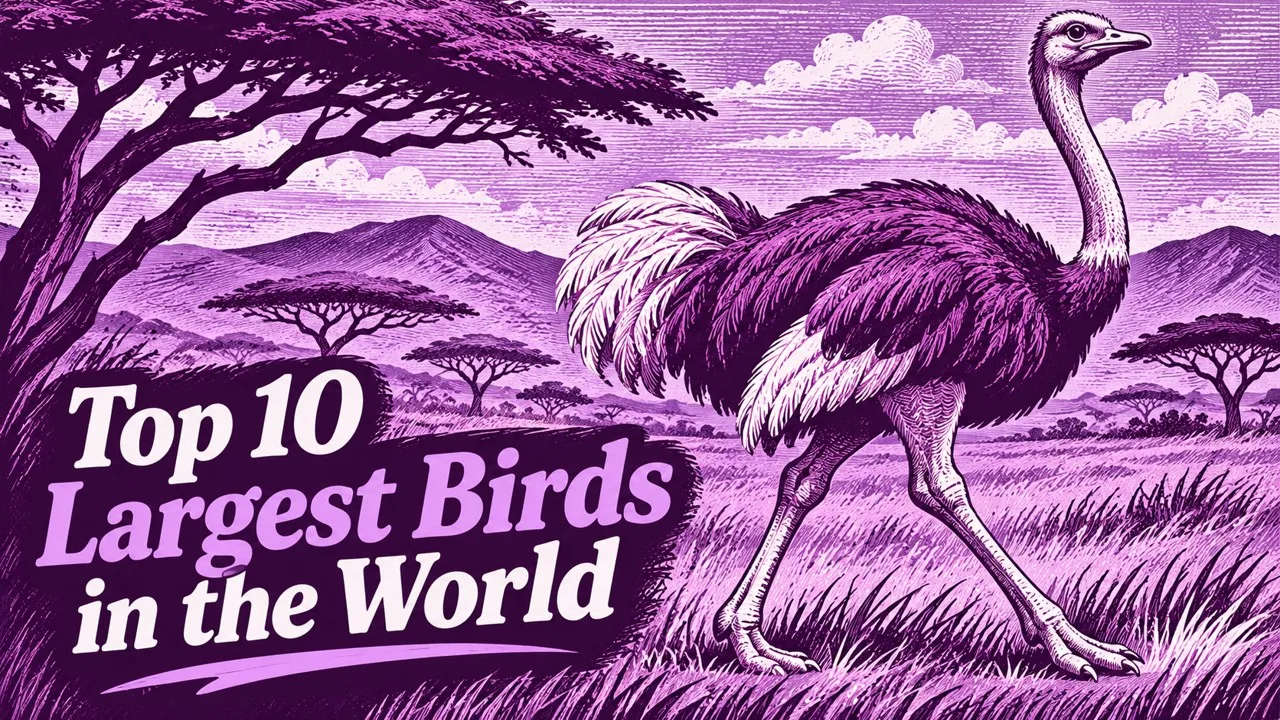
From the ostrich to the wandering albatross, these ten largest birds in the world set records for height, weight and wingspan on land, sea and in the air. Birds come in a huge range of sizes, and the biggest ones have taken very different paths. Some gave up flight and grew tall and heavy, while others kept flying and developed enormous wings for soaring over oceans and mountains.
This list covers ten living birds that are among the largest by height, weight or wingspan. It mixes flightless giants with the heaviest and widest-winged flyers, and the figures are typical ranges for adults taken from ornithological references.
Key Facts
The ten birds below include five flightless giants and five record-setting flyers.
The Largest Birds at a Glance
| # | Bird | Region | Typical size | Can it fly |
|---|---|---|---|---|
| 1 | Common Ostrich | Africa | Up to about 2.7 m tall | No |
| 2 | Somali Ostrich | Horn of Africa | Up to about 2.5 m tall | No |
| 3 | Southern Cassowary | New Guinea and Australia | Up to about 1.8 m tall | No |
| 4 | Emu | Australia | Up to about 1.9 m tall | No |
| 5 | Emperor Penguin | Antarctica | Up to about 1.3 m tall | No |
| 6 | Kori Bustard | Southern and eastern Africa | Males up to about 18 kg | Yes |
| 7 | Andean Condor | Andes of South America | Wingspan up to about 3.3 m | Yes |
| 8 | Wandering Albatross | Southern Ocean | Wingspan up to about 3.5 m | Yes |
| 9 | Dalmatian Pelican | Southeast Europe to China | Wingspan up to about 3.5 m | Yes |
| 10 | Mute Swan | Europe and Asia | Up to about 15 kg | Yes |
1. Common Ostrich
The common ostrich is the largest and heaviest living bird. Adult males can stand about 2.1 to 2.8 metres tall and weigh more than 100 kilograms. It lives in open savanna and semi-desert across parts of Africa. [1]
The ostrich cannot fly, but it is the fastest bird on land and can run at around 70 kilometres per hour. It also lays the largest egg of any living bird, weighing about 1.4 kilograms, and has the largest eyes of any land animal. [1]
Ostriches live in small groups, and several females may lay eggs in a single shared nest guarded by a dominant pair. They were farmed widely in the nineteenth century for their plumes, which were in high demand for fashion.
Key Figures
- Height: about 2.1 to 2.8 metres
- Weight: around 100 to 150 kilograms in males
- Top running speed: about 70 kilometres per hour
Why It Made the List
The ostrich holds several records at once for height, weight, egg size and running speed. It is the benchmark against which every other large bird is measured.
2. Somali Ostrich
The Somali ostrich was long treated as a subspecies of the common ostrich, but many authorities now recognise it as a separate species. It lives in the Horn of Africa, mainly in Somalia, Ethiopia and Kenya. [2]
It is almost as large as the common ostrich. Males are easy to tell apart because their neck and thighs turn blue-grey rather than pink in the breeding season. It tends to browse more than its relative and often lives in bushier country. [2]
The species is listed as vulnerable because of hunting, egg collection and habitat loss in a region affected by conflict. Wild populations are thought to be declining, and little detailed survey work has been possible.
Key Figures
- Range: Somalia, Ethiopia, Kenya and nearby areas
- Recognised as a separate species: from 2014 by several authorities
- Male skin colour: blue-grey neck and legs
Why It Made the List
The Somali ostrich shows how modern genetic studies can split a familiar animal into two species. It ranks as the second-largest bird alive.
Related: Top 10 Colourful Parrots of the World
3. Southern Cassowary
The southern cassowary lives in tropical rainforests of New Guinea and north-eastern Australia. Females are larger than males and can weigh up to about 60 kilograms or more, making it one of the heaviest birds in the world. [3]
It has a tall, helmet-like casque on its head, bright blue and red skin on its neck and powerful legs ending in a long dagger-like inner claw. Cassowaries eat mostly fallen fruit and play an important role in spreading the seeds of rainforest trees. [3]
Cassowaries are usually shy and avoid people, but they can defend themselves with powerful kicks when cornered. Road traffic, dog attacks and the loss of rainforest are the main threats to the Australian population.
Key Figures
- Height: up to about 1.8 metres
- Weight: females often 45 to 60 kilograms or more
- Inner toe claw: up to about 12 centimetres long
- Main food: fallen rainforest fruit
Why It Made the List
The cassowary is the heaviest bird in Australia and Asia. Its role as a seed disperser makes it vital to the health of its rainforest home.
4. Emu
The emu is Australia's largest native bird and the second-tallest living bird after the ostriches. Adults can stand up to about 1.9 metres tall and weigh 30 to 45 kilograms. [4]
Emus are strong walkers and runners, covering long distances in search of food and water and reaching speeds of about 50 kilometres per hour. Males incubate the eggs for around eight weeks and barely eat during that time. [4]
In 1932 Western Australian farmers asked the army for help against emus damaging wheat crops. The so-called Emu War, using machine guns, killed fewer birds than expected and is often remembered as a humorous footnote in history.
Key Figures
- Height: up to about 1.9 metres
- Weight: usually 30 to 45 kilograms
- Incubation: done by the male, about 8 weeks
- Top running speed: about 50 kilometres per hour
Why It Made the List
The emu is the most widespread of the giant flightless birds. It is a national symbol of Australia and has adapted to deserts, plains and forests alike.
5. Emperor Penguin
The emperor penguin is the largest and heaviest of all penguins. Adults stand about 1.1 to 1.3 metres tall and may weigh up to about 45 kilograms before the breeding season. [5]
Related: Top 10 Largest Animals of Their Kind
Emperors breed on the sea ice of Antarctica in the middle of winter. Males hold the single egg on their feet under a fold of skin for about two months, huddling together against temperatures that can fall below minus 40 degrees Celsius. [5]
After the egg hatches, the female returns from the sea to feed the chick, and the parents then take turns travelling to the ocean. Scientists are concerned that thinning sea ice could threaten many breeding colonies this century.
Key Figures
- Height: about 1.1 to 1.3 metres
- Weight: about 22 to 45 kilograms
- Diving depth: over 500 metres recorded
Why It Made the List
The emperor penguin is the largest bird that lives in the sea. Its winter breeding cycle is one of the toughest in the animal world.
6. Kori Bustard
The kori bustard of southern and eastern Africa is among the heaviest birds that can fly. Large males commonly weigh 10 to 18 kilograms, and they are much bigger than females. [6]
Koris spend most of their time walking on open grassland, feeding on insects, small animals and seeds. They fly only when they need to, because taking off is hard work for such a heavy body. Males puff out their white neck feathers in courtship displays. [6]
The kori is the national bird of Botswana. It eats gum from acacia trees as well as animal food, a habit reflected in its Afrikaans name, gompou, which means gum peacock.
Key Figures
- Weight of males: about 10 to 18 kilograms
- Height: up to about 1.2 metres
- Habitat: open grassland and savanna
- National bird of: Botswana
Why It Made the List
The kori bustard sits near the upper weight limit for flying birds. It shows how far a bird can grow and still get off the ground.
7. Andean Condor
The Andean condor is one of the largest flying birds in the world by combined weight and wingspan. Its wings can span about 3 to 3.3 metres, and males can weigh up to around 15 kilograms. [7]
It lives along the Andes and nearby coasts, soaring on rising air for hours with barely a wingbeat while searching for carcasses. Condors breed slowly, raising one chick every year or two, and can live for more than fifty years. [7]
Related: Top 10 Common Misconceptions About Birds
The condor features in the folklore and national symbols of several Andean countries. It is listed as vulnerable, with poisoning and persecution being among the main threats, and captive breeding has been used to support some wild populations.
Key Figures
- Wingspan: about 3 to 3.3 metres
- Weight: up to about 15 kilograms in males
- Lifespan: often more than 50 years
Why It Made the List
The condor has the largest wing area of any land bird. Its efficient soaring makes it a masterclass in flying with very little effort.
8. Wandering Albatross
The wandering albatross has the longest wingspan of any living bird, typically 2.5 to 3.5 metres. It spends most of its life flying over the Southern Ocean and comes to land mainly to breed on remote islands. [8]
Using a technique called dynamic soaring, it gains energy from the wind and the waves and can travel thousands of kilometres in a single foraging trip. Pairs mate for life and raise one chick at a time, so populations recover slowly from losses. [8]
Satellite tracking has shown individual birds covering huge loops of the Southern Ocean between breeding attempts. Many albatross colonies are now protected, and fishing fleets have been encouraged to use bird-scaring lines and weighted hooks to reduce deaths at sea.
Key Figures
- Wingspan: about 2.5 to 3.5 metres
- Weight: about 6 to 12 kilograms
- Breeding: one chick every two years
Why It Made the List
No living bird has longer wings. The wandering albatross is also a symbol of ocean conservation, since many have been killed as bycatch on fishing lines.
9. Dalmatian Pelican
The Dalmatian pelican is the largest of the pelicans and one of the heaviest flying birds. Its wingspan can reach about 3.5 metres, rivalling the albatross, and big males can weigh around 10 to 15 kilograms. [9]
It breeds on lakes, river deltas and wetlands from southeastern Europe across Central Asia to China. Like other pelicans it scoops fish with its large throat pouch. It has curly feathers on its nape, which gave rise to its scientific name, Pelecanus crispus. [9]
Related: Top 10 Fascinating Spiders of the World
The species was once widespread but declined sharply because of wetland drainage, persecution by fishers and collisions with power lines. Several European colonies have recovered since the late twentieth century thanks to wetland protection and nesting rafts.
Key Figures
- Wingspan: up to about 3.5 metres
- Weight: about 7 to 15 kilograms
- Habitat: freshwater lakes and wetlands
Why It Made the List
The Dalmatian pelican combines great size with powered flight. It is also a conservation success in places like Lake Prespa, where protection has helped colonies grow.
10. Mute Swan
The mute swan is one of the heaviest flying birds, with large males weighing up to about 15 kilograms. Its wingspan is around 2 to 2.4 metres, and its long neck is usually held in a graceful S-curve. [10]
Native to Europe and Asia, it has been introduced to North America and other regions. Despite its name it is not silent, and makes hissing and snorting sounds. The rhythmic throbbing of its wings in flight can be heard from a distance. [10]
In Britain the Crown has long claimed ownership of unmarked mute swans on open waters, and the annual Swan Upping census on the River Thames still records and checks the birds. Swans can be fiercely protective of their nests and young.
Key Figures
- Weight: about 9 to 15 kilograms in males
- Wingspan: about 2 to 2.4 metres
- Length: up to about 1.6 metres
Why It Made the List
The mute swan is among the heaviest birds able to fly. Its size and grace have made it a favourite in parks, poems and royal traditions.
Conclusion
The largest birds fall into two groups. The ostriches, cassowary, emu and emperor penguin gave up flight and grew heavy, while the condor, albatross, pelican, bustard and swan show how big a bird can be and still fly.
Many of these giants breed slowly, so they are vulnerable to hunting, habitat loss and fishing bycatch. Protecting them helps to keep some of the most impressive animals on Earth in the wild.
- ^ [1] "Common Ostrich". Wikipedia. Wikipedia: Common ostrich
- ^ [2] "Somali Ostrich". Wikipedia. Wikipedia: Somali ostrich
- ^ [3] "Southern Cassowary". Wikipedia. Wikipedia: Southern cassowary
- ^ [4] "Emu". Wikipedia. Wikipedia: Emu
- ^ [5] "Emperor Penguin". Wikipedia. Wikipedia: Emperor penguin
- ^ [6] "Kori Bustard". Wikipedia. Wikipedia: Kori bustard
- ^ [7] "Andean Condor". Wikipedia. Wikipedia: Andean condor
- ^ [8] "Wandering Albatross". Wikipedia. Wikipedia: Wandering albatross
- ^ [9] "Dalmatian Pelican". Wikipedia. Wikipedia: Dalmatian pelican
- ^ [10] "Mute Swan". Wikipedia. Wikipedia: Mute swan






















Discussion
Log in with