




 By
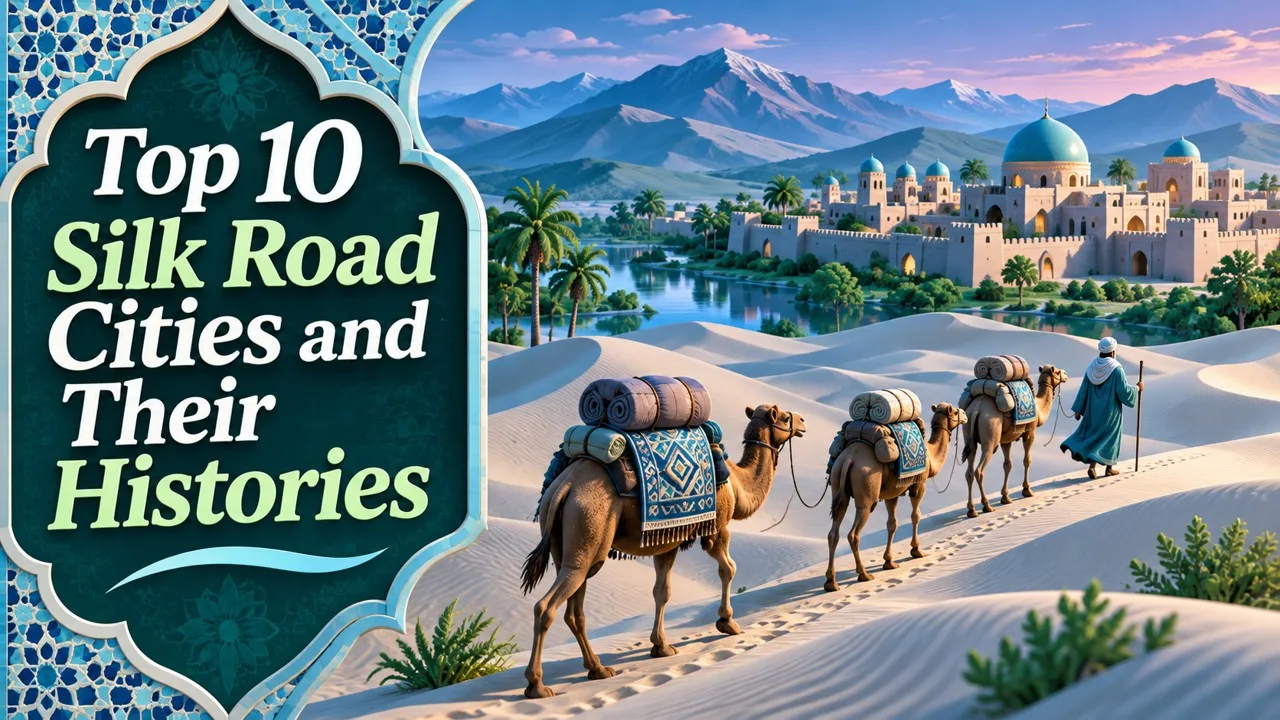
Samarkand, Bukhara, Kashgar and Xi'an grew rich on caravans. Ten Silk Road cities and the stories of trade, faith and conquest that shaped them. The Silk Road was not a single road but a web of caravan routes linking China with Central Asia, Persia, India and the Mediterranean. From about the second century BC, goods such as silk, horses, paper, spices and glass moved along it, together with religions, languages and technologies.
Cities grew up at oases, river crossings and mountain passes where caravans rested and traded. This list picks ten of the most important, from the eastern capital of China to the western gateway of Constantinople, and explains what made each one special.
Key Facts
These ten cities were the main stopping points, markets and cultural centres of the Silk Road.
Silk Road Cities at a Glance
| # | City | Modern country | Golden age | Known for |
|---|---|---|---|---|
| 1 | Xi'an | China | Han and Tang dynasties | Eastern start of the Silk Road |
| 2 | Dunhuang | China | 4th to 14th centuries | Mogao Caves and their library |
| 3 | Turpan | China | Gaochang kingdom era | Oasis below sea level |
| 4 | Kashgar | China | Long-standing crossroads | Meeting point of routes |
| 5 | Samarkand | Uzbekistan | Sogdian and Timurid eras | Registan square and scholarship |
| 6 | Bukhara | Uzbekistan | Samanid era, 9th to 10th centuries | Learning and the Kalyan Minaret |
| 7 | Merv | Turkmenistan | Seljuk era, 11th to 12th centuries | One of the world's largest cities |
| 8 | Khiva | Uzbekistan | Khanate of Khiva, 17th to 19th centuries | Walled inner city |
| 9 | Balkh | Afghanistan | Ancient Bactria | Called the Mother of Cities |
| 10 | Constantinople | Turkey | Byzantine era | Western gateway of the silk trade |
1. Xi'an
Xi'an, known in ancient times as Chang'an, was the capital of the Han dynasty when the envoy Zhang Qian set out westward around 138 BC. His journeys opened Chinese contact with Central Asia and are often treated as the start of organised Silk Road trade. [1]
Under the Tang dynasty, from the seventh to the ninth century, Chang'an was one of the largest cities in the world, with perhaps a million people. Foreign merchants, envoys and monks gathered in its Western Market, and Persian, Sogdian and Arab traders lived in the city. [1]
The monk Xuanzang returned to Chang'an in 645 after years in India, and the Big Wild Goose Pagoda was built to store the Buddhist texts he brought back. Today Xi'an is also famous for the nearby Terracotta Army of the first emperor.
Key Figures
- Ancient name: Chang'an
- Population under the Tang: perhaps around one million
- Key traveller: the monk Xuanzang, returned in 645
Why It Made the List
Chang'an was where many caravans began and ended. Its size and wealth set the demand for goods that kept the whole network moving.
2. Dunhuang
Dunhuang is an oasis town in Gansu province at the edge of the Gobi Desert, close to where the Silk Road split into northern and southern routes around the Taklamakan. Travellers stocked up here before facing the desert crossing, and the Jade Gate and Yang passes lay nearby. [2]
Its fame comes from the Mogao Caves, hundreds of Buddhist cave shrines carved into a cliff over about a thousand years and filled with murals and sculptures. The site became a UNESCO World Heritage Site in 1987. [2]
In 1900 a sealed chamber now called the Library Cave was found to hold tens of thousands of manuscripts in many languages. Among them was a printed copy of the Diamond Sutra dated 868, the oldest known dated printed book.
Key Figures
- Number of decorated caves: about 490
- Library Cave discovered: 1900
- Diamond Sutra date: 868
Why It Made the List
Dunhuang preserves the most complete record of everyday life, religion and art from the Silk Road. Its manuscripts are still being studied around the world.
Related: Top 10 Trade Goods That Connected the Ancient World
3. Turpan
Turpan lies in the Turpan Depression in Xinjiang, one of the lowest and hottest places in Asia. Parts of the basin floor sit more than 150 metres below sea level, and summer temperatures can rise well above 40 degrees Celsius. [3]
The oasis was a key stop on the northern route around the Taklamakan Desert. The ruined cities of Gaochang and Jiaohe nearby were capitals of local kingdoms, and Jiaohe was built on a narrow island plateau between two river channels, carved largely out of the earth itself. [3]
Farmers in Turpan use karez, underground channels that carry meltwater from the mountains without losing much to evaporation. The water allows the oasis to grow grapes, and Turpan is still famous for its raisins and grape-drying houses.
Key Figures
- Lowest point of the depression: about 154 metres below sea level
- Ancient ruins: Gaochang and Jiaohe
- Irrigation system: karez underground channels
Why It Made the List
Turpan shows how Silk Road towns survived in extreme environments. Its clever water engineering and multicultural ruins make it a living link to the old trade routes.
4. Kashgar
Kashgar is the westernmost major city in China, standing at the foot of the Pamir and Tian Shan mountains. Here the northern and southern routes around the Taklamakan Desert met before climbing over the passes towards Central Asia and South Asia. [4]
For more than two thousand years Kashgar was a trading post where caravans changed animals and goods. Its large bazaar, famous for its Sunday livestock market, has long drawn traders from across the region. [4]
The city is a centre of Uyghur culture, and its Id Kah Mosque, founded in the fifteenth century, is one of the largest mosques in China. Kashgar's old town, with its mud-brick houses, has been heavily rebuilt in recent decades.
Key Figures
- Location: western edge of the Taklamakan Desert
- Main mosque: Id Kah, founded around 1442
- Famous market: the Sunday livestock bazaar
- Surrounding mountains: Pamir and Tian Shan
Why It Made the List
Kashgar was the hinge of the Silk Road where China met Central Asia. Its markets still echo the trade that has passed through for centuries.
5. Samarkand
Samarkand is one of the oldest cities in Central Asia, with roots in the settlement of Afrasiab dating to around the seventh century BC. As Maracanda, the Sogdian capital, it was captured by Alexander the Great in 329 BC, and Sogdian merchants from the region became the great middlemen of Silk Road trade. [5]
Related: History of Bombay: From Seven Islands to Mumbai
The city was devastated by the Mongols in 1220 but rose again in the late fourteenth century as the capital of the conqueror Timur. He and his successors filled it with blue-tiled mosques and madrasas, including those around the Registan square. [5]
Timur's grandson Ulugh Beg built an observatory in the 1420s, where astronomers compiled a star catalogue of remarkable accuracy. Samarkand was added to the UNESCO World Heritage List in 2001 as a crossroads of cultures.
Key Figures
- Founded: around the 7th century BC
- Timur's capital: from 1370
- UNESCO listing: 2001
Why It Made the List
Samarkand combined commerce, power and learning. Its Sogdian traders and Timurid scholars made it one of the most influential cities along the routes.
6. Bukhara
Bukhara rose to prominence as the capital of the Samanid dynasty in the ninth and tenth centuries. It became a great centre of Islamic learning and Persian literature, with libraries that drew scholars from across the Muslim world. [6]
The physician and philosopher Ibn Sina, known in Europe as Avicenna, was born near Bukhara around 980 and studied in its royal library. The Samanid Mausoleum, built in the early tenth century, is a masterpiece of decorative brickwork. [6]
The Kalyan Minaret, completed in 1127 and about 45 metres tall, is said to have so impressed Genghis Khan that he spared it when he sacked the city in 1220. The historic centre of Bukhara became a UNESCO World Heritage Site in 1993.
Key Figures
- Samanid capital: 9th and 10th centuries
- Kalyan Minaret: completed 1127
- UNESCO listing: 1993
- Famous scholar born nearby: Ibn Sina, around 980
Why It Made the List
Bukhara shows that the Silk Road traded ideas as well as goods. Its scholars influenced science and medicine far beyond Central Asia.
7. Merv
Merv was an oasis city on the Murghab River in present-day Turkmenistan, on the route linking Persia with Central Asia. Over many centuries several walled cities were built side by side as the settlement shifted, leaving a vast archaeological landscape. [7]
In the eleventh and twelfth centuries Merv was a capital of the Seljuk Turks and is thought to have been one of the largest cities in the world. The mausoleum of Sultan Sanjar, who died in 1157, still stands among the ruins. [7]
Related: Top 10 Best-Preserved Medieval Towns in Europe
In 1221 Mongol forces captured Merv and killed much of its population, and the city never recovered its former size. The site, known as Ancient Merv, became a UNESCO World Heritage Site in 1999.
Key Figures
- River: the Murghab
- Seljuk ruler buried there: Sultan Sanjar, died 1157
- Destroyed by the Mongols: 1221
Why It Made the List
Merv shows how quickly great Silk Road cities could rise and fall. Its ruins record more than two thousand years of urban history in one place.
8. Khiva
Khiva lies in the historic region of Khwarazm, south of the Aral Sea, where caravans stopped before crossing the deserts to Persia. The famous mathematician al-Khwarizmi, whose name gave us the word algorithm, came from this region. [8]
The city became the capital of the Khanate of Khiva in the seventeenth century. Its walled inner town, Itchan Kala, is packed with mosques, madrasas, palaces and minarets, including the unfinished, turquoise-tiled Kalta Minor minaret. [8]
Itchan Kala was the first site in Central Asia to be added to the UNESCO World Heritage List, in 1990. Because so much of the old town survives within its walls, Khiva is often described as an open-air museum.
Key Figures
- Historic region: Khwarazm
- Walled inner town: Itchan Kala
- UNESCO listing: 1990
- Unfinished minaret: Kalta Minor
Why It Made the List
Khiva is the best-preserved walled town of the later Silk Road. It gives a vivid sense of how a caravan city looked behind its gates.
9. Balkh
Balkh, in northern Afghanistan, was the ancient city of Bactra, capital of the region of Bactria. Arab geographers called it the Mother of Cities because of its great age, and it stood where routes from China, India and Persia met. [9]
Alexander the Great campaigned in Bactria, and Greek kings ruled the region for about two centuries after him. Later the city was an important Buddhist centre, with monasteries visited by Chinese pilgrims, before becoming a major Islamic city. [9]
Related: Marco Polo (2014): The Netflix Series that Explores the Mongol Empire
The Persian poet Rumi is traditionally said to have been born in Balkh in 1207. The city was badly damaged by Genghis Khan's armies around 1220 and slowly declined, but its massive mud-brick walls can still be traced today.
Key Figures
- Ancient name: Bactra
- Nickname: Mother of Cities
- Mongol destruction: around 1220
- Famous figure linked by tradition: the poet Rumi, born 1207
Why It Made the List
Balkh linked the cultures of Greece, India, Persia and Central Asia over many centuries. Few Silk Road cities had such a long and varied history.
10. Constantinople
Constantinople, today Istanbul, was the capital of the Byzantine Empire and one of the greatest markets at the western end of the Silk Road. Goods from Asia arrived by land and sea before moving on to the rest of Europe and the Mediterranean. [10]
For centuries China guarded the secret of silk making. Around 552, under the emperor Justinian I, monks are said to have smuggled silkworm eggs to Constantinople, allowing the Byzantines to set up their own silk industry under tight state control. [10]
After the Ottoman conquest of 1453, the city remained a trading hub, and the Grand Bazaar grew into one of the largest covered markets in the world. Its location between Europe and Asia kept it at the heart of trade for centuries.
Key Figures
- Byzantine capital: from 330 to 1453
- Silkworms smuggled in: around 552
- Grand Bazaar founded: 1450s and 1460s
Why It Made the List
Constantinople was where the Silk Road met Europe. Its own silk industry also shows how trade could spread technology as well as goods.
Conclusion
These ten cities show how the Silk Road worked as a chain of oases, markets and capitals rather than one road. Each played its part in moving goods, people and ideas across thousands of kilometres.
Many of them suffered from war and changing trade routes, especially after sea trade grew in the fifteenth and sixteenth centuries. Yet their mosques, caves, walls and bazaars still show the wealth and culture that the caravans brought.
- ^ [1] "Xi'an". Wikipedia. Wikipedia: Xi'an Wikipedia: Zhang Qian
- ^ [2] "Dunhuang". Wikipedia. Wikipedia: Dunhuang Wikipedia: Mogao Caves
- ^ [3] "Turpan". Wikipedia. Wikipedia: Turpan Wikipedia: Karez
- ^ [4] "Kashgar". Wikipedia. Wikipedia: Kashgar Wikipedia: Id Kah Mosque
- ^ [5] "Samarkand". Wikipedia. Wikipedia: Samarkand Wikipedia: Ulugh Beg Observatory
- ^ [6] "Bukhara". Wikipedia. Wikipedia: Bukhara Wikipedia: Kalyan Minaret
- ^ [7] "Merv". Wikipedia. Wikipedia: Merv Wikipedia: Ahmad Sanjar
- ^ [8] "Khiva". Wikipedia. Wikipedia: Khiva Wikipedia: Itchan Kala
- ^ [9] "Balkh". Wikipedia. Wikipedia: Balkh Wikipedia: Bactria
- ^ [10] "Constantinople". Wikipedia. Wikipedia: Constantinople Wikipedia: Grand Bazaar, Istanbul


















Discussion
Log in with