





 By
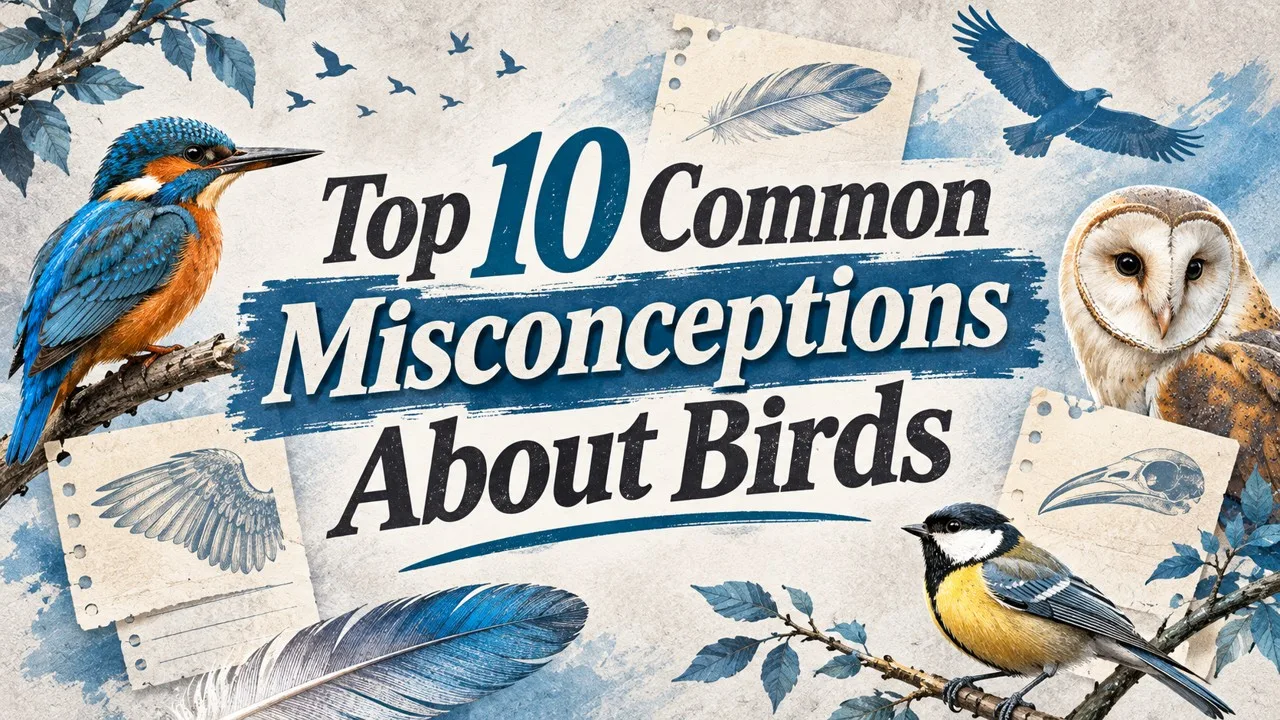
Common ideas about birds often outrun the evidence, from an ostrich that does not bury its head to a dodo that was not simply dim.
A misconception can be a cartoon, a film sound effect, or a story that grew after the fact. The ten cases below are an ostrich myth, an owl that cannot turn a full circle, a starling story that is probably too neat, parrot speech that is neither a tape nor a conversation, a wedding-rice scare that does not hold, a "wise owl" that is the wrong specialist, a scent myth about nestlings, a borrowed eagle cry, a claim that autumn feeding stops migration, and a dodo that was naive rather than stupid. This article is not a wildlife-handling manual, and it does not use cartoon characters as witnesses.
Key Facts
| Claim | What is closer to the evidence | Caution | |
|---|---|---|---|
| 1 | Ostriches bury their heads in the sand when frightened | They do not; a lowered head at a nest or in foraging was probably misread | Not a cartoon lesson |
| 2 | Owls can turn their heads a full 360 degrees | They can rotate unusually far, on the order of 270 degrees, not a full circle | A specialized neck, not a magic hinge |
| 3 | Eugene Schieffelin set out to release every bird in Shakespeare | Starlings were released in New York in the 1890s; the "complete Shakespeare" motive is shaky | The invasion is real; the motive is the part to qualify |
| 4 | Parrots can talk | They are vocal learners; some can use words referentially; they do not have human conversation | Neither a tape recorder nor a person in a bird |
| 5 | Uncooked rice kills birds at weddings | The claim is a myth; rice is not a proven avian poison in that setting | A reason to skip rice, if any, is not this one |
| 6 | Owls are unusually wise or intelligent birds | They are exceptional nocturnal hunters; the usual problem-solving standouts are corvids and parrots | "Wise" is a symbol, not a ranking |
| 7 | A human touch will make a parent abandon a chick because of scent | Most birds have a limited sense of smell and will not reject a chick for that reason | Nestlings and fledglings are different cases; this is not a handling guide |
| 8 | A bald eagle sounds like its film cry | The familiar scream in many soundtracks is often a red-tailed hawk | The bird has its own, thinner calls |
| 9 | Feeding birds in the fall will stop them migrating | Migration is driven mainly by day length and internal state, not by a full feeder | A backyard feeder is not a migration switch |
| 10 | Dodos were uniquely stupid | Relative brain size was not unusually poor for a pigeon; naivete around people is not the same as dimness | Extinction had human and introduced-animal causes, not a moral |
1. A Head Near the Sand, Not in It
Ostriches do not bury their heads in the sand when they are frightened [1]. The idea is old, and it may have started in a misreading of birds that lower their heads to check a nest, to feed, or to lie low against the horizon. A large, grounded bird can look, from a distance, as if it has hidden its head, when it has only put its bill down [1].
The unexpected fact is how little evidence the famous image ever had in field biology, and how much work it still does as a metaphor for denial [1]. This article will not restage a cartoon, and it will not treat an ostrich as a coward in a fable. The careful fact is a well-documented living bird, a posture that can be misunderstood, and a myth that traveled farther than any carefully observed burial. Ostriches can run, kick, and hide by becoming less visible. They do not dig a hole for the head as a plan.
A head in the sand is a proverb. It is not an ostrich behavior, and the proverb does not become true by repetition.
2. A Long Turn, Not a Full Circle
Owls can turn their heads much farther than a human can, which is why a full circle is such a tempting claim [2]. The usual figure in anatomical accounts is on the order of 270 degrees, not 360. Their eyes are relatively fixed in the skull, so the neck has to do the work of looking around, and the blood vessels in that neck are arranged in a way that makes the long turn possible without the disaster a human neck would have [2].
The unexpected fact is that the real adaptation is already strange enough. A three-quarter turn, with a specialized vascular system, does not need an extra ninety degrees of folklore [2]. This article will not treat the neck as a parlor trick, and it will not offer a demonstration. The careful fact is an unusual but finite rotation, a reason for it in the fixed eyes, and a popular 360-degree claim that overshoots the anatomy. An owl can look almost behind itself. It cannot, in the simple slogan, look all the way around and keep going.
A circle is a clean number. The neck, measured, is a little less than a circle, and that is still a remarkable neck.
3. Starlings Were Released; the Shakespeare Script Is Shakier
European starlings were released in New York, including in Central Park, in the early 1890s, in numbers often given as about a hundred birds in two years, and they later spread across North America [3]. Eugene Schieffelin, and the American Acclimatization Society, are the names usually attached to those releases. The later, neater story says that he wanted to introduce every bird mentioned in Shakespeare. Shakespeare does mention a starling, in Henry IV, but historians have been less sure that a complete literary program was the real plan [3].
Related: Top 10 Colourful Parrots of the World
The unexpected fact is that the invasion does not depend on the literary motive. The birds were released, they established, and they became a major, often damaging, introduced species [3]. This article will not treat a playwright as the author of an ecological disaster, and it will not quote a play as if it were a shipping list. The careful fact is a documented introduction, a well-studied spread, and a biographical story that may have been tidied after the fact. A Shakespeare garden is a charming idea. A continent of starlings is a biological event, and the event is not in doubt.
A motive can be embroidered. A release record is harder to embroider, and it is the part this list will keep.
4. Vocal Learners, Not Human Conversationalists
Parrots, and some other birds, are vocal learners: they can acquire new sounds, including words and phrases, by hearing them [4]. That is already unusual among animals, and it is the basis of the popular claim that parrots "talk." In research settings, some individual parrots, most famously an African grey named Alex, have used words in ways that look referential, not only like playback. That evidence is interesting, and it is not the same as a human conversation [4].
The unexpected fact is that both of the blunt slogans are too blunt. "Parrots can talk" oversells the language. "Parrots are only mimicking" undersells the learning and, in some studies, the use [4]. This article will not treat a laboratory bird as a person, and it will not use a performing animal as a toy. The careful fact is vocal learning, a limited and real referential use in some studied birds, and a gap that remains between that use and human speech. A grey parrot can surprise a visitor. It cannot, on the evidence, join the visitor's grammar.
A word in a cage can be a learned sound, a used label, or a bit of both. It is still a bird's word, which is remarkable enough.
5. A Wedding Myth That Did Not Hold
The claim that uncooked rice, thrown at weddings, will swell in a bird's stomach and kill it is a modern scare that has been examined and not sustained [5]. Rice does absorb water, but birds that eat grain already handle seeds that change in the gut, and wildlife and ornithological sources have repeatedly said that the wedding-rice story is not a documented cause of mass bird deaths [5]. Some venues still prefer not to use rice, for cleaning or for other reasons. Those reasons are not this myth.
The unexpected fact is how quickly a caution can outrun a citation. A single vivid mechanism, the swelling grain, is easy to imagine and hard to find in a mortality record [5]. This article will not advise anyone on what to throw at a celebration, and it will not treat rice as a poison. The careful fact is a popular belief that specialists have not supported, and a reminder that a bird's digestive system is not a closed bottle in a thought experiment. If rice is a poor party choice, it is probably because it is messy, not because it is a trap.
Related: Top 10 Most Dangerous Birds on Earth
A myth can be kind in intention and still be wrong. The birds, in this case, were never the evidence.
6. A Symbol of Wisdom, Not a Ranking of Wit
Owls are extraordinary nocturnal hunters, with hearing and vision that are specialized for finding prey in low light [6]. They are not, in the usual laboratory and field measures of problem-solving, the birds that sit at the top of a popular "intelligence" list. That place, when people insist on such a list, more often goes to corvids and to parrots. The wise owl is a symbol with a long cultural history, not a finding from a puzzle box [6].
The unexpected fact is that a specialist can be misread as a general genius. An owl's face is a sound-collecting and sight-collecting tool; it looks thoughtful to a human, which is not the same as solving a new mechanical problem [6]. This article will not call owls stupid, and it will not use a storybook owl as a witness. The careful fact is a mismatch between a symbol and a set of comparative studies, and a reminder that "intelligent" is a messy word when applied across birds that make their livings in different ways. A barn owl can hunt in the dark with a precision that no crow needs. A crow can solve a puzzle that no owl is asked to solve.
Wisdom, in an owl, is a human projection. The bird's actual excellence is sensory, and it is already enough.
7. A Scent Story That Most Birds Do Not Tell
The idea that a parent bird will abandon a chick because a human has touched it, and left a scent, is a widespread claim, and it is generally false [7]. Most birds have a limited sense of smell and identify their young by sight and sound, and by the nest itself. Wildlife agencies have said for years that the scent story should not be the reason a person refuses to put a true nestling back in a reachable nest [7]. That sentence is not a handling manual.
The unexpected fact is the other half, which the cheerful version of the myth-busting sometimes buries. Many young birds on the ground are fledglings, which are supposed to be out of the nest, and picking them up "to help" can be the mistake [7]. Some species are legally protected. This article will not give a rescue protocol, and it will not encourage unnecessary handling. The careful fact is that the abandonment-by-scent claim is a myth for most birds, and that a person who finds a young bird still has to tell a nestling from a fledgling and, in any serious case, to call a local wildlife authority. A false scent story is not a license to interfere.
Related: Top 10 Epic Animal Migrations Across the Planet
A parent bird is not generally reading a human fingerprint. It may still be a bad idea, for other reasons, to become part of the nest.
8. A National Cry That Often Belongs to a Hawk
The bald eagle, a large fish-eating sea eagle of North America, has become a visual emblem, and in films and advertisements it is often given a piercing, descending scream [8]. That scream, in many soundtracks, is not the eagle. It is often the call of a red-tailed hawk, a common buteo whose voice records more easily as "fierce." A bald eagle's own vocalizations are higher, quicker, and, to many listeners, thinner than the sound they thought they knew [8].
The unexpected fact is how completely a borrowed cry can become the official memory of a bird [8]. This article will not treat the eagle as a flag, and it will not use a national emblem as a political poster. The careful fact is a documented dubbing habit in popular sound, and a real eagle repertoire that is less theatrical than the substitute. A bird can be impressive in the air and modest on a microphone. The hawk, in this story, is the uncredited singer.
A soundtrack can assign a voice. The bird, in the field, keeps the one it has.
9. A Feeder Is Not a Migration Switch
The claim that feeding birds in the autumn will stop them migrating, because they will no longer need to leave, overstates what a backyard feeder can do [9]. Migration in most of the species people feed is timed mainly by day length and by internal state, not by a local assessment that the seed will last the winter. Birds that are going to move still move, and residents or short-distance wanderers were not going to make a long flight anyway [9].
The unexpected fact is that a kindness can be framed as a trap without much evidence that the trap works [9]. This article will not issue feeding rules, and it will not tell anyone to start or to stop a feeder. Winter feeding has its own debates, about window strikes, disease at trays, and what a feeder changes in a local population; those debates are separate from a migration on/off switch. The careful fact is that photoperiod and physiology are the usual clocks, and that a full hopper is not, on the ordinary evidence, enough to cancel them.
A bird can take seed and still leave. The departure, when it happens, is not a referendum on the feeder.
Related: Top 10 Amazing Animals of the Amazon Rainforest
10. Naive, Not a Fable About Stupidity
The dodo, a large, flightless pigeon of Mauritius, was extinct by the end of the seventeenth century, after people arrived with hunting, habitat change, and introduced animals [10]. Later jokes treated the bird as uniquely stupid, "dumb as a dodo," as if extinction were a verdict on its mind. Studies of the skull and of relative brain size have not supported a uniquely poor brain for a bird of its kind, and the usual modern account is that a island pigeon with no fear of people was vulnerable, not that it was a dunce [10].
The unexpected fact is how useful a dead bird became as an insult. A naivete that was fatal in a new human landscape is not the same trait as a failure to solve puzzles [10]. This article will not treat the extinction as a joke, and it will not use the dodo as a moral. The careful fact is a well-studied extinct pigeon, a set of human-caused pressures, and a later reputation that is harsher than the anatomy. Island animals that did not flee people were often the first to go. That is a history of contact, not a league table of wit.
A dodo was a pigeon that had lived without a reason to fear humans. The insult came later, and it is the part of the story that should be retired.
Conclusion
The ten claims above are a buried ostrich head, a 360-degree owl, a Shakespearean starling program, a talking parrot, a lethal handful of wedding rice, a uniquely wise owl, a parent bird that abandons a touched chick, a bald eagle's film scream, a feeder that cancels migration, and a uniquely stupid dodo. None of those slogans survives a careful look, and none of the corrections requires a cartoon, a handling lesson, or a borrowed coat of arms.
A misconception about birds is often a story that was easier to tell than the observation. The decent list keeps the observation, qualifies the biography, and leaves the proverb on the page only long enough to retire it.
- ^ [1] Ornithological and general accounts of ostrich behavior that reject the buried-head claim and treat a lowered head as a misread posture. Britannica: ostrich Wikipedia: ostrich
- ^ [2] Anatomical accounts of owl neck rotation, including a typical range near 270 degrees rather than a full circle, and vascular adaptations for the turn. Britannica: owl Scientific American: how owls turn their heads
- ^ [3] Historical accounts of European starling releases in 1890s New York, with the "every bird in Shakespeare" motive treated as a later, uncertain story. Britannica: starling Wikipedia: European starling
- ^ [4] Overviews of vocal learning in parrots, including limited referential use in some studied individuals, without equating that use with human language. Britannica: parrot Wikipedia: Alex the parrot
- ^ [5] Ornithological discussions that do not support the claim that uncooked wedding rice kills birds. Cornell Lab of Ornithology: rice at weddings Britannica: bird
- ^ [6] Comparative discussions of owl sensory specialization versus problem-solving studies that more often highlight corvids and parrots. Britannica: owl Britannica: corvid
- ^ [7] Wildlife-agency and ornithological guidance that parent birds do not generally abandon chicks because of human scent, with nestling and fledgling cases distinguished and no handling protocol offered. U.S. Fish and Wildlife Service: if you care, leave it there Britannica: related notes on early bird behavior
- ^ [8] Accounts of bald-eagle vocalizations and of the common practice of dubbing a red-tailed hawk cry in popular soundtracks. Britannica: bald eagle Cornell Lab: bald eagle sounds
- ^ [9] Ornithological overviews of migration timing by photoperiod and internal state, as distinct from a claim that autumn feeding cancels departure. Britannica: migration Cornell Lab: feeding questions
- ^ [10] Paleontological and historical accounts of the dodo as an extinct island pigeon, including work on relative brain size and a rejection of uniqueness-in-stupidity claims. Britannica: dodo Wikipedia: dodo





















Discussion
Log in with