






 By
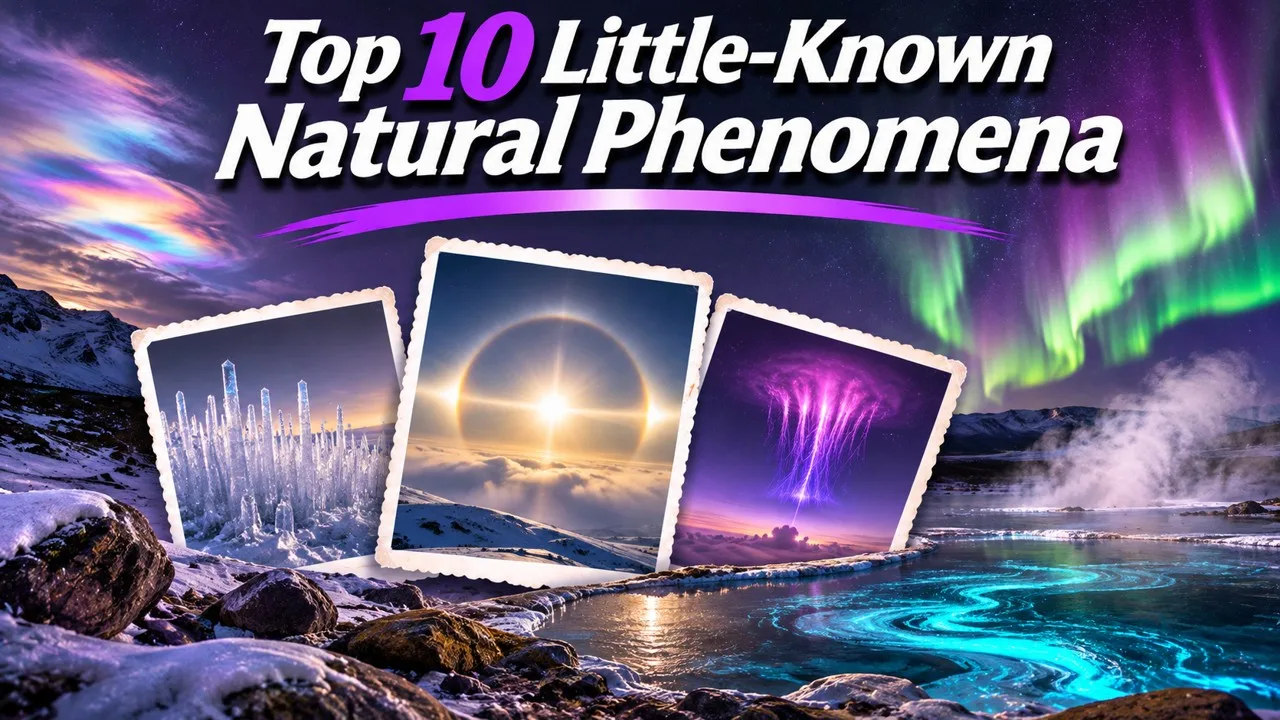
Light pillars, a hole-punch cloud and a pink lake have ordinary explanations; a frog with a mushroom on its back is a fungus on an animal, not a hybrid. A phenomenon can look like a message, a portal, or a riddle and still belong to optics, radio, or ecology [1][3][6]. The ten items below are documented, and several arrived in public view only because a photograph went far in a hurry [2][3]. This list will not promote an invasion, a ghost, or a plant-animal hybrid, and it will not treat a numbers station as a voice from outside the Earth [1][4][10].
Where the mechanism is still argued, the argument is part of the entry, not a stain to be wiped off [5][8].
Key Facts
These are uncommon or easily misread natural, or human-and-natural, events. Optical tricks, radio practice, and a single striking field observation are kept in their right categories.
Ten Phenomena at a Glance
| Rank | Nickname | Careful version |
|---|---|---|
| 1 | Mysterious messages | Shortwave "numbers stations," including Cuba's HM01, are coded radio broadcasts long associated with intelligence work, not with visitors |
| 2 | Pillars of light | Columns of light are usually reflections from ice crystals, sometimes from fishing lamps or streetlights |
| 3 | A heavenly portal | A circular gap in a cloud layer is typically a fallstreak, or hole-punch, cloud |
| 4 | STEVE and a companion | STEVE is a distinct upper-atmosphere light, often with a picket-fence companion; it is not a unique purple aurora in the old sense |
| 5 | Sprites | Brief red flashes can leap upward from intense storms into the mesosphere; they are transient luminous events, not omens |
| 6 | Zombie fires | Some peat fires smolder through winter and re-emerge in spring; other reignition paths are still discussed |
| 7 | Lake Hillier | A pink lake in Western Australia is well explained by salt-loving algae and bacteria, not by a lasting mystery |
| 8 | Mobile microscopic blobs | Some choanoflagellates can change shape and crawl as well as swim; they are ordinary, if surprising, microbes |
| 9 | A hole in a galaxy | The nearby spiral NGC 247 has a striking gap in its disk; the cause is still argued |
| 10 | A mushroom on a frog | A fungus was photographed growing from a living frog in the Western Ghats; that is not a hybrid organism |
1. Coded Groups, on a Known Band
Radio amateurs and monitoring groups have, for decades, logged shortwave "numbers stations": monotonous voices, tones, or data bursts that repeat groups of digits, often on a schedule [1]. One well-documented example, tracked by the enthusiast network Priyom and others, is HM01, associated with Cuban transmissions, a mix of voice and digital traffic that sits in the same family as other suspected intelligence broadcasts [1]. The messages are mysterious only if you expect the airwaves to be a public salon. Encrypted or formatted number groups are a long-standing way to reach a receiver who already has a book, or a key, and they do not require an unearthly sender. This article will not treat the traffic as a puzzle to be solved, or as a how-to for clandestine radio.
The unexpected fact is institutional, not cosmic. A state can still talk, in the open, in a language that is not meant to be read by everyone who happens to have a set.
2. Ice, a Lamp, and a Vertical Glare
In May 2024, photographs of tall, discrete pillars of light over parts of Japan spread quickly, and some of the commentary ran ahead of the optics [2]. Light pillars form when platelike ice crystals hang in the air and reflect a strong source, often streetlights, or, in a Japanese fishing context, the powerful lamps known in the phrase isaribi kochu [2]. The result can look like a row of beams standing on the horizon, which is why the pictures invited wilder stories. The geometry is ordinary once it is named: the pillars are not solid objects, and they are not incoming craft. They are a glitter path, stood on its end.
A cold, still night and a bright lamp are usually enough. The strange part is only how architectural the reflection can appear.
Related: Top 10 Unusual Local Phenomena Around the World
3. A Hole Punched in a Cloud Sheet
On 4 June 2024, images from Indonesia of an elliptical gap in a cloud layer, ringed as if a door had opened, were described in some posts as a portal [3]. The standard meteorological name is a fallstreak hole, or hole-punch cloud. In a bank of supercooled droplets, often altocumulus or cirrocumulus, a local burst of freezing can make ice crystals grow, fall, and leave a clean gap, sometimes with a fallstreak in the middle and a brighter rim [3]. Aircraft are a common trigger, because a passage through the layer can start the glaciation. The unexpected fact is how theatrical a bit of cloud microphysics can look from the ground. The sky does not open. A layer simply loses a patch of its droplets, on time scales that a camera loves and a myth can misuse.
A hole in a cloud is still a cloud, with a hole. That is the whole phenomenon, and it is already enough.
4. A Ribbon that Needed Its Own Name
STEVE, a backronym for Strong Thermal Emission Velocity Enhancement, is a narrow, mauve or white ribbon of upper-atmosphere light, first widely noticed by sky-watchers in Canada and later shown to be distinct from the usual green and red auroral ovals [4]. It is often accompanied by a green "picket fence" that can travel with it, a companion that makes the event look twinned even though the two structures are not the same phenomenon [4]. Researchers have been mapping the temperatures, the subauroral ion drift, and the conditions that light the ribbon. The unexpected fact is taxonomic. The sky had a feature that did not fit the old aurora bins, and the citizen photographs came first, the name and the physics later. It is not a unique purple northern light in the textbook sense, and it is not a visitor.
A new label in the upper atmosphere is a genuine discovery of attention. The ribbon was probably never new to the sky, only to the catalog.
5. A Flash that Goes Up, not Down
Sprites are extremely brief, red, tendril-like flashes that leap upward from the tops of intense thunderstorms into the mesosphere, tens of kilometres above the cloud [5]. They belong to a family of transient luminous events that also includes elves and jets, and they are tied to strong electrical activity in the storm below, often a powerful positive stroke [5]. They are uncommon in everyday experience because they are faint, high, and over in milliseconds, which is why they were reliably photographed later than they were first reported by pilots. They are not "stratospheric perturbations" as a formal name, and they are not a sign. The unexpected fact is direction. Lightning, in the popular image, comes down. This relative of the same electrical family can bloom upward, in red, and be gone before a casual glance can settle.
Related: Ball Lightning: The Mysterious Spherical Phenomenon
A storm can have a second, higher show. Most of us will never see it without a camera pointed at the right moment.
6. A Fire that Can Wait Underground
In peat country, from Alaska and Canada to Siberia, fires can appear to die in autumn and then return in spring, a habit that has earned the grim nickname "zombie fires" [6]. The leading account is that the fire never fully went out: it smoldered in dry peat through the winter and found air and fuel again when the season turned [6]. Some researchers have also asked whether warming itself can help a peat surface reignite, or whether more than one pathway is at work, so the mechanism should not be treated as a single, fully closed story. The unexpected fact is seasonal. A fire can have a hidden life in the soil, which is a problem for carbon, for air, and for anyone who thought a snowfall was a full stop.
The nickname is journalistic. The overwintering, if that is the path in a given burn, is a materials fact about peat, not a resurrection.
7. A Pink Lake with a Microbial Palette
Lake Hillier, on Middle Island off Western Australia, is famously pink, a color so even and so strong that first photographs look edited [7]. The color is not an unsolved riddle. Salt-tolerant microbes, including the alga Dunaliella salina and halophilic bacteria, produce carotenoid pigments in a very salty basin, and those pigments, in the water and in the organisms, give the lake its look [7]. Details of the mix can still be refined, which is not the same as "nobody knows." The unexpected fact is only the strength of the result. A chemistry that occurs in other saline lakes as well can, here, reach a shade usually reserved for candy, and it can do so beside an ordinary green shore.
A pink lake is a microbial factory in a brine. The mystery, at this point, is mostly in the postcards.
Related: Top 10 Rare Cloud Formations and How They Form
8. A Microbe that Can Swim, then Crawl
Choanoflagellates are single-celled relatives of animals, usually described as tiny swimmers with a collar and a flagellum [8]. Work associated with Thibaut Brunet, Nicole King, and colleagues has shown that some of them can also change form, retract or remodel their usual swimming gear, and crawl in an amoeboid way, a flexibility that looks, under a microscope, almost like a different organism [8]. The lab tricks used to watch that change are ordinary experimental setups, not magic, and the "mobile microscopic blobs" of a headline are these cells doing something their lineage was already equipped to try. The unexpected fact is evolutionary as well as visual. A close relative of animals can switch between a swimming state and a crawling one, which is a clue about how early animal body plans may have had more than one gear.
A blob in a chamber is still a cell with a name. The surprise is the gait, not an unknown kingdom.
9. A Nearby Spiral with a Missing Patch
NGC 247 is a spiral galaxy, relatively close on a cosmic scale, with bright star-forming regions and, more strikingly, a large, apparently empty gap in one part of the disk [9]. Early ideas included a past gravitational interaction, or an encounter with a dense clump of dark matter; later work has kept the hole in the catalog while leaving the exact cause unsettled [9]. The unexpected fact is the gap itself, which is real as an absence of stars and light in that region, and which does not have to be a bite taken by a hidden object of a preferred theoretical kind. A galaxy can have a lopsided or excavated look for more than one reason, and the honest entry is that astronomers can see the hole more clearly than they can name its author.
A missing patch of disk is a phenomenon. A finished story about a collision with a particular kind of dark clump is, for now, one hypothesis among others.
Related: Top 10 Most Unusual Lakes in the World
10. A Fungus, a Frog, and One Photograph
In the Western Ghats of India, a field surveyor, Lohit Y. T., photographed a Rao's intermediate golden-backed frog with a mushroom apparently growing from its flank, an image that later reached a scientific note and a much larger public [10]. The observation is of a fungus on a living amphibian, possibly opportunistic, possibly a stress or a wound made visible, and not a first "plant-animal hybrid" [10]. Hybrids of that kind are not how mushrooms and frogs work. A single striking record raises questions about how often such growths occur, whether the frog was ill, and what the fungus is, questions that a photograph can start and cannot finish. This article will not turn the animal into a mascot of fusion, or into a gore image.
The unexpected fact is simply that a mushroom can, rarely, be seen using a living frog as a substrate. That is already strange enough, and it should be left at the size of one careful field record.
Conclusion
The ten phenomena above are a lesson in naming. A coded broadcast can sound like a riddle and still be a station. Ice can stand a lamp's reflection on end. A cloud can lose a disk of droplets and look like a door. The upper atmosphere can carry a ribbon that needed a new acronym, and a storm can flash red in the mesosphere. Peat can hold a fire until spring, a lake can be dyed by its own microbes, and a choanoflagellate can change gait. A galaxy can show a hole whose cause is still argued, and a frog can briefly wear a mushroom without becoming a new kind of being.
Little-known, in this list, often means little-photographed until last year, or little-explained in the first caption. The second caption, when it is honest, is usually enough.
- ^ [1] Documentation of shortwave numbers stations, including monitoring of HM01, treated here as coded radio practice, not as an unearthly signal. Britannica: Shortwave radio
- ^ [2] Optical accounts of light pillars, including ice-crystal reflection of ground sources and fishing lamps. Britannica: Atmospheric optics
- ^ [3] Meteorological descriptions of fallstreak, or hole-punch, clouds, including aircraft-triggered glaciation in supercooled layers. Britannica: Cloud
- ^ [4] Research on STEVE and the accompanying green picket-fence emission as features distinct from the classical auroral oval. Britannica: Aurora
- ^ [5] Accounts of red sprites and other transient luminous events above intense thunderstorms. Britannica: Lightning
- ^ [6] Studies of overwintering peat fires, including debate over smoldering versus other reignition paths. Britannica: Peat
- ^ [7] Explanations of Lake Hillier's color in terms of halophilic algae, bacteria, and carotenoid pigments. Britannica: related saline-lake microbiology
- ^ [8] Laboratory work on choanoflagellates that can switch between swimming and crawling forms. Britannica: Choanoflagellate
- ^ [9] Astronomical descriptions of NGC 247 and the debated origin of a prominent gap in its disk. Britannica: Spiral galaxy
- ^ [10] The field record of a mushroom growing from a living Rao's intermediate golden-backed frog in the Western Ghats, distinguished from any hybrid claim. Britannica: Frog



















Discussion
Log in with