




Top 10 Personifications of Death in Myth and Folklore
 By Dhiraj Sharma · Published
Share Post
Loading…
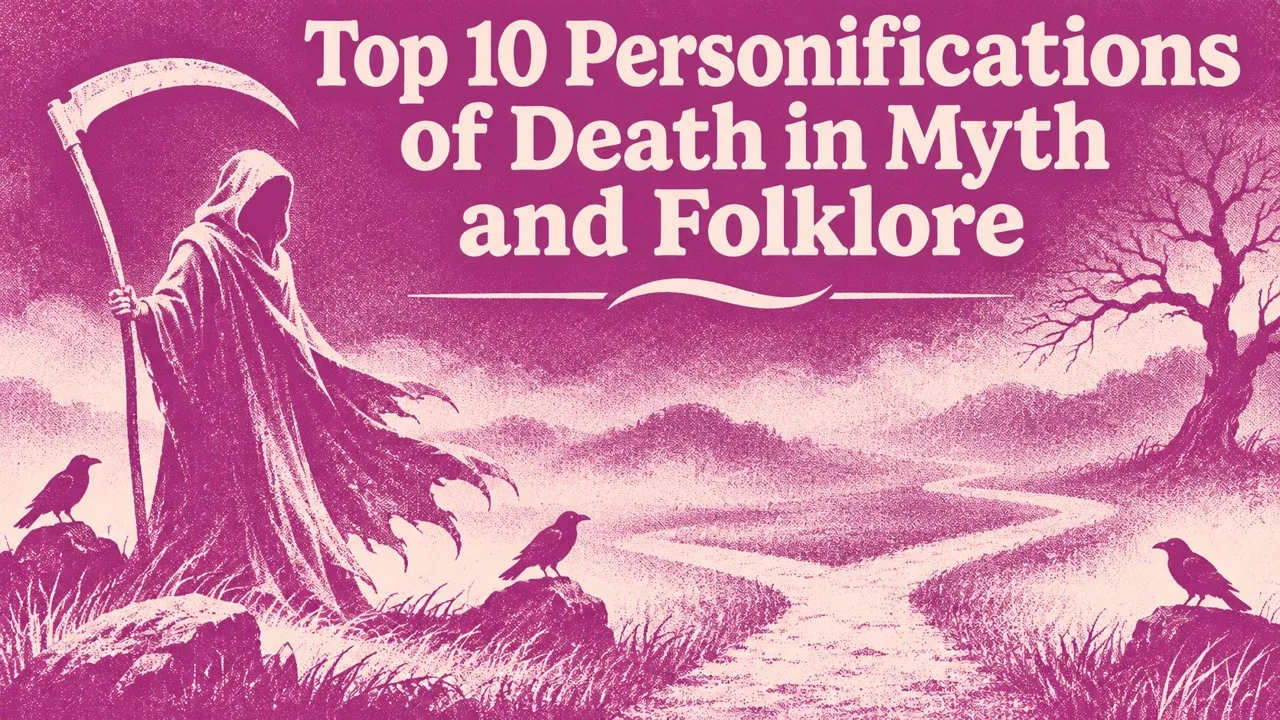
From the Grim Reaper and Greek Thanatos to Yama, the Ankou, Santa Muerte and Baron Samedi: ten ways cultures have pictured Death as a figure. Every culture has had to explain death, and many have done so by giving it a face. In myths, legends and religious traditions, death appears as a skeleton with a scythe, a winged youth, a stern judge, a queen of the underworld or a cheerful spirit in a top hat.
These figures reflect how societies understood mortality. Some portray death as a terrifying enemy, while others see it as a gentle guide, a fair judge or a natural part of the cycle of seasons.
Many of these personifications have survived for centuries and continue to shape art, festivals, films and popular culture. Some are still objects of religious devotion today.
The ten figures below come from Europe, Asia, the Americas, the Middle East and the Caribbean, and show the wide range of ways people have imagined death.
Key Facts
| # | Figure | Culture | Typical image |
|---|---|---|---|
| 1 | Death with a scythe | Medieval and modern Europe | Skeleton in a hooded robe |
| 2 | Greek god of death | Ancient Greece | Winged young man |
| 3 | Lord of death | Hindu and Buddhist traditions | Rides a buffalo and carries a noose |
| 4 | Breton harvester of souls | Brittany, France | Skeleton with a cart and scythe |
| 5 | Folk saint of death | Mexico | Skeleton in robes holding a scythe and globe |
| 6 | Aztec lord of the underworld | Ancient Mexico | Skeletal figure with owls and spiders |
| 7 | Norse ruler of the dead | Scandinavia | Half living, half dead |
| 8 | Angel of death | Islamic and Jewish traditions | Angel who takes souls |
| 9 | Lord of the dead | Haitian Vodou | Top hat, tailcoat and skull face |
| 10 | Slavic goddess of winter and death | Central and Eastern Europe | Straw effigy |
1. The Grim Reaper
The image of Death as a skeleton in a dark hooded robe, carrying a scythe and sometimes an hourglass, became common in Europe in the late Middle Ages. It spread widely after the Black Death killed a large share of Europe's population in the fourteenth century [1].
The scythe likens death to a harvester cutting down people like grain, and the hourglass shows that each person's time is limited. Paintings known as the Dance of Death showed skeletons leading people of every rank, from popes and kings to peasants, to their graves [1].
In some languages, such as French and Spanish, the word for death is feminine, and death is sometimes pictured as a woman. The English name Grim Reaper came into wide use much later, in the nineteenth century. One of the best-known Dance of Death series was a set of woodcuts by the German artist Hans Holbein the Younger, published in 1538. The figure later appeared in Ingmar Bergman's 1957 film The Seventh Seal, in which a knight plays chess with Death.
2. Thanatos
In Greek mythology, Thanatos was the personification of death, the son of Nyx, the night, and the twin brother of Hypnos, the god of sleep. Rather than a monster, he was often depicted as a winged young man and associated with a peaceful death [2].
A famous Greek vase painted around 515 BC by the artist Euphronios shows Thanatos and Hypnos carrying the body of the fallen hero Sarpedon from the battlefield at Troy [2].
In one myth, the cunning King Sisyphus tricked Thanatos and chained him up, so that no one could die until the war god Ares freed him. In another, the hero Heracles wrestled Thanatos to win back the life of Queen Alcestis. The Euphronios vase was returned to Italy by the Metropolitan Museum of Art in New York in 2008, after evidence showed that it had been illegally excavated. Thanatos gave his name to the modern study of death, known as thanatology.
Related: Top 10 Mythical Creatures of Indian and Asian Mythology
3. Yama
In Hindu tradition, Yama is the god of death and the ruler of the dead. Early Vedic texts describe him as the first mortal to die, who then showed the way to the world of the dead for those who followed [3].
Yama is usually shown riding a water buffalo and carrying a noose to capture souls. He is assisted by Chitragupta, who keeps records of every person's deeds. In the story of Savitri, a devoted wife persuades Yama to return her husband's life [3].
As Buddhism spread, Yama became a judge of the dead in East Asia, known as Yanluo in China and Enma in Japan. In these traditions, he decides the fate of souls based on their actions in life. In the Katha Upanishad, a boy named Nachiketa visits Yama's house and asks him what happens after death. Their dialogue is one of the most famous philosophical texts in Hinduism.
4. The Ankou
In the folklore of Brittany in northwestern France, the Ankou is a figure who collects the souls of the dead. He is often described as a tall, thin man or skeleton with a wide hat, carrying a scythe and driving a creaking cart [4].
According to tradition, the Ankou is the last person to die in a parish each year, who then serves as the collector of souls for the following year. Hearing the creak of his cart was considered a sign that someone would soon die [4].
Carvings of the Ankou appear on churches and ossuaries in Brittany. At La Roche-Maurice, one carving bears an inscription in French meaning I kill you all. The folklorist Anatole Le Braz collected many Ankou tales in the 1890s. Similar figures appear in the folklore of Wales, Cornwall and Ireland, which share Celtic roots with Brittany. In some versions, the Ankou is the first person to die in the new year rather than the last of the old one.
5. Santa Muerte
Santa Muerte, or Holy Death, is a female figure venerated by many people in Mexico and among Mexican communities in the United States. She is usually shown as a skeleton wearing a long robe and carrying a scythe and a globe [5].
Her devotion became much more visible in the early 2000s, when a public shrine was set up in the Tepito neighborhood of Mexico City. Followers pray to her for protection, health and help in difficult circumstances [5].
Related: Top 10 Urban Legends That Persist Despite the Record
The Catholic Church does not recognize Santa Muerte, and some church leaders have condemned her veneration. Her origins are debated, with some scholars pointing to Spanish Catholic images of death and others to Indigenous traditions. Her followers are estimated to number in the millions, making her one of the fastest-growing religious movements in the Americas. Devotees often leave offerings of flowers, candles, tequila and cigarettes at her altars.
6. Mictlantecuhtli
In Aztec religion, Mictlantecuhtli was the lord of Mictlan, the lowest level of the underworld, which he ruled with his wife, Mictecacihuatl. He was often depicted as a skeleton or with a skull for a face, sometimes adorned with owl feathers [6].
According to Aztec belief, the souls of most people who died of ordinary causes undertook a difficult journey of four years through the underworld to reach Mictlan. In one myth, the god Quetzalcoatl stole bones from Mictlantecuhtli to create a new humanity [6].
Archaeologists excavating the Templo Mayor in Mexico City found two life-size clay statues of Mictlantecuhtli in the 1990s. Mictecacihuatl is often linked to modern Day of the Dead traditions. Mictlantecuhtli was associated with the north, a direction linked with death in Aztec thought. Owls, bats and spiders were connected with him, and offerings of incense were burned in his honor.
7. Hel
In Norse mythology, Hel was the ruler of the realm of the dead, also called Hel. She was a daughter of the trickster god Loki and was sent by Odin to rule the dead who had not died in battle [7].
The thirteenth-century Icelandic writer Snorri Sturluson described her as half blue-black and half flesh-colored, a striking image of the boundary between life and death [7].
In one story, after the god Baldr was killed, Hel agreed to release him only if every being in the world wept for him. A single giantess refused, so Baldr remained in her realm. The English word hell is related to her name. Hel's realm was described as cold and gloomy, reached by a road leading downward and northward. Her hall was called Eljudnir.
Related: Top 25 Unique Religions You Have Probably Never Heard Of
8. Azrael
In Islamic tradition, the angel of death, often named Azrael or Izrail, is the angel responsible for taking the souls of the dead. The Quran refers to the angel of death but does not give him a name [8].
Traditions describe him as vast in size, with many eyes and wings, and as knowing the moment of every person's death. He is said to take souls at their appointed time, in obedience to God [8].
The idea of an angel of death also appears in Jewish tradition and folklore, where the name Azrael is used in some later writings. The name has also appeared in literature, comics and films. Some traditions hold that Azrael keeps a vast scroll or tablet listing all people, and erases a person's name when their time comes. In Persian and Turkish literature, he often appears as a solemn but just figure.
9. Baron Samedi
In Haitian Vodou, Baron Samedi is a spirit, or lwa, associated with death and the dead. He is the leader of the Gede, a family of spirits linked to death, sexuality and humor [9].
He is usually depicted wearing a top hat, a black tailcoat and dark glasses, with a skull-like face, and is associated with rum and cigars. He is known for crude jokes and lively behavior [9].
Baron Samedi is also believed to be able to heal. According to tradition, a person cannot die unless he digs their grave. The Gede are honored during the Fet Gede festival in early November. His wife is Maman Brigitte, another powerful spirit of the cemetery. Baron Samedi also appears in popular culture, including the 1973 James Bond film Live and Let Die.
10. Morana
In Slavic folk tradition, Morana, also called Marzanna or Morena, is a figure associated with winter, death and rebirth. She was often linked with the end of winter and the coming of spring [10].
Related: Top 10 Mythical Creatures in World Mythology - That Inspired Myths Across Civilizations (unchanged)
In Poland, the Czech Republic, Slovakia and other countries, people still make straw effigies of Morana in spring, then burn them or throw them into rivers to drive away winter. Schoolchildren often take part in the custom [10].
The fifteenth-century Polish historian Jan Dlugosz described Marzanna as a goddess worshipped by pagan Poles. The church tried to suppress the custom, but it survived as a folk tradition. The custom is usually held around the spring equinox in March. In some places, a decorated green branch or tree, representing new life, is carried through the village after Morana has been destroyed.
Conclusion
These figures show how cultures have tried to understand and cope with death. Some made it frightening, others comforting, and many made it a part of the natural cycle of life.
Their images have influenced art, literature and religious practices for centuries and continue to appear in films, books and festivals.
The variety of personifications reflects different beliefs about what happens after death and how people should face it.
Despite their differences, all of these figures express a shared human need to give shape to the unknown.
- ^ [1] Accounts of the Grim Reaper. Wikipedia: Death (personification) Wikipedia: Danse Macabre
- ^ [2] Accounts of Thanatos. Wikipedia: Thanatos Wikipedia: Euphronios Krater
- ^ [3] Accounts of Yama. Wikipedia: Yama Wikipedia: Savitri and Satyavan
- ^ [4] Accounts of the Ankou. Wikipedia: Ankou Wikipedia: Brittany
- ^ [5] Accounts of Santa Muerte. Wikipedia: Santa Muerte Wikipedia: Tepito
- ^ [6] Accounts of Mictlantecuhtli. Wikipedia: Mictlantecuhtli Wikipedia: Templo Mayor
- ^ [7] Accounts of Hel. Wikipedia: Hel Wikipedia: Baldr
- ^ [8] Accounts of Azrael. Wikipedia: Azrael Wikipedia: angel of death
- ^ [9] Accounts of Baron Samedi. Wikipedia: Baron Samedi Wikipedia: Haitian Vodou
- ^ [10] Accounts of Morana. Wikipedia: Marzanna Wikipedia: Slavic paganism



















Discussion
Log in with