






 By
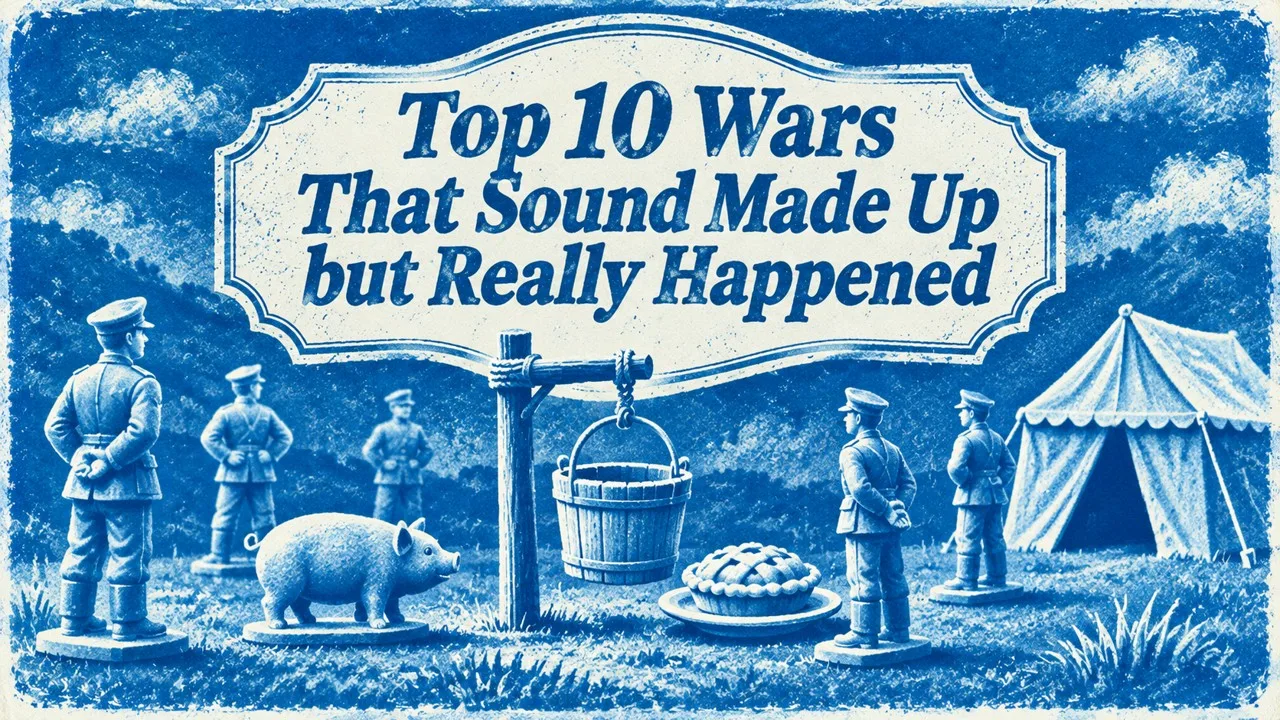
A stolen bucket, a severed ear, a shot pig and a pastry shop: ten real conflicts with names and causes that sound too strange to be true. War is one of the most serious subjects in history, bringing death, destruction and suffering. Yet some conflicts have names or origins so strange that they sound like jokes or fictional inventions.
Wars have been named after a bucket, a pastry shop, a pig and a severed ear. One lasted less than an hour, and another was fought between two American states over a strip of land along a lake shore.
Behind these odd names, the causes were usually more complex. Many of these conflicts grew out of long-standing disputes over borders, trade, fishing rights or political power. The unusual incident that gave each war its name was often only the final spark.
Some of these conflicts were nearly bloodless, with more threats and posturing than actual fighting. Others caused real loss of life, and it is important not to treat them as merely amusing curiosities.
The names themselves were often given later, sometimes by historians or journalists who wanted to highlight the absurdity of the trigger. In several cases, the participants at the time would not have recognized the label.
The ten conflicts below come from medieval Italy, the Caribbean, North America, Mexico, East Africa, the Balkans, Central America and the North Atlantic. They are arranged in chronological order.
Some details of the stories behind them have been embellished over time. Where accounts are uncertain or disputed, that is noted.
Each entry gives the name of the conflict, the main opponents and the years in which it took place, followed by an account of what happened and how it ended.
Together, these stories show how small incidents can escalate into international crises when tensions are already high. They also show how diplomacy, arbitration and compromise have sometimes prevented minor disputes from becoming major wars.
They remind us that history is full of surprises, and that the line between the serious and the absurd can be surprisingly thin.
Key Facts
| # | Conflict | Opponents | Years |
|---|---|---|---|
| 1 | The War of the Bucket | Modena and Bologna | 1325 |
| 2 | The War of Jenkins' Ear | Britain and Spain | 1739 to 1748 |
| 3 | The Toledo War | Ohio and the Michigan Territory | 1835 to 1836 |
| 4 | The Pastry War | France and Mexico | 1838 to 1839 |
| 5 | The Aroostook War | Maine and New Brunswick | 1838 to 1839 |
| 6 | The Pig War | United States and Britain | 1859 |
| 7 | The Anglo-Zanzibar War | Britain and Zanzibar | 1896 |
| 8 | The War of the Stray Dog | Greece and Bulgaria | 1925 |
| 9 | The Football War | El Salvador and Honduras | 1969 |
| 10 | The Cod Wars | Iceland and the United Kingdom | 1958 to 1976 |
1. A War Over a Bucket
In 1325, soldiers from the Italian city of Modena reportedly raided neighboring Bologna and carried off a wooden bucket from a well as a trophy. The two cities were already bitter rivals, belonging to opposing factions in the long struggle between supporters of the pope and supporters of the Holy Roman Emperor across northern Italy [1].
Related: Top 10 Historical Facts That Sound Fake but Are True
The conflict included the Battle of Zappolino, in which Modena's forces defeated a much larger Bolognese army. The battle was a significant engagement and resulted in many casualties on both sides, despite the light-hearted name later attached to the war [1].
The bucket remained in Modena, where it is still displayed today, with a replica shown in the city's cathedral bell tower. The episode inspired a seventeenth-century mock-heroic poem by Alessandro Tassoni called The Stolen Bucket, which helped make the story famous across Italy.
2. A Severed Ear Shown to Parliament
In 1731, a British merchant captain named Robert Jenkins claimed that Spanish coast guards had boarded his ship in the Caribbean and cut off his ear. Several years later, according to popular accounts, he displayed the preserved ear to members of the British Parliament [2].
The story fueled public anger against Spain at a time of growing commercial rivalry in the Americas. In 1739, Britain declared war on Spain, though the real causes were disputes over trade, smuggling and colonial ambitions [2].
The conflict eventually merged into the larger War of the Austrian Succession. The name War of Jenkins' Ear was popularized more than a century later by the Scottish historian Thomas Carlyle.
3. Ohio Versus Michigan
In the 1830s, the state of Ohio and the Michigan Territory both claimed a strip of land along their border that included the growing port town of Toledo. Both sides passed laws asserting control and sent militias to the area [3].
The confrontation produced plenty of drama but very little bloodshed. The most serious injury was reportedly a stab wound suffered by a sheriff's deputy during a scuffle [3].
The United States Congress resolved the dispute by giving the Toledo Strip to Ohio. In exchange, Michigan was granted the western part of the Upper Peninsula when it became a state in 1837, which later proved valuable because of its rich mineral resources.
4. Compensation for a Pastry Shop
In the years after Mexican independence, foreign residents in Mexico often complained that their property was damaged during political unrest. One of these was a French pastry cook who said that his shop near Mexico City had been looted by Mexican officers [4].
France demanded compensation for its citizens, including the pastry cook, and in 1838 French ships blockaded Mexican ports and bombarded the fortress at Veracruz. Mexico declared war in response [4].
Related: Top 10 Overlooked Events of World War II
During the fighting, the Mexican general Antonio López de Santa Anna was wounded and later lost part of his leg, which he reportedly gave an elaborate burial. With British mediation, Mexico agreed to pay compensation, and the conflict ended in 1839.
5. A Border Dispute Without Battles
The border between the American state of Maine and the British colony of New Brunswick was unclear after the American Revolution. In the late 1830s, disputes over logging in the Aroostook River valley led both sides to send militias into the area [5].
Troops were mobilized, and the situation became tense, but no real battles took place. The conflict was sometimes nicknamed the Pork and Beans War, perhaps referring to the rations of the soldiers [5].
The dispute was resolved by the Webster-Ashburton Treaty of 1842, which set the border between Maine and what is now Canada. The war is remembered as an example of a crisis settled by diplomacy.
6. The Only Casualty Was a Pig
In 1859, the United States and Britain both claimed the San Juan Islands, located between present-day Washington State and Vancouver Island. On San Juan Island, an American farmer shot a pig that had been rooting in his garden [6].
The pig belonged to an employee of the Hudson's Bay Company, a British firm. A dispute over compensation escalated, and both countries sent soldiers and warships to the island [6].
Fortunately, cooler heads prevailed, and no shots were fired between the forces. The two countries jointly occupied the island for years until the dispute was settled by arbitration in 1872, which awarded the islands to the United States. The pig was the only casualty.
7. The Shortest War in History
In August 1896, the pro-British sultan of Zanzibar died, and a new claimant named Khalid bin Barghash took the throne without British approval. Britain issued an ultimatum demanding that he step down [7].
When the deadline passed, British warships bombarded the sultan's palace. The fighting lasted somewhere between about thirty-eight and forty-five minutes, making it widely regarded as the shortest war in recorded history [7].
Related: Stalingrad Was a Major Turning Point
The bombardment caused hundreds of casualties among the defenders, while only one British sailor was reported wounded. Khalid fled, and a sultan favored by the British was installed in his place.
8. A Soldier and a Dog
In October 1925, an incident on the border between Greece and Bulgaria led to a brief conflict. According to popular accounts, a Greek soldier ran after his dog, which had strayed across the border, and was shot by a Bulgarian sentry [8].
Greece responded by sending troops into Bulgarian territory. Fighting followed, and dozens of people were killed before the League of Nations intervened [8].
The League ordered Greek forces to withdraw and required Greece to pay compensation to Bulgaria. The episode is often cited as one of the League's early successes in preventing a wider war.
9. A War Sparked by Football
In 1969, tensions between El Salvador and Honduras were running high over migration, land reform and border disputes. These tensions boiled over during a series of World Cup qualifying matches between the two countries [9].
Riots broke out around the matches, and shortly afterward, El Salvador launched a military attack on Honduras. The war lasted about one hundred hours before a ceasefire was arranged with the help of the Organization of American States [9].
Although the war was brief, it caused thousands of deaths and displaced many people. The name Football War emphasizes the matches, but historians stress that deeper social and economic issues were the real causes.
10. Battles Over Fish
Between 1958 and 1976, Iceland and the United Kingdom clashed three times over fishing rights in the North Atlantic. Iceland extended its fishing limits to protect its fish stocks, which British trawlers had long relied on [10].
The confrontations involved Icelandic coast guard vessels cutting the nets of British trawlers and British naval ships attempting to protect them. Some ships were rammed, though there were few casualties [10].
Related: Germany's Invasion of Poland Began the War in Europe
Iceland ultimately won the disputes, and its exclusive economic zone was extended to two hundred nautical miles. The Cod Wars had a lasting impact on the British fishing industry.
Conclusion
These conflicts show that wars can have surprising names and unusual triggers. A bucket, a pig, a pastry shop and a stray dog all played roles in sparking international crises.
Yet behind each of these incidents lay deeper tensions over territory, trade, resources and national pride. The strange triggers were symptoms of larger problems rather than their true causes.
Some of these conflicts were resolved peacefully through diplomacy or arbitration, while others caused real loss of life. Their names can be amusing, but the human costs were often serious.
These stories also show the importance of international institutions and negotiation. In several cases, mediation helped prevent a minor dispute from becoming a much larger war.
The history of these strange-sounding conflicts reminds us that the causes of war are often more complex than they first appear.
Studying them can also be a useful way into larger subjects, such as colonial rivalries, the drawing of national borders and the development of international law.
For anyone interested in history, these lesser-known wars offer memorable stories that reveal how ordinary incidents can collide with politics in unexpected and sometimes tragic ways.
- ^ [1] Accounts of the War of the Bucket. Wikipedia: War of the Bucket Wikipedia: Battle of Zappolino
- ^ [2] Accounts of the War of Jenkins' Ear. Wikipedia: War of Jenkins' Ear Wikipedia: Robert Jenkins
- ^ [3] Accounts of the Toledo War. Wikipedia: Toledo War Wikipedia: Toledo Strip
- ^ [4] Accounts of the Pastry War. Wikipedia: Pastry War Wikipedia: Antonio López de Santa Anna
- ^ [5] Accounts of the Aroostook War. Wikipedia: Aroostook War Wikipedia: Webster-Ashburton Treaty
- ^ [6] Accounts of the Pig War. Wikipedia: Pig War Wikipedia: San Juan Island
- ^ [7] Accounts of the Anglo-Zanzibar War. Wikipedia: Anglo-Zanzibar War Wikipedia: Khalid bin Barghash
- ^ [8] Accounts of the War of the Stray Dog. Wikipedia: War of the Stray Dog Wikipedia: League of Nations
- ^ [9] Accounts of the Football War. Wikipedia: Football War Wikipedia: Organization of American States
- ^ [10] Accounts of the Cod Wars. Wikipedia: Cod Wars Wikipedia: Exclusive economic zone



















Discussion
Log in with