





Top 10 Women Who Disguised Themselves to Serve in Armies
 By Dhiraj Sharma · Published
Share Post
Loading…
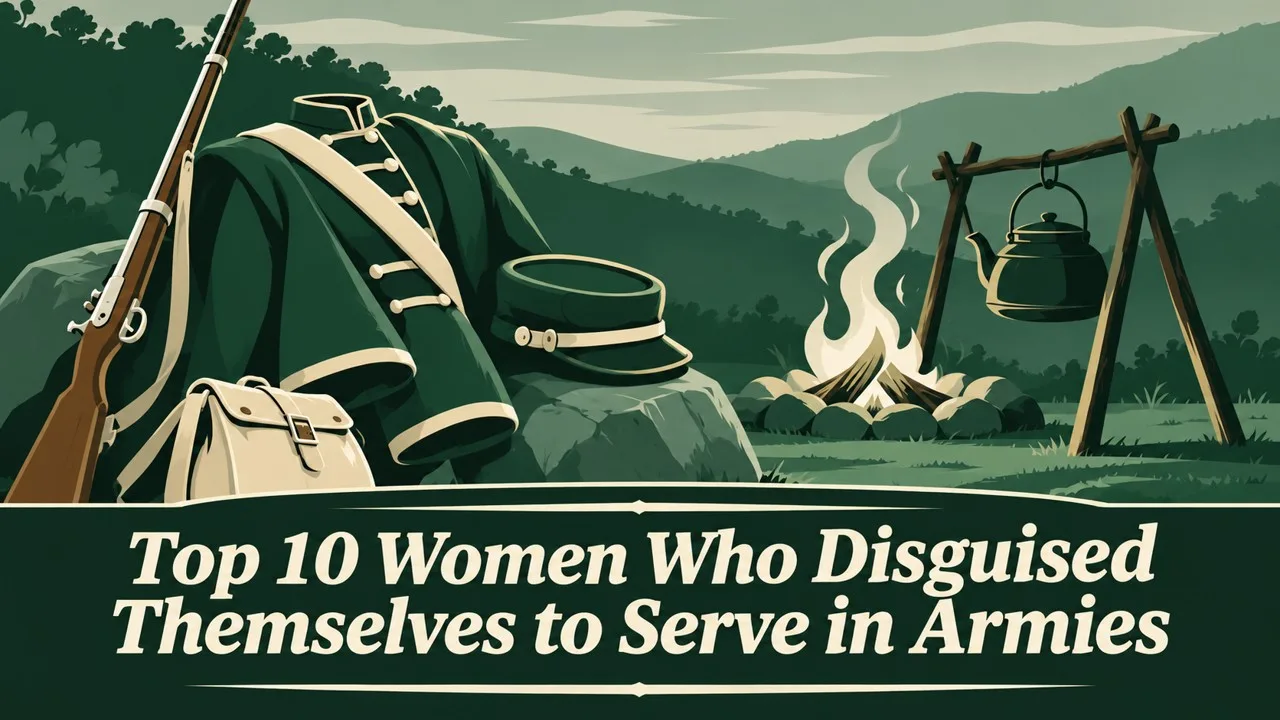
From the legend of Mulan to a Buffalo Soldier and a First World War journalist, ten women who disguised themselves as men to serve in armies. For most of history, women were officially barred from serving as soldiers in most armies. Yet throughout the centuries, some women found a way around the rules by disguising themselves as men and enlisting under false names.
Their reasons varied. Some wanted to follow husbands or lovers into the army, while others sought adventure, steady pay or an escape from limited lives at home. Some were motivated by patriotism or a desire to prove themselves equal to men.
Maintaining a disguise in a crowded military camp was extremely difficult. Women had to hide their bodies, change their voices and manners, and avoid medical examinations. Loose uniforms, the youthful appearance of many recruits and the fact that soldiers often slept in their clothes all helped.
Many were discovered only when they were wounded or fell ill and had to be examined by a doctor. Others served for years without being found out, and some kept their secret for the rest of their lives.
Historians believe that hundreds of women served in disguise during the American Civil War alone, and similar cases have been documented in European armies over several centuries.
The stories below include one famous legend, several well-documented cases and one account that historians have questioned. Where the evidence is uncertain, that is noted.
These women's experiences were often recorded in memoirs, newspaper reports, pension applications and military records. Some memoirs may have exaggerated details, as was common in popular writing of the time.
The ten entries below are arranged in roughly chronological order, from ancient China to the First World War, and include women from China, Ireland, England, the United States, Russia and Canada.
Each entry names the person, the army in which she served and the era of her service, followed by an account of how she enlisted, how she was discovered and what happened afterward.
Together, these stories reveal remarkable courage and determination, and they challenge the assumption that war has always been an exclusively male experience.
Key Facts
| # | Person | Army | Era |
|---|---|---|---|
| 1 | Hua Mulan | Chinese army in legend | Probably fourth to sixth century |
| 2 | Christian Davies | English army under the Duke of Marlborough | Early eighteenth century |
| 3 | Hannah Snell | British Royal Marines | 1740s |
| 4 | Mary Anne Talbot | British army and navy | 1790s |
| 5 | Deborah Sampson | Continental Army | 1782 to 1783 |
| 6 | Nadezhda Durova | Russian Imperial Army | 1806 to 1816 |
| 7 | Sarah Emma Edmonds | Union Army | 1861 to 1863 |
| 8 | Cathay Williams | United States Army | 1866 to 1868 |
| 9 | Dorothy Lawrence | British Expeditionary Force | 1915 |
| 10 | Loreta Janeta Velázquez | Confederate army, according to her own account | 1860s |
1. The Legendary Daughter Who Took Her Father's Place
The story of Hua Mulan comes from a Chinese poem known as the Ballad of Mulan, which probably dates from the period of the Northern and Southern dynasties. In the poem, Mulan takes her elderly father's place when he is called up for military service, disguising herself as a man [1].
Related: Women Served in Armed Forces and Wartime Industries
According to the ballad, she serves for many years and wins great honor. When she returns home and puts on her old clothes, her fellow soldiers are astonished to discover that their comrade was a woman [1].
Historians do not know whether Mulan was a real person. Her story has been retold many times in Chinese literature, opera and film, and it became internationally famous through animated and live-action films.
2. Searching for a Missing Husband
Christian Davies was an Irish woman whose husband, Richard Welsh, disappeared and was later found to have joined the army. Disguising herself as a man named Christopher Welsh, she enlisted to search for him [2].
She served for years in campaigns in Flanders and was wounded at the Battle of Ramillies in 1706, when surgeons discovered that she was a woman. She was reunited with her husband and continued to accompany the army, working as a cook [2].
Davies later received a pension and was buried with military honors at the Royal Hospital Chelsea. A popular account of her life was published after her death, though some details may have been embellished.
3. A Marine Wounded in India
Hannah Snell, from Worcester, England, enlisted under the name James Gray in the 1740s. She joined the marines and sailed to India, where she took part in the siege of Pondicherry in 1748 [3].
She was wounded during the fighting but reportedly managed to avoid discovery by having a local woman help remove a musket ball. She revealed her identity to her shipmates after returning to England in 1750 [3].
Her story became a sensation. She performed on stage in her uniform and received a pension from the Royal Hospital Chelsea, which was rare recognition for a woman soldier at the time.
4. A Drummer Boy at Sea
Mary Anne Talbot claimed that she was taken to Europe as a young girl by an officer who forced her to dress as a boy and serve as his footboy and drummer. She later served as a sailor under the name John Taylor [4].
According to her account, she was wounded during the naval battle known as the Glorious First of June in 1794. She later revealed her identity and lived in London, where her story attracted attention [4].
Related: Top 10 Women Who Changed History
Her life story was published around the time of her death in 1808. Historians have questioned some of its details, but it remains one of the best-known accounts of a woman serving in disguise in the British forces.
5. A Continental Army Soldier
Deborah Sampson grew up in Massachusetts and worked as an indentured servant and teacher. In 1782, she enlisted in the Continental Army under the name Robert Shurtleff and served in a light infantry company [5].
She was wounded in a skirmish and reportedly treated some of her injuries herself to avoid detection. Her identity was discovered when she fell seriously ill with fever in Philadelphia, and she received an honorable discharge in 1783 [5].
After the war, Sampson gave public lectures about her experiences. With support from figures including Paul Revere, she eventually received a military pension. In 1983, Massachusetts declared her its official state heroine.
6. The Cavalry Maiden
Nadezhda Durova ran away from home in 1806 and joined a Russian cavalry regiment disguised as a young man. She served with distinction in campaigns against Napoleon's forces [6].
When her identity became known, Tsar Alexander I met her and allowed her to continue serving under a new name, Alexandrov. She was awarded the Cross of Saint George for saving an officer's life [6].
Durova fought at the Battle of Borodino in 1812 and retired as a captain. Her memoir, published in the 1830s with the help of the poet Alexander Pushkin, became known in English as The Cavalry Maiden.
7. A Union Soldier and Nurse
Sarah Emma Edmonds was born in Canada and later moved to the United States. When the American Civil War began, she enlisted in a Michigan infantry regiment under the name Franklin Flint Thompson [7].
She served as a nurse and mail carrier, and in her later memoir she described undertaking spy missions, though some of these accounts have been questioned. In 1863, she fell ill with malaria and left the army, fearing that a hospital examination would reveal her identity [7].
Related: Top 10 Most Bizarre Phobias: Strange Fears That Exist
Her memoir, published as Nurse and Spy in the Union Army, became a bestseller. Years later, she received a military pension and was admitted to a Union veterans' organization.
8. The Woman Buffalo Soldier
Cathay Williams was born into slavery in Missouri. After the Civil War, she enlisted in the United States Army in 1866 under the name William Cathay, joining one of the regiments of African American soldiers later known as Buffalo Soldiers [8].
She served for nearly two years, despite frequent illness. A surgeon eventually discovered that she was a woman, and she was discharged in 1868 [8].
Williams is the only documented woman known to have served as a Buffalo Soldier. She later applied for a disability pension but was denied. Today, she is honored with memorials and is recognized as a pioneering figure in American military history.
9. A Journalist in the Trenches
Dorothy Lawrence was an English woman who wanted to report on the First World War as a journalist. Frustrated by restrictions on women reporters, she traveled to France in 1915 and, with the help of soldiers she befriended, obtained a uniform [9].
Disguised as a soldier named Denis Smith, she reached the front lines and worked with a unit of the Royal Engineers that dug tunnels. After about ten days, she became ill and revealed her identity [9].
The army was embarrassed and made her promise not to write about her experiences during the war. She later published a book, but it attracted little attention, and she spent her final years in a psychiatric hospital.
10. A Disputed Confederate Officer
Loreta Janeta Velázquez published a memoir in 1876 called The Woman in Battle. In it, she claimed to have served as a Confederate officer named Harry T. Buford and to have fought in several major battles of the Civil War [10].
Her claims were disputed at the time, including by a former Confederate general who called her account a fabrication. Historians continue to debate how much of her story is true [10].
Related: Top 10 Oldest Buildings in the World
Some researchers believe that parts of her account may be based on real experiences, while others consider much of it invented. Her story remains one of the most famous and controversial accounts of a woman soldier in the Civil War.
Conclusion
These women's stories show remarkable courage and determination. They defied the rules of their societies to serve as soldiers, facing not only the dangers of war but also the constant risk of discovery.
Their experiences varied widely. Some were celebrated and received pensions, while others were punished, ignored or forgotten. Some stories are well documented, while others remain uncertain.
Together, they show that women have taken part in warfare throughout history, even when official rules excluded them.
Today, many armies allow women to serve openly, including in combat roles. The stories of these pioneering women have helped inspire changes in attitudes and policies.
Historians continue to uncover new evidence about women who served in disguise, through records such as pension files, letters and medical reports.
Their research suggests that the women whose names are known represent only a small fraction of those who served, since many who were never discovered left no trace in the records.
Remembering these women helps give a fuller picture of military history and honors the contributions of those who served without recognition.
- ^ [1] Accounts of Hua Mulan. Wikipedia: Hua Mulan Wikipedia: Ballad of Mulan
- ^ [2] Accounts of Christian Davies. Wikipedia: Christian Davies Wikipedia: Battle of Ramillies
- ^ [3] Accounts of Hannah Snell. Wikipedia: Hannah Snell Wikipedia: Royal Hospital Chelsea
- ^ [4] Accounts of Mary Anne Talbot. Wikipedia: Mary Anne Talbot Wikipedia: Glorious First of June
- ^ [5] Accounts of Deborah Sampson. Wikipedia: Deborah Sampson Wikipedia: Continental Army
- ^ [6] Accounts of Nadezhda Durova. Wikipedia: Nadezhda Durova Wikipedia: Battle of Borodino
- ^ [7] Accounts of Sarah Emma Edmonds. Wikipedia: Sarah Emma Edmonds Wikipedia: Women in the American Civil War
- ^ [8] Accounts of Cathay Williams. Wikipedia: Cathay Williams Wikipedia: Buffalo Soldier
- ^ [9] Accounts of Dorothy Lawrence. Wikipedia: Dorothy Lawrence Wikipedia: Royal Engineers
- ^ [10] Accounts of Loreta Janeta Velázquez. Wikipedia: Loreta Janeta Velázquez Wikipedia: Women in the American Civil War




















Discussion
Log in with