




Top 10 Songs and Products That Became Hits the Second Time
 By Dhiraj Sharma · Published
Share Post
Loading…
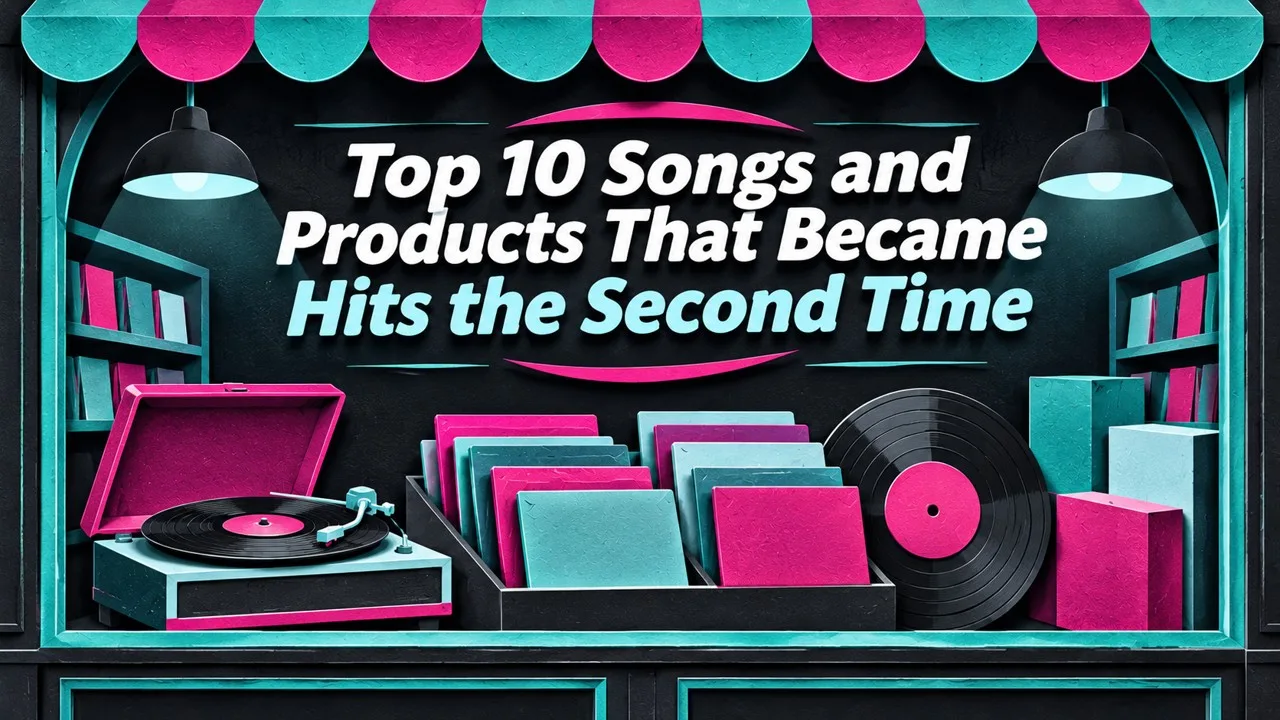
A flop soul single, a failed wallpaper and a forgotten shoe brand: ten songs and products that found far greater success on their second time around. Success does not always arrive on the first attempt. In music and business, some of the most famous hits began as flops, curiosities or modest successes before finding a much larger audience years later.
A second chance can come in many ways. A song may be covered by a new artist, featured in a popular film or television series, or rediscovered by a new generation. A product may be reinvented for a completely different purpose after its original market disappears.
These stories show how much timing matters. The right context, whether a dance craze, a hit movie or a change in fashion, can transform something overlooked into a phenomenon.
They also show the importance of persistence and creativity. In several cases, a company or individual refused to give up on an idea, or found a new way to use something that had failed.
The examples below include six songs and four products. The songs span from the late 1950s to the 2020s, and the products range from children's toys to office supplies and shoes.
Some of these songs were already hits the first time but became far bigger on a second run. Others were genuine flops that only found success when someone else recorded them.
The products were mostly failures or declining brands in their original form. Their revival came from new uses, clever marketing or unexpected changes in public taste.
Each entry gives the song or product, a summary of what happened the first time and what changed the second time, followed by the story behind its revival.
Chart positions and sales figures come from widely reported sources, though exact numbers can differ slightly between them.
Together, these stories offer encouragement to anyone whose first attempt did not succeed, and a reminder that a good idea can find its moment long after it first appears.
Key Facts
| # | Song or product | First time around | Second time around |
|---|---|---|---|
| 1 | Tainted Love | A little-noticed soul single in the 1960s | A worldwide synth-pop hit in 1981 |
| 2 | Unchained Melody | A hit for the Righteous Brothers in 1965 | A chart-topper again after the film Ghost in 1990 |
| 3 | The Twist | A number one hit for Chubby Checker in 1960 | Number one again in 1962 as adults joined the craze |
| 4 | Stand by Me | A top ten hit for Ben E. King in 1961 | A hit again after the 1986 film and a jeans advertisement |
| 5 | Don't Stop Believin' | A top ten hit for Journey in 1981 | A digital download phenomenon decades later |
| 6 | Running Up That Hill | A top ten hit in Britain for Kate Bush in 1985 | A global number one hit in 2022 |
| 7 | Play-Doh | A putty for cleaning soot from wallpaper | A famous children's modeling compound |
| 8 | Bubble Wrap | A failed textured wallpaper | A world-famous packaging material |
| 9 | Post-it Notes | A weak adhesive and a failed test launch | A best-selling office product |
| 10 | Hush Puppies | A declining casual shoe brand in the 1990s | A sudden fashion craze |
1. A Soul Song Reborn as Synth-Pop
Tainted Love was written by Ed Cobb and first recorded by the American singer Gloria Jones in the mid-1960s. Her version was not a commercial success at the time, though it later became popular on the Northern soul scene in England, where DJs played rare American soul records [1].
Related: Top 10 Famous Bands That Began with Worse Names
In 1981, the British duo Soft Cell recorded a synth-pop version of the song. Their slower, electronic arrangement topped the British singles chart and became a hit in many countries [1].
In the United States, Soft Cell's version spent a remarkable length of time on the Billboard Hot 100, setting a record for its era. The song has since been covered and sampled many times, but it is best remembered in its second incarnation.
2. A Ghostly Revival
Unchained Melody was written for a 1955 prison film called Unchained, and several versions charted that year. The most famous recording came in 1965, when it was released by the Righteous Brothers, with Bobby Hatfield singing lead [2].
That version was a hit, but its greatest success came twenty-five years later. In 1990, the song featured in a memorable scene in the film Ghost, starring Patrick Swayze and Demi Moore [2].
The film's success sent the Righteous Brothers' recording back up the charts. It reached number one in the United Kingdom and became one of the most recognizable love songs in the world.
3. The Dance That Topped the Charts Twice
The Twist was first recorded by Hank Ballard and the Midnighters in the late 1950s as a B-side. In 1960, Chubby Checker released a cover version that reached number one on the Billboard Hot 100, popular mostly with teenagers [3].
The following year, the dance became fashionable among adults, including celebrities who were seen twisting at the Peppermint Lounge nightclub in New York. Checker's single re-entered the charts [3].
In January 1962, The Twist returned to number one. For decades, it was the only single to top the Hot 100 in two separate chart runs, and it remains one of the most successful singles in the chart's history.
4. A Classic Rediscovered Through Film
Stand by Me, written by Ben E. King with Jerry Leiber and Mike Stoller, was released in 1961 and became a top ten hit in the United States. It became one of the best-known soul songs of its era [4].
In 1986, the song was used as the title song for Rob Reiner's coming-of-age film Stand by Me. The film's success brought King's recording back into the American top ten [4].
Related: Top 10 Albums That Were Panned and Later Became Classics
The following year, the song was featured in a television advertisement for Levi's jeans in Britain. It reached number one on the British singles chart, more than twenty-five years after its original release.
5. From Arena Rock to Digital Bestseller
Journey's Don't Stop Believin' reached the top ten of the Billboard Hot 100 in 1981. It was a successful single, but it was not the band's biggest hit at the time [5].
The song gained new life in the 2000s. It was famously used in the final scene of the television series The Sopranos in 2007, and it was performed in the first episode of the musical series Glee in 2009 [5].
The song became one of the best-selling digital downloads of any song released in the twentieth century. It is now often sung at sporting events and karaoke nights, enjoyed by fans who were not born when it first came out.
6. A Hit Again After Thirty-Seven Years
Kate Bush's Running Up That Hill was released in 1985 and became a hit in Britain, reaching the top ten. It was less successful in the United States, where it reached the lower half of the top forty [6].
In 2022, the song was featured prominently in the fourth season of the Netflix series Stranger Things. A new generation of listeners discovered it through the show and social media [6].
The song reached number one in the United Kingdom and became a top ten hit in the United States for the first time. Bush said she was amazed by the response, which came about thirty-seven years after the song's release.
7. From Wallpaper Cleaner to Toy
Play-Doh began as a product for cleaning wallpaper. In the early twentieth century, homes heated by coal often had soot-stained walls, and a soft, dough-like compound could be rolled over the wallpaper to remove the dirt [7].
As homes switched to cleaner heating, demand for wallpaper cleaner fell. According to the company's history, Kay Zufall, a relative of one of the company's owners, suggested that children could use the compound for modeling [7].
Related: Top 10 Common Misconceptions About Music History
The company reformulated the product and began selling it as a toy in the 1950s. Play-Doh became one of the best-selling toys in the world, and its distinctive smell is familiar to generations of children.
8. From Wallpaper to Packaging
In 1957, the engineers Alfred Fielding and Marc Chavannes tried to create a textured wallpaper by sealing two shower curtains together, trapping air bubbles. The wallpaper idea did not catch on [8].
They also tried marketing the material as greenhouse insulation, without much success. In 1960, they founded the company Sealed Air to develop new uses for their invention [8].
Its breakthrough came when it was used to protect delicate computer equipment during shipping, including machines made by IBM. Bubble wrap became one of the most widely used packaging materials, and popping its bubbles became a popular pastime.
9. The Adhesive Nobody Wanted
In 1968, Spencer Silver, a scientist at the company 3M, developed an adhesive that stuck lightly to surfaces and could be removed easily. For years, nobody at the company could find a practical use for it [9].
In the 1970s, his colleague Art Fry realized it could be used to make bookmarks that would stay in place in his church hymnal without damaging the pages. 3M developed the idea into sticky notes, but a test launch under a different name in 1977 performed poorly [9].
The company then gave away free samples to office workers in Boise, Idaho, and many began reordering. The product was launched nationally as Post-it Notes in 1980 and became one of the most popular office supplies in the world.
10. A Shoe Brand Revived by Fashion
Hush Puppies, a brand of casual suede shoes, was very popular in the 1950s and 1960s. By the early 1990s, sales had fallen dramatically, and the brand seemed old-fashioned [10].
In the mid-1990s, young people in New York's fashionable neighborhoods reportedly began wearing the shoes, perhaps because nobody else did. Fashion designers took notice and featured them in their shows [10].
Related: Top 10 Chance Meetings That Formed Famous Bands
Sales rose sharply. The writer Malcolm Gladwell used the story in his book The Tipping Point to illustrate how small groups of trendsetters can spark widespread changes in behavior.
Conclusion
These stories show that success often depends on timing, context and persistence. A song or product that fails the first time may find its audience years later, sometimes in a completely different form.
Films, television shows and advertisements have played a major role in reviving songs, introducing them to new generations of listeners.
Products have been revived through reinvention, finding new uses when their original markets disappeared or never materialized.
The digital age has made second chances even more common. Streaming services and social media allow old songs to be discovered by new audiences almost instantly.
For artists, inventors and businesses, these stories offer a valuable lesson. An idea that seems to have failed may simply be waiting for the right moment.
They also suggest that audiences are often more open to rediscovering the past than marketers expect, especially when an old song or product is presented in a fresh way.
The next time an old song suddenly appears in the charts, it may be the latest example of an idea that has finally found its moment.
- ^ [1] Accounts of Tainted Love. Wikipedia: Tainted Love Wikipedia: Soft Cell
- ^ [2] Accounts of Unchained Melody. Wikipedia: Unchained Melody Wikipedia: Ghost (1990 film)
- ^ [3] Accounts of The Twist. Wikipedia: The Twist Wikipedia: Chubby Checker
- ^ [4] Accounts of Stand by Me. Wikipedia: Stand by Me Wikipedia: Ben E. King
- ^ [5] Accounts of Don't Stop Believin'. Wikipedia: Don't Stop Believin' Wikipedia: Journey
- ^ [6] Accounts of Running Up That Hill. Wikipedia: Running Up That Hill Wikipedia: Kate Bush
- ^ [7] Accounts of Play-Doh. Wikipedia: Play-Doh Wikipedia: Modelling clay
- ^ [8] Accounts of Bubble Wrap. Wikipedia: Bubble wrap Wikipedia: Sealed Air
- ^ [9] Accounts of Post-it Notes. Wikipedia: Post-it Note Wikipedia: Spencer Silver
- ^ [10] Accounts of Hush Puppies. Wikipedia: Hush Puppies Wikipedia: The Tipping Point






















Discussion
Log in with