






 By
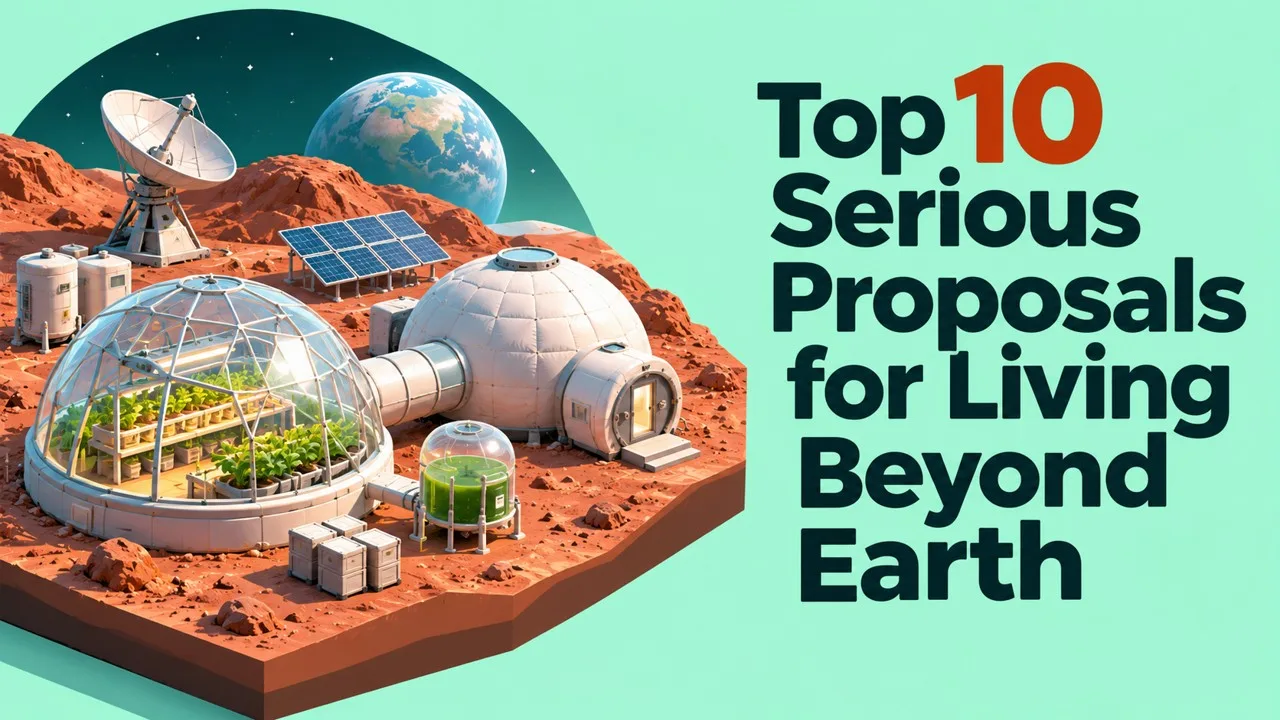
Serious proposals for living beyond Earth range from inflatable habitats to food-system research, and a concept is not a settlement already under way.
The ten items below are inflatable habitat modules, closed-loop food and air research, high-altitude balloon tourism proposals, large lunar-infrastructure concepts from Japanese industry, the Dream Chaser lifting-body spaceplane, animal studies of reduced loading, assistive-limb concepts for low gravity, plant-growth experiments in dusty simulants, locomotion and short-radius fitness ideas, and long-term interstellar precursor proposals. A popular list sometimes dresses these as jokes or as accomplished facts. This article labels them as proposals, programs, or laboratory work. It will not offer engineering instructions, weapons, or a claim that anyone is already colonizing another world.
Key Facts
| Idea | What actually exists | A limit |
|---|---|---|
| 1 | Inflatable modules, including a later station demonstration, are a real habitat approach | A soft wall is not a ready-made town |
| 2 | Agencies study how to recycle air, water, and waste, and how to make food in closed systems | A menu item in a press photo is not a farm already feeding a city |
| 3 | High-altitude balloon flights have been proposed, and in some cases developed, as a tourism experience | A reservation page is not orbit, and this is not a booking guide |
| 4 | Japanese industrial concepts have imagined large lunar or orbital structures, including funnel-like or underground cities | A white paper is a proposal |
| 5 | Dream Chaser is a real lifting-body spaceplane program intended, among other jobs, to resupply a station | A program can slip, shrink, or change its customer |
| 6 | Mice and other animals are used in research on unloading, radiation, and later recovery | An animal study is not a medical promise for a crew, and this is not advice |
| 7 | Assistive or extra limbs have been proposed as a way to help a person move or work in unfamiliar gravity | The hardware is conceptual or early; this is not a build sheet |
| 8 | Groups have grown some plants in lunar or analog soils and simulants, sometimes with help from microbes | A pot in a laboratory is not a harvest on the Moon |
| 9 | Designers have proposed wall-running, centrifuges, and other ways to keep a body working off Earth | The ideas are exercises in design, not a gym already in flight |
| 10 | Interstellar precursor missions, including very small sails, remain proposals or early technology work | Distances are huge, and no crew is on the way |
1. A Soft Module, Already Demonstrated in Miniature
Inflatable, or expandable, habitats have been a serious design family for decades, from earlier TransHab work to a later module flown as a demonstration at a space station [1]. The appeal is volume: a packed fabric or composite shell can open into a room that a metal can of the same launch size would not allow. The demonstration showed that a soft-walled room can hold pressure in orbit for years. It did not show a city, a "bounce house" for daily life, or a finished architecture for a Mars surface base. Those remain proposals built on a real, limited success [1].
The unexpected fact is that a habitat can be, in part, a bag with a serious structural pedigree [1]. This article will not offer a sewing pattern. The careful fact is documented design history and a documented orbital demonstration. Volume is the selling point. A town is the leap.
A room can inflate and still not have been, except in a rendering, a neighborhood.
2. Air, Water, and Food, as a Loop Still in Research
Life-support research has long asked how to recycle air and water, how to handle waste, and how to grow or print some of a crew's food without endless resupply [2]. Later public stories about making a familiar staple from recycled carbon dioxide or from a laboratory protein are at their best when they are labeled as food-systems research, not as a kitchen already running on another world. Closed loops are hard, incomplete, and essential if a long stay is ever to be more than a picnic with a long supply chain. This article will not give a recipe [2].
The unexpected fact is that a future menu can be, today, a chemistry problem about a cabin's air [2]. The careful fact is documented agency and university work and documented, modest demonstrations. Nutrition is the brief. A restaurant in orbit is the caption that runs ahead.
A flour can be made in a laboratory and still not have been, on any crew schedule, dinner for a town.
3. A Balloon, as a Tourism Proposal, Not as Orbit
Several firms have proposed, and in some cases begun to develop, high-altitude balloon flights that would carry paying passengers to the edge of the atmosphere for a view of the curve of the Earth [3]. That is a serious, if commercial, proposal, with aircraft-like safety questions and a long road of tests. It is not a vacation already for sale in the ordinary sense, and it is not a path to orbit or to another world. This article will not take a booking or compare ticket prices. It will say that a balloon is a documented way to lift a cabin, and that "space" in the marketing is a height, not a settlement [3].
Related: Top 10 Most Bizarre Phobias: Strange Fears That Exist
The unexpected fact is that a nineteenth-century vehicle can be asked, again, to do a twenty-first-century luxury job [3]. The careful fact is documented later proposals and documented test work. A view is the product. A colony is not.
A cabin can hang under a balloon and still not have been, except in a brochure, a hotel.
4. A Funnel or a City, on a Japanese Drawing Board
Japanese industry and research groups have, over several decades, published concepts for large lunar or orbital infrastructure: bases under regolith, long cables or funnels, and even city-scale structures meant to be built much later [4]. The drawings are serious in the sense that they come from firms and laboratories that also build real hardware. They are still concepts. A funnel-shaped lunar city is a way of talking about light, landing, and volume, not a construction site. Labeling the work as a proposal is a form of respect for both the engineers and the Moon [4].
The unexpected fact is that a cautious industrial culture can still publish, on paper, a very large dream [4]. This article will not treat a rendering as a permit. The careful fact is documented concept studies and a documented absence of any such city. Ambition is allowed. Occupancy is not.
A funnel can be elegant in a report and still not have been, on the ground, a street.
5. A Lifting Body, as a Program with a Job
Dream Chaser is a lifting-body spaceplane program, developed over many years, and intended in later plans to carry cargo, and possibly eventually people, to a space station [5]. Unlike a purely paper vehicle, it has hardware, tests, and a public customer story. Unlike a completed airline, it has also slipped, changed shape, and waited on funding and on a launch plan. This article lists it as a serious program, not as a promised taxi already in regular service. A spaceplane can be real as a project and still not be, in this decade, a timetable you can memorize [5].
The unexpected fact is that a vehicle can spend longer as a program than some spacecraft spend in flight [5]. The careful fact is documented development and documented later cargo plans. Reusability is the hope. A schedule is the fragile part.
Related: Top 10 Oldest Buildings in the World
A wing can have been built for a runway and still not have been, by the time of writing, a routine supply run.
6. Mice, Unloading, and a Limit on What They Promise
Researchers use mice and other animals to study what happens to bone, muscle, immunity, and later recovery when loading or when radiation conditions change, work that informs, at a distance, the medical file of a long voyage [6]. Public captions sometimes turn a particular strain or a particular result into "health hope for astronauts" as if a therapy were already in the kit. An animal study is a step. It is not a treatment, not a guarantee, and not medical advice for a person. This article will not name a protocol or a drug [6].
The unexpected fact is that a small animal can be asked to stand in, for a time, for a problem a crew has not yet lived at full length [6]. The careful fact is documented unloading and radiation research and a documented need to keep the hope smaller than the headline. Biology is the subject. A cure is the over-claim.
A mouse can lose bone in a study and still not have been, for a future crew, a finished answer.
7. Extra Limbs, as a Concept for an Unfamiliar Weight
Designers have proposed assistive or additional robotic limbs to help a person stand, fall more safely, or do work in reduced or unfamiliar gravity, including after a landing [7]. The idea is serious as a human-factors problem: a body trained on Earth is clumsy in a new weight, and a tool might help. The hardware, in the form the popular lists prefer, is early or conceptual. This article will not offer a wiring diagram or a training program. It will say that a "super limb" is a name for a class of proposals, not a product on a belt [7].
The unexpected fact is that a fall, in a new gravity, can be a design brief [7]. The careful fact is documented later concept work and a documented absence of a finished, flown standard tool. Help is the aim. A comic-book limb is the metaphor.
Related: 10 Sikh Gurus: The Pillars of Sikhism Who Shaped Faith, Equality, Courage, and Humanity
A brace can be imagined for the Moon and still not have been, in any packing list, a standard issue.
8. A Plant in a Dusty Simulant, Not a Lunar Field
Laboratories have grown some plants in lunar meteorite or returned samples, in carefully prepared simulants, and in mixtures that include microbes or added nutrients [8]. The results are encouraging at the scale of a pot and a paper. They are not a farm, and they do not mean that "worms and fungi" have opened the Moon to chickpeas as a settled agricultural fact. Soil on another world is a chemistry and a dust problem as well as a biology problem. This article will not give a growing method [8].
The unexpected fact is that a seed can germinate in a material that was, recently, a rock from somewhere else [8]. The careful fact is documented later experiments and documented, small yields. Agriculture is the long goal. A harvest photograph is the part that needs a caption about scale.
A pot can be true and still not have been, except in a headline, a field.
9. Fitness Ideas That Are Still on the Board
Designers and physiologists have proposed many ways to keep a body working off Earth: treadmills with bungee, short-radius centrifuges, and even odd locomotion such as running along a wall in a rotating space [9]. A few exercise devices have already flown. The more striking "run on the walls" pictures are usually still concepts or ground demonstrations. The medical problem is real: unloading changes bone and muscle. The solutions should be labeled according to whether they have flown, been tested on the ground, or only been drawn [9].
The unexpected fact is that a gym can be, in a study, a question of which way is down [9]. This article will not prescribe an exercise. The careful fact is documented flown devices and documented later, unflown concepts. Health is the brief. A spectacular path around a cylinder is the optional drawing.
A wall can be a track in a paper and still not have been, on a station, the way a crew actually trained.
Related: Top 10 Tallest Buildings in the World
10. A First Step Toward Other Stars, Still a Proposal
Proposals for interstellar precursor missions, including very small sails pushed by light and larger, much later, conceptual probes, are a serious branch of long-range thinking [10]. A few technology pieces have been tested at small scale. No crew, and no current spacecraft, is on the way to another star, and the distances make even a fast unmanned flyby a work of decades at best. This article will not offer a drive design or a weaponized interpretation of a sail. It will say that "first steps" are real as research and still tiny beside the gap they hope to cross [10].
The unexpected fact is that a chip-sized craft can be, in a proposal, the only honest scale for a first try [10]. The careful fact is documented concept work and a documented absence of an underway interstellar mission. Ambition is allowed. Departure is the word that should wait.
A sail can be tested in a lab and still not have been, except as a hope, a ship already aimed at another sun.
Conclusion
The ten items above include an inflatable room that has already flown in miniature, a food-and-air loop still in research, a balloon tourism proposal, a Japanese paper city, a spaceplane program, animal studies that should not be over-promised, assistive-limb concepts, a pot of plants in a simulant, fitness ideas still on the board, and interstellar precursors that remain proposals. Seriousness is not the same as arrival.
A drawing can be careful engineering and still not have been, until someone lives there, a place.
- ^ [1] Historical and program accounts of expandable habitats, including earlier TransHab work and a later inflatable module demonstrated at a space station, labeled as a habitat approach rather than as a town. NASA expandable-habitat materials https://www.britannica.com/topic/International-Space-Station
- ^ [2] Agency and research accounts of closed-loop air, water, waste, and food-system work, including later laboratory demonstrations, without recipes or a claim of a working off-world farm. exploration life-support materials European Space Agency life-support materials
- ^ [3] Industry and aviation-safety discussions of high-altitude balloon tourism proposals and tests, labeled as proposals and not as a booking guide or as orbit. https://www.britannica.com/science/balloon-flight related commercial-space materials
- ^ [4] Concept-study accounts of later Japanese industrial ideas for large lunar or orbital infrastructure, clearly labeled as proposals. Japan Aerospace Exploration Agency https://www.britannica.com/place/Moon
- ^ [5] Program accounts of the Dream Chaser lifting-body spaceplane and of later cargo plans, including the fact that schedules can slip, without a promised timetable. commercial crew and cargo materials https://www.britannica.com/technology/spaceplane
- ^ [6] Research accounts of animal studies on unloading and radiation, clearly distinguished from a medical promise or a protocol for a crew. Human Research Program materials https://www.britannica.com/science/space-medicine
- ^ [7] Design and human-factors accounts of assistive or additional limbs proposed for unfamiliar gravity, labeled as concepts and without a build sheet. related exploration human-factors materials https://www.britannica.com/technology/prosthesis
- ^ [8] Laboratory accounts of plant growth in lunar samples, simulants, and related mixtures, including microbial assistance, labeled as small experiments rather than as a farm, and without a growing method. https://www.nasa.gov/ https://www.britannica.com/science/regolith
- ^ [9] Accounts of flown exercise devices and of later unflown locomotion or centrifuge concepts for keeping a body working off Earth, without an exercise prescription. https://www.nasa.gov/hrp https://www.britannica.com/science/centrifuge
- ^ [10] Concept and technology accounts of interstellar precursor proposals, including small light-sail ideas, clearly labeled as proposals and not as an underway crew mission, without a drive design. https://www.britannica.com/science/interstellar-flight https://www.esa.int/




















Discussion
Log in with