





 By
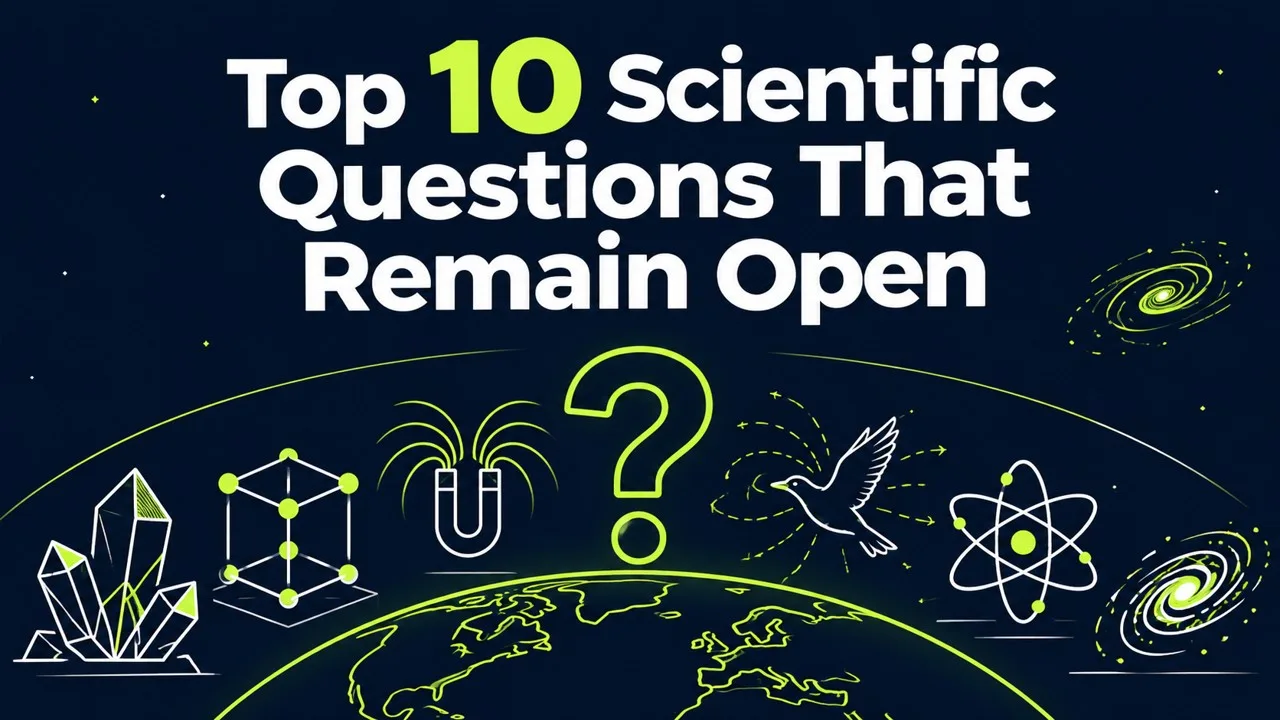
Open scientific questions include disappearing crystal forms, a debated superconductor mechanism, and how some animals sense a magnetic field.
The ten questions below concern disappearing polymorphs, the mechanism of high-temperature cuprate superconductivity, the causes of idiopathic pulmonary fibrosis, metallic hydrogen, how placebo and nocebo effects work, the carbon source of the Paleocene-Eocene Thermal Maximum, animal magnetoreception, the origin of eukaryotic cells, how general anesthesia produces reversible unconsciousness, and the remaining spread in estimates of Earth's equilibrium climate sensitivity. The set is mixed across chemistry, physics, geology, biology, and medicine, and it is distinct from a Finepedia list of unsolved cosmic puzzles. This article will not give medical advice, and it will not treat a headline "mystery" as a license for mysticism.
Key Facts
| Question | The careful present state | A limit |
|---|---|---|
| 1 | Some crystalline forms can become hard or impossible to make again after a more stable form appears | A vanished form is a manufacturing and theory problem, not a haunting |
| 2 | Cuprate high-temperature superconductivity is real; a single agreed microscopic mechanism is not | "High temperature" is still, for many of these materials, very cold in everyday terms |
| 3 | Idiopathic pulmonary fibrosis is a documented disease whose causes are still incompletely mapped | This is not a diagnosis or a treatment guide |
| 4 | Metallic hydrogen is expected from theory and is hard to make and to prove in the laboratory | Planetary interiors are the large natural setting |
| 5 | Placebo and nocebo effects are real; their mechanisms are only partly understood and vary by condition | This is not a reason to discard a tested treatment, and it is not advice |
| 6 | The Paleocene-Eocene Thermal Maximum was a rapid warming; the exact carbon source and pathway remain debated | A known event can still have an open ledger |
| 7 | Some animals sense magnetic fields; the receptor and the quantum or chemical details are still argued | The debate is biological, not a door to pop mysticism |
| 8 | Eukaryotic cells have a documented later origin involving, in the leading view, an archaeal host and a bacterial symbiont; the steps are not all settled | A textbook diagram can be a hypothesis with remaining gaps |
| 9 | General anesthesia reliably produces reversible unconsciousness; how the drugs do that, at the level of networks and molecules, is still incomplete | This is not anesthetics advice |
| 10 | A range of later estimates of equilibrium climate sensitivity is narrower than it once was and still not a single tight number | A remaining spread is not a reason to ignore the well-established direction of the risk |
1. A Crystal Form That Will Not Come Back
Some solids can pack the same molecules in more than one crystal form, or polymorph, and a form that was once easy to grow can later become elusive or, in industrial folklore, nearly impossible to make again after a more stable form has appeared [1]. The most famous modern teaching case is a later antiviral whose first crystal form caused manufacturing trouble once a second form arrived. The problem is thermodynamics, kinetics, and surfaces, not a haunting of a laboratory. It still has open theoretical and practical edges: why a first form can become so hard to nucleate, and how to keep a wanted form under control. A vanished polymorph is a serious open issue in chemistry and in pharmacy [1].
The unexpected fact is that a recipe can fail because the solid state, not the chemist, has changed its habit [1]. This article will not give a manufacturing method. The careful fact is documented later cases and documented remaining control problems. Stability is the eventual winner. The first form is the one a plant may need.
A crystal can disappear from a factory floor and still not have been, except as a joke, a ghost.
2. A Superconductor Whose Mechanism Is Still Argued
Cuprate materials can conduct electricity without resistance at temperatures that, for superconductors, are unusually high, though still very cold by everyday standards [2]. The phenomenon is experimentally solid. A single, agreed microscopic mechanism, of the kind that explains ordinary low-temperature superconductors, is not. Later theories compete, experiments constrain them, and the gap is now a famous open problem in condensed-matter physics rather than a doubt that the materials work. "We do not fully understand" here means that the theory is unfinished, not that the measurements are a rumor [2].
The unexpected fact is that a technology can be, in some applications, already used, while its deepest explanation is still a fight [2]. The careful fact is documented later cuprate superconductivity and a documented unfinished mechanism. Utility can precede a final theory. Mystery language should stay in the seminar, not in a mystic pamphlet.
A current can flow without resistance and still not have told us, in every detail, why the electrons agreed.
3. A Lung Disease Whose Causes Are Still Incompletely Mapped
Idiopathic pulmonary fibrosis is a documented disease in which lung tissue becomes scarred, with a later course that medicine already knows too well [3]. "Idiopathic" in the name is a confession: the causes are incompletely mapped, even as risk factors, including some environmental and genetic associations, have been identified. The open question is not whether the disease exists. It is how to tell a complete causal story, and how later treatments follow from that story. This article will not offer a diagnosis, a prognosis, or a therapy [3].
Related: Top 10 Cases Where the Placebo Effect Misled Science
The unexpected fact is that a named disease can still have, in its first adjective, a gap [3]. The careful fact is a documented clinical entity and documented, incomplete later causal maps. Suffering is real. A complete cause list is the unfinished part.
A scar can be visible on a scan and still not have been, in every patient, traced to a single first insult.
4. Hydrogen as a Metal, Expected and Hard to Pin Down
Theory has long said that hydrogen, under enough pressure, should become a metal, and that such a metal may have unusual properties, including, in some predictions, superconductivity [4]. The large natural setting is the deep interior of giant planets. The laboratory setting is a tiny, extreme press, where claiming a true metallic, and especially a room-temperature-relevant, result is hard, and where later claims have sometimes been contested. The open questions are both "have we really made it, cleanly?" and "what, exactly, is it like if we have?" This article will not treat a press release as a final phase diagram [4].
The unexpected fact is that the most common element can be, in its metallic form, one of the hardest to certify [4]. The careful fact is documented theoretical expectation and documented, difficult later experiments. Pressure is the tool. Proof is the scarce product.
A gas can be predicted to shine like a metal and still not have been, in every later cell, a settled photograph.
5. Placebo and Nocebo, Real and Only Partly Explained
People can improve, or worsen, in ways that depend on expectation, ritual, and context as well as on a drug's direct chemistry; those effects are often called placebo and nocebo [5]. They are real enough to be measured in many trial settings, and they are not a proof that "it is all in the mind" in a dismissive sense. Mechanisms, which may include later learned responses, later meaning, and later changes in attention and in some measurable pathways, are only partly understood and almost certainly not one mechanism for every condition. This article will not tell anyone to skip a tested treatment, and it will not sell a mindset as a therapy [5].
The unexpected fact is that a sugar pill can be, in a trial, a complicated instrument [5]. The careful fact is documented later effects and documented, incomplete mechanism maps. Context is powerful. A miracle is the wrong word.
Related: Top 25 Interesting Facts About the Solar System
An expectation can change a reported symptom and still not have been, in every disease, a complete explanation of the disease.
6. A Rapid Warming Whose Carbon Ledger Is Still Open
The Paleocene-Eocene Thermal Maximum, about fifty-six million years ago, was a rapid global warming accompanied by a large injection of carbon into the ocean-atmosphere system [6]. The event is well documented in later cores and in later isotope records. The exact mix of sources, among later candidates such as methane hydrates, later organic-carbon oxidation, later volcanism associated with a large igneous province, and other reservoirs, remains debated. A known event can still have an open ledger. The open question is a geological accounting problem, not a doubt that the warming happened [6].
The unexpected fact is that a famous ancient heat can be, in its carbon, a story with more than one invoice [6]. The careful fact is a documented later event and documented later disagreement about sources. Climate can change fast in the record. A single culprit is the part that has not been locked.
A core can show a spike and still not have named, with a single later consensus, every source of the carbon.
7. A Magnetic Sense Whose Receptor Is Still Argued
Some animals, including some birds, turtles, and other groups, can use the Earth's magnetic field in orientation and navigation [7]. That behavioral fact is strongly supported. The receptor, and the later physical chemistry, are still argued: leading later ideas include later radical-pair chemistry in later cryptochrome proteins, and later magnetite-based sensors, and they may not be mutually exclusive in every species. The debate is biological and physical. It is not a door to pop-quantum mysticism, and it is not a claim that a person can casually "feel the field" as a party trick [7].
The unexpected fact is that a compass can be, in an animal, a molecule whose exact trick is still on the bench [7]. The careful fact is documented later behavior and documented later, competing receptor models. Navigation is real. A finished widget in the eye or the beak is the unfinished part.
Related: Top 25 Interesting Facts About the Universe
A migration can follow a field and still not have shown us, in every species, the first tiny part that feels it.
8. Eukaryotes, a Later Origin with Remaining Steps
Complex cells with a nucleus, the eukaryotes, appear later in the tree of life than bacteria and archaea, and the leading later view is that they arose from an archaeal host and a bacterial symbiont that became the mitochondrion [8]. That outline is widely supported by later genomes. The remaining questions are about the host's exact identity, the timing, the other later organelles, and the steps that turned a partnership into a new kind of cell. A textbook drawing can be a good hypothesis with gaps. The open question is a historical one, not a doubt that later animals, plants, and fungi are eukaryotes [8].
The unexpected fact is that a nucleus can be, in evolutionary time, a late invention [8]. The careful fact is a documented later symbiotic outline and documented remaining steps. Partnership is the central idea. A finished movie of the first cell is not yet available.
A cell can be our kind of cell and still not have left, in the rocks, a complete diary of how it began.
9. A Reversible Unconsciousness Whose Wiring Is Incomplete
General anesthesia, as later practiced, can reliably produce a reversible unconsciousness that surgery requires [9]. The later drugs are known, and some of their molecular binding sites are known. How those later actions, at the level of later networks, produce a loss of later connected experience, and how the brain comes back, are still incomplete. The open question is scientific. This article will not offer anesthetics advice, a protocol, or a comment on any person's care [9].
The unexpected fact is that a daily hospital tool can be, in its deepest account, unfinished [9]. The careful fact is documented later clinical reliability and documented, incomplete later mechanism work. Reversibility is the medical marvel. A complete wiring diagram is the missing chapter.
Related: Top 10 Mythical Creatures in World Mythology - That Inspired Myths Across Civilizations (unchanged)
A patient can go under and come back and still not have told, except as a later scientific puzzle, the exact path the lights took.
10. A Sensitivity Range That Narrowed and Has Not Vanished
Equilibrium climate sensitivity, the later warming expected after a doubling of carbon dioxide, once sat in a famously wide later range [10]. Later assessments have narrowed that range, with a central later estimate that is not a single tight digit. The remaining spread is an open quantitative question, and it is not a reason to ignore the well-established later direction of the risk, or the later fact that adding later greenhouse gases warms the later climate. This article will not treat a remaining error bar as a license for dismissal, and it will not give policy advice disguised as a number [10].
The unexpected fact is that a later number can be both better known than it was and still not a pin [10]. The careful fact is documented later narrowing and a documented remaining range. Physics is not in doubt in its direction. The last later half-degree of precision is the open part.
A planet can be on a known road and still not have told us, in a single official decimal, exactly how far a later doubling goes.
Conclusion
The ten questions above include a vanished crystal form, an unfinished superconductor theory, an incompletely mapped lung disease, a hard-to-certify metallic hydrogen, partly explained placebo effects, an ancient warming with an open carbon ledger, a magnetic sense whose receptor is still argued, a eukaryotic origin with remaining steps, a reversible anesthesia whose wiring is incomplete, and a climate sensitivity that narrowed without becoming a pin. An open question can be exacting. It does not have to be cosmic, and it does not have to be mystical.
A science can be mature and still not have been, in every chapter, finished.
- ^ [1] Chemical and pharmaceutical accounts of disappearing polymorphs, including later manufacturing cases, treated as a solid-state problem and not as a haunting, without a production method. https://www.britannica.com/science/polymorphism-chemistry https://www.britannica.com/science/crystal
- ^ [2] Condensed-matter accounts of cuprate high-temperature superconductivity as an experimental fact with a still-debated microscopic mechanism. https://www.britannica.com/science/high-temperature-superconductivity https://www.britannica.com/science/superconductivity
- ^ [3] Medical-scientific accounts of idiopathic pulmonary fibrosis as a documented disease with incompletely mapped causes, presented without diagnosis, prognosis, or treatment advice. https://www.britannica.com/science/pulmonary-fibrosis related public medical-science materials
- ^ [4] Physical and planetary accounts of metallic hydrogen as a theoretical expectation and as a difficult, sometimes contested, laboratory target. https://www.britannica.com/science/metallic-hydrogen https://www.britannica.com/science/hydrogen
- ^ [5] Research reviews of placebo and nocebo effects and of later, incomplete mechanism accounts, presented without advice to skip a tested treatment. https://www.britannica.com/science/placebo https://www.ncbi.nlm.nih.gov/
- ^ [6] Paleoclimate accounts of the Paleocene-Eocene Thermal Maximum and of later debate about the carbon sources involved. https://www.britannica.com/science/Paleocene-Eocene-Thermal-Maximum https://www.britannica.com/science/paleoclimatology
- ^ [7] Sensory-biology accounts of animal magnetoreception, including later competing receptor models, without pop-quantum mysticism or a human party-trick claim. https://www.britannica.com/science/magnetoreception https://www.britannica.com/science/animal-navigation
- ^ [8] Evolutionary accounts of the later origin of eukaryotic cells, including a leading symbiotic outline and remaining gaps in the steps. https://www.britannica.com/science/eukaryote https://www.britannica.com/science/endosymbiont
- ^ [9] Scientific accounts of general anesthesia as a reliable reversible unconsciousness whose later network and molecular explanation is still incomplete, without anesthetics advice or a protocol. https://www.britannica.com/science/anesthesia https://www.ncbi.nlm.nih.gov/
- ^ [10] Later assessment accounts of Earth's equilibrium climate sensitivity, including a narrowed but still unpinned range, without treating the remaining spread as a reason to ignore the direction of the risk. https://www.ipcc.ch/ https://www.britannica.com/science/greenhouse-effect






















Discussion
Log in with