




 By
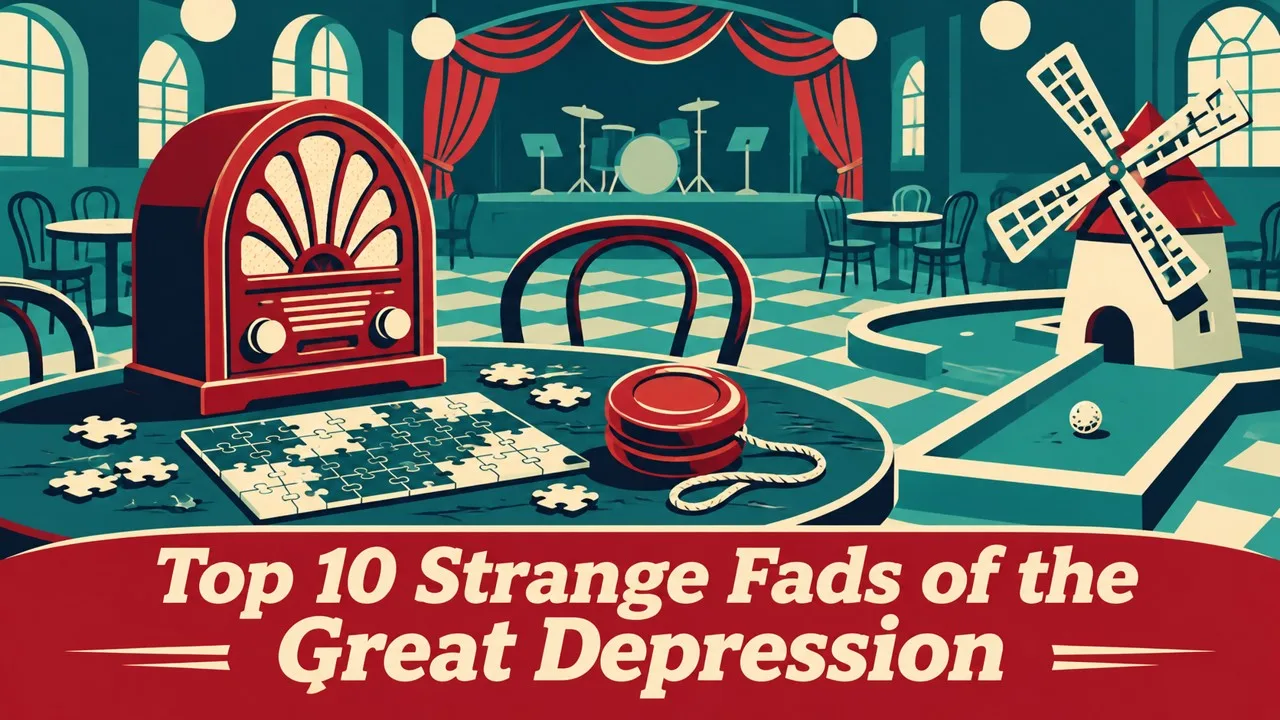
Dance marathons, rooftop mini golf, weekly jigsaws, chain letters and knock-knock jokes: ten fads that swept America during the Great Depression. The Great Depression, which began after the stock market crash of 1929, brought mass unemployment, bank failures and widespread poverty to the United States. At its worst, around a quarter of the workforce was out of work.
Yet the decade also produced a string of crazes and pastimes. Some offered a chance to win money. Others provided cheap entertainment, a way to pass long hours or a brief escape from worry.
Many of these fads were short-lived, rising and collapsing within a year or two. Others left lasting marks on American culture, giving rise to games, toys and forms of entertainment that are still familiar.
The ten fads below show how people sought fun, hope and distraction during one of the hardest periods in modern history.
Key Facts
| # | Fad | Peak years | Why it caught on |
|---|---|---|---|
| 1 | Dance marathons | Late 1920s to 1930s | Food, shelter and prize money |
| 2 | Miniature golf | 1929 to 1931 | Cheap fun and low startup costs |
| 3 | Jigsaw puzzles | 1932 to 1933 | A cheap way to fill the evenings |
| 4 | Monopoly | 1935 onward | Fantasy wealth in hard times |
| 5 | Chain letters | 1935 | The hope of quick money |
| 6 | Bank Night | 1930s | Cash prizes for moviegoers |
| 7 | Contract bridge | 1930s | A sociable game for all classes |
| 8 | Knock-knock jokes | 1936 | Silly humor for hard times |
| 9 | Yo-yos | Late 1920s to 1930s | Cheap toys and public contests |
| 10 | Pinball machines | 1931 onward | Cheap thrills for a penny or nickel |
1. Dancing Until They Dropped
Dance marathons began in the 1920s as endurance contests, but during the Depression they became a way for desperate people to earn food and a chance at prize money. Couples danced, shuffled and held each other up for weeks or even months [1].
Contestants were usually allowed short rest breaks each hour and were fed several meals a day, which for some was the main attraction. Spectators paid admission to watch exhausted dancers and dramatic eliminations [1].
Critics considered the contests exploitative and dangerous, and many cities and states restricted or banned them. Horace McCoy's 1935 novel They Shoot Horses, Don't They? portrayed their grim side. The novel was adapted into a 1969 film starring Jane Fonda, which earned nine Academy Award nominations. Some later celebrities, including the comedian Red Skelton, worked as masters of ceremonies at dance marathons early in their careers. Promoters sometimes staged fake romances or feuds between couples to keep audiences coming back night after night.
2. Mini Golf Everywhere
Miniature golf became one of the first big crazes of the Depression. Garnet Carter built a small course called Tom Thumb Golf on Lookout Mountain, on the Tennessee and Georgia border, in the late 1920s, and franchised the idea [2].
By 1930, tens of thousands of courses had appeared across the United States, including on rooftops in New York City. Courses were cheap to build and gave unemployed people a way to start a small business [2].
The boom collapsed almost as quickly as it had begun. Carter turned his attention to Rock City, a tourist attraction on Lookout Mountain, which he advertised by painting slogans on barn roofs across the South. At the peak of the boom, Hollywood studios worried that miniature golf was drawing customers away from cinemas, especially on warm summer evenings. Many courses were built on vacant lots left empty by the slump in construction, using cheap materials such as old tires, pipes and barrels.
Related: Top 10 Forgotten American Pastimes
3. A Puzzle Every Week
In the early 1930s, cheap die-cut cardboard jigsaw puzzles became a national craze. Manufacturers produced weekly puzzles that were sold at newsstands, much like magazines [3].
At the height of the fad, around 1933, millions of puzzles were reportedly being sold each week. Companies also gave away puzzles as advertising promotions, and some stores rented them out [3].
Puzzles were popular because they were inexpensive and could occupy a family for hours. Some people even made their own puzzles to sell during hard times. Unemployed carpenters and architects sometimes cut wooden puzzles with jigsaws in their homes and rented them through drugstores and libraries for a few cents a day. Puzzle images included landscapes, famous paintings and scenes from popular films, and some puzzles were sold without a picture on the box to make them harder.
4. A Game About Getting Rich
In 1935, the game company Parker Brothers began selling Monopoly, a board game about buying property and bankrupting opponents. It became a bestseller during the Depression [4].
The game was promoted as the invention of Charles Darrow, an unemployed salesman. But it was based on earlier games, especially The Landlord's Game, patented by Elizabeth Magie in 1904 to show the dangers of land monopolies [4].
Monopoly allowed players to pretend to become wealthy property owners at a time when many people had lost their homes. It went on to become one of the best-selling board games in history. Magie, a stenographer and writer, sold her patent to Parker Brothers for around 500 dollars, while Darrow became a millionaire. Her role was largely forgotten until the 1970s, when an economics professor researching the game's history brought it to light during a trademark dispute.
5. Letters Promising Riches
In 1935, a chain letter craze spread from Denver across the United States. Recipients were told to send a dime to the name at the top of a list, add their own name and send copies to friends, with the promise that they would eventually receive many dimes in return [5].
The letters flooded post offices, especially in Denver, where postal workers struggled with the sudden increase in mail. Some people opened businesses that copied and sold chain letters [5].
Related: Top 10 Most Bizarre Phobias: Strange Fears That Exist
The Post Office ruled that such schemes were illegal lotteries or fraud, and the craze soon faded. Like all chain schemes, the letters could pay off only for those near the start. Similar chain letter crazes recurred later in the twentieth century and moved onto the internet, where chain emails and social media posts continue to circulate. Postal authorities in many countries still treat chain letters that ask for money as illegal.
6. Prizes at the Movies
Bank Night was a promotion in which movie theaters held weekly drawings for cash prizes. Patrons registered their names, and a winner was chosen on a particular night, often drawing large crowds [6].
The scheme was created by Charles Yeager in the early 1930s and licensed to thousands of theaters. It helped theaters attract customers when many people could barely afford a ticket [6].
Critics argued that Bank Night was an illegal lottery, and its legality was challenged in courts across the country. The promotion faded by the end of the decade. At its peak, Bank Night ran in thousands of cinemas across the United States, and some theaters reported that attendance on the drawing night was far higher than on any other evening. Winners often had to be present in the theater or nearby to claim the prize, which encouraged people to come to the movies.
7. The Bridge Craze
Contract bridge, a card game refined by Harold Vanderbilt in 1925, became a national obsession during the Depression. Bridge clubs, newspaper columns and books about the game flourished [7].
The most famous bridge expert of the period was Ely Culbertson, who promoted his own bidding system. In 1931, he and his wife Josephine played a widely publicized match against Sidney Lenz and his partner, which the Culbertsons won [7].
The match was covered by newspapers and radio. Bridge became so popular that it was blamed for marital arguments, and its popularity remained high for decades. Culbertson founded a bridge magazine, ran a chain of bridge schools and earned large sums from his books and radio appearances, even during the worst years of the Depression. In 1929, a Kansas City woman shot her husband after a bridge game argument, a case that was widely reported and became part of bridge legend.
Related: Top 10 Oldest Buildings in the World
8. Knock, Knock, Who's There
In 1936, knock-knock jokes became a sudden craze in the United States. Newspapers printed them, radio comedians used them, and people exchanged them at work and school [8].
Bandleaders held contests for the best jokes, and songs based on the format were released. The jokes spread so quickly that some newspapers described the craze with mock alarm [8].
Similar call-and-response formats existed earlier, but the knock-knock joke in its familiar form became fixed during this period. It remains a staple of children's humor. One popular song of the period was titled Knock Knock, Who's There?, and some newspapers ran daily columns of reader-submitted jokes. A similar setup can be found much earlier, in the porter's scene in Shakespeare's Macbeth, which begins with the words knock, knock, who's there.
9. The Yo-Yo Takes Off
The yo-yo became a major American fad in the late 1920s and early 1930s. Pedro Flores, a Filipino immigrant, began manufacturing yo-yos in California in 1928 and helped popularize the toy [9].
The businessman Donald F. Duncan bought Flores's company and promoted yo-yos with contests and demonstrators, many of them Filipino performers who showed off tricks in towns across the country [9].
Yo-yos were cheap and could provide hours of entertainment. Duncan's company became the most famous yo-yo brand, and later revivals made the toy popular again in the 1950s, 1960s and 1990s. The word yo-yo itself is thought to come from the Philippines, where similar toys had long been used. Duncan's demonstrators often traveled from town to town holding contests at local stores, cinemas and schools, with prizes for the best trick performers.
10. Pinball Arrives
Coin-operated pinball games became popular in the early 1930s. One of the first big hits was Baffle Ball, released by David Gottlieb in 1931, which sold in large numbers [10].
Related: 10 Sikh Gurus: The Pillars of Sikhism Who Shaped Faith, Equality, Courage, and Humanity
Another game, Ballyhoo, gave its name to the Bally company. Early pinball machines had no flippers; players launched balls and tried to guide them by nudging the machine [10].
Because some machines offered payouts, pinball was associated with gambling. New York City banned pinball in 1942, and the ban lasted until 1976. The ban was lifted after the journalist and pinball expert Roger Sharpe convinced a city council committee that the game involved skill, famously calling a shot before making it. Flippers were introduced in 1947, transforming pinball into the game known today.
Conclusion
These fads show how Americans found ways to entertain themselves during a time of economic hardship. Many offered hope of winning money or the chance to escape daily worries.
Some fads disappeared quickly, while others, like Monopoly, yo-yos and pinball, became lasting parts of popular culture.
The Depression also influenced how businesses marketed products, using contests, promotions and giveaways to attract customers with little money to spend.
Looking back, these crazes reveal both the struggles and the resilience of people living through difficult times.
- ^ [1] Accounts of dance marathons. Wikipedia: Dance marathon Wikipedia: They Shoot Horses, Don't They?
- ^ [2] Accounts of miniature golf. Wikipedia: Miniature golf Wikipedia: Garnet Carter
- ^ [3] Accounts of jigsaw puzzles. Wikipedia: Jigsaw puzzle Wikipedia: Great Depression in the United States
- ^ [4] Accounts of Monopoly. Wikipedia: History of Monopoly Wikipedia: The Landlord's Game
- ^ [5] Accounts of chain letters. Wikipedia: Chain letter Wikipedia: Pyramid scheme
- ^ [6] Accounts of Bank Night. Wikipedia: Bank Night Wikipedia: Movie theater
- ^ [7] Accounts of contract bridge. Wikipedia: Ely Culbertson Wikipedia: Contract bridge
- ^ [8] Accounts of knock-knock jokes. Wikipedia: Knock-knock joke Wikipedia: joke
- ^ [9] Accounts of yo-yos. Wikipedia: Yo-yo Wikipedia: Pedro Flores
- ^ [10] Accounts of pinball. Wikipedia: Baffle Ball Wikipedia: Pinball



















Discussion
Log in with