






Top 10 Government Contingency Plans for the Unthinkable
 By Dhiraj Sharma · Published
Share Post
Loading…
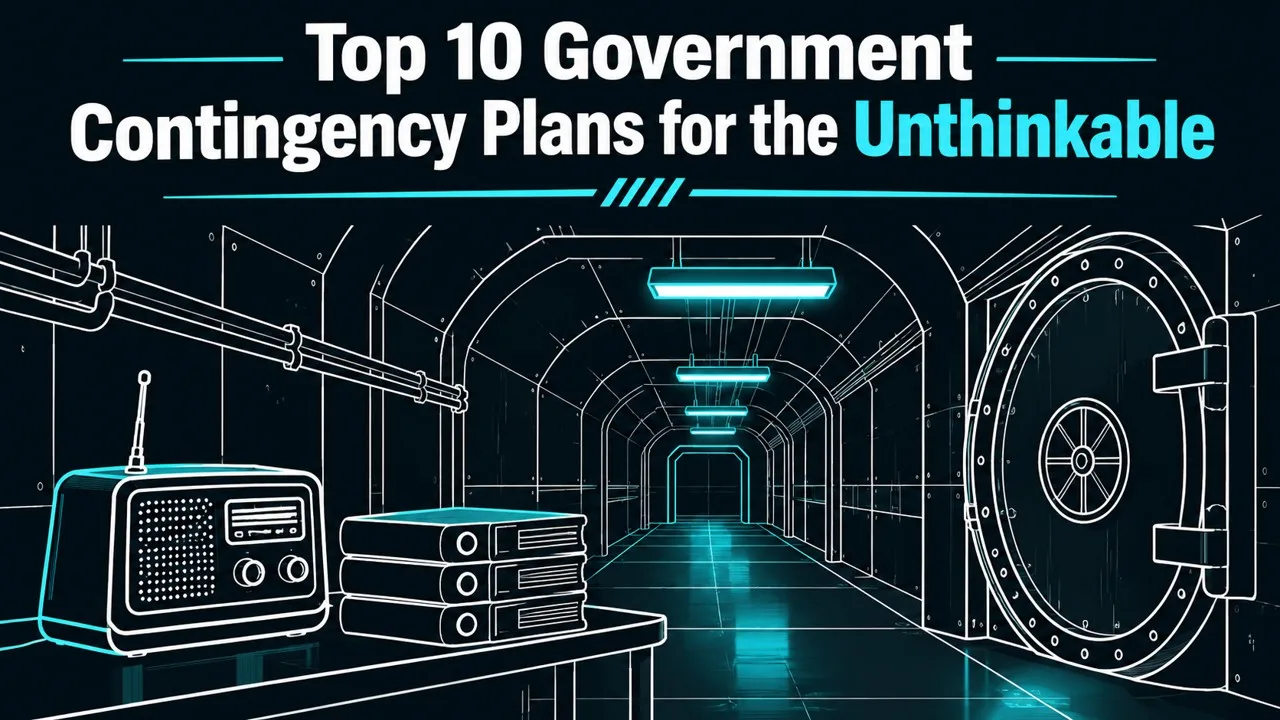
A speech for astronauts stranded on the Moon, a plan to invade Canada and a bunker under a luxury hotel: ten government plans made for the unthinkable. Governments spend enormous effort preparing for events they hope will never happen. Military staffs draw up plans for wars against unlikely enemies, and officials design ways to keep the state running after a nuclear attack.
Many of these plans were secret for decades. When they were finally declassified or leaked, they revealed how leaders imagined disasters, from failed space missions to the destruction of capitals.
Some contingency plans now seem alarming, others almost absurd. But planners argue that thinking through extreme scenarios is a necessary part of government, and that a plan prepared in advance is better than improvisation in a crisis.
The ten examples below come from the United States, Britain, Canada and Switzerland, and span the twentieth and twenty-first centuries.
Key Facts
| # | Plan | Country and date | What it prepared for |
|---|---|---|---|
| 1 | In Event of Moon Disaster | United States, 1969 | Astronauts stranded on the Moon |
| 2 | Operation Unthinkable | Britain, 1945 | An attack on the Soviet Union |
| 3 | War Plan Red | United States, 1930 | War with the British Empire |
| 4 | Project Greek Island | United States, 1958 to 1992 | Sheltering Congress after a nuclear attack |
| 5 | Central Government War Headquarters | Britain, 1950s to 1990s | Running the country after nuclear war |
| 6 | Diefenbunker | Canada, 1959 to 1994 | Protecting government leaders |
| 7 | Letters of last resort | Britain, ongoing | Instructions after a nuclear attack |
| 8 | Designated survivor | United States, since the Cold War | Preserving the line of succession |
| 9 | Swiss nuclear shelters | Switzerland, since 1963 | Protecting the whole population |
| 10 | CONPLAN 8888 | United States, 2011 | A training exercise using zombies |
1. A Speech for a Moon Disaster
Before the Apollo 11 landing in July 1969, President Richard Nixon's speechwriter William Safire prepared a statement in case Neil Armstrong and Buzz Aldrin could not return from the Moon [1].
The speech began, Fate has ordained that the men who went to the Moon to explore in peace will stay on the Moon to rest in peace. The plan also called for the president to telephone the astronauts' future widows and for a clergyman to commend their souls to the deepest of the deep [1].
The speech was never needed. It was later made public through the National Archives, and in 2019 researchers at MIT used it to create a deepfake video showing Nixon delivering it, to highlight the dangers of misinformation. Safire's memo was addressed to H. R. Haldeman, Nixon's chief of staff, and dated two days before the landing. The risk was real: the lunar module's ascent engine had to work perfectly, as there was no backup way to leave the Moon's surface.
2. Planning War With an Ally
In May 1945, just after the defeat of Nazi Germany, Prime Minister Winston Churchill asked British military planners to consider an attack on the Soviet Union, which had been Britain's wartime ally. The resulting plan was called Operation Unthinkable [2].
The plan assumed an offensive beginning on July 1, 1945, aimed at forcing the Soviet Union to accept a fair settlement for Poland. The planners concluded that the chances of success were poor, given the size of Soviet forces in Europe [2].
A second version of the plan considered how Britain could defend itself if the Soviets advanced westward. The plans were never put into effect and remained secret until 1998. The British Chiefs of Staff were skeptical from the start, and the planners' report described the operation as hazardous. The name itself reflected how improbable such a war seemed to many in the British government at the time.
Related: Top 10 Declassified Cold War Military Plans
3. A Plan to Invade Canada
In the 1920s and 1930s, the United States Army and Navy prepared color-coded war plans for conflicts with various countries. War Plan Red dealt with a hypothetical war against the British Empire [3].
The plan, approved in 1930, envisioned invading Canada to prevent it from being used as a British base, including seizing the port of Halifax. A 1935 update even considered the use of chemical weapons [3].
The plan was not seen as a likely scenario, but military planners prepared for many possibilities. Canada had its own plan, drawn up in 1921, for a surprise invasion of the United States in the event of war. The Canadian plan, known as Defence Scheme No. 1, was written by Colonel James Sutherland Brown and called for quick raids on American cities such as Seattle and Spokane to delay an American invasion. Both plans were declassified decades later, and War Plan Red became public in the 1970s.
4. A Bunker Under a Luxury Hotel
Between 1958 and 1961, the US government built a huge secret bunker beneath the Greenbrier, a luxury resort in White Sulphur Springs, West Virginia. It was designed to house members of Congress in the event of a nuclear war [4].
The bunker included dormitories, a cafeteria, a hospital, decontamination showers and a large meeting hall where Congress could convene. It was maintained for decades by government employees posing as workers for a television repair company [4].
The bunker's existence was revealed by the journalist Ted Gup in The Washington Post in 1992, and it was soon decommissioned. It is now open to visitors on guided tours. The facility was large enough for more than a thousand people, including members of Congress and their staff. Its blast doors weighed many tons and were hidden behind ordinary-looking walls in the resort's conference wing, which guests used for meetings without knowing what lay behind.
5. An Underground City in England
During the Cold War, Britain built a vast underground complex in a former stone quarry near Corsham, Wiltshire. Known by codenames including Burlington, it was designed to house the government and thousands of staff after a nuclear attack [5].
The complex covered about 35 acres and included offices, dormitories, kitchens, a hospital, a telephone exchange and a broadcasting studio from which the prime minister could address the nation [5].
Related: Top 10 Notable Friendly Fire Incidents in Military History
It was never used for its intended purpose. The site was declassified in 2004, revealing a time capsule of Cold War equipment, furniture and supplies. The site included its own reservoir, a water treatment plant and enough fuel to power the facility for months. It also contained a replica of a pub, intended to make long periods underground more bearable for staff.
6. Canada's Nuclear Bunker
Between 1959 and 1961, Canada built a four-story underground bunker in Carp, near Ottawa, to protect government and military leaders in case of nuclear attack. It was nicknamed the Diefenbunker after Prime Minister John Diefenbaker [6].
The bunker was designed to house more than 500 people for about a month. It included a vault for the Bank of Canada's gold reserves, a broadcasting studio and a hospital [6].
The Diefenbunker was decommissioned in 1994 and is now a museum and National Historic Site. Visitors can see the prime minister's suite and the vault. Diefenbaker himself reportedly never visited the bunker after it was completed. During the Cold War, Canada built a network of smaller regional bunkers, sometimes called Diefenbunkers, across the country.
7. Letters From the Prime Minister
Each new British prime minister writes four identical handwritten letters to the commanders of the country's nuclear-armed submarines. The letters contain instructions on what to do if the government has been destroyed by a nuclear attack [7].
The letters are locked in a safe on each submarine. Their contents are secret, but options reportedly include retaliating, not retaliating, placing the submarine under the command of an ally or leaving the decision to the commander [7].
When a prime minister leaves office, the letters are destroyed unopened. Only the prime minister who wrote them is believed to know their contents. The system was designed so that Britain's nuclear deterrent would remain credible even if the government in London were wiped out. The letters are written soon after a new prime minister takes office, often as one of the first official tasks after a briefing on nuclear weapons.
Related: Midway Turned the Tide in the Pacific
8. The Cabinet Member Kept Away
During major events that bring together the president, vice president and other senior officials, such as the State of the Union address, one member of the presidential line of succession is kept at a secure, undisclosed location [8].
This person, known as the designated survivor, would become president if a catastrophe killed the others. The practice began during the Cold War, when officials feared a nuclear attack on Washington [8].
The designated survivor is usually a cabinet member. The concept became widely known after a television drama of the same name, which aired from 2016 to 2019. In the years after the September 11 attacks in 2001, members of Congress have also been designated to stay away from some joint sessions. The designated survivor receives a security detail and a briefing on the duties of the presidency for the evening.
9. A Shelter for Every Resident
Since 1963, Swiss law has required that every resident have access to a place in a nuclear shelter. Many houses and apartment buildings have their own shelters, and communities maintain public ones [9].
Switzerland has hundreds of thousands of shelters, enough space for its entire population. One of the largest, inside a motorway tunnel in Lucerne, was designed to hold 20,000 people [9].
Many shelters are used for storage or other purposes in peacetime but must be ready for use if needed. The policy reflects Switzerland's tradition of armed neutrality and preparedness. The Sonnenberg tunnel shelter, completed in 1976, included a hospital, a command post and a prison. A test in 1987 revealed that it would take many days to close its huge blast doors and prepare the shelter, and its capacity was later reduced.
10. A Plan to Fight Zombies
In 2011, officers at United States Strategic Command wrote a contingency plan for defending against a zombie attack. Known as CONPLAN 8888, it described various types of zombies and how the military would respond [10].
Related: Top 10 Most Bizarre Phobias: Strange Fears That Exist
The plan explained that it was a training document, designed to teach planning skills using a fictional scenario. Using zombies avoided the political problems that could arise if a plan described attacking a real country [10].
The document became public in 2014 and attracted widespread media attention. It shows how planners use imaginative scenarios to practice responding to real crises. The plan opened with a disclaimer stating that it was not designed as a joke, and it divided zombies into categories such as those created by radiation, by magic and by disease. Planners said students were more engaged when working with an obviously fictional threat.
Conclusion
These contingency plans show the lengths to which governments go to prepare for disasters, wars and catastrophes. Many were made in secret and revealed only years later.
Some plans reflect the fears of their time, especially during the Cold War, when nuclear war seemed a real possibility.
Others show the value of planning for unlikely events, from failed space missions to extreme crises.
Most of these plans were never used, which is exactly what their creators hoped. Their existence, however, offers insight into how governments think about risk.
- ^ [1] Accounts of the Moon disaster speech. Wikipedia: In Event of Moon Disaster Wikipedia: William Safire
- ^ [2] Accounts of Operation Unthinkable. Wikipedia: Operation Unthinkable Wikipedia: Winston Churchill
- ^ [3] Accounts of War Plan Red. Wikipedia: War Plan Red Wikipedia: Defence Scheme No. 1
- ^ [4] Accounts of the Greenbrier bunker. Wikipedia: The Greenbrier Wikipedia: Continuity of government
- ^ [5] Accounts of Burlington. Wikipedia: Central Government War Headquarters Wikipedia: Corsham
- ^ [6] Accounts of the Diefenbunker. Wikipedia: Diefenbunker Wikipedia: John Diefenbaker
- ^ [7] Accounts of the letters of last resort. Wikipedia: Letters of last resort Wikipedia: Trident
- ^ [8] Accounts of the designated survivor. Wikipedia: Designated survivor Wikipedia: presidential line of succession
- ^ [9] Accounts of Swiss shelters. Wikipedia: Fallout shelter Wikipedia: Sonnenberg Tunnel
- ^ [10] Accounts of CONPLAN 8888. Wikipedia: Zombie apocalypse Wikipedia: United States Strategic Command



















Discussion
Log in with