





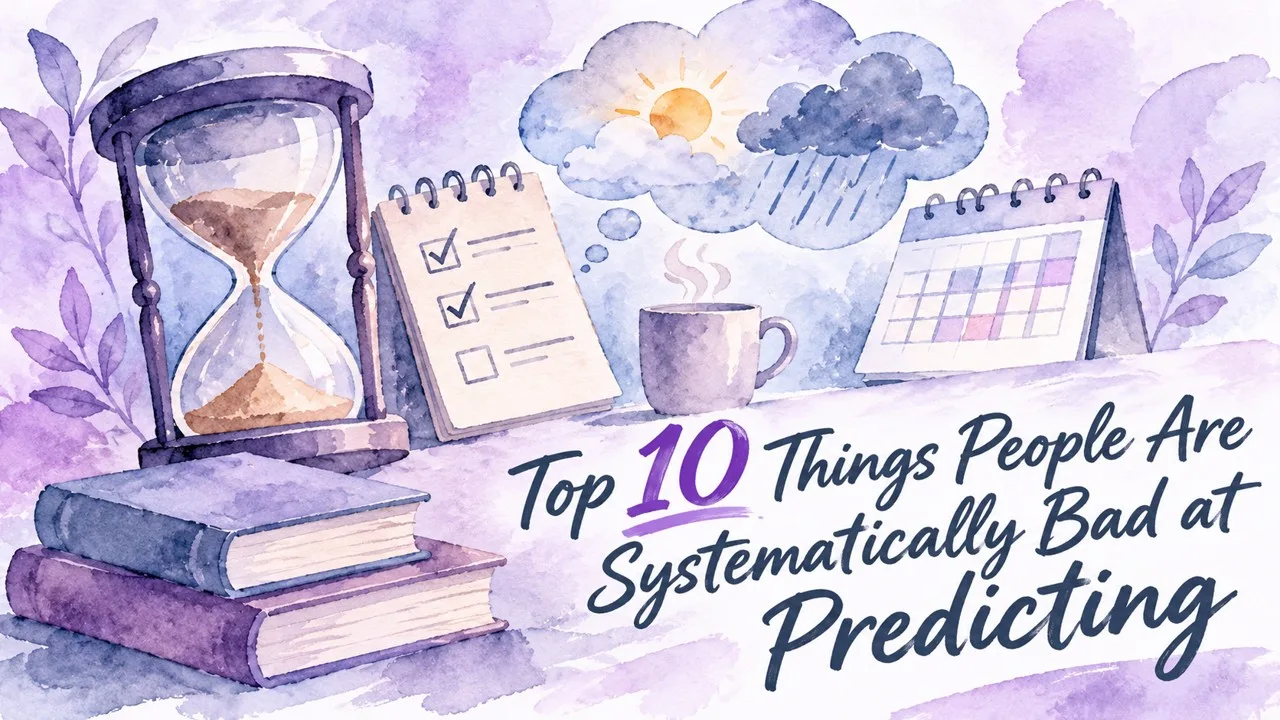
Top 10 Things People Are Systematically Bad at Predicting
 By Dhiraj Sharma · Published
Share Post
Loading…
People are systematically bad at some everyday forecasts, from how long a task will take to how they will feel later, and a bias is not a tip about money.
The ten weaknesses below concern the time a task will take, the happiness a change will bring, randomness and probability, reactions under pressure, how much will be needed, later personal behavior, the pace of long-term change, other people's thoughts, the impact of large crises, and a person's own mortality. The research is about typical errors, not about any one reader's fate. This article will not give financial advice, medical advice, or betting tips, and it will not treat a bias as a character flaw.
Key Facts
| Forecast | A documented tendency | A limit |
|---|---|---|
| 1 | People often underestimate how long a familiar kind of task will take, even after past overruns | A bias is not a reason to abandon plans; it is a reason to check them |
| 2 | People often mis-predict the intensity and duration of later feelings about a good or bad event | Adaptation is common; it is not a command to be indifferent |
| 3 | Intuition about chance is pulled toward streaks, "due" outcomes, and patterns in noise | This is not a betting system, and it is not a tip to ignore every pattern |
| 4 | People are imperfect at forecasting how they will think and choose in a stressful moment | Training and design can help; a list of errors is not a performance guide |
| 5 | Households and projects often mis-guess how much of a resource they will need or use | "Buy less" is not the advice; "the first guess may be wrong" is the finding |
| 6 | Present intentions are a weak forecast of later behavior, especially when context changes | Shame is not a method |
| 7 | The pace of large change is easy to overstate in the short run and to understate over a longer run | This is not a market call |
| 8 | People over-read how visible their own knowledge and motives are to others | Mind-reading is a folk skill with a known error rate |
| 9 | Public forecasts of crisis impacts swing between panic and complacency, and both can be wrong in detail | Hindsight is cheap; this is not a denial of real risks |
| 10 | Personal beliefs about "my own odds" often sit on the optimistic side of a mortality table | Statistics are not a diagnosis, and this is not medical advice |
1. Tasks, and the Time They Usually Take
People asked how long a task will take, even a kind of task they have done before, often give a time that would be true if little went wrong [1]. Psychologists call a famous form of this the planning fallacy: the plan is built from a hopeful scenario, and the person's own past overruns are treated as special cases. Groups can share the same optimism. The finding is not that planning is useless. It is that a first guess, made from inside the project, is a biased instrument, and that looking at how similar tasks actually ended is a better check than a hope. This article will not offer a productivity system [1].
The unexpected fact is that experience does not automatically correct a clock [1]. The careful fact is documented underestimation in many study settings and documented value in using past cases. Hope is a planner's fuel. It is a poor stopwatch.
A deadline can be sincere and still have been, in the average of past attempts, too soon.
2. Feelings That Fade Faster, or Differently, Than Expected
People are not hopeless at knowing whether a future event will feel good or bad, but they are systematically imperfect at predicting how intense the feeling will be and how long it will last [2]. Work on affective forecasting has found that both hoped-for joys and feared miseries often occupy less of later daily experience than the forecast allowed, in part because attention moves on and because people adapt. The result is sometimes offered as a cheap comfort. It should not be. A shorter-than-expected intensity is not a reason to ignore a harm, and a weaker-than-expected delight is not a reason to refuse a good. The useful point is that the future feeling is not a simple enlargement of the present feeling [2].
The unexpected fact is that a vivid forecast can be, later, a smaller room in the day [2]. This article will not give happiness advice. The careful fact is documented mis-prediction of intensity and duration, and documented later adaptation in many ordinary cases. Emotion is real. The duration is the part the guess often inflates.
A future Tuesday can matter less, or differently, than a present evening thinks it will.
3. Chance, Streaks, and Patterns in Noise
Human intuition about randomness looks for texture [3]. A short run of similar outcomes can feel like a system, or like a debt the process now "owes" the other way. People underrate how often a fair process produces clumps, and they overrate their ability to see a real pattern in a small sample. The research is descriptive. It is not a betting method, and it is not a claim that no real patterns exist in the world. Cards, coins, and noisy data are the usual teaching tools because they isolate the error. A person who has to act under uncertainty still needs evidence, not a folk rule about what is due [3].
Related: Top 10 Most Bizarre Phobias: Strange Fears That Exist
The unexpected fact is that a "fair-looking" sequence is often the suspicious one, to a mind that expects alternation [3]. This article will not offer a wager or a system. The careful fact is documented, systematic errors in chance judgments. Luck is a word. The clumps are often just the mathematics of small runs.
A streak can feel meaningful and still have been, under a fair process, an ordinary bump.
4. The Self Under Pressure Is a Hard Forecast
People asked how they will think, choose, or feel in a later stressful moment often answer from a calm room [4]. Later, in noise, fatigue, or fear, the same person may be more impulsive, more frozen, or more bound to a habit than the forecast allowed. Research on predicted versus actual behavior in demanding conditions, and on "hot-cold" empathy gaps, documents that gap without turning it into a character test. Designers of procedures, and people who train for emergencies, already assume the calm self is an incomplete guide. This article will not offer a performance or combat manual, and it will not tell anyone how they will act [4].
The unexpected fact is that a person can be a poor expert on a future version of themselves [4]. The careful fact is documented discrepancies between predicted and later behavior under stress. Courage and panic are both possible. The forecast made at the desk is the weak instrument.
A vow made in quiet can be sincere and still not be, when the room is loud, a reliable script.
5. How Much Will Be Needed, and the First Guess
Households, travelers, and project teams often mis-forecast how much of a thing they will need or use: space, supplies, attention, or a budget of time already covered above [5]. The errors run in both directions. People pack for a rare case and then carry it unused, or they under-buy a consumable they have underestimated. The research sits beside the planning fallacy and beside work on over-acquisition. The useful public sentence is not "buy less" or "buy more." It is that a first, unaided guess about quantity is a biased tool, and that a look at the last similar occasion is often kinder than a feeling of readiness [5].
The unexpected fact is that a cupboard can be a museum of earlier forecasts [5]. This article will not give shopping or financial advice. The careful fact is documented, systematic quantity errors in everyday settings. Provisioning is a skill. The first number is often a mood.
Related: Top 10 Oldest Buildings in the World
A spare can be wise in one case and still have been, in many other cases, a confident guess that was too high.
6. Intentions, and the Behavior That Does Not Follow
A present intention is a forecast of later behavior, and it is a weak one when the later context changes [6]. People mean to exercise, to stop a habit, to write, or to keep a promise, and then the surroundings that produced the intention are gone. The gap between intention and action is one of the most repeated findings in psychology, and it is also an ordinary complaint. Shame is a common public reaction and a poor method. Changing cues, reducing friction for the wanted act, and treating a slip as information are the modest, evidence-aligned ideas. This article will not sell a life overhaul [6].
The unexpected fact is that a sincere plan can have, statistically, a disappointing conversion rate [6]. The careful fact is documented intention-behavior gaps and documented context effects. Will is not nothing. It is not a complete forecast.
A resolution can be honest at midnight and still not be, in February, a description of what was done.
7. The Pace of Change, Mis-timed
People are often poor at timing large change [7]. A new tool can be over-forecast in its effects next year and under-forecast in its effects over a couple of decades, once it has had time to become infrastructure. The reverse error also happens: a slow, compounding shift is treated as a sudden surprise because yearly increments were easy to ignore. Histories of technology and of public expectation are full of both mistakes. This article will not make a market call, name a winning firm, or promise a date. The finding is about a typical timing error, not about a particular stock or product [7].
The unexpected fact is that a person can be, at once, too eager this year and too deaf to a decade [7]. The careful fact is documented, repeated mismatches between short-term hype and long-term adoption, in both directions. Change is real. The calendar is the hard part.
Related: 10 Sikh Gurus: The Pillars of Sikhism Who Shaped Faith, Equality, Courage, and Humanity
A future can arrive late for a forecast and early for a habit.
8. Other People's Thoughts Are Easy to Over-Read
A common folk skill is guessing what another person knows, wants, or has noticed [8]. People systematically overestimate how visible their own knowledge, motives, and embarrassments are, a family of errors that includes the curse of knowledge and an illusion of transparency. They also lean, in some settings, toward thinking others share their own view. The result is not that empathy is fake. It is that an unaided reading of a room is a noisy instrument, and that a question is often cheaper than a confident inference. This article will not offer a social-climbing method [8].
The unexpected fact is that a private thought can feel, to its owner, louder than it is [8]. The careful fact is documented over-projection of one's own information and feelings onto others. Minds are real. Their contents are less public than they seem from inside.
A blush can feel like a broadcast and still have been, to the people in the room, a small fact or an unnoticed one.
9. Crisis Impacts, Overshot and Shrugged Off
When a large threat is on the table, public and official forecasts of its impact have a history of overshoot and of complacency, sometimes in sequence [9]. A risk can be described as a near end of ordinary life, or as a thing that will somehow stay in its lane, and both stories can be wrong in the details while still pointing at a real danger. Later commentators enjoy naming the error. Hindsight is cheap. The useful caution is that first-impact guesses, especially vivid ones, are fragile, and that dismissing a risk because an earlier picture was too dramatic is a second error. This article will not deny documented hazards or offer a survival plan [9].
The unexpected fact is that a society can panic at a headline and then under-prepare for the slower harm [9]. The careful fact is documented swings in crisis forecasting and documented later revisions. Danger can be real. The first numerical picture is often not the last.
A warning can be necessary and still have been, in its first public form, too sharp, too dull, or both in different chapters.
Related: Top 10 Tallest Buildings in the World
10. Our Own Odds, Viewed from the Inside
Asked about their own chances of living a long time, or of avoiding a common late-life fate, people often sit on the optimistic side of a table of averages [10]. Unrealistic optimism about personal risk is a repeatedly measured tendency, not a proof that any one reader is wrong. Tables describe populations. They are not a diagnosis, a prognosis, or a reason to skip care, and they are not a reason to despair. This article will not give medical advice, a screening schedule, or a lecture about death. It will say that a private sense of being the exception is a weak forecast [10].
The unexpected fact is that a mortality table can be accepted as true for other people and quietly renegotiated for oneself [10]. The careful fact is documented optimistic bias in personal risk beliefs. Death is certain in the large. Its timing, for a person, is not a subject for a list to settle.
A future can feel specially reserved and still have been, in the only numbers we have, a share of a common pattern.
Conclusion
The ten weaknesses above concern time, later feelings, chance, the self under pressure, quantities, intentions, the pace of change, other minds, crisis impacts, and personal odds. They are regular enough to study. They are not a reason to offer a tip about money, medicine, or a wager, and they are not a verdict on anyone's character.
A forecast can be honest and still need, if it is about a human being, a second look at how such forecasts have failed before.
- ^ [1] Psychological accounts of the planning fallacy and of documented underestimation of task duration, including the value of looking at similar past cases, without a productivity program. https://www.britannica.com/science/cognition American Psychological Association materials on planning and judgment
- ^ [2] Research reviews of affective forecasting, including typical errors in predicted intensity and duration of later feelings, presented without happiness advice. https://www.britannica.com/science/emotion https://www.apa.org/
- ^ [3] Cognitive-psychological accounts of systematic errors in judging randomness and probability, presented without betting or gambling advice. https://www.britannica.com/science/probability https://www.britannica.com/topic/gamblers-fallacy
- ^ [4] Research on predicted versus actual behavior under stress, including hot-cold empathy gaps, presented without a performance or emergency manual. https://www.britannica.com/science/stress-psychology-and-biology https://www.apa.org/
- ^ [5] Accounts of everyday quantity and resource-forecasting errors in households and projects, presented without shopping or financial advice. https://www.britannica.com/science/decision-making https://www.apa.org/
- ^ [6] Psychological accounts of the intention-behavior gap and of context effects on later action, presented without a life-overhaul program or shaming advice. https://www.britannica.com/science/motivation https://www.apa.org/
- ^ [7] Historical and psychological accounts of typical errors in timing long-term technological and social change, presented without market calls or product predictions. https://www.britannica.com/topic/forecasting https://www.britannica.com/technology/technological-change
- ^ [8] Research on the curse of knowledge, illusions of transparency, and related errors in reading other minds, presented without social-skill coaching. https://www.britannica.com/science/social-cognition https://www.apa.org/
- ^ [9] Historical and judgment-research accounts of overshoot and complacency in public forecasts of crisis impacts, without denying documented risks or offering a survival plan. https://www.britannica.com/topic/risk https://www.britannica.com/topic/forecasting
- ^ [10] Research on unrealistic optimism about personal risk and mortality, presented without medical advice, diagnosis, or a lecture on individual fate. https://www.britannica.com/science/mortality-demography https://www.apa.org/






















Discussion
Log in with