






Top 10 Undeciphered or Poorly Translated Historical Texts
 By Dhiraj Sharma · Published
Share Post
Loading…
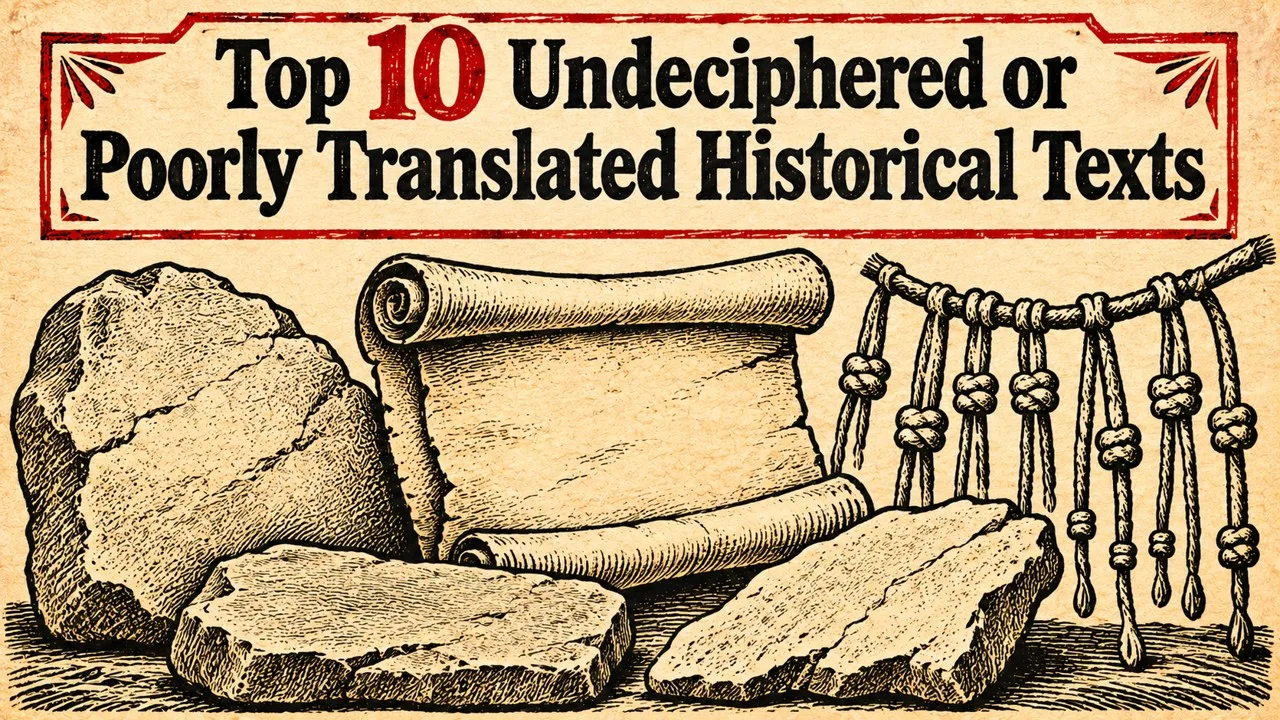
Some historical scripts remain unread or only partly read, from Linear Elamite to knotted Andean records, and secret is the wrong word for a text still hard.
The ten cases below are Linear Elamite, Cypro-Minoan, the Isthmian or Epi-Olmec script, Andean khipu, the Rohonc Codex, the Singapore Stone, Proto-Elamite, the Etruscan language, the Byblos syllabary, and the Khitan scripts. An earlier Finepedia list of historical mysteries already treated the Voynich manuscript, the Indus script, Linear A, the Phaistos Disc, and Rongorongo; this list uses other corpora so that the tens do not mostly match. "Secret" is the wrong word for a text that was, in its own time, probably ordinary administration, ritual, or display. This article will not quote long passages or offer a private decipherment.
Key Facts
| Corpus | The careful status | A limit |
|---|---|---|
| 1 | Linear Elamite has been the subject of a later, serious decipherment claim that other specialists still discuss | A claim can be important and still not be, yet, a settled textbook reading |
| 2 | Cypro-Minoan, used in Late Bronze Age Cyprus, remains unread, with a small and uneven corpus | A family resemblance to other Aegean scripts is a clue, not a key |
| 3 | The Isthmian or Epi-Olmec script is known from a few texts; a published decipherment is not universally accepted | A long stone text can still be a thin basis |
| 4 | Many khipu are clearly record systems, especially for accounts; whether some also encode language is still argued | A knot is not automatically a letter |
| 5 | The Rohonc Codex is a later-attested illustrated book in an unknown script, with hoax and cipher theories both still alive | A puzzle book is not a lost national chronicle until it is read |
| 6 | The Singapore Stone was a large inscribed rock, later destroyed except for a fragment, and the writing is not fully read | A blown-up stone is a poor corpus |
| 7 | Proto-Elamite tablets are early administrative texts; some signs, especially numbers, are understood, and the language is not | An account book can be unread and still not be a mystery religion |
| 8 | The Etruscan alphabet can largely be sounded out; the language is only partly understood, especially in longer texts | This is a language problem more than a "cracked alphabet" problem |
| 9 | The Byblos syllabary, sometimes called pseudo-hieroglyphic, is known from a handful of inscriptions and is unread | A tiny corpus makes a unique solution easy to over-fit |
| 10 | The Khitan large and small scripts of the Liao period are partly read, the small script more so than the large | Partial success is still not a complete library |
1. Linear Elamite, and a Claim Still Being Weighed
Linear Elamite was used in Iran in the late third millennium BCE, on a modest number of inscriptions, including later-famous silver objects [1]. In the early 2020s, François Desset and colleagues argued that they could read it, a claim that other specialists have treated as serious, interesting, and not yet a fully settled textbook result. The corpus is small, which is both why a breakthrough would matter and why caution is reasonable. This article will not retell the proposed readings as finished fact, and it will not quote the inscriptions at length. The status, for a general reader, is "a live decipherment claim" [1].
The unexpected fact is that a script can sit unread for a century and then suddenly have, in public, a proposed grammar [1]. The careful fact is a documented corpus and a documented later claim under review. Hope is allowed. A school primer is early.
A silver vessel can carry a text and still not have been, in every colleague's view, already translated.
2. Cypro-Minoan, a Small Unread Corpus
Cypro-Minoan was used on Cyprus, and in related trade settings, in the Late Bronze Age [2]. It looks, in some signs, as if it belongs in the same wider family as other Aegean administrative scripts, and it remains unread. The corpus is small and is often divided into typological groups that may not all be one writing system. Clay and other objects give short texts, which is a poor diet for a decipherer. A family resemblance is a clue. It is not a key that has already been turned [2].
The unexpected fact is that an island at the center of later trade can have left, in writing, almost no sentence we can yet say [2]. The careful fact is a documented, limited corpus and a documented unread status. Isolation of the texts is the practical problem. A secret society is not required.
A tablet can be administrative and still not have been, for us, an account we can add up.
3. Isthmian Writing, and an Unsettled Reading
The Isthmian, or Epi-Olmec, script is known from a small set of Mesoamerican texts, including a long inscription on the La Mojarra stela [3]. A published decipherment, associated with later work by Justeson and Kaufman, has been influential and has also been contested. A few long texts are a thin basis for a unique solution, even when the solution is careful. The honest public status is "proposed, not universally accepted." This article will not pretend to settle the argument or quote the stela as if it were already a facing-page translation [3].
Related: Cleopatra's Tomb: History, Theories and the Search at Taposiris Magna
The unexpected fact is that a single long stone can be both a treasure and a dangerously small sample [3]. The careful fact is a documented small corpus and a documented, disputed later reading. Ambition was reasonable. Consensus has not arrived.
A stela can be almost a book and still not have been, in every specialist's file, a book already read.
4. Khipu, as Records, Not Automatically as Letters
Andean khipu, knotted-cord records used in Inca and earlier contexts, are among the most important recording systems in the world, and they are not, in any simple sense, an unread alphabet [4]. Many cords are clearly quantitative: colors, pendant positions, and knot types can encode numbers and categories for accounts. Whether some khipus also encode language, narrative, or names is a live research question, with careful later work on both sides of the hope. Calling the whole system "an untranslated text" flattens a technology that was already doing work we can, in part, see. A knot is a record. It is not automatically a letter [4].
The unexpected fact is that a state can have been, in its paperwork, a textile [4]. This article will not offer a reading method. The careful fact is documented accounting use and documented later debate about linguistic encoding. Administration is the secure chapter. A novel in string is the unproved one.
A cord can hold a census and still not have been, except in a hopeful paper, a sentence.
5. The Rohonc Codex, as a Book That Still Will Not Sit Still
The Rohonc Codex, a later-attested illustrated book now in Hungary, is written in an unknown script and has attracted both decipherment attempts and hoax theories [5]. It is not an ancient "lost language of a forgotten people" in any secure sense; it is a physical book with a modern curatorial history and an unsolved text. Until a reading is agreed, "cipher," "invented script," and "undeciphered natural language" are all still on the table. This article will not quote pages or endorse a private solution [5].
The unexpected fact is that a book can be held in a library and still have been, for its letters, nowhere [5]. The careful fact is a documented object and a documented, unsettled debate. Mystery, here, is bibliographic. It is not a secret in the political sense.
Related: Top 10 Overlooked Ancient Mysteries
A page can be turned and still not have been, in any shared grammar, read.
6. A Stone That Was Broken, and a Text That Is Incomplete
The Singapore Stone was a large inscribed sandstone at the mouth of the Singapore River, dynamited in 1843, with only a fragment later preserved in a museum [6]. The writing has not been fully read. Suggestions have pointed toward an Indic-related script and a regional language, but a fragmentary, damaged surface is a poor corpus, and a complete reading has not been established. The object's later colonial destruction is part of the story: some unread texts are unread because there is, now, almost nothing left to read [6].
The unexpected fact is that a port city can have lost, in a public-works blast, one of its oldest sentences [6]. The careful fact is a documented later destruction and a documented, incomplete inscription. Fragmentation is the main enemy. A secret is not required.
A river mouth can have had a text and still not have been, after the blast, a place where that text can be finished.
7. Proto-Elamite, as Unread Accounts
Proto-Elamite tablets, from the end of the fourth and the start of the third millennium BCE in Iran, are among the world's early administrative writing systems [7]. Some signs, especially numerical ones, are understood. The language, if a single language is even the right idea, is not. The tablets look like accounts, which makes them less glamorous than a "lost epic" and more like a warehouse. An unread account book is still a historical source, because layout, numbers, and find-spots already tell us something. It is not a mystery religion only because we cannot yet sound the words [7].
The unexpected fact is that a first writing can be, in its own time, mostly about goods [7]. The careful fact is a documented early corpus and a documented partial understanding of the numerical part. Administration is the genre. A secret doctrine is the projection.
A tablet can be full of marks and still have been, for its first users, a delivery.
Related: Top 10 Biggest Historical Mysteries
8. Etruscan, Sounded Out, Only Partly Understood
Etruscan is written in an alphabet that can largely be sounded out, because the letters are relatives of a Greek alphabet [8]. The problem is the language. A modest vocabulary and some grammar are understood from short texts, names, and bilingual clues; longer texts still leave large gaps. Calling Etruscan "undeciphered" in the same breath as an unread signary is a category error. The script is not the lock. The language, with too few long bilinguals, is the lock [8].
The unexpected fact is that a sentence can be pronounced and still not have been, except in parts, understood [8]. This article will not quote long funerary texts. The careful fact is a documented readable script and a documented, incomplete language. Sound is available. Sense is rationed.
A tomb can be labeled in letters we can say and still not have told us, in every line, what the family wanted said.
9. The Byblos Syllabary, Starved of Text
The Byblos syllabary, sometimes called Byblos pseudo-hieroglyphic, is known from a handful of inscriptions from the Lebanese port [9]. It has not been read. Tiny corpora invite solutions that fit the surviving signs and fail the next find, if a next find ever arrives. The writing looks, to specialists, like a syllabic system, which is a typological guess, not a transcription. This article will not offer a grid of values [9].
The unexpected fact is that a famous port of later alphabets can have, in an earlier drawer, a script with almost no pages [9]. The careful fact is a documented, very small corpus and a documented unread status. Scarcity is the problem. A hidden library is not implied.
A city can later give the world letters and still not have left, in this earlier form, enough of them to read.
Related: Top 10 Oldest Surviving Buildings on Earth
10. Khitan Scripts, Partly Open
The Liao state used two Khitan scripts, a large script and a small script, to write the Khitan language in the tenth to twelfth centuries [10]. The small script has been partly deciphered, with later help from related writing and from a limited bilingual trail; the large script remains less well understood. Official histories in Chinese also talk about the people who used these scripts, which is a reminder that an unread or partly read corpus can sit beside a well-documented dynasty. Partial success is real, and it is not a complete library [10].
The unexpected fact is that a conquest dynasty can have been, in one of its languages, only half on the page for later readers [10]. The careful fact is documented later partial readings and a documented remaining gap, especially in the large script. Progress is uneven. A "lost tongue" slogan overstates a court that also wrote in other scripts.
A dynasty can be famous in one language and still not have been, in another, fully available to a modern grammar.
Conclusion
The ten corpora above include a live Linear Elamite claim, unread Cypro-Minoan, an unsettled Isthmian reading, khipu as records, an unsolved later book, a blasted Singapore stone, Proto-Elamite accounts, Etruscan as a partly understood language, a starved Byblos signary, and partly read Khitan. A text can be hard without being a secret.
A script can wait, and still not have been, in its own century, anything but a normal way to keep a fact.
- ^ [1] Epigraphic and later-scholarly accounts of Linear Elamite and of early-2020s decipherment claims, treated as a live, still-discussed proposal rather than as a finished school reading, without long quotation. https://www.britannica.com/topic/Elamite-language https://www.britannica.com/place/Elam
- ^ [2] Accounts of Cypro-Minoan as a Late Bronze Age, still unread corpus with typological subgroups and a small body of texts. https://www.britannica.com/place/Cyprus https://www.britannica.com/topic/Linear-A
- ^ [3] Accounts of the Isthmian or Epi-Olmec script, including the La Mojarra stela and later published, not universally accepted, decipherment work, without a claimed official translation. https://www.britannica.com/topic/Mesoamerican-writing https://www.britannica.com/topic/Olmec
- ^ [4] Andean-studies accounts of khipu as record systems, especially for accounts, and of later debate about possible linguistic encoding, without a reading method. https://www.britannica.com/topic/quipu https://www.britannica.com/topic/Inca
- ^ [5] Bibliographic accounts of the Rohonc Codex as a later-attested book in an unknown script, with hoax and cipher theories both still in play, without long quotation or a private solution. https://www.britannica.com/topic/codex-manuscript https://www.britannica.com/topic/cryptology
- ^ [6] Historical accounts of the Singapore Stone, its mid-nineteenth-century destruction, and the still incomplete reading of the surviving fragment. https://www.britannica.com/place/Singapore National Heritage Board materials
- ^ [7] Accounts of Proto-Elamite as early administrative writing, with partial understanding of numerical signs and without a full language reading. https://www.britannica.com/topic/Elamite-language https://www.britannica.com/topic/cuneiform
- ^ [8] Accounts of Etruscan as a largely readable alphabet attached to a only partly understood language, especially in longer texts, without long funerary quotation. https://www.britannica.com/topic/Etruscan-language https://www.britannica.com/topic/Etruscan-alphabet
- ^ [9] Epigraphic accounts of the Byblos syllabary, or pseudo-hieroglyphic, as a very small unread corpus, without a proposed sign grid. https://www.britannica.com/place/Byblos https://www.britannica.com/topic/writing
- ^ [10] Accounts of the Khitan large and small scripts, including later partial decipherment of the small script and a remaining gap in the large, in the context of the Liao period. https://www.britannica.com/topic/Khitan https://www.britannica.com/topic/Liao-dynasty



















Discussion
Log in with