


 By
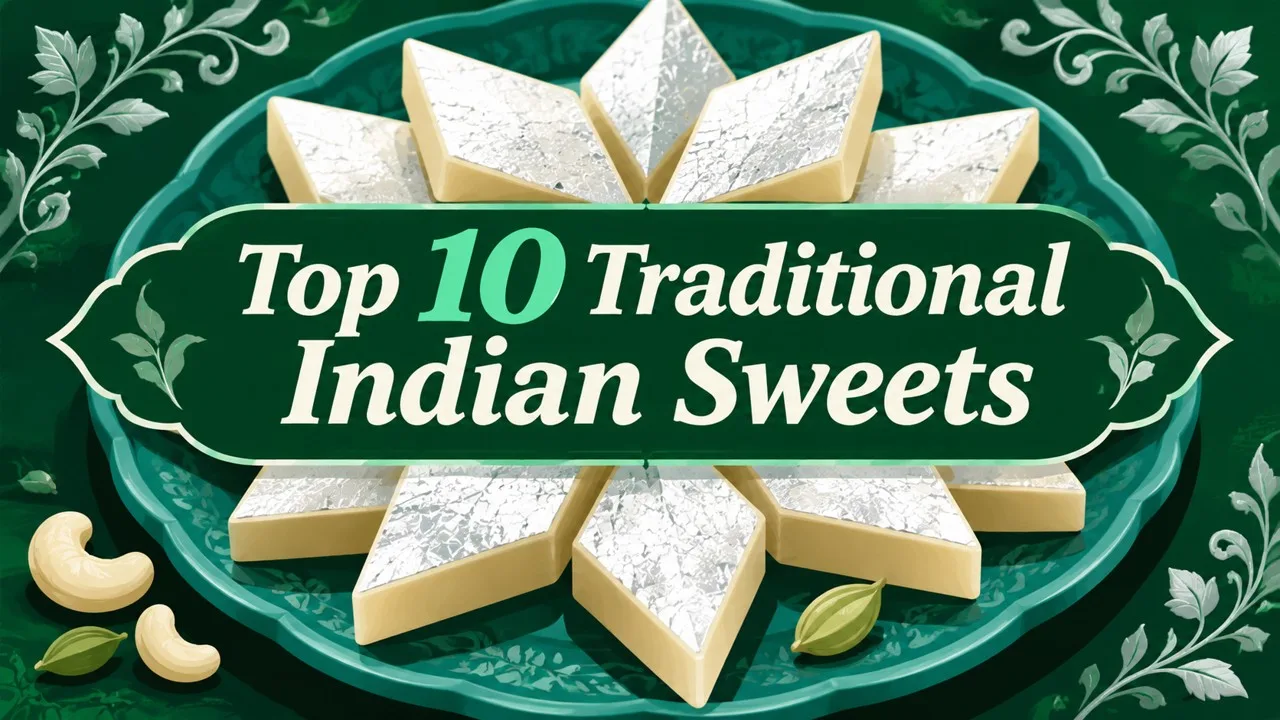
From rasgulla and gulab jamun to Mysore pak, ghevar and modak, discover ten traditional Indian sweets and the stories, festivals and cities behind them. Sweets, or mithai, are part of almost every celebration in India. They are offered to deities, shared at weddings and festivals, and exchanged as gifts to mark good news, from exam results to a new job.
India's sweets are made from milk, flour, lentils, nuts, fruit, jaggery and sugar, and every region has its own specialities. Many have colourful origin stories, some well documented and others based on local tradition. This list brings together ten of the most famous, from Bengal to Rajasthan and from Mysuru to Agra.
Key Facts
Each of these sweets is loved across India and tied to a particular place or festival.
Traditional Indian Sweets at a Glance
| # | Sweet | Home region | Main ingredients | Best known for |
|---|---|---|---|---|
| 1 | Rasgulla | Odisha and West Bengal | Chhena and sugar syrup | Spongy balls in light syrup |
| 2 | Gulab Jamun | Across India | Milk solids and rose-scented syrup | Fried dough balls in syrup |
| 3 | Mysore Pak | Karnataka | Gram flour, ghee and sugar | Born in a palace kitchen |
| 4 | Sandesh | West Bengal | Chhena and sugar or jaggery | Bengal's delicate sweet |
| 5 | Motichoor Laddoo | North India | Tiny gram-flour pearls | The sweet of celebrations |
| 6 | Kaju Katli | Across India | Cashews, sugar and silver leaf | Diwali's favourite gift |
| 7 | Ghevar | Rajasthan | Flour batter fried into a honeycomb | The monsoon sweet |
| 8 | Petha | Agra, Uttar Pradesh | Ash gourd and sugar | Agra's translucent candy |
| 9 | Modak | Maharashtra | Rice flour, coconut and jaggery | Ganesha's favourite |
| 10 | Kheer and Payasam | Across India | Rice, milk and sugar | One of India's oldest desserts |
1. Rasgulla
The rasgulla is a soft, spongy ball of chhena, a fresh cheese made by curdling milk, cooked in light sugar syrup until it swells and turns springy. [1]
Its origin is the subject of a famous friendly rivalry between Odisha and West Bengal, two neighbouring states that both claim the sweet as their own. [1]
Odisha links the rasgulla to the Jagannath Temple in Puri, where by tradition it is offered during the Niladri Bije ritual at the end of the Rath Yatra festival.
In Kolkata, the confectioner Nobin Chandra Das is widely credited with creating the spongy white rasgulla in 1868, and his family's firm later popularised it far beyond Bengal.
In 2017 West Bengal received a geographical indication tag for Banglar Rasogolla, and in 2019 Odisha received one for Odisha Rasagola, which is softer and slightly creamy in colour.
Canned rasgullas, introduced in the 20th century, allowed the sweet to travel across India and around the world.
Today rasgullas are served at weddings, festivals and everyday meals, and they are one of the most recognisable Indian sweets anywhere.
Key Figures
- Main ingredient: chhena
- Rival claims: Odisha and West Bengal
- Kolkata pioneer: Nobin Chandra Das, 1868
- GI tags: 2017 and 2019
Why It Made the List
The rasgulla is one of India's most loved sweets. Its origin story is as famous as its taste.
2. Gulab Jamun
Gulab jamun are small balls made from khoya, milk reduced to soft solids, mixed with a little flour, fried until dark brown and soaked in sugar syrup flavoured with cardamom and rose water. [2]
The name combines the Persian words gul, meaning flower, and ab, meaning water, which refer to the rose water syrup, with jamun, a dark Indian fruit of similar size and colour. [2]
Food historians link the sweet to fried dough desserts of the Persian and Arab world, such as luqmat al-qadi, which may have inspired cooks in medieval India.
Many regional versions exist. Kala jamun is fried until almost black, while Bengal's pantua is made with chhena.
One famous Bengali variety, ledikeni, is said to be named after Lady Canning, wife of the first Viceroy of India, in the mid-19th century.
Gulab jamun are served warm or cold at weddings, festivals and parties, sometimes with vanilla ice cream in modern restaurants.
The sweet is equally popular in Pakistan, Bangladesh and Nepal, and it has become one of the best-known South Asian desserts worldwide.
Related: Top 10 Most Popular Desserts in the World
Key Figures
- Main ingredient: khoya
- Name: Persian gul and ab, plus jamun fruit
- Variants: kala jamun, pantua, ledikeni
- Served: warm or cold
Why It Made the List
Gulab jamun is a festive favourite across South Asia. Its rich, syrupy taste wins hearts everywhere.
3. Mysore Pak
Mysore pak is a rich sweet made from gram flour, generous amounts of ghee and sugar, cooked until it sets into a porous, melt-in-the-mouth block. [3]
According to tradition, it was created in the kitchens of the Mysore Palace in the early 20th century by the royal cook Kakasura Madappa for the Maharaja Krishna Raja Wadiyar IV. [3]
When the Maharaja asked the name of the new sweet, the cook is said to have called it Mysore paka, paka meaning a sugar syrup in Kannada.
The Maharaja liked it so much that he encouraged the cook to sell it to the public, and Madappa's descendants still run a sweet shop in Mysuru today.
There are two main styles: the older, harder and more porous version, and a softer, ghee-rich version popularised by sweet shops in Tamil Nadu.
Mysore pak is a favourite at weddings, Diwali and the Dasara festival, when Mysuru celebrates with great pageantry.
It is a good example of how a royal kitchen invention became a sweet loved across South India.
Key Figures
- Region: Karnataka
- Created: early 20th century, by tradition
- Ingredients: gram flour, ghee, sugar
- Name: paka, sugar syrup
Why It Made the List
Mysore pak is a royal sweet that became a people's favourite. Its story links it forever to Mysuru.
4. Sandesh
Sandesh is a delicate Bengali sweet made from fresh chhena kneaded with sugar or jaggery and pressed into shapes, often using decorative wooden or stone moulds. [4]
The name means news or message in Bengali, and sandesh was traditionally sent to friends and relatives along with good news. [4]
Bengal's sweet makers developed many varieties, from soft makha sandesh to the firmer kada pak.
In winter, sandesh is made with nolen gur, a fragrant jaggery from the sap of the date palm, which gives it a rich caramel flavour.
Some sandesh hide a surprise, such as jolbhora sandesh, which has a pocket of syrup inside.
Kolkata's old sweet shops, some more than a century old, compete to create new flavours and shapes, from mango to chocolate.
Sandesh is lighter and less syrupy than many Indian sweets, and it remains a centrepiece of Bengali hospitality.
Key Figures
- Region: West Bengal
- Main ingredient: chhena
- Winter variety: nolen gur sandesh
- Name meaning: news or message
Why It Made the List
Sandesh shows the artistry of Bengal's sweet makers. Its lightness and variety are unmatched.
Related: Top 10 Most Bizarre Phobias: Strange Fears That Exist
5. Motichoor Laddoo
Motichoor laddoo is made from tiny droplets of gram flour batter fried in ghee, soaked in syrup and pressed into round balls. [5]
Its name means crushed pearls, describing the tiny fried drops, called boondi, that make up each laddoo. [5]
Laddoos of many kinds are among the oldest sweets in India, and they are a traditional offering to the god Ganesha, who is often shown holding one.
Motichoor laddoos are distributed at weddings, temple festivals and celebrations of good news, such as births or exam success.
Making them requires skill, as the batter must be poured through a perforated ladle to form perfectly small pearls.
Other famous laddoos include the besan laddoo, made from roasted gram flour, and the Tirupati laddoo, offered at the Venkateswara Temple, which received a geographical indication tag in 2009.
Simple to share and rich in symbolism, the laddoo is perhaps India's most widely distributed sweet.
Key Figures
- Main ingredient: gram flour
- Name meaning: crushed pearls
- Offered to: Ganesha
- Relative: Tirupati laddoo
Why It Made the List
The motichoor laddoo is the sweet of celebration. No Indian festivity feels complete without it.
6. Kaju Katli
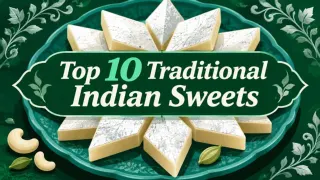
Kaju katli is a thin, diamond-shaped sweet made from ground cashew nuts and sugar, often decorated with edible silver leaf known as vark. [6]
The sweet has a smooth, fudge-like texture and a delicate flavour. [6]
Cashew trees came to India from Brazil with the Portuguese in the 16th century and were first planted on the Goa coast.
India later became one of the world's largest producers and processors of cashews, especially in Kerala, Goa and Karnataka.
Kaju katli is one of the most popular sweets for Diwali gift boxes, and sweet shops sell enormous quantities in the weeks before the festival.
Edible silver leaf is beaten extremely thin and is used to decorate many Indian sweets.
Variations include pista katli, made with pistachios, and kaju rolls filled with nuts.
Key Figures
- Main ingredient: cashew nuts
- Shape: diamond
- Decoration: silver vark
- Season: Diwali
Why It Made the List
Kaju katli is India's favourite festive gift. Its elegant simplicity has made it a modern classic.
7. Ghevar
Ghevar is a disc-shaped sweet from Rajasthan made by pouring a thin batter of flour and ghee into hot ghee, where it forms a lacy, honeycomb-like structure. [7]
Related: Top 10 Oldest Buildings in the World
The disc is soaked in sugar syrup and often topped with rabri, a thickened sweet milk, along with nuts and saffron. [7]
Ghevar is closely linked with the monsoon festival of Teej and with Raksha Bandhan, and it is traditionally made only in the rainy season.
Married women often receive ghevar from their parents at Teej as part of a family custom.
Making ghevar is a skilled task, as the batter must be poured in a steady stream to build up the honeycomb.
Cities such as Jaipur are famous for their ghevar shops, and the sweet is also popular in Uttar Pradesh, Delhi and Haryana.
Its crisp, lacy texture makes it unlike any other Indian sweet.
Key Figures
- Region: Rajasthan
- Festivals: Teej and Raksha Bandhan
- Texture: lacy honeycomb
- Topping: rabri
Why It Made the List
Ghevar is the taste of the monsoon in Rajasthan. Its delicate texture is a marvel of skill.
8. Petha
Petha is a translucent, chewy sweet made from ash gourd, a pale vegetable, cooked in sugar syrup. [8]
It is the most famous sweet of Agra, and hundreds of shops in the city sell it. [8]
According to local legend, petha was first made in the royal kitchens of Shah Jahan to feed the thousands of workers building the Taj Mahal, though there is no firm historical evidence for this.
The ash gourd is peeled, cut into pieces, soaked in lime water to firm the texture, and then boiled in syrup.
Varieties include plain white petha, saffron-flavoured kesar petha, and small, syrupy angoori petha.
Petha keeps well for days, which makes it a popular gift for visitors to take home.
Agra's petha makers have adapted to changing tastes, adding flavours such as chocolate, paan and coconut.
Key Figures
- City: Agra
- Main ingredient: ash gourd
- Legend: linked to the building of the Taj Mahal
- Varieties: plain, kesar, angoori
Why It Made the List
Petha is Agra's signature sweet. Its legend and texture make it unique.
9. Modak
Modak is a dumpling with a sweet filling of fresh coconut and jaggery, flavoured with cardamom, inside a shell of rice flour. [9]
The steamed version, called ukadiche modak, is a speciality of Maharashtra, while fried versions are also popular. [9]
Modak is believed to be the favourite sweet of Ganesha, who is sometimes called Modakapriya, the one who loves modak.
Related: 10 Sikh Gurus: The Pillars of Sikhism Who Shaped Faith, Equality, Courage, and Humanity
During the Ganesh Chaturthi festival, families traditionally offer 21 modaks to the god.
Shaping modaks requires skill, as the dough must be pinched into many fine pleats and closed at the top.
Similar dumplings are made in other parts of India, such as kozhukattai in Tamil Nadu and kudumu in Andhra Pradesh.
In recent years, sweet shops have created modern variations filled with chocolate, mango or dry fruits.
Key Figures
- Region: Maharashtra
- Main ingredients: rice flour, coconut, jaggery
- Festival: Ganesh Chaturthi
- Offering: 21 modaks
Why It Made the List
Modak is a sweet of devotion and skill. It is central to India's favourite festival of Ganesha.
10. Kheer and Payasam
Kheer is a pudding made by slowly simmering rice in milk with sugar, flavoured with cardamom and decorated with nuts. In South India it is called payasam. [10]
The name kheer comes from the Sanskrit kshira, meaning milk, and rice puddings of this kind are among the oldest recorded desserts in India. [10]
Payasam is an essential part of the sadya feast during Kerala's Onam festival, where several kinds may be served in one meal.
The palpayasam of the Ambalappuzha Sri Krishna Temple in Kerala is famous, and a legend says it began after a king lost a chess game to Krishna and owed him rice that doubled on every square of the board.
Variations include vermicelli kheer, called semiyan or sheer khurma at Eid, and versions made with lentils or jaggery.
Kheer is offered at temples and served at weddings and festivals across the country.
Its simple ingredients and comforting taste make it the most widespread dessert in Indian homes.
Key Figures
- Main ingredients: rice, milk, sugar
- Name: from Sanskrit kshira, milk
- Southern name: payasam
- Festival: Onam sadya
Why It Made the List
Kheer is one of India's oldest and best-loved desserts. It is found in every region and every celebration.
Conclusion
India's sweets reflect the country's diversity, history and love of celebration. Each region has its own specialities, and new creations appear every year.
Whether bought from a famous old shop or made at home for a festival, mithai remain a delicious way to share happiness in India.
- ^ [1] "Rasgulla". Wikipedia. Wikipedia: Rasgulla Wikipedia: Chhena Wikipedia: Nobin Chandra Das
- ^ [2] "Gulab Jamun". Wikipedia. Wikipedia: Gulab jamun Wikipedia: Khoa Wikipedia: Pantua
- ^ [3] "Mysore Pak". Wikipedia. Wikipedia: Mysore pak Wikipedia: Mysore Palace Wikipedia: Krishna Raja Wadiyar IV
- ^ [4] "Sandesh". Wikipedia. Wikipedia: Sandesh (confectionery) Wikipedia: Chhena Wikipedia: Jaggery
- ^ [5] "Motichoor Laddoo". Wikipedia. Wikipedia: Laddu Wikipedia: Boondi Wikipedia: Tirupati laddu
- ^ [6] "Kaju Katli". Wikipedia. Wikipedia: Kaju katli Wikipedia: Cashew Wikipedia: Vark
- ^ [7] "Ghevar". Wikipedia. Wikipedia: Ghevar Wikipedia: Teej Wikipedia: Rabri
- ^ [8] "Petha". Wikipedia. Wikipedia: Petha Wikipedia: Wax gourd Wikipedia: Agra
- ^ [9] "Modak". Wikipedia. Wikipedia: Modak Wikipedia: Ganesh Chaturthi Wikipedia: Ganesha
- ^ [10] "Kheer and Payasam". Wikipedia. Wikipedia: Kheer Wikipedia: Payasam Wikipedia: Ambalappuzha Sri Krishna Temple





















Discussion
Log in with