






 By
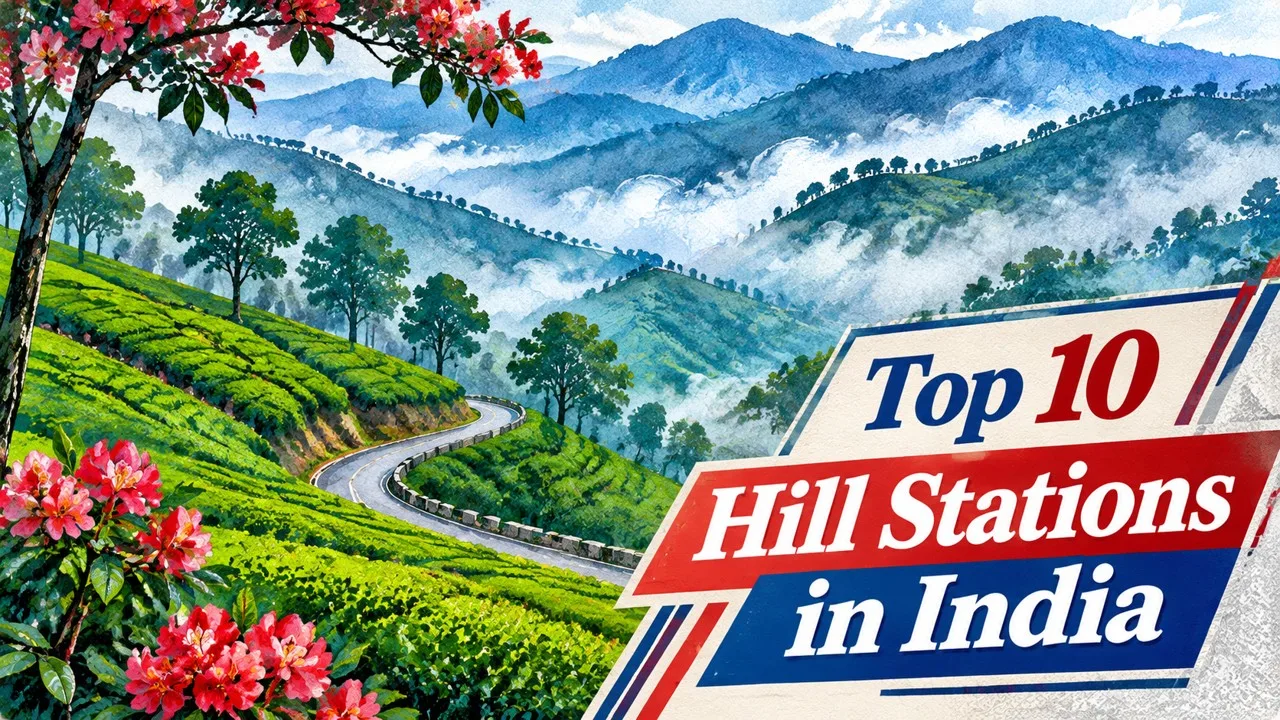
From Shimla and Darjeeling to Ooty, Munnar and Gangtok, these ten hill stations in India offer cool air, tea gardens, mountain views and colonial-era charm. Hill stations are towns in the mountains, high enough to escape the heat of the Indian plains. Many were developed by the British in the 19th century as summer retreats, and some served as seasonal capitals.
Today they are among India's most popular holiday destinations, offering cool weather, forests, tea gardens and views of the Himalayas or the Western Ghats. This list brings together ten of the best known, from the far north to the far south. Altitudes are approximate.
Key Facts
Each of these towns has its own history, landscape and charm.
The Hill Stations of India at a Glance
| # | Hill station | State | Altitude | Known for |
|---|---|---|---|---|
| 1 | Shimla | Himachal Pradesh | About 2,200 metres | The summer capital of British India |
| 2 | Darjeeling | West Bengal | About 2,050 metres | Tea and Himalayan views |
| 3 | Ooty | Tamil Nadu | About 2,240 metres | Queen of the Nilgiris |
| 4 | Munnar | Kerala | About 1,600 metres | Tea estates and rare flowers |
| 5 | Manali | Himachal Pradesh | About 2,050 metres | Gateway to the high Himalayas |
| 6 | Mussoorie | Uttarakhand | About 2,000 metres | Queen of the Hills |
| 7 | Nainital | Uttarakhand | About 1,940 metres | The lake district of India |
| 8 | Shillong | Meghalaya | About 1,500 metres | The Scotland of the East |
| 9 | Kodaikanal | Tamil Nadu | About 2,225 metres | Princess of hill stations |
| 10 | Gangtok | Sikkim | About 1,650 metres | Gateway to Sikkim |
1. Shimla
Shimla, the capital of Himachal Pradesh, sits at about 2,200 metres on a ridge in the lower Himalayas. [1]
From 1864 it was the official summer capital of British India, and the government moved there each year to escape the heat of the plains. [1]
The Kalka–Shimla Railway, opened in 1903, climbs to the town through more than 100 tunnels. It is part of the Mountain Railways of India UNESCO World Heritage Site.
The former Viceregal Lodge now houses the Indian Institute of Advanced Study.
Shimla has hosted important political meetings, including the Simla Conference of 1945 and the Simla Agreement between India and Pakistan in 1972.
Its Mall Road and Ridge are lined with colonial buildings, and the town gets snow in winter.
Key Figures
- State: Himachal Pradesh
- Altitude: about 2,200 metres
- Summer capital: from 1864
- Railway: Kalka–Shimla, 1903
Why It Made the List
Shimla is the classic Indian hill station. Its history and railway make it unique.
2. Darjeeling
Darjeeling, in the hills of northern West Bengal, sits at about 2,050 metres. [2]
It is famous worldwide for Darjeeling tea, which in 2004 became the first product in India to receive a geographical indication tag. [2]
The Darjeeling Himalayan Railway, opened in 1881, became a UNESCO World Heritage Site in 1999. Its small steam locomotives are known as toy trains.
On clear mornings the town offers views of Kangchenjunga, the third-highest mountain in the world.
The Himalayan Mountaineering Institute was founded here in 1954, and Tenzing Norgay, who climbed Everest in 1953, lived in Darjeeling.
The town has a mixed population of Gorkha, Lepcha, Tibetan and Bengali communities.
Its tea gardens, many founded in the mid-19th century, produce a light, fragrant tea sometimes called the champagne of teas.
Key Figures
- State: West Bengal
- Altitude: about 2,050 metres
- Famous for: Darjeeling tea
- Railway: Darjeeling Himalayan Railway, 1881
Why It Made the List
Darjeeling is the queen of Himalayan hill stations. Its tea and mountain views are world famous.
Related: Top 10 Famous Forts of India
3. Ooty
Ooty, officially Udhagamandalam, sits at about 2,240 metres in the Nilgiri Hills of Tamil Nadu. [3]
The British collector John Sullivan began developing it in the 1820s, and it became the summer capital of the Madras Presidency. [3]
The Nilgiri Mountain Railway, completed in 1908, climbs to Ooty using a rack system on its steepest stretch. It was added to UNESCO's World Heritage list in 2005.
The Government Botanical Garden, laid out in the 1840s, has a famous collection of plants and trees.
Ooty Lake, created in the 1820s, is popular for boating.
The surrounding hills are covered with tea plantations and eucalyptus forests and form part of the Nilgiri Biosphere Reserve.
Its annual flower show in May draws large crowds.
Homemade chocolates and tea are popular souvenirs.
Key Figures
- State: Tamil Nadu
- Altitude: about 2,240 metres
- Official name: Udhagamandalam
- Railway: Nilgiri Mountain Railway
Why It Made the List
Ooty is the most famous hill station of the south. Its railway and gardens are delightful.
4. Munnar
Munnar lies at about 1,600 metres in the Western Ghats of Kerala, at the meeting point of three mountain streams. [4]
The town is surrounded by vast tea estates that cover the hillsides in green. [4]
Nearby Eravikulam National Park protects the endangered Nilgiri tahr, a mountain goat found only in the Western Ghats.
Anamudi, the highest peak in southern India at about 2,695 metres, rises within the park.
The hills around Munnar are famous for the Neelakurinji, a shrub that blooms only once every twelve years, turning the slopes blue. The last mass flowering was in 2018.
Munnar was badly hit by floods in 2018 but remains one of Kerala's most popular destinations.
Spice plantations of cardamom and pepper are also found in the surrounding hills.
Key Figures
- State: Kerala
- Altitude: about 1,600 metres
- Wildlife: Nilgiri tahr
- Flower: Neelakurinji, every 12 years
Why It Made the List
Munnar is the green jewel of Kerala. Its tea gardens and rare flowers make it unforgettable.
Related: History of Bombay: From Seven Islands to Mumbai
5. Manali
Manali lies at about 2,050 metres at the northern end of the Kullu Valley, on the Beas River. [5]
It is a base for trekking, skiing, paragliding and river rafting. [5]
Manali is the gateway to the high Himalayan regions of Lahaul, Spiti and Ladakh.
The Atal Tunnel, opened in 2020, runs for about 9 kilometres under the Rohtang Pass and allows year-round travel to Lahaul. It is one of the longest highway tunnels in the world above 3,000 metres.
The town is known for the Hadimba Devi Temple, built in 1553 in a cedar forest, and for its apple orchards.
Old Manali, with its guesthouses and cafes, attracts backpackers from around the world.
Snowfall in winter turns the valley white and draws visitors from the plains.
Key Figures
- State: Himachal Pradesh
- Altitude: about 2,050 metres
- River: Beas
- Tunnel: Atal Tunnel, 2020
Why It Made the List
Manali is India's adventure capital in the mountains. It opens the way to the high Himalayas.
6. Mussoorie
Mussoorie sits at about 2,000 metres in the Garhwal Himalaya of Uttarakhand, above Dehradun. [6]
Often called the Queen of the Hills, it was developed as a hill station from the 1820s. [6]
Its neighbour Landour is home to the writer Ruskin Bond, whose stories are set in these hills.
Sir George Everest, the Surveyor General of India after whom Mount Everest is named, had his home and office near Mussoorie.
The town is home to the Lal Bahadur Shastri National Academy of Administration, which trains India's top civil servants.
From its ridges, visitors can see the snow peaks of the Himalayas on one side and the Doon Valley on the other.
Camel's Back Road and Gun Hill are popular walking spots, and the town's Mall Road is lined with shops, cafes and old hotels.
Key Figures
- State: Uttarakhand
- Altitude: about 2,000 metres
- Nickname: Queen of the Hills
- Resident: Ruskin Bond
Why It Made the List
Mussoorie is a classic hill station with literary charm. Its views are spectacular.
Related: Top 10 Highest Bungee Jumps in the World
7. Nainital
Nainital sits at about 1,940 metres in the Kumaon hills of Uttarakhand, around a beautiful eye-shaped lake. [7]
The town was founded in 1841 when a British sugar trader built the first house there. [7]
It became the summer capital of the United Provinces, the predecessor of Uttar Pradesh.
In 1880 a landslide killed around 150 people, and much of the town was later rebuilt with improved drainage.
Naini Lake is surrounded by hills, and the Naina Devi Temple stands on its northern shore.
Nearby is the Aryabhatta Research Institute of Observational Sciences, an important centre for astronomy.
The town is also the seat of the Uttarakhand High Court. Visitors can take boats on the lake, ride a cable car to Snow View, or walk the Mall Road between Mallital and Tallital at either end of the lake.
Key Figures
- State: Uttarakhand
- Altitude: about 1,940 metres
- Founded: 1841
- Lake: Naini Lake
Why It Made the List
Nainital is India's lake district. Its setting is one of the prettiest in the Himalayas.
8. Shillong
Shillong, the capital of Meghalaya, sits at about 1,500 metres in the Khasi Hills. [8]
Its rolling hills, pine forests and cool climate earned it the name Scotland of the East. [8]
It was the capital of Assam until 1972, when Meghalaya became a separate state.
The Khasi people of the region follow a matrilineal system, in which property and family names pass through the female line.
Shillong has a lively music scene and is sometimes called India's rock music capital.
Nearby are Sohra, also called Cherrapunji, and Mawsynram, two of the wettest places on Earth, as well as the famous living root bridges of Meghalaya.
Related: Top 10 Pilgrim and Mayflower Myths: What History Really Shows
The town's Police Bazaar is its busy commercial centre, and Umiam Lake lies just to the north. Football is also hugely popular.
Key Figures
- State: Meghalaya
- Altitude: about 1,500 metres
- Nickname: Scotland of the East
- Culture: Khasi matrilineal society
Why It Made the List
Shillong is the musical capital of the northeast. Its landscape and culture are unique.
9. Kodaikanal
Kodaikanal sits at about 2,225 metres in the Palani Hills of Tamil Nadu. [9]
Known as the Princess of Hill Stations, it was established in 1845 by American missionaries and British officials seeking relief from the heat of the plains. [9]
The Kodaikanal Solar Observatory, founded in 1899, is one of the oldest observatories in India. John Evershed discovered the Evershed effect there in 1909.
The town is built around a star-shaped artificial lake created in 1863.
Kodaikanal's forests, cliffs and waterfalls attract walkers, and the town is famous for homemade chocolates and eucalyptus oil.
The Neelakurinji also blooms on the surrounding hills once every twelve years.
Popular walks include Coaker's Walk, a path along a steep ridge with views over the plains far below.
Key Figures
- State: Tamil Nadu
- Altitude: about 2,225 metres
- Founded: 1845
- Science: Kodaikanal Solar Observatory
Why It Made the List
Kodaikanal is a peaceful hill retreat with a scientific past. Its lake and forests are charming.
10. Gangtok
Gangtok, the capital of Sikkim, sits at about 1,650 metres in the eastern Himalayas. [10]
The town has superb views of Kangchenjunga, the sacred mountain of Sikkim. [10]
Sikkim was an independent kingdom until 1975, when it became a state of India.
The town is a centre of Tibetan Buddhism, and the Rumtek Monastery lies nearby.
In 2016 Sikkim was declared India's first fully organic state.
Gangtok is the starting point for trips to Tsomgo Lake and the Nathu La pass on the border with China. Its main street, MG Marg, is pedestrian-only and known for cleanliness.
Its flower shows feature orchids, of which Sikkim has hundreds of species. The town is also known for momos and thukpa, dishes of Tibetan origin, and for the views from its many viewpoints.
Key Figures
- State: Sikkim
- Altitude: about 1,650 metres
- Joined India: 1975
- Distinction: first fully organic state
Why It Made the List
Gangtok is a clean, friendly Himalayan capital. It is the gateway to beautiful Sikkim.
Conclusion
India's hill stations offer an escape from the summer heat and a chance to enjoy nature, history and local culture.
Many face pressure from crowds, traffic and construction. Visiting outside peak season and respecting local rules helps protect them for future visitors.
- ^ [1] "Shimla". Wikipedia. Wikipedia: Shimla Wikipedia: Kalka–Shimla Railway Wikipedia: Simla Agreement
- ^ [2] "Darjeeling". Wikipedia. Wikipedia: Darjeeling Wikipedia: Darjeeling tea Wikipedia: Darjeeling Himalayan Railway
- ^ [3] "Ooty". Wikipedia. Wikipedia: Ooty Wikipedia: Nilgiri Mountain Railway Wikipedia: John Sullivan (colonial administrator)
- ^ [4] "Munnar". Wikipedia. Wikipedia: Munnar Wikipedia: Eravikulam National Park Wikipedia: Strobilanthes kunthiana
- ^ [5] "Manali". Wikipedia. Wikipedia: Manali, Himachal Pradesh Wikipedia: Atal Tunnel Wikipedia: Hidimba Devi Temple
- ^ [6] "Mussoorie". Wikipedia. Wikipedia: Mussoorie Wikipedia: Landour Wikipedia: Lal Bahadur Shastri National Academy of Administration
- ^ [7] "Nainital". Wikipedia. Wikipedia: Nainital Wikipedia: Naini Lake Wikipedia: Aryabhatta Research Institute of Observational Sciences
- ^ [8] "Shillong". Wikipedia. Wikipedia: Shillong Wikipedia: Khasi people Wikipedia: Mawsynram
- ^ [9] "Kodaikanal". Wikipedia. Wikipedia: Kodaikanal Wikipedia: Kodaikanal Solar Observatory Wikipedia: Evershed effect
- ^ [10] "Gangtok". Wikipedia. Wikipedia: Gangtok Wikipedia: Rumtek Monastery Wikipedia: Tsomgo Lake























Discussion
Log in with