





 By
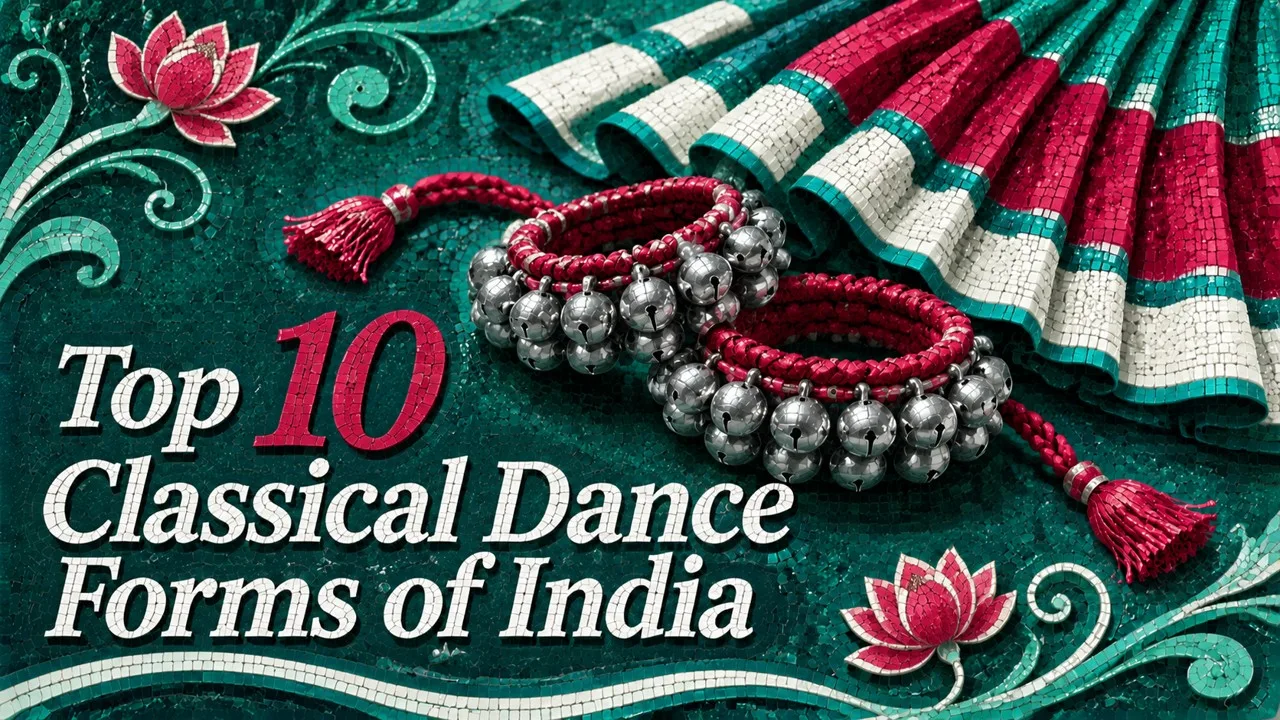
From Bharatanatyam and Kathak to Kathakali, Odissi and Manipuri, discover ten classical and traditional dance forms of India and the stories they tell. India's classical dances combine movement, music, drama and devotion. Most trace their principles to the Natya Shastra, an ancient Sanskrit treatise on the performing arts, and many grew up in temples and royal courts.
The Sangeet Natak Akademi, India's national academy of music, dance and drama, recognises eight classical dance forms. This list covers those eight, along with Chhau, which India's Ministry of Culture also lists among its classical dances, and Yakshagana, a celebrated dance-drama of Karnataka usually described as semi-classical.
Key Facts
Each dance has its own costumes, music, gestures and stories.
The Classical Dance Forms of India at a Glance
| # | Dance | Region | Key feature | Recognition |
|---|---|---|---|---|
| 1 | Bharatanatyam | Tamil Nadu | Precise geometry and expressive storytelling | Sangeet Natak Akademi |
| 2 | Kathak | North India | Fast spins and rhythmic footwork | Sangeet Natak Akademi |
| 3 | Kuchipudi | Andhra Pradesh | Dance-drama with fast, fluid movement | Sangeet Natak Akademi |
| 4 | Odissi | Odisha | Sculptural poses and fluid grace | Sangeet Natak Akademi |
| 5 | Kathakali | Kerala | Dramatic make-up and costumes | Sangeet Natak Akademi |
| 6 | Mohiniyattam | Kerala | Gentle swaying movements | Sangeet Natak Akademi |
| 7 | Manipuri | Manipur | Soft, devotional movement | Sangeet Natak Akademi |
| 8 | Sattriya | Assam | Monastic devotional dance | Sangeet Natak Akademi |
| 9 | Chhau | Eastern India | Masked martial dance | UNESCO intangible heritage |
| 10 | Yakshagana | Coastal Karnataka | Night-long dance-drama | Semi-classical |
1. Bharatanatyam
Bharatanatyam is one of the oldest and most widely performed classical dances of India, originating in the temples of Tamil Nadu. [1]
It grew out of a dance tradition called Sadir, once performed by temple dancers known as devadasis. [1]
In the 1930s, reformers such as Rukmini Devi Arundale renamed and revived the dance and brought it to the concert stage. She founded the Kalakshetra academy in Chennai in 1936.
Bharatanatyam is known for its fixed upper torso, bent legs and intricate footwork, combined with expressive hand gestures called mudras and facial expressions.
A traditional recital follows a set sequence of pieces, from the opening alarippu to the central varnam and the lively closing tillana.
Carvings of 108 dance poses, known as karanas, decorate the gateways of the temple at Chidambaram.
Key Figures
- Region: Tamil Nadu
- Revived: 1930s
- Key figure: Rukmini Devi Arundale
- Music: Carnatic
Why It Made the List
Bharatanatyam is India's best-known classical dance. It is performed and taught around the world.
2. Kathak
Kathak is the main classical dance of northern India. [2]
Its name comes from kathakars, the storytellers who travelled from place to place telling stories from the epics through song and dance. [2]
Under the Mughals, Kathak moved into royal courts, where it absorbed Persian influences and became more elegant.
The dance is famous for fast spins, called chakkars, and complex footwork performed with hundreds of ankle bells.
It has several main schools, or gharanas, including those of Lucknow, Jaipur and Banaras.
Pandit Birju Maharaj of the Lucknow gharana, who died in 2022, was one of its greatest masters.
Dancers also recite rhythmic syllables, called bols, before performing them with their feet. Kathak dancers often engage in playful rhythmic exchanges with the tabla player. Sitara Devi was another legendary performer of the 20th century.
Key Figures
- Region: North India
- Influences: Hindu and Mughal
- Gharanas: Lucknow, Jaipur, Banaras
- Music: Hindustani
Why It Made the List
Kathak combines Hindu and Muslim traditions. Its footwork and spins are thrilling.
Related: Top 10 Most Bizarre Phobias: Strange Fears That Exist
3. Kuchipudi
Kuchipudi is named after the village of Kuchipudi in Andhra Pradesh, where it developed. [3]
Tradition credits the 17th-century saint Siddhendra Yogi with shaping the dance, though older forms existed. [3]
It began as a dance-drama performed by troupes of Brahmin men, who played both male and female roles.
Kuchipudi is fast and fluid, combining pure dance with expressive storytelling and dialogue.
In a famous item called the tarangam, the dancer performs on the rim of a metal plate, sometimes with a pot of water balanced on the head.
In the 20th century, Vempati Chinna Satyam turned Kuchipudi into a solo form performed widely by women.
Kuchipudi is accompanied by Carnatic music, and its gestures and stories are drawn largely from the Bhagavata Purana. The village of Kuchipudi still has a dance school that keeps the tradition alive.
Key Figures
- Region: Andhra Pradesh
- Named after: Kuchipudi village
- Famous item: tarangam
- Music: Carnatic
Why It Made the List
Kuchipudi combines drama and dance with great skill. Its plate dance is a highlight.
4. Odissi
Odissi comes from Odisha and is one of the oldest surviving dance forms of India. [4]
Carvings of dancers in the Udayagiri caves, dating to around the 2nd century BCE, suggest that dance was performed there in ancient times. [4]
The dance was kept alive by temple dancers called maharis and by gotipuas, young boys who danced dressed as girls.
Odissi is known for the tribhangi, a pose in which the body bends at the neck, waist and knee, giving it a sculptural quality.
Many performances are based on the Gita Govinda, a 12th-century poem about Krishna and Radha.
Gurus such as Kelucharan Mohapatra revived and reconstructed the dance in the mid-20th century.
Related: Top 10 Oldest Buildings in the World
Odissi is usually accompanied by the pakhawaj drum, flute and violin, with songs in Odia and Sanskrit. Dancers wear silver jewellery and a headdress of white flowers.
Key Figures
- Region: Odisha
- Pose: tribhangi
- Text: Gita Govinda
- Key figure: Kelucharan Mohapatra
Why It Made the List
Odissi brings temple sculpture to life. Its grace is mesmerising.
5. Kathakali
Kathakali is a spectacular dance-drama from Kerala that developed in the 17th century. [5]
Performers wear elaborate make-up and costumes, with colours that indicate the type of character. Green faces, for example, show noble heroes. [5]
Traditionally performed by men, Kathakali tells stories from the Mahabharata and Ramayana through gestures, facial expressions and dance.
Performers train for years to control their facial muscles and eye movements.
Performances traditionally lasted all night, lit by a single large oil lamp on stage.
The poet Vallathol Narayana Menon founded the Kerala Kalamandalam in 1930 to preserve Kathakali and other arts.
Musicians playing loud chenda and maddalam drums accompany the performance, while singers narrate the story. The make-up can take several hours to apply.
Short performances for visitors are now staged daily in Kochi.
Key Figures
- Region: Kerala
- Developed: 17th century
- Feature: elaborate make-up
- Institution: Kerala Kalamandalam, 1930
Why It Made the List
Kathakali is one of the most dramatic dance forms in the world. Its make-up and costumes are iconic.
6. Mohiniyattam
Mohiniyattam is a graceful classical dance from Kerala, named after Mohini, the enchantress form of the god Vishnu. [6]
It is traditionally performed solo by women. [6]
The dance is known for gentle, swaying movements of the body, said to resemble swaying palm trees and the waves of the sea.
Dancers wear a simple white or cream sari with a coloured border and a bun of hair on the side of the head.
The dance was patronised in the 19th century by Swathi Thirunal, the musician king of Travancore.
After a period of decline, it was revived in the 20th century at the Kerala Kalamandalam.
Related: The Evolution of Stranger Things: Seasons, Themes, and Characters
The music follows the Carnatic tradition, with songs often in Manipravalam, a blend of Malayalam and Sanskrit. Dancers such as Kalamandalam Kalyanikutty Amma helped bring it back to life.
Key Figures
- Region: Kerala
- Named after: Mohini
- Performed by: women
- Patron: Swathi Thirunal
Why It Made the List
Mohiniyattam is the gentlest of India's classical dances. Its grace is captivating.
7. Manipuri
Manipuri dance comes from Manipur in northeastern India and is closely linked to devotion to Krishna. [7]
Its most famous form is the Ras Lila, which tells the story of Krishna and the gopis. The king Bhagyachandra is credited with shaping it in the 18th century. [7]
Manipuri also draws on older rituals such as the Lai Haraoba festival.
The dance is soft and flowing, with no strong foot stamping, and dancers wear a distinctive stiff, cylindrical skirt.
Male dancers perform the energetic Pung Cholom, dancing while playing a drum.
Rabindranath Tagore admired Manipuri dance and introduced it at his school in Santiniketan.
The dance is accompanied by the pung drum, cymbals, flute and singing. Facial expressions are subtle, and the dancers' eyes are often lowered in devotion.
Key Figures
- Region: Manipur
- Famous form: Ras Lila
- Drum dance: Pung Cholom
- Patron: Rabindranath Tagore
Why It Made the List
Manipuri is one of the most graceful and devotional dances of India. Its costumes are unique.
8. Sattriya
Sattriya comes from Assam and was created as part of devotional plays by the saint and reformer Srimanta Sankardev in the 15th and 16th centuries. [8]
It has been preserved for centuries in sattras, the Vaishnavite monasteries of Assam, where it was performed by monks. [8]
The dances tell stories of Krishna and other forms of Vishnu.
Sattriya was recognised by the Sangeet Natak Akademi as a classical dance in 2000.
Today it is performed by both men and women on stage around the world.
Majuli, the river island in the Brahmaputra, is one of its main centres.
Its music uses the khol drum and cymbals, with songs called borgeet written by Sankardev and his disciple Madhavdev. Dancers wear costumes woven from Assamese silk.
Rich in gesture and footwork, it also includes vigorous dances for male performers.
Related: Chernobyl Miniseries: Stories of Tragedy of a Nuclear Catastrophe, Heroism and Sacrifice
Key Figures
- Region: Assam
- Founder: Srimanta Sankardev
- Recognised: 2000
- Centre: sattras of Majuli
Why It Made the List
Sattriya is the youngest recognised classical dance. Its monastic roots make it special.
9. Chhau
Chhau is a dance of eastern India with strong roots in martial arts and folk traditions. [9]
It has three main styles, named after the places where they are performed: Purulia in West Bengal, Seraikela in Jharkhand and Mayurbhanj in Odisha. [9]
Purulia and Seraikela dancers wear masks, while Mayurbhanj dancers do not.
The dances are energetic and athletic, with leaps and spins, and tell stories from the Ramayana, the Mahabharata and local legends.
Chhau is performed especially during the spring festival of Chaitra Parva.
It was added to UNESCO's list of intangible cultural heritage in 2010.
The masks of Purulia Chhau are made of papier-mache and clay, and the craft of mask-making in the village of Charida is famous. Seraikela masks are more delicate and stylised.
Key Figures
- Region: West Bengal, Jharkhand and Odisha
- Styles: Purulia, Seraikela, Mayurbhanj
- Feature: masks
- UNESCO: 2010
Why It Made the List
Chhau combines martial art and dance. Its masks and leaps are spectacular.
10. Yakshagana
Yakshagana is a traditional dance-drama from coastal Karnataka and parts of northern Kerala. [10]
It combines dance, music, dialogue, costume and make-up, and is usually performed through the night in the open air. [10]
Performers wear huge, elaborate headdresses and bright costumes.
A singer called the bhagavata leads the performance and tells the story, accompanied by drums and cymbals.
The stories come mainly from the Ramayana, the Mahabharata and the Puranas.
Yakshagana is believed to have developed several centuries ago during the Bhakti movement and remains extremely popular in coastal Karnataka.
Troupes, called melas, often tour villages from November to May, setting up stages in fields and temple grounds. Some performances are now shorter, aimed at urban audiences, and new stories have been added to the repertoire.
Key Figures
- Region: coastal Karnataka
- Style: night-long dance-drama
- Leader: bhagavata
- Themes: epics and Puranas
Why It Made the List
Yakshagana is one of India's most vibrant theatre traditions. Its headdresses and energy are unforgettable.
Conclusion
India's classical dances are living traditions passed from guru to student over many years of training.
Watching a live performance is the best way to appreciate them. Many festivals across India showcase these dances every year.
- ^ [1] "Bharatanatyam". Wikipedia. Wikipedia: Bharatanatyam Wikipedia: Rukmini Devi Arundale Wikipedia: Kalakshetra Foundation
- ^ [2] "Kathak". Wikipedia. Wikipedia: Kathak Wikipedia: Birju Maharaj Wikipedia: Lucknow gharana
- ^ [3] "Kuchipudi". Wikipedia. Wikipedia: Kuchipudi Wikipedia: Siddhendra Yogi Wikipedia: Vempati Chinna Satyam
- ^ [4] "Odissi". Wikipedia. Wikipedia: Odissi Wikipedia: Gita Govinda Wikipedia: Kelucharan Mohapatra
- ^ [5] "Kathakali". Wikipedia. Wikipedia: Kathakali Wikipedia: Kerala Kalamandalam Wikipedia: Vallathol Narayana Menon
- ^ [6] "Mohiniyattam". Wikipedia. Wikipedia: Mohiniyattam Wikipedia: Mohini Wikipedia: Swathi Thirunal Rama Varma
- ^ [7] "Manipuri". Wikipedia. Wikipedia: Manipuri dance Wikipedia: Pung cholom Wikipedia: Lai Haraoba
- ^ [8] "Sattriya". Wikipedia. Wikipedia: Sattriya Wikipedia: Srimanta Sankardeva Wikipedia: Majuli
- ^ [9] "Chhau". Wikipedia. Wikipedia: Chhau Wikipedia: Purulia Wikipedia: Seraikela
- ^ [10] "Yakshagana". Wikipedia. Wikipedia: Yakshagana Wikipedia: Tulu Nadu Wikipedia: Bhakti movement




















Discussion
Log in with