

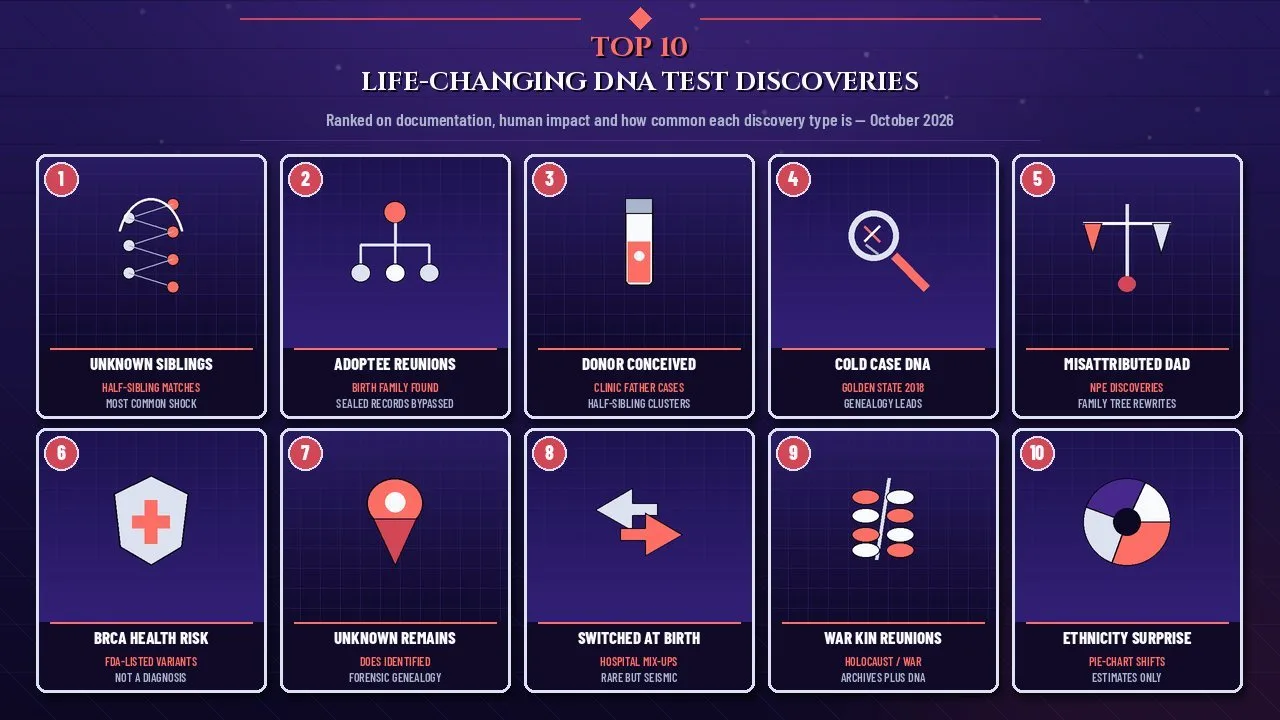
These DNA test discoveries remade families, health choices and cold cases, ranked by how well documented, how disruptive and how common each type is.
A spit-in-a-tube kit once sold for genealogy fun. Within a decade the same databases began reuniting adoptees, exposing fertility-clinic fraud, rewriting family trees and helping police name serial offenders who had stayed anonymous for decades. The science is not magic: autosomal matches estimate shared DNA segments; ethnicity pie charts are statistical models; health reports cover only selected variants. Still, the social consequences are hard to overstate.
This Finepedia ranking, written as of October 2026, covers ten well-reported kinds of discoveries that followed consumer or investigative genetic testing. It prefers public cases covered by major newsrooms, courts and scientific agencies. It does not copy any single listicle's order or wording. Private individuals are named only when major outlets already did so. Ethnicity estimates are estimates, not certificates of identity. Health results are screening clues, not diagnoses. Anyone facing a medical or legal shock from a result should seek qualified counselling rather than treating a match list as final truth.
How We Ranked These DNA Test Discoveries
Each discovery type was scored from 1 to 5 on four criteria, for a total out of 20. Scores are Finepedia's editorial judgement, applied with the same definitions to every entry and checked against reputable sources such as the U.S. Department of Justice, FBI statements, FDA authorisations, peer-reviewed genetics and genealogy research, the New York Times, Washington Post, BBC, Reuters, Associated Press, NBC News, NPR and court or agency records summarised in those outlets.
- Documentation quality (1 to 5): how clearly the discovery type is established in independent reporting, scientific literature or official case summaries, not folklore.
- Human impact (1 to 5): how deeply a typical confirmed result can change identity, medical decisions, legal outcomes or family relationships.
- How common the type is (1 to 5): how often similar discoveries appear across consumer databases and investigative genetics, relative to rarer one-off scandals.
- What it reveals about DNA testing (1 to 5): how clearly the pattern teaches the strengths and limits of consumer kits, relative-matching and investigative genealogy.
When totals tie, higher Human impact ranks first, then Documentation. Honourable Mentions cover related stories that did not make the cut.
The Scorecard
| Rank | Discovery type | Docs | Impact | Common | Reveals | Total |
|---|---|---|---|---|---|---|
| 1 | Finding unknown siblings and half-siblings | 5 | 5 | 5 | 5 | 20 |
| 2 | Adoptees reuniting with birth families | 5 | 5 | 5 | 4 | 19 |
| 3 | Donor-conceived people and fertility-doctor fathers | 5 | 5 | 3 | 5 | 18 |
| 4 | Cold cases cracked by genetic genealogy | 5 | 5 | 3 | 5 | 18 |
| 5 | Misattributed paternity discoveries | 4 | 5 | 4 | 4 | 17 |
| 6 | Inherited health-risk findings such as BRCA | 5 | 5 | 3 | 4 | 17 |
| 7 | Identifying unknown remains | 5 | 5 | 3 | 4 | 17 |
| 8 | Switched-at-birth confirmations | 4 | 5 | 2 | 4 | 15 |
| 9 | Holocaust and war-separated relatives | 4 | 5 | 2 | 4 | 15 |
| 10 | Surprise ethnicity estimate results | 4 | 3 | 5 | 3 | 15 |
Cold-case genetic genealogy ties the donor-conceived pattern on total score (both 18). The fertility-doctor / donor cluster ranks third because it more directly reshapes ordinary consumer match lists; golden-state-style arrests rank fourth as the clearest public-safety demonstration. Celebrity TV ancestry segments that merely confirm expected heritage were left out; they entertain but rarely change lives.
DNA Test Discoveries at a Glance
| Rank | Discovery | Typical trigger | Snapshot example | Main caution |
|---|---|---|---|---|
| 1 | Unknown siblings | Close autosomal match | Clusters of half-siblings in consumer databases | Contact can shock relatives who never tested |
| 2 | Adoptee reunions | Parent or sibling match | International adoptees finding birth kin | Records and laws vary by country |
| 3 | Donor / clinic fathers | Many half-sibling matches | Donald Cline case, Indianapolis | Fraud cases are rare; most donors are not doctors |
| 4 | Cold-case genealogy | Crime-scene DNA to tree | Golden State Killer arrest, 2018 | Investigative use differs from hobby kits |
| 5 | Misattributed paternity | Unexpected parent-child share | NPEs found via kits | Sensitive; rates are debated and context-specific |
| 6 | BRCA-type health risks | Selected variant reports | FDA-authorised BRCA reports on some kits | Not a full clinical gene panel |
| 7 | Unknown remains | Forensic genealogy | Does identified after decades | Needs law-enforcement and lab partners |
| 8 | Switched at birth | Parent mismatch | Hospital-era swaps confirmed later | Rare; needs careful verification |
| 9 | War / Holocaust kin | Distant matches plus records | Families bridging wartime gaps | Trauma-informed contact matters |
| 10 | Ethnicity surprises | Pie-chart shift | Estimates change with reference panels | Models, not passports |
Related Finepedia reading for science and health context includes the live posts on Most Dangerous Science Experiments: Top 10 in History, Rare Medical Conditions You&, Most Deadly Diseases in the World: Top 10 and Most Advanced Hospitals in the World: Top 10.
1. Finding Unknown Siblings and Half-Siblings
| Attribute | Details |
|---|---|
| What it is | Close autosomal matches that indicate full or half siblings the tester never knew about |
| Typical DNA signal | Shared DNA often in ranges associated with sibling or half-sibling relationships (centimorgan totals interpreted with age and family context) |
| Why it ranks first | Extremely common in large databases, emotionally seismic and well documented in journalism and genetic-genealogy guides |
| Public illustrations | Clusters of half-siblings among donor-conceived people; late-life discoveries of brothers or sisters who grew up apart |
| Main caution | A match is a hypothesis until trees, ages and possible other relationships are checked |
Unknown siblings sit at the top because they are both frequent and life-altering. Consumer databases grew large enough that people who share a parent often land as strong matches even when no one set out to find family. Newsrooms have repeatedly covered adults who messaged a stranger after a half-sibling prediction and then confirmed the link with records or further testing.
Background
Autosomal tests look across the 22 non-sex chromosome pairs. Full siblings typically share more DNA than half-siblings, who share roughly half as much on average, but the ranges overlap with other relationships such as avuncular or grandparental ties. Genetic genealogists therefore combine shared DNA amounts, age gaps and documentary research rather than trusting a single label on a website. As more people tested through the 2010s, sibling discoveries stopped being freak events and became a recurring theme in support groups and major features.
How It Happened (Key Features)
- A tester uploads or receives results and sees a close match labelled sibling or half-sibling
- Messaging, shared matches and family-tree building test whether the prediction fits
- Birth years, geography and known donor or affair stories often supply the missing parent link
- Additional relatives testing can confirm which side of the family is shared
- Outcomes range from joyful meetings to painful confrontations with secrecy
Significance
Sibling discoveries show the core power of relative matching: the product is not only an ethnicity chart but a living network. They also expose how secrets that once stayed inside one household can surface when a cousin tests for fun. For donor-conceived people, sibling clusters can reveal how many offspring share a donor long before any clinic file is opened.
Interesting Facts
- Shared DNA is usually measured in centimorgans; relationship predictors use statistical ranges, not certainty.
- People who share both parents can still show different ethnicity percentages because recombination is random.
- Some sibling discoveries happen between people who already knew each other as friends, which news features have highlighted as especially striking.
- Opting into matching is typically required; kits do not automatically publish your identity to every relative.
- Support organisations for NPE and donor-conceived communities grew alongside database growth in the 2010s and 2020s.
2. Adoptees Reuniting with Birth Families
| Attribute | Details |
|---|---|
| What it is | Adopted people identifying birth parents, siblings or wider kin through DNA matches and trees |
| Typical DNA signal | Parent-child or close sibling matches; otherwise clusters of first and second cousins |
| Why it ranks high | Very common use-case, strong documentation, transformative for identity |
| Public illustrations | International and domestic adoptees who found siblings or parents after agencies or sealed records stalled |
| Main caution | Contact laws, privacy wishes and incomplete records vary widely |
Adoption search is one of the clearest everyday uses of consumer genetics. Where paper trails end at sealed files or lost orphanage records, a single first-cousin match can reopen a branch of the tree that paperwork never named.
Background
Before cheap autosomal kits, many adoptees relied on registries, search angels and court petitions. DNA did not replace those tools; it accelerated them. A birth parent who never registered for contact may still appear because a niece or half-sibling tested. International adoptees, including people adopted from Asia and Latin America to North America and Europe, have used matches plus local research to bridge continents. Journalism has covered reunions that happened decades after placement, including siblings raised in the same city who never knew each other.
How It Happened (Key Features)
- Adoptee tests and opts into relative matching
- Close matches or cousin clusters point to a birth family surname or region
- Researchers build trees outward from matches until a candidate parent appears
- Documentary evidence and sometimes additional DNA tests confirm the link
- Reunions may include siblings first when parents are deceased or unwilling
Significance
These discoveries show DNA as a workaround for institutional secrecy, not only as a hobby. They also remind readers that a match can affect people who never consented to be found. Ethical guides for genetic genealogy stress respectful contact scripts and acceptance when a relative declines a relationship.
Interesting Facts
- Some adoptees find dozens of maternal or paternal relatives before identifying the exact parent.
- Closed-adoption eras left many adults with amended birth certificates that omit biological parents.
- Sibling-first reunions are common when a birth parent has died or refuses contact.
- DNA cannot by itself grant legal rights; citizenship, inheritance and records still follow local law.
- Finepedia's science and health listicles on Rare Medical Conditions You& and Most Deadly Diseases in the World: Top 10 sit beside this topic for readers thinking about inherited risk after a reunion.
3. Donor-Conceived People and Fertility-Doctor Fathers
| Attribute | Details |
|---|---|
| What it is | Donor-conceived testers finding large half-sibling groups — and, in rare scandals, learning a clinic doctor used his own sperm |
| Typical DNA signal | Many half-sibling matches converging on one man |
| Landmark public case | Jacoba Ballard and others linked to Indianapolis physician Donald Cline; widely reported by major U.S. outlets |
| Why it ranks here | Extreme impact, strong documentation, reveals database power to expose institutional betrayal |
| Main caution | Fertility-doctor fraud is rare; most donor discoveries involve arranged anonymous donors, not physicians |
Donor conception was designed, in many eras, for secrecy. Consumer DNA dissolved that secrecy. Half-sibling groups formed in match lists, private Facebook groups and nonprofit registries. In a smaller set of criminal or ethical scandals, offspring learned that the physician who ran the clinic was himself the biological father of many patients' children.
Background
Jacoba Ballard's search for donor siblings, reported by NBC News and others, led to a cluster of matches and eventually to Donald Cline, a former Indianapolis fertility doctor. Reporting described dozens of offspring. Cline faced criminal charges tied to obstruction and false statements; coverage emphasised how DNA evidence undercut earlier denials. Similar physician-donor scandals have been reported in other countries, but the Cline story became one of the best-known U.S. examples precisely because match lists made the pattern undeniable.
How It Happened (Key Features)
- A donor-conceived person tests and finds an unusually large set of half-sibling matches
- Shared-match analysis points to one paternal source
- Public records, yearbooks or relative trees identify the man
- Journalism and sometimes prosecutors become involved when fraud is alleged
- Offspring networks form for mutual support and medical history sharing
Significance
This discovery type shows that databases can police institutions as well as reconnect families. It also fuels debates about donor limits, consent and the right of offspring to know their genetic origins. For ordinary readers, the lesson is double: anonymous donation is hard to keep anonymous, and a shocking headline about a doctor should not be confused with typical clinic practice.
Interesting Facts
- Some half-sibling groups number in the tens or more when a popular donor was used for years.
- Medical history sharing among siblings can matter for hereditary conditions long before any clinic releases a file.
- Laws on donor anonymity and offspring rights differ sharply between jurisdictions.
- Obstruction or false-statement charges have appeared where direct "fraudulent reproduction" statutes were weak.
- Ethical clinics now often warn patients that consumer DNA may identify donors later.
4. Cold Cases Cracked by Genetic Genealogy
| Attribute | Details |
|---|---|
| What it is | Comparing crime-scene DNA to consumer-style relative databases and building family trees to identify a suspect or victim |
| Landmark case | Arrest of Joseph James DeAngelo, the Golden State Killer, in April 2018 |
| Why it ranks fourth | Exceptional documentation and public-safety impact; redefined forensic practice |
| Typical tools | SNP profiles, public genealogy sites used under site policies, tree building by investigators or contractors |
| Main caution | Investigative genetic genealogy follows different rules and ethics than hobby matching |
In April 2018, U.S. authorities arrested Joseph James DeAngelo, later convicted for a series of murders and rapes attributed to the Golden State Killer / East Area Rapist. Reporting by the New York Times, Los Angeles Times and others explained that investigators used DNA from crime scenes to find distant relatives in a genealogy database, then built trees to a suspect who was confirmed with further testing. The case became the template for a wave of cold-case resolutions.
Background
For decades, CODIS-style forensic databases excelled when a suspect's profile was already on file. They struggled when the offender had never been typed. Genetic genealogy borrowed the consumer world's SNP dense profiles and cousin-matching logic. After 2018, agencies and private labs applied similar methods to other unsolved murders and sexual assaults, with success stories regularly reaching national news. Policy debates followed: which databases allow law-enforcement matching, what notice users receive, and how far distant-relative searching should go.
How It Happened (Key Features)
- Crime-scene DNA yields a profile suitable for genealogy comparison
- Investigators search a permitted database for relative hits
- Genealogists build trees from matches toward a candidate
- Police collect a confirmatory sample from the suspect through a warrant or legal means
- Charging decisions still require ordinary forensic and courtroom proof
Significance
This discovery type shows DNA testing jumping from living-room curiosity to public safety. It also clarifies a boundary: most kit buyers will never be part of a murder investigation, yet their opt-in choices can affect distant relatives. Readers comparing science risk topics may also browse Finepedia's Most Dangerous Science Experiments: Top 10 in History list for another angle on research ethics.
Interesting Facts
- DeAngelo pleaded guilty in 2020 and received multiple life sentences under California law as reported by major outlets.
- GEDmatch and other sites adjusted law-enforcement access policies after public debate.
- Victim identification and suspect identification both use genealogy methods, with different emotional stakes.
- Tree building can involve hundreds of hours even when a good second-cousin match exists.
- Confirmatory forensic testing remains essential; a genealogy lead is not a courtroom DNA match by itself.
| Attribute | Details |
|---|---|
| What it is | Learning that the man raised as father is not the biological father (sometimes called NPE: non-paternity event or not parent expected) |
| Typical DNA signal | Unexpectedly low or absent sharing with a presumed parent or paternal relatives |
| Why it ranks fifth | High emotional impact, fairly common among unexpected findings, well discussed in counselling literature |
| Public framing | News features and support communities; individual private cases usually anonymised |
| Main caution | Population-wide percentage claims vary by study design; treat viral statistics carefully |
Misattributed paternity is among the most sensitive DNA test discoveries. Some people test specifically for peace of mind; others chase ethnicity fun and instead face a family crisis. Responsible coverage avoids turning private households into spectacle and focuses on how common the pattern is and how to handle it.
Background
Genetic counsellors and NPE support groups describe a recurring path: a customer expects cousin matches on both sides, then notices that an entire paternal side is missing or that a parent-child prediction fails. Causes include undisclosed affairs, donor conception that was never told, undisclosed adoption or fertility-clinic mix-ups. Academic estimates of misattributed paternity differ by population and method; Finepedia does not invent a single global rate. What is clear from reporting is that consumer kits made an old human reality newly visible at scale.
How It Happened (Key Features)
- Tester compares results with a presumed parent or with expected paternal surnames
- Shared DNA falls outside parent-child ranges, or paternal-line matches are absent
- Family conversations, records or further tests seek an explanation
- Outcomes range from private acceptance to divorce, reconciliation or continued secrecy
- Some adults discover they were donor-conceived rather than the product of an affair
Significance
These cases underline a limit of casual testing: relatives who never ordered a kit can still be implicated. They also show why companies and educators urge users to read consent and matching settings before clicking purchase. Unlike cold-case work, most NPEs never enter a courtroom; the stakes are relational and medical.
Interesting Facts
- Y-chromosome tests track a paternal line surname story but do not prove a specific recent father alone.
- Some people learn of misattributed paternity only after a sibling or cousin tests first.
- Counselling resources specifically for NPE discoveries expanded as kit sales rose.
- A failed parent-child match can also stem from sample mix-ups; labs and retests matter before life decisions.
- Medical family history on the assumed paternal side may be irrelevant after an NPE, which affects screening plans.
6. Inherited Health-Risk Findings Such as BRCA
| Attribute | Details |
|---|---|
| What it is | Consumer reports flagging selected pathogenic variants linked to higher disease risk, such as certain BRCA1 or BRCA2 variants |
| Regulatory marker | U.S. FDA authorisations for specific 23andMe genetic health risk reports, including selected BRCA1/BRCA2 variants (2018 announcements) |
| Why it ranks here | High medical impact when true positives lead to clinical follow-up; clear official documentation |
| What it is not | A complete clinical sequencing panel or a diagnosis of cancer |
| Main caution | Negative consumer results do not rule out risk; positive results need confirmatory clinical testing |
Health-oriented DNA test discoveries sit apart from ancestry matches. A report may say a customer carries a variant associated with higher risk of hereditary breast and ovarian cancer syndrome. That knowledge can prompt earlier screening, cascade testing of relatives or preventive options — after clinical confirmation. It can also cause anxiety if misunderstood.
Background
Traditional clinical genetics used targeted tests ordered by physicians for people with strong family histories. Consumer health reports brought a subset of those findings into retail kits. The U.S. Food and Drug Administration has authorised certain genetic health risk reports for specific variants, while emphasising limits. Major medical organisations continue to stress that consumer kits are not a substitute for comprehensive counselling and laboratory testing when risk is suspected. Finepedia's posts on Most Deadly Diseases in the World: Top 10 and Most Advanced Hospitals in the World: Top 10 provide adjacent context on disease burden and care systems, not genetic advice.
How It Happened (Key Features)
- Customer opts into a health report module where offered
- Algorithm checks a limited list of variants, not every possible mutation
- A risk notification points the user toward confirmatory clinical care
- Relatives may be offered testing if a pathogenic variant is confirmed
- Lifestyle and screening plans change only under medical guidance
Significance
BRCA-type findings show the promise and the marketing risk of consumer genomics. A true positive can save lives through surveillance; a false sense of security from a narrow negative can delay care. The discovery type earns a high impact score because medical decisions, not only identity stories, hang on the result.
Interesting Facts
- BRCA1 and BRCA2 have thousands of known variants; retail reports cover only some of them.
- Ancestry composition does not determine whether a health variant is present.
- Cascade testing means relatives are tested after one family member's confirmed result.
- Pharmacogenetic reports (drug response) are a related but separate consumer category.
- Genetic counselling helps interpret variants of uncertain significance, which retail kits may not fully address.
7. Identifying Unknown Remains
| Attribute | Details |
|---|---|
| What it is | Naming unidentified deceased people by matching forensic DNA to relatives in genealogy databases and building trees |
| Why it ranks here | Strong humanitarian impact; growing case volume since investigative genealogy matured |
| Typical partners | Medical examiners, police, nonprofit labs, genetic genealogists |
| Public pattern | Decades-old "John Doe" or "Jane Doe" cases resolved and reported locally and nationally |
| Main caution | Requires quality forensic samples and careful chain of custody |
Not every genetic-genealogy headline is about a perpetrator. Increasingly, the same methods return names to unidentified remains, giving families answers after years of ambiguity. Outlets have covered cases where bodies found in the 1970s–1990s were identified only after SNP testing and cousin matching became practical.
Background
Traditional forensic identification relied on dental records, fingerprints, prior DNA from the missing person or direct family reference samples. When those were missing, cases stalled. Investigative genetic genealogy offered a path: generate a genealogy-compatible profile from remains, find relatives who tested as consumers or who uploaded to permitted databases, then hypothesise an identity and confirm with additional DNA or records. Success stories often mention multi-year efforts and collaboration between agencies and civilian genealogists.
How It Happened (Key Features)
- Remains yield usable DNA despite age or environment
- A genealogy profile is compared to relative databases under applicable policies
- Tree building produces a candidate name
- Confirmation uses a known sample from a relative or prior medical/dental evidence
- Families receive notification through official channels
Significance
These DNA test discoveries highlight a quieter side of the technology: closure rather than arrest. They also depend on strangers' willingness to keep profiles available for matching. For readers interested in how health systems handle extreme cases, Finepedia's Most Advanced Hospitals in the World: Top 10 overview sits in a related knowledge neighbourhood.
Interesting Facts
- Degraded DNA may require specialised sequencing approaches before genealogy comparison.
- Some identifications correct earlier mistaken names or open homicide investigations.
- Nonprofits and university labs have partnered with counties that lack in-house genealogy teams.
- Public Doe Network-style listings sometimes update after a DNA identification.
- Cultural and religious practices around remains make respectful family contact essential.
8. Switched-at-Birth Confirmations
| Attribute | Details |
|---|---|
| What it is | DNA proof that newborns were sent home with the wrong families, sometimes decades earlier |
| Why it ranks here | Enormous identity impact when proven; rarer than sibling or adoptee discoveries |
| How DNA enters | Parent-child mismatches or unexpected non-matches inside a household, followed by hospital-era investigation |
| Documentation | Court cases and investigative journalism; less common than other list items |
| Main caution | Extraordinary claims need laboratory-grade confirmation, not only ethnicity apps |
Hospital switches are rare relative to ordinary NPE or adoptee stories, yet when DNA confirms them the human stakes are absolute: two families may have raised each other's children. Some historic cases predated consumer kits and used clinical paternity tests; newer stories sometimes begin when a parent-child kit fails at home and lawyers or journalists dig into maternity-ward records.
Background
Twentieth-century maternity wards occasionally mixed babies through labelling errors or chaotic deliveries. Courts in several countries have heard suits after adult discoveries. Consumer testing adds a new on-ramp: a family that never suspected a switch notices that a child shares no DNA with a parent, then learns a same-day birth at the same hospital does. Because the base rate is low, responsible writers treat each case as exceptional and verify through named reporting rather than viral posts.
How It Happened (Key Features)
- A failed parent-child match raises the first alarm
- Timeline checks show another infant born in the same facility hours apart
- Legal DNA tests compare both families
- Courts or settlements address custody, damages or amended records when living people are involved
- Adult discoverers face identity questions without simple remedies
Significance
Switched-at-birth cases show DNA as a last-resort auditor of institutional error. They score lower on commonality but remain essential to this list because they illustrate a different failure mode than secrecy or crime: paperwork mistakes with lifelong consequences.
Interesting Facts
- Some alleged switches turn out to be undisclosed adoption or donor conception instead.
- Wristband and nursery protocols improved partly because of past mix-up scandals.
- Adult switches may leave inheritance and medical-history questions unresolved even after truth is known.
- Media must balance public interest against the privacy of people who did not choose the spotlight.
- Re-testing at accredited labs is standard before irreversible legal steps.
9. Holocaust and War-Separated Relatives
| Attribute | Details |
|---|---|
| What it is | Using DNA matches plus archival records to reconnect families split by genocide, forced migration or war |
| Why it ranks here | Profound impact; strong documentary pairing of genetics with historical archives |
| Typical path | Distant autosomal matches combined with Holocaust, Red Cross or immigration records |
| Public pattern | Features on reunions between descendants of survivors and branches that emigrated earlier |
| Main caution | Trauma-informed contact; many relatives are deceased, so discoveries are often among descendants |
War and genocide shattered paper trails on purpose. Synagogue records, town registries and family letters burned; survivors emigrated under new names. Genetic matching cannot restore the dead, but it can link living descendants across continents when a second cousin in another country appears on a match list and archives confirm the shared ancestral town.
Background
Projects linking DNA to Jewish genealogy, Holocaust victim databases and similar wartime archives have been covered by outlets such as the New York Times and BBC. Success usually blends three ingredients: a DNA match, a carefully built tree and digitised historical records. Similar patterns appear among families separated by other twentieth-century conflicts and displacements, though the Holocaust-related examples are among the best documented in English-language media.
How It Happened (Key Features)
- Descendants test and find unexpected cross-border matches
- Shared ancestral surnames or towns emerge from trees
- Archival databases corroborate deportation, survival or emigration paths
- Families exchange photographs, letters and oral history
- Younger generations often broker contact when elders are frail
Significance
These DNA test discoveries sit at the intersection of genetics and memory. They show why ethnicity percentages alone are a thin story compared with named relatives and documents. They also demand care: contacting someone about genocide-era family history can reopen trauma.
Interesting Facts
- Some reunions occur between people who already shared a fragmentary surname story but lacked proof.
- Y-DNA and mitochondrial lines sometimes support deep paternal or maternal hypotheses alongside autosomal matches.
- Museums and memorial institutions increasingly digitise records that genealogists cross-check with DNA.
- Not every match becomes a relationship; some exchanges stay at information only.
- Language barriers are common when branches settled in different countries.
10. Surprise Ethnicity Estimate Results
| Attribute | Details |
|---|---|
| What it is | Pie charts and region percentages that clash with family stories or personal identity |
| Why it ranks tenth | Very common, widely discussed, but usually lower stakes than kinship or medical shocks |
| Technical reality | Estimates depend on reference panels and algorithms that companies update over time |
| Public illustrations | High-profile TV ancestry segments and countless consumer blog posts about unexpected percentages |
| Main caution | Small percentages can be noise; updates can move the same person between regions |
Ethnicity surprises are the discovery type most people expect from a kit — and the one scientists most often qualify. A result might show less of a claimed heritage, a trace region the family never mentioned or a reshuffle after the company updates its model. Celebrities have aired such moments on television; ordinary customers post screenshots by the million. Relative to finding a sibling or a BRCA variant, the practical fallout is usually milder, which is why this type closes the ranking despite its frequency.
Background
Companies compare a customer's markers with reference groups assembled from people with recent ancestry in particular regions. Those groups are uneven; some parts of the world are undersampled. Algorithms also smooth and assign percentages that look precise. When reference panels grow, the same raw data can yield a new chart. Journalists and geneticists have repeatedly warned that ethnicity estimates are entertainment-grade population genetics, useful as clues, not as courtroom proof of identity or tribal affiliation.
How It Happened (Key Features)
- Customer receives a regional breakdown that conflicts with oral history
- Shared matches and documentary genealogy sometimes support or contradict the chart
- Company updates later shift percentages without any new spit sample
- Emotional reactions range from curiosity to identity distress
- Serious kinship questions still depend on relative matching, not the pie chart
Significance
Including ethnicity surprises keeps the list honest about what most buyers came for. It also teaches the central limit of consumer genomics: the flashy chart is less reliable than the cousin list. Readers should treat unexpected percentages as prompts for research, not as verdicts.
Interesting Facts
- Trace amounts under a few percent often vanish or move after algorithm updates.
- Two full siblings can receive noticeably different ethnicity breakdowns.
- Ancestry stories about a single great-grandparent may leave only a small, easy-to-miss signal.
- Some regions on charts are broad marketing labels, not political borders.
- Communities have raised concerns when estimates are misused in identity or benefits disputes.
Frequently Asked Questions
Are consumer DNA test discoveries legally binding proof of parentage?
Not by themselves. Company predictions are statistical. Courts and agencies typically require accredited laboratory tests and proper chain of custody before parentage or inheritance decisions. A kit result can start a conversation or an investigation; it should not be the final legal word.
Can ethnicity estimates change after I already tested?
Yes. Companies periodically update reference panels and algorithms. The same uploaded data can produce a new pie chart years later. Large shifts in tiny trace regions are common and do not mean your relatives changed.
Do health reports from kits replace clinical genetic testing?
No. Authorised consumer reports cover selected variants only. A clean consumer report does not rule out risk, and a positive flag needs confirmatory testing and counselling through licensed care. Treat kit health results as prompts, not diagnoses.
Why do investigators use genetic genealogy if CODIS already exists?
CODIS works best when a suspect's forensic profile is already in a criminal database. Genetic genealogy can point to a suspect who was never typed by using distant relatives who tested as consumers, subject to database policies and law. It is a lead-generation method, not a replacement for confirmatory forensic DNA.
Is fertility-doctor fraud a common DNA test discovery?
No. Large half-sibling groups more often reflect a single prolific arranged donor. Physician misuse cases are rare but heavily reported because of the betrayal involved. Both patterns surface through the same half-sibling matching tools.
What should someone do after an unexpected family match?
Pause before mass-messaging relatives. Verify relationship ranges, build a basic tree and consider counselling if the result threatens core identity. Respect people who decline contact. If medical risk is involved, speak with a clinician rather than relying on forum advice alone.
Are my results private from police if I test for fun?
Policies differ by company and by country. Some databases restrict law-enforcement matching; others allow it for certain crimes when users opt in. Read current terms before you buy or upload. Privacy expectations from 2015 may not match 2026 rules.
Conclusion
The most important DNA test discoveries of the consumer-genetics era are not party tricks with percentages. They are the moments when a match list rewrites who counts as family, when a health flag sends someone to a clinic, when a cold case finally has a name or when wartime silence meets a living cousin. This Top 10 ranks those discovery types by documentation, human impact, how common they are and what they teach about the tools themselves.
Used carefully, relative matching is one of the most consequential popular technologies of the early twenty-first century. Used casually, it can ambush relatives who never ordered a kit. The wise approach is the one this article has stressed throughout: verify with records and accredited tests, treat ethnicity charts as estimates, treat health reports as screening clues and seek human support when a result shakes your story of who you are.
- U.S. Department of Justice / FBI public statements and major press coverage of the April 2018 arrest of Joseph James DeAngelo (Golden State Killer) and subsequent guilty plea and sentencing reports (New York Times, Los Angeles Times, Associated Press)
- NBC News and other national reporting on Jacoba Ballard, Donald Cline and related Indianapolis fertility-doctor offspring discoveries
- U.S. Food and Drug Administration announcements on authorised 23andMe Genetic Health Risk reports, including selected BRCA1/BRCA2 variants (2018)
- Scientific American, Nature news and genetics explainers on consumer ancestry estimates, reference panels and limitations
- National Society of Genetic Counselors and clinical genetics primers on NPE discoveries, cascade testing and the limits of retail health reports
- Reporting on investigative genetic genealogy for unidentified remains and cold cases (Washington Post, New York Times, NPR)
- Features on adoptee and donor-conceived reunions via consumer DNA (BBC, Guardian, major U.S. networks)
- Coverage of Holocaust and war-family DNA reunions paired with archival research (New York Times, BBC)
- Reference theme article: 10 Most Today piece on consumer DNA outcomes (11 September 2019), https://10mosttoday.com/taking-dna-test/ — used only as a topic prompt; wording and ranking are original to Finepedia
- Related Finepedia context: https://finepedia.com/post/most-dangerous-science-experiments-top-10-in-history ; https://finepedia.com/post/rare-medical-conditions-youve-never-heard-of-top-10 ; https://finepedia.com/post/most-deadly-diseases-in-the-world-top-10 ; https://finepedia.com/post/most-advanced-hospitals-in-the-world-top-10















Log in with