



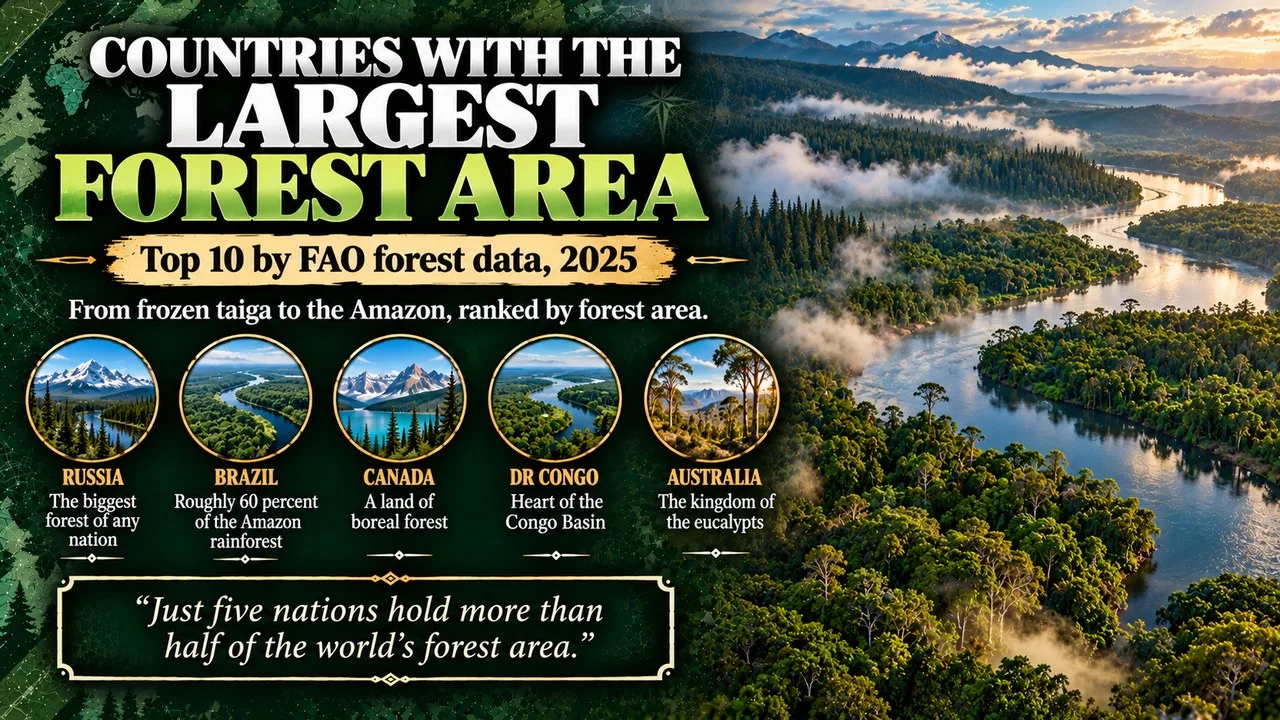
Countries with the largest forest area are led by Russia, Brazil and Canada, and just five nations hold more than half of the world's forest area.
This Finepedia guide, written in October 2026, ranks the 10 countries with the most forest, using the latest global survey by the Food and Agriculture Organization of the United Nations (FAO). Each entry gives the forest area, the main types of woodland and one detail that makes the country's forests special. For more about trees and woodland life, see the Finepedia guides Most Famous Trees in the World: Top 10 and Amazing Animals of the Amazon Rainforest: Top 10.
How We Chose These
Our figures come from the FAO Global Forest Resources Assessment 2025, which collects data reported by 236 countries and areas every five years. The FAO counts land as forest when it covers more than half a hectare, has trees taller than 5 m and a canopy over at least a tenth of the ground. Older surveys placed Australia ahead of DR Congo, so rankings can shift slightly between editions. The order follows the FAO figures as of October 2026.
The 10 Forest Countries at a Glance
| Rank | Country | Forest area (million ha) | Main forest type |
|---|---|---|---|
| 1 | Russia | 832.63 | boreal taiga |
| 2 | Brazil | 486.09 | tropical rainforest |
| 3 | Canada | 368.82 | boreal and temperate |
| 4 | United States | 308.90 | temperate and boreal |
| 5 | China | 227.15 | temperate, subtropical and planted |
| 6 | DR Congo | 139.19 | tropical rainforest |
| 7 | Australia | 133.56 | eucalyptus woodland |
| 8 | Indonesia | 95.97 | tropical rainforest and peat swamp |
| 9 | India | 72.74 | tropical dry, moist and mangrove |
| 10 | Peru | 67.16 | Amazon rainforest |
1. Russia Has the Biggest Forest of Any Nation
Russia has about 832.6 million hectares of forest, roughly one-fifth of the global total and more than any other nation. Most of it is taiga, a cold northern woodland of larch, pine, spruce and fir that stretches from the Baltic to the Pacific.
Key Facts
- Forest area: 832.63 million ha
- Share of world forest: about 20 percent
- Forest cover: around half of the country's land
- Most common tree: larch, which can survive on frozen ground
Did You Know?
Siberian and Dahurian larches are among the few conifers that shed their needles every autumn. This helps them survive winters that can fall below minus 50 °C, and it lets them grow on permafrost where few other trees can take root.
2. Brazil Contains Most of the Amazon
Brazil has about 486.1 million hectares of forest, the largest area of tropical forest in any country. Roughly 60 percent of the Amazon rainforest lies within its borders.
Key Facts
- Forest area: 486.09 million ha
- Forest cover: close to 60 percent of the land
- Other great forest: the Atlantic Forest along the coast
- Name: the country is named after brazilwood, a tree once prized for red dye
Why It Matters
The Brazilian Amazon stores vast amounts of carbon and shelters a huge share of the world's plant and animal species. Clearing for cattle pasture, soya and logging has made it a focus of global concern, although official figures show that the rate of clearing has fallen in recent years.
3. Canada Is a Land of Boreal Forest
Canada has about 368.8 million hectares of forest, much of it in a wide boreal belt that runs from Yukon to Newfoundland and Labrador. Spruce, fir, pine, birch and poplar dominate these northern woods.
Key Facts
- Forest area: 368.82 million ha
- Share of world forest: about 9 percent
- Ownership: most forest land is publicly owned by the provinces and territories
- National symbol: the maple leaf on the flag
Did You Know?
Canada produces around 70 percent of the world's maple syrup, most of it in Quebec. Sap is collected from sugar maples in early spring, and about 40 litres of sap are boiled down to make a single litre of syrup.
4. The United States Manages Huge National Forests
The United States has about 308.9 million hectares of forest, covering roughly a third of its land. Its woods range from Alaskan spruce and Pacific rainforests to the hardwood forests of the east and the pine woods of the south.
Key Facts
- Forest area: 308.90 million ha
- Forest cover: about one-third of the land
- Federal agency: the US Forest Service, created in 1905
- Largest national forest: Tongass in south-east Alaska, about 6.8 million ha
Why It Matters
America's national forests supply timber, clean water and outdoor recreation to millions of people each year. The Tongass is the largest temperate rainforest under protection in the country, and its old trees and salmon streams make it a key haven for brown bears and bald eagles.
5. China Has Planted More Forest Than Any Other Country
China has about 227.2 million hectares of forest, and a large part of it has been planted by people in recent decades. Its natural woods range from the cold forests of the north-east to the subtropical hills of the south.
Key Facts
- Forest area: 227.15 million ha
- Forest cover: close to a quarter of the land
- Planted forest: the largest area of any country
- Famous project: the Three-North Shelterbelt, begun in 1978
Did You Know?
The Three-North Shelterbelt, often called the Great Green Wall, aims to plant belts of trees across northern China to slow the spread of deserts and shield farms from dust storms. Scientists still debate how well some of the drier plantings survive, but China's forest area has grown steadily since the 1990s.
6. DR Congo Guards the Heart of the Congo Basin
The Democratic Republic of the Congo has about 139.2 million hectares of forest, more than any other country in Africa. Most of it belongs to the Congo Basin rainforest, the second-largest tropical forest on Earth after the Amazon.
Key Facts
- Forest area: 139.19 million ha
- Forest cover: more than half of the land
- Biggest reserve: Salonga National Park, a UNESCO site since 1984
- Rare residents: bonobos and okapis, both found in the wild only in this region
Why It Matters
The Congo Basin forests soak up large amounts of carbon and support millions of people who rely on them for food, fuel and medicine. Salonga, covering about 36,000 km², is Africa's largest protected tropical rainforest and one of the last strongholds of the bonobo.
7. Australia Is the Kingdom of the Eucalypts
Australia has about 133.6 million hectares of forest, much of it open woodland rather than dense jungle. Eucalypts, the gum trees that give the bush its scent, make up the great majority of its native forest.
Key Facts
- Forest area: 133.56 million ha
- Forest cover: about 17 percent of the land
- Main tree group: eucalypts, with more than 700 species
- Tallest species: the mountain ash of Victoria and Tasmania
Did You Know?
The mountain ash is the tallest flowering plant in the world, and a tree in Tasmania called Centurion stands about 100 m high. Many eucalypts depend on fire, with seeds that are released or sprout after bushfires sweep through.
8. Indonesia Has Vast Rainforests and Peat Swamps
Indonesia has about 96 million hectares of forest spread across thousands of islands, including Borneo, Sumatra and New Guinea. These forests are among the richest in the world for wildlife and plant life.
Key Facts
- Forest area: 95.97 million ha
- Share of world forest: about 2 percent
- Special habitat: peat swamp forests that store deep layers of carbon
- Famous residents: orangutans, found in the wild only on Borneo and Sumatra
Why It Matters
Indonesia's peatlands hold huge stores of carbon, so fires and drainage there can release large amounts of greenhouse gases. In 2017 scientists described a new great ape, the Tapanuli orangutan of northern Sumatra, which is now among the rarest apes on Earth.
9. India Grows Forests From Mangroves to Mountains
India has about 72.7 million hectares of forest, from Himalayan pines and oak woods to the evergreen jungles of the Western Ghats. Its forests also include dry teak woodlands and the coastal mangroves of the Sundarbans.
Key Facts
- Forest area: 72.74 million ha
- Forest cover: close to a quarter of the land
- Mangroves: the Sundarbans, shared with Bangladesh, form the largest mangrove forest on Earth
- Wildlife: home to most of the world's wild tigers
Did You Know?
In 1973, villagers in the Himalayan foothills of what is now Uttarakhand began the Chipko movement, hugging trees to stop them from being cut down. Many of its leaders were women, and the protest became one of the best-known examples of people defending their local forests.
10. Peru Is Mostly Amazon Rainforest
Peru has about 67.2 million hectares of forest, and the Amazon covers well over half of the country, east of the Andes. After Brazil, it holds the second-largest share of the Amazon rainforest.
Key Facts
- Forest area: 67.16 million ha
- Forest cover: more than half of the land
- Famous park: Manú National Park, a UNESCO site since 1987
- Cloud forests: misty woods on the Andean slopes facing the Amazon
Why It Matters
Manú is often named one of the most biodiverse places on the planet, with more than 1,000 bird species recorded in and around the park. Peru's forests also protect the headwaters of rivers that feed the Amazon, and many Indigenous communities live within them.
Frequently Asked Questions
Which country has the largest forest area in the world?
Russia has the largest forest area, with about 832.6 million hectares according to the FAO. That is roughly one-fifth of all the forest on Earth.
How much of the world is covered by forest?
Forests cover about 4.14 billion hectares, or nearly a third of the world's land. That equals roughly half a hectare of forest for every person on the planet.
Conclusion
From the frozen taiga of Russia to the Amazon rainforest of Brazil and Peru, the world's largest forest countries hold about two-thirds of all its woodland. Their choices about logging, farming and protection shape the future of the climate and of countless species. For more about trees and forests, read the Finepedia guides Most Famous Trees in the World: Top 10 and Amazing Animals of the Amazon Rainforest: Top 10.
- Food and Agriculture Organization of the United Nations, Global Forest Resources Assessment 2025, Key findings and Main report, fao.org (accessed October 2026).
- UNESCO World Heritage Centre, listings for Salonga National Park, Manú National Park and the Sundarbans.
- Wikipedia (accessed October 2026): List of countries by forest area, Taiga, Forests of Russia, Deforestation in Brazil, Forestry in Canada, Forests of Australia, Congo Rainforest, Deforestation in Indonesia, Peruvian Amazonia and Forestry in India.
- 10 Most Today, 10 Countries With the Largest Forest Area, 10mosttoday.com (topic reference).


























Discussion
Log in with