









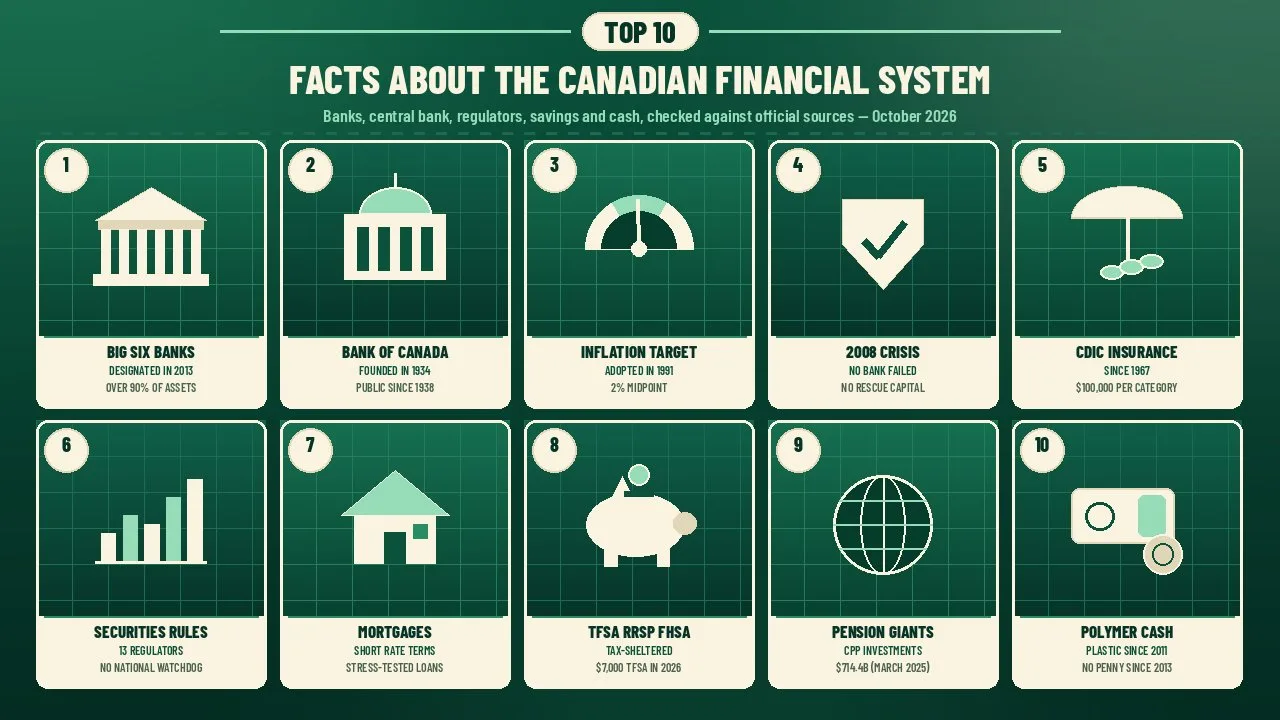
The Canadian financial system blends six dominant banks, a 1934 central bank, provincial securities rules and giant pension funds, as these ten facts show.
Canada is often held up as a quiet success story in global finance. Its banks came through the 2008 crisis without a single failure, its central bank helped popularise inflation targeting, and its public pension managers now invest across every continent. Yet the system also has unusual habits that surprise newcomers: there is no single national securities watchdog, mortgages renew every few years instead of locking in for decades, and the humble penny has been out of production since 2012.
This Finepedia guide, written as of October 2026, explains ten facts that define how money moves in Canada. Each one is drawn from official sources such as the Bank of Canada, the Office of the Superintendent of Financial Institutions (OSFI), the Canada Deposit Insurance Corporation (CDIC), the Canada Revenue Agency and the Supreme Court of Canada. Figures carry their reporting dates so readers can check whether a number has since moved.
How We Chose These Canadian Financial System Facts
We looked for facts that explain structure rather than trivia. A good entry had to tell a reader something about who holds power in the system, how risk is managed, or how ordinary households save, borrow and pay. Every number had to appear in an official publication or in reporting that cites one.
- Structure: who the big institutions are and how they are supervised.
- Safety nets: deposit insurance, crisis tools and capital rules.
- Household finance: mortgages, registered savings accounts and pensions.
- Everyday money: banknotes, coins and payment networks.
- Verifiability: each figure dated and listed under Sources.
Facts that could not be confirmed against at least one primary source were left out, including several colourful claims that circulate on older listicles without any traceable origin.
Canadian Financial System Facts at a Glance
| # | Fact | Key number or date | Main source |
|---|---|---|---|
| 1 | Six banks dominate | 6 domestic systemically important banks (D-SIBs) | OSFI |
| 2 | Central bank began privately owned | Act passed 1934, opened 1935, nationalised 1938 | Bank of Canada |
| 3 | Early inflation targeter | 2 per cent target since 1991 | Bank of Canada |
| 4 | No bank failed in 2008 | Mortgage purchase program up to C$125 billion | Bank of Canada, Government of Canada |
| 5 | Deposit insurance since 1967 | C$100,000 per eligible category | CDIC |
| 6 | No single securities regulator | 2011 Supreme Court reference | Supreme Court of Canada |
| 7 | Mortgages run on short terms | Insurance required under 20 per cent down | Department of Finance, OSFI |
| 8 | Tax-sheltered savings menu | TFSA C$7,000 limit for 2026 | Canada Revenue Agency |
| 9 | Pension funds are global giants | CPP Investments C$714.4 billion (31 Mar 2025) | CPP Investments |
| 10 | Plastic money, no penny | Polymer notes from 2011; penny distribution ended 2013 | Bank of Canada, Government of Canada |
If you are new to the country itself, start with Canada: A Comprehensive Overview of Its Geography and Culture. Readers interested in money history may also enjoy Most Profitable Investments in History: Top 10, Warren Buffett: The Sage of Omaha and Value Investing Pioneer and Ways Smart Travelers Save Money Abroad: Top 10.
1. Six Big Banks Anchor the System
| Attribute | Details |
|---|---|
| Institutions | Royal Bank of Canada, Toronto-Dominion Bank, Bank of Nova Scotia, Bank of Montreal, Canadian Imperial Bank of Commerce, National Bank of Canada |
| Official label | Domestic systemically important banks (D-SIBs), designated by OSFI in March 2013 |
| Share of assets | Over 90 per cent of Canadian banking assets at the time of designation |
| Global status | RBC and TD are also counted as global systemically important banks |
| Extra capital | A 1 per cent common equity surcharge applied from January 2016 |
When Canadians talk about the banks, they usually mean six names. Together these institutions run most branch networks, payroll accounts, credit cards, mortgages and brokerage arms in the country. OSFI, the federal banking supervisor, formally recognised that weight in 2013 by naming all six as domestic systemically important banks, meaning a failure at any one of them could seriously damage the wider economy.
Origins and History
Canada's banking model grew out of federal control over banking, which the Constitution Act, 1867 gave to Parliament. Instead of thousands of small local banks, as happened in the United States, Canada developed a few nationally chartered banks with branches from coast to coast. Over the twentieth century, mergers and acquisitions of trust companies and investment dealers concentrated the industry further, producing the six-bank structure seen today.
Key Features
- National branch networks rather than state or regional charters
- Universal banking: retail, commercial, wealth and capital markets under one roof
- Federal supervision by OSFI with stricter capital buffers for the largest six
- Large operations in the United States and the Caribbean for several of the group
- A credit union and cooperative sector, led by Desjardins in Quebec, as the main domestic alternative
Significance
Concentration cuts both ways. Supporters argue that large, diversified banks with national deposit bases are harder to topple and easier to supervise. Critics point to limited competition, similar fee structures and slower adoption of some consumer-friendly features. Both views help explain why policy debates in Ottawa so often focus on open banking, account switching and fees.
For households, the practical effect is familiarity. A worker moving from Halifax to Vancouver can usually keep the same bank, card and online login, something that is far less certain in countries with fragmented regional banking.
Interesting Facts
- OSFI judged systemic importance on size, interconnectedness and how hard each bank would be to replace in payments and markets.
- On top of the 1 per cent surcharge, OSFI sets a separate Domestic Stability Buffer for the six that it adjusts as risks change.
- Desjardins traces its roots to a savings and credit cooperative founded in Lévis, Quebec, in 1900.
- Two of the six, RBC and TD, sit on the Financial Stability Board's global list of systemically important banks.
2. The Bank of Canada Started Life Privately Owned
| Attribute | Details |
|---|---|
| Founding law | Bank of Canada Act, royal assent 3 July 1934 |
| Opened | March 1935, with shares sold to the public |
| Nationalised | Fully publicly owned from 1938 |
| First governor | Graham F. Towers, aged 37 at appointment |
| Head office | 234 Wellington Street, Ottawa |
Canada was relatively late to create a central bank. Before the 1930s, chartered banks issued their own notes and the federal Department of Finance handled many monetary tasks. The Great Depression changed that. A royal commission recommended a central bank, Parliament passed the Bank of Canada Act in 1934, and the new institution opened for business in March 1935.
Origins and History
The surprising detail is that the first Bank of Canada was owned by private shareholders. Shares were sold to the public, much as with an ordinary company. A new government soon amended the law, and by 1938 the bank was entirely owned by the federal government, which it remains today. That same year the bank moved into its purpose-built head office on Wellington Street, and the public debt work transferred from the Department of Finance finally came under its roof.
Key Features
- Sole issuer of Canadian banknotes
- Sets the policy interest rate to steer inflation
- Acts as fiscal agent and banker to the federal government
- Oversees major payment systems and supports financial stability
- Governed by a board but operationally independent on monetary policy
Significance
The preamble of the Bank of Canada Act has never changed. The bank still describes its purpose as acting "to regulate credit and currency in the best interests of the economic life of the nation." That wording links a Depression-era rescue project to a modern inflation-targeting central bank, and it reminds readers that monetary policy in Canada is a public trust rather than a private business.
Its early private ownership also matters as history. It shows that central banking can be designed in different ways, and that Canada experimented before settling on full public ownership.
Interesting Facts
- Graham Towers, the first governor, came from the Royal Bank of Canada and had wide international experience.
- The bank's original Wellington Street building, completed in 1938, was later flanked by glass towers and an indoor garden court.
- Private chartered banks gradually lost the right to issue their own banknotes after the central bank took over.
- The Bank of Canada Museum in Ottawa displays historical notes, coins and monetary artefacts.
3. Canada Was an Early Inflation Targeter
| Attribute | Details |
|---|---|
| Adopted | 1991, jointly by the Bank of Canada and the Government of Canada |
| Target | 2 per cent total CPI inflation, midpoint of a 1 to 3 per cent range |
| Renewal | Renewed several times; the December 2021 agreement runs to the end of 2026 |
| Policy horizon | Usually six to eight quarters for rate changes to take full effect |
| Notable move | First G7 central bank to cut rates in the 2024 easing cycle (5 June 2024) |
Inflation targeting is now normal for central banks around the world, but Canada was one of the first to adopt it. In 1991, after years of stubborn inflation in the 1970s and 1980s, the Bank of Canada and the federal government agreed on explicit numerical targets. Since the mid-1990s that target has centred on 2 per cent.
Origins and History
New Zealand pioneered formal inflation targets at the start of the 1990s, and Canada followed closely. The arrangement is set out in a joint agreement between the bank and the government that is reviewed roughly every five years. Each review has examined alternatives, such as price-level targeting or a dual mandate with employment, before deciding whether to keep the framework.
Key Features
- A public, numerical target that anyone can check against monthly CPI data
- A tolerance band of 1 to 3 per cent around the 2 per cent midpoint
- Eight fixed policy rate announcement dates each year
- Quarterly Monetary Policy Reports explaining forecasts and risks
- A five-year renewal cycle that allows periodic rethinking
Significance
A clear target anchors expectations. When workers, firms and lenders believe inflation will average near 2 per cent, wage deals and loan contracts stay more predictable. The framework faced its toughest test in 2022, when inflation rose far above the band after the pandemic and supply shocks. The bank responded with rapid rate hikes and then, once inflation eased, became the first G7 central bank to start cutting, with a 25 basis point reduction to 4.75 per cent on 5 June 2024.
Because the 2021 agreement covers the five years to the end of 2026, the next renewal is a live topic as this article is written, so readers should check the bank's site for the latest framework.
Interesting Facts
- The bank adjusts its policy rate to bring inflation back to target typically within six to eight quarters.
- The 2021 renewal kept the 2 per cent target but said the bank would also consider maximum sustainable employment.
- Core inflation measures are published alongside headline CPI to help separate temporary price swings from lasting trends.
- Rate announcements are made at 9:45 a.m. Eastern time on scheduled dates.
4. No Canadian Bank Failed in the 2008 Crisis
| Attribute | Details |
|---|---|
| Outcome | No Canadian bank failed or received a direct government capital injection |
| International view | The World Economic Forum ranked Canada's banking system the soundest in the world |
| Main support tool | Insured Mortgage Purchase Program, expanded to up to C$125 billion |
| Amount used | About C$69 billion of that capacity was taken up |
| Lessons cited | Strong capital, conservative mortgage rules and active supervision |
While banks in the United States and Europe needed rescues in 2008 and 2009, Canada's lenders came through without a failure. That record turned the country's banking model into a talking point at international summits, and Canadian officials took prominent roles in post-crisis reform at the Financial Stability Board and the Basel Committee.
Origins and History
Canadian banks entered the crisis with relatively high capital and limited exposure to the riskiest subprime securities. Mortgage lending was already tightly linked to government-backed insurance, and lenders kept many loans on their own books. Even so, funding markets froze worldwide, so Ottawa stepped in with liquidity support rather than bailouts. Through the Canada Mortgage and Housing Corporation (CMHC), the government bought pools of insured mortgages from lenders, giving them cash to keep lending.
Key Features
- No direct equity stakes taken by government in any major bank
- Liquidity support through purchases of already insured mortgages
- Bank of Canada emergency lending facilities for short-term funding
- Stricter capital rules and leverage limits than many peers before the crisis
- A small number of large, closely supervised institutions
Significance
The 2008 record is part of the system's reputation, but it should be read precisely. Canada did not sail through without help: the mortgage purchase program and central bank facilities were real interventions. The difference was that support took the form of liquidity against insured assets, not capital injections to save failing firms. That distinction is why the episode is still studied by regulators abroad.
Interesting Facts
- The World Economic Forum's competitiveness surveys rated Canada's banks the soundest in the world in the years after the crisis.
- Lenders used roughly 55 per cent of the C$125 billion mortgage purchase capacity.
- Canadian mortgages are full recourse in most provinces, so borrowers cannot simply hand back the keys and walk away from the debt.
- Mark Carney, Bank of Canada governor during the crisis, went on to chair the Financial Stability Board while still in that role.
5. Deposit Insurance Has Protected Savers Since 1967
| Attribute | Details |
|---|---|
| Insurer | Canada Deposit Insurance Corporation (CDIC), a federal Crown corporation |
| Created | 1967, by an Act of Parliament |
| Coverage | Up to C$100,000 per eligible category, including principal and interest |
| Eligible products | Savings and chequing accounts, GICs and other term deposits, in Canadian or foreign currency |
| Track record | 43 member failures resolved; no one has lost a dollar of insured deposits |
Every major Canadian bank account comes with a quiet guarantee. The CDIC insures eligible deposits at its member institutions, so if a member fails, insured savers are repaid. It is funded by premiums paid by member institutions rather than by general tax revenue.
Origins and History
Parliament created CDIC in 1967 after a period of turmoil among smaller trust and loan companies shook depositor confidence. Since then, the corporation has handled 43 member failures, affecting about two million depositors, most of them in the 1980s and early 1990s when several trust companies and smaller banks collapsed. According to CDIC, no depositor has ever lost a dollar of insured money.
Key Features
- Separate C$100,000 limits for categories such as single-name deposits, joint deposits, RRSPs, TFSAs, FHSAs and RRIFs
- Foreign-currency deposits are eligible as well as Canadian dollars
- Automatic coverage, with no application needed
- Products such as mutual funds, stocks, bonds, ETFs and cryptocurrencies are not covered
- Provincially regulated credit unions are protected by separate provincial deposit insurers
Significance
Because limits apply per category, a household can hold well over C$100,000 of insured savings at one bank by spreading money across eligible account types. That design encourages savers to keep money in the banking system and reduces the risk of panicked withdrawals during a scare. For readers comparing countries, it is worth noting that coverage rules differ: some provincial credit union insurers guarantee far higher amounts or even unlimited deposits.
Interesting Facts
- Coverage is automatic at member institutions; savers do not need to buy it.
- Joint accounts and registered accounts each have their own separate C$100,000 limit.
- Deposits paid in through payroll, cheques or Interac e-Transfer are eligible like any other deposit.
- CDIC also has resolution powers to help wind down or restructure a failing bank in an orderly way.
6. There Is No Single National Securities Regulator
| Attribute | Details |
|---|---|
| Who regulates | Provincial and territorial securities commissions |
| Coordination | Canadian Securities Administrators (CSA), an umbrella of all 13 regulators |
| Key court ruling | Reference re Securities Act, 2011 SCC 66, rejected a federal takeover |
| Follow-up ruling | 2018 SCC 48 upheld a voluntary cooperative system |
| Industry watchdog | Canadian Investment Regulatory Organization (CIRO), named in June 2023 |
Canada is unusual among large economies because it has no single national stock market regulator. Each province and territory runs its own securities commission. The Ontario Securities Commission, home regulator for the Toronto Stock Exchange, is the largest, but a public company or investment dealer often has to deal with several regulators at once.
Origins and History
Under the Constitution, property and civil rights fall to the provinces, and courts have long treated securities regulation as part of that. In 2011, the federal government asked the Supreme Court of Canada whether Parliament could create a single national regulator. The court said no, because the proposed law would have taken over day-to-day regulation that belongs to the provinces. It added that a cooperative approach could work. In 2018, the court approved such a cooperative design, but stressed that each province must decide for itself whether to join.
Key Features
- Thirteen provincial and territorial regulators coordinated through the CSA
- A passport system that lets firms rely mainly on their home regulator
- Harmonised national instruments on disclosure, registration and trading
- CIRO, created by amalgamating the former IIROC and MFDA in 2023, oversees investment dealers and mutual fund dealers
- Federal involvement focused on systemic risk rather than daily oversight
Significance
The patchwork rarely shows up for ordinary investors, because most rules are harmonised. It matters more for companies raising money, cross-border dealers and enforcement cases that span provinces. The debate over a national regulator has not fully disappeared, and international bodies such as the IMF have repeatedly encouraged closer integration.
Interesting Facts
- The Toronto Stock Exchange traces its roots to an association of brokers formed in 1852 and was incorporated in 1878.
- The 2018 cooperative system was backed by Ontario, British Columbia, Saskatchewan, New Brunswick, Prince Edward Island and Yukon, along with the federal government.
- CIRO first operated under the placeholder name New Self-Regulatory Organization of Canada before adopting its current name on 1 June 2023.
- Quebec's securities work is handled by the Autorité des marchés financiers, which also supervises insurers and credit unions in that province.
7. Canadian Mortgages Renew on Short Terms
| Attribute | Details |
|---|---|
| Default insurance | Required when the down payment is below 20 per cent |
| Insured price cap | Homes under C$1.5 million (from 15 December 2024) |
| Minimum down payment | 5 per cent on the first C$500,000, 10 per cent on the rest |
| Stress test | Qualify at the higher of contract rate plus 2 points or 5.25 per cent |
| Longer amortisation | 30 years for insured loans to first-time buyers or new builds |
A Canadian mortgage looks different from the 30-year fixed loan many Americans know. The total repayment period, called the amortisation, is often 25 years, but the interest rate is usually locked only for a shorter term, commonly a few years. At the end of each term, borrowers renew at whatever rates the market offers, which makes households sensitive to changes in Bank of Canada policy.
Origins and History
Canada's mortgage market has long relied on government-backed default insurance. CMHC, created at the end of the Second World War to help house returning veterans, still insures many high-ratio loans, alongside private insurers. After the 2008 crisis, Ottawa tightened insured lending several times, then OSFI applied a minimum qualifying rate, the so-called stress test, to uninsured mortgages at federally regulated lenders. In late 2024, the government loosened some rules to help first-time buyers, raising the insured price cap and allowing 30-year amortisation for eligible borrowers.
Key Features
- Interest is fixed or variable for a term, then renewed or renegotiated
- Default insurance premiums are added to the loan when the down payment is under 20 per cent
- Borrowers must pass a stress test at a higher qualifying rate
- Prepayment penalties apply if a closed mortgage is broken early
- Mortgage interest on a principal home is generally not tax deductible
Significance
Short terms spread interest rate risk to households instead of leaving it with lenders. That makes the system more responsive to policy rate changes, for better and worse. When rates rose sharply in 2022 and 2023, many families faced much higher payments at renewal, and renewals remain a closely watched risk in Bank of Canada financial stability reports.
Interesting Facts
- An insured high-ratio mortgage requires premium payments that are usually rolled into the loan balance.
- The minimum qualifying rate applies whether a borrower picks a fixed or variable rate.
- Unlike in the United States, homeowners in Canada usually cannot deduct mortgage interest on their own home from income tax.
- The 5.25 per cent floor means borrowers must prove they could afford payments even if rates rose.
8. Registered Accounts Shape How Canadians Save
| Attribute | Details |
|---|---|
| RRSP | Registered Retirement Savings Plan, introduced in 1957 |
| TFSA | Tax-Free Savings Account, launched 2009; C$7,000 annual limit in 2026 |
| TFSA cumulative room | C$109,000 for someone eligible since 2009 and never contributed |
| FHSA | First Home Savings Account, available since 1 April 2023 |
| FHSA limits | C$8,000 a year, C$40,000 lifetime, within 15 years of opening |
Canadian personal finance revolves around acronyms. The three most important are the RRSP, the TFSA and the newer FHSA, each offering a different tax deal. Choosing between them is one of the first money decisions young Canadians face.
Origins and History
The RRSP arrived in 1957, before the Canada and Quebec Pension Plans existed, to encourage private retirement saving with tax deductions. The TFSA followed in 2009 with the reverse design: contributions are not deductible, but growth and withdrawals are tax-free. The FHSA, launched in 2023, combines both ideas for first-time home buyers, offering deductible contributions and tax-free qualifying withdrawals.
Key Features
- RRSP: contributions deductible, withdrawals taxed as income
- TFSA: no deduction, tax-free growth and withdrawals, room returned the following year
- FHSA: deductible going in, tax-free coming out for a first home
- Unused TFSA room carries forward indefinitely
- RRSP Home Buyers' Plan allows withdrawals of up to C$35,000 for a first home
Significance
These accounts shape what banks sell and how Canadians invest. Many savers hold GICs, ETFs or mutual funds inside a TFSA, and contribution season for RRSPs drives a burst of marketing every winter. The TFSA's annual limit has varied over time, from C$5,000 in 2009 to a one-off C$10,000 in 2015, and C$7,000 for 2024, 2025 and 2026.
Interesting Facts
- TFSA room accumulates from age 18 for Canadian residents even if they never open an account.
- Withdrawals from a TFSA are added back as new room on 1 January of the following year.
- The FHSA can be combined with the RRSP Home Buyers' Plan for the same purchase.
- CDIC counts RRSPs, TFSAs and FHSAs as separate deposit insurance categories.
9. Pension Funds Are Global Heavyweights
| Attribute | Details |
|---|---|
| Largest fund | CPP Investments, manager of the Canada Pension Plan Fund |
| Net assets | C$714.4 billion at 31 March 2025 |
| Fiscal 2025 result | Net income of C$59.8 billion; one-year net return 9.3 per cent |
| Long-run return | 10-year net return of 8.3 per cent |
| Members served | More than 22 million contributors and beneficiaries |
Canada's public pension managers are among the most influential investors anywhere. They own airports, toll roads, office towers, private companies and stakes in listed firms across the world. Industry observers group the largest of them as the Maple 8, and their approach is often called the Canadian model.
Origins and History
The Canada Pension Plan began in 1966, but for decades its money sat mostly in government bonds. Reforms in the late 1990s created an independent investment board operating at arm's length from governments, with a professional board and a mandate to maximise returns without undue risk of loss. Other large plans, covering teachers, public servants and Quebec workers, adopted similar governance and in-house investment teams.
Key Features
- Independent boards with professional investment staff
- Large in-house teams instead of relying only on outside managers
- Heavy use of private equity, infrastructure, real estate and private credit
- Long time horizons matching pension liabilities
- Offices abroad, including Hong Kong, London, Mumbai, New York, San Francisco, São Paulo and Sydney for CPP Investments
Significance
The Canadian model shows how a mid-sized economy can build world-scale capital pools. Returns help keep contribution rates stable, and the funds' size lets them negotiate directly for large deals. Critics question fees, transparency on private assets and whether foreign holdings should be balanced with more domestic investment, a debate that has grown louder in Canada since 2024.
Interesting Facts
- Roughly three quarters of CPP Investments' assets, about C$492 billion, came from investment income rather than contributions.
- CPP Investments says it is on track to reach C$1 trillion by 2031.
- The fund separates base CPP and additional CPP accounts, which have different risk profiles.
- A May 2025 Global SWF report placed CPP Investments second among national pension funds on 10-year calendar returns.
10. Canadian Cash Is Plastic and the Penny Is Gone
| Attribute | Details |
|---|---|
| Polymer notes | First polymer note, the C$100, issued 14 November 2011 |
| Full series | C$50 in 2012, C$20 in 2012, C$5 and C$10 on 7 November 2013 |
| Coins | Loonie (C$1) introduced 1987; toonie (C$2) in 1996 |
| Penny | Last struck 4 May 2012; distribution ended 4 February 2013 |
| Debit network | Interac, operating since 1984 |
Canadian cash is distinctive in the hand. Banknotes are printed on polymer, a thin plastic film with clear windows and metallic security features, and the smallest coin in daily use is the nickel. Most payments, though, are electronic, carried on Interac debit, credit cards and Interac e-Transfer.
Origins and History
The Bank of Canada moved to polymer to fight counterfeiting and to make notes last longer. The C$100 note led the Frontier series in 2011, with the smaller denominations following by late 2013. The Royal Canadian Mint struck its last penny in Winnipeg on 4 May 2012 and stopped distributing them on 4 February 2013. Since then, cash totals are rounded to the nearest five cents, while card and electronic payments still settle to the exact cent.
Key Features
- Polymer notes with transparent windows, holograms and raised ink
- Symmetric rounding of cash totals: 1, 2, 6 and 7 cents round down; 3, 4, 8 and 9 round up
- Pennies remain legal tender and keep their value indefinitely
- Interac Debit and Interac e-Transfer as domestic payment rails
- A vertical C$10 note honouring civil rights pioneer Viola Desmond, issued in 2018
Significance
Plastic money and the end of the penny are small details with practical effects. Rounding applies only to the final cash total after taxes, so shoppers paying by card see no change. Interac's reach is large: the company reports that 88 per cent of Canadians have used Interac e-Transfer and that Canadians completed more than 6.5 billion Interac Debit transactions in the year to October 2023.
Interesting Facts
- The government announced on 16 December 2024 that Terry Fox will appear on a future C$5 note.
- A new vertical C$20 polymer note featuring King Charles III is in development.
- The loonie gets its nickname from the common loon on its reverse side.
- Canada was not the first country to drop its one-cent coin; Australia and New Zealand had done so earlier.
Honourable Mentions
- The Toronto Stock Exchange, founded as an association of brokers in 1852, is part of TMX Group and lists a large share of the world's mining companies.
- Desjardins, born as a single caisse populaire in Lévis in 1900, has grown into one of Canada's largest financial groups.
- Canada's Consumer-Driven Banking framework, the federal name for open banking, aims to let customers share their financial data securely with approved apps.
- The Financial Consumer Agency of Canada supervises how federally regulated banks treat customers and publishes free guides on mortgages and fees.
Comparison: Canada and the United States
| Feature | Canada | United States |
|---|---|---|
| Bank structure | Six national banks dominate | Thousands of banks, many regional or community |
| Securities regulation | Provincial and territorial commissions | Single federal regulator (SEC) plus states |
| Typical mortgage | Shorter rate term, renewed; 25-year amortisation common | 30-year fixed common |
| Mortgage interest on home | Generally not tax deductible | Deductible for many itemisers |
| Deposit insurance limit | C$100,000 per category (CDIC) | US$250,000 per depositor, per bank, per ownership category (FDIC) |
| Smallest coin in everyday use | Nickel (5 cents) | Penny (1 cent) still circulates |
Frequently Asked Questions
What are the Big Six banks in the Canadian financial system?
They are the Royal Bank of Canada, Toronto-Dominion Bank, Bank of Nova Scotia, Bank of Montreal, Canadian Imperial Bank of Commerce and National Bank of Canada. OSFI designated all six as domestic systemically important banks in 2013, so they face extra capital requirements and closer supervision.
Is the Bank of Canada owned by the government?
Yes. The Bank of Canada opened in 1935 with private shareholders, but the government changed the law and the bank has been fully publicly owned since 1938. It remains operationally independent when it sets the policy interest rate to meet its inflation target.
How much does CDIC insure?
CDIC insures up to C$100,000 per eligible category at each member institution, including principal and interest. Categories include deposits in one name, joint deposits and registered accounts such as RRSPs, TFSAs and FHSAs, so total protection can exceed C$100,000.
Why does Canada not have a national securities regulator?
The Constitution gives provinces authority over property and civil rights, which courts link to securities regulation. In 2011 the Supreme Court rejected a federal plan for a single regulator. A voluntary cooperative model was approved in 2018, but each province chooses whether to participate.
Did Canadian banks get bailed out in 2008?
No Canadian bank failed or received a direct capital injection. The government did support funding markets by buying insured mortgages through CMHC under a program of up to C$125 billion, and the Bank of Canada offered emergency liquidity. That support was liquidity, not rescue capital.
What is the TFSA limit for 2026?
The TFSA dollar limit for 2026 is C$7,000. Unused room carries forward, so someone who has been 18 or older and a Canadian resident since 2009, and has never contributed, would have C$109,000 of total room at the start of 2026.
Can you still use pennies in Canada?
Yes. Pennies keep their value and remain legal tender, but the Mint stopped distributing them on 4 February 2013. Businesses round cash totals to the nearest five cents, while card, debit and cheque payments still settle to the exact cent.
Conclusion
The Canadian financial system is built on a handful of strong institutions and a set of rules that favour caution. Six banks carry most of the load, a publicly owned central bank targets 2 per cent inflation, deposit insurance and mortgage insurance cushion households, and giant pension funds invest the country's retirement savings around the world. At the same time, its quirks, from provincial securities regulators to short mortgage terms and penny-free cash, make it unlike its southern neighbour.
For anyone moving to Canada, investing there or simply curious about how money works in another country, these ten facts are a practical starting map. Rules change quickly, especially limits on registered accounts and mortgage policy, so check the official sources below before making financial decisions.
- Bank of Canada, history of the Bank: https://www.bankofcanada.ca/about/history/
- Bank of Canada, inflation-control target: https://www.bankofcanada.ca/rates/indicators/key-variables/inflation-control-target/
- Bank of Canada, rate cut press release, 5 June 2024: https://www.bankofcanada.ca/2024/06/fad-press-release-2024-06-05/
- Bank of Canada, Looking Back, Moving Forward: Canada and Global Financial Reform (2010): https://www.bankofcanada.ca/2010/11/looking-back-moving-forward/
- OSFI, systemically important banks: https://www.osfi-bsif.gc.ca/en/supervision/financial-institutions/banks/systemically-important-banks
- Government of Canada, additional support for Canadian credit markets (2008): https://www.canada.ca/en/news/archive/2008/11/government-canada-announces-additional-support-canadian-credit-markets.html
- CDIC, what is covered: https://www.cdic.ca/your-coverage/whats-covered/
- CDIC, our history: https://www.cdic.ca/about/our-history/
- Supreme Court of Canada, Reference re Securities Act, 2011 SCC 66: https://decisions.scc-csc.ca/scc-csc/scc-csc/en/7984/1/document.do
- Supreme Court of Canada, Reference re Pan-Canadian Securities Regulation (2018) case brief: https://www.scc-csc.ca/judgments-jugements/cb/2018/37613/
- Ontario Securities Commission, Canadian Investment Regulatory Organization: https://www.osc.ca/en/industry/market-regulation/self-regulatory-organizations-sro/canadian-investment-regulatory-organization-ciro
- Department of Finance Canada, mortgage reform details (September 2024): https://www.canada.ca/en/department-finance/news/2024/09/government-announces-mortgage-reform-details-to-ensure-canadians-can-access-lower-monthly-mortgage-payments-by-december-15.html
- OSFI, minimum qualifying rate for uninsured mortgages: https://www.osfi-bsif.gc.ca/en/supervision/financial-institutions/banks/minimum-qualifying-rate-uninsured-mortgages
- Canada Revenue Agency, TFSA and registered plan limits: https://www.canada.ca/en/revenue-agency/services/tax/registered-plans-administrators/pspa/mp-rrsp-dpsp-tfsa-limits-ympe.html
- Department of Finance Canada, First Home Savings Account (2023): https://www.canada.ca/en/department-finance/news/2023/08/canadians-can-save-for-their-first-home-with-new-tax-free-first-home-savings-account.html
- CPP Investments, Fiscal 2025 Annual Report: https://www.cppinvestments.com/wp-content/uploads/attachments/CPP-Investments-F2025-Annual-Report-English.pdf
- Bank of Canada, first Canadian polymer bank note (2011): https://www.bankofcanada.ca/2011/11/bank-canada-issues-100-bill-first-canadian-polymer-bank-note
- Government of Canada, farewell to the Canadian penny (2013): https://www.canada.ca/en/news/archive/2013/02/government-canada-royal-canadian-mint-bid-farewell-canadian-penny.html
- Interac, about the company: https://www.interac.ca/en/about/our-company/
- TMX Group historical timeline: https://investors.tmx.com/About-Us/historical-timeline/
- Topic prompt only (not copied): https://10mosttoday.com/10-interesting-facts-about-the-canadian-financial-system/
















Log in with