









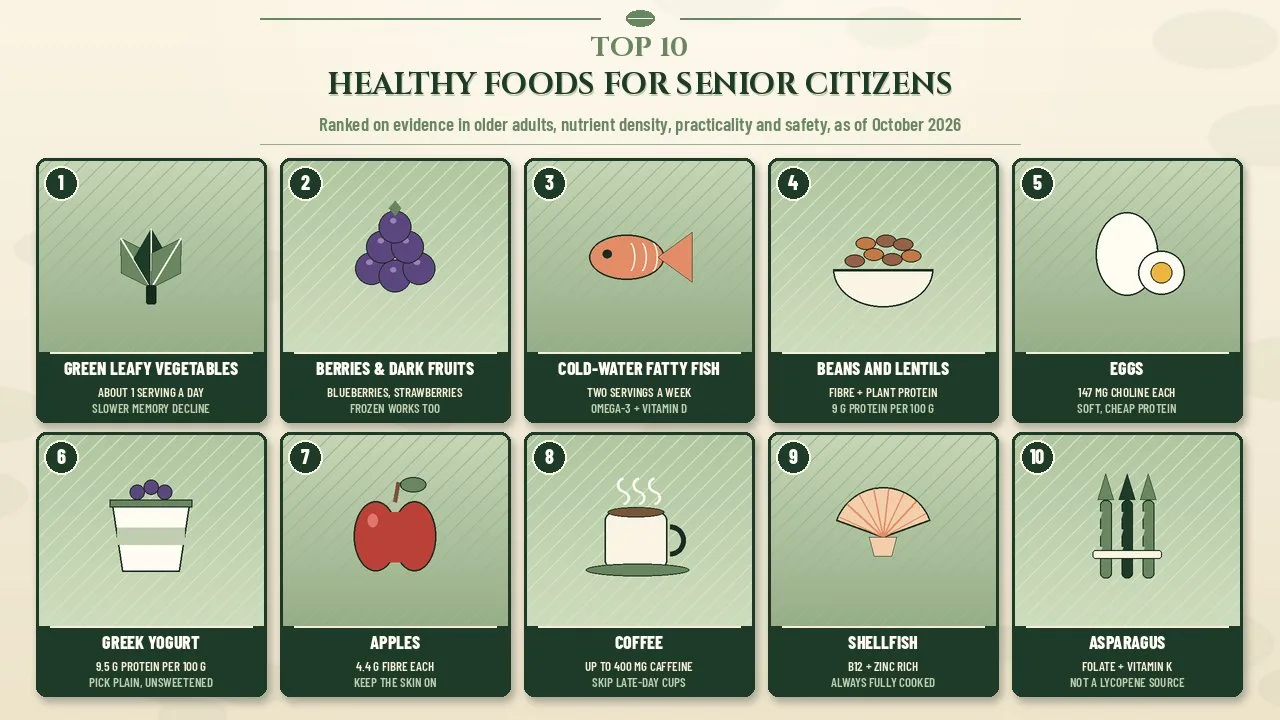
These healthy foods for senior citizens support memory, muscle, bones and heart health, ranked by research in older adults, nutrients and practicality.
Appetite, chewing, digestion and medication lists all change with age, yet the body's need for protein, vitamin B12, calcium, vitamin D and fibre stays high or even rises. That gap is why nutrition researchers talk about nutrient density for older adults: getting more nourishment from every bite, often from smaller meals. No single food cures a disease or prevents dementia on its own, but certain everyday foods keep appearing in long-running studies of older people and in the eating patterns that public health bodies recommend.
This Finepedia ranking, written as of October 2026, picks ten foods that are well studied, widely available and realistic for a later-life kitchen. It adapts a familiar list of senior-friendly foods but replaces one weakly supported entry, corrects a common nutrient myth about asparagus, and adds safety notes that many round-ups leave out. It is general education, not medical advice. Anyone managing a health condition, a special diet or prescription medicines should check changes with a doctor, pharmacist or registered dietitian.
How We Ranked the Healthy Foods for Senior Citizens
Each food was scored from 1 to 5 on four criteria, for a total out of 20. Scores are Finepedia's editorial judgement, applied with the same definitions to every entry and checked against reputable sources such as the U.S. National Institutes of Health Office of Dietary Supplements (NIH ODS), USDA FoodData Central, Harvard T.H. Chan School of Public Health, the World Health Organization, the American Heart Association, Mayo Clinic, CDC and peer-reviewed journals.
- Evidence in older adults (1 to 5): how directly studies of people over about 60 link the food, or its key nutrients, to outcomes that matter in ageing, such as cognitive decline, bone strength, muscle mass, heart health or survival. Large prospective cohorts and randomised trials score higher than single small studies.
- Nutrient density (1 to 5): how much of the nutrients older adults commonly fall short on, including protein, vitamin B12, vitamin D, calcium, folate, potassium and fibre, the food supplies per typical serving relative to its calories.
- Practicality (1 to 5): price, year-round availability, ease of chewing and swallowing, shelf life and how little cooking it needs.
- Safety profile (1 to 5): how few cautions apply for typical older adults, such as drug interactions, food-poisoning risk, allergens, mercury, added sugar or caffeine sensitivity.
When totals tie, higher Evidence ranks first, then Nutrient density. Foods are judged as part of a varied diet, not as stand-alone remedies.
The Scorecard
| Rank | Food | Evidence | Nutrients | Practicality | Safety | Total |
|---|---|---|---|---|---|---|
| 1 | Green Leafy Vegetables | 5 | 5 | 4 | 4 | 18 |
| 2 | Berries and Dark-Skinned Fruits | 4 | 4 | 5 | 5 | 18 |
| 3 | Cold-Water Fatty Fish | 5 | 5 | 3 | 4 | 17 |
| 4 | Beans and Lentils | 3 | 5 | 5 | 4 | 17 |
| 5 | Eggs | 3 | 4 | 5 | 4 | 16 |
| 6 | Greek Yogurt | 3 | 4 | 4 | 4 | 15 |
| 7 | Apples | 2 | 3 | 5 | 4 | 14 |
| 8 | Coffee | 4 | 1 | 5 | 3 | 13 |
| 9 | Shellfish | 2 | 5 | 2 | 3 | 12 |
| 10 | Asparagus | 1 | 4 | 3 | 4 | 12 |
Dark chocolate appears on many older lists of senior superfoods. It was moved to the Honourable Mentions here because the strongest evidence comes from a purified cocoa-flavanol supplement rather than chocolate bars, which also carry sugar, fat and calories. Beans and lentils took its place because dietary guidelines, the MIND eating pattern and a multinational study of people over 70 all support them.
Healthy Foods for Seniors at a Glance
| Rank | Food | Standout nutrients | Main benefit studied in older adults | Key caution |
|---|---|---|---|---|
| 1 | Green leafy vegetables | Vitamin K, folate, lutein, nitrate | Slower cognitive decline in a Rush University cohort | Keep intake steady if taking warfarin |
| 2 | Berries and dark-skinned fruits | Anthocyanins, vitamin C, fibre | Slower cognitive ageing in the Nurses' Health Study | Watch sugar in juices and jams |
| 3 | Cold-water fatty fish | EPA and DHA omega-3s, vitamin D, protein | Heart health; AHA advises fish twice a week | Choose lower-mercury species |
| 4 | Beans and lentils | Plant protein, fibre, folate, potassium | Longer survival in a study of people 70 and over | Increase slowly to limit gas |
| 5 | Eggs | Protein, choline, lutein, vitamin B12 | Soft, cheap protein for muscle maintenance | Cook until firm; cholesterol limits for some |
| 6 | Greek yogurt | Protein, calcium, live cultures | Protein and calcium for muscle and bone | Pick plain, unsweetened tubs |
| 7 | Apples | Soluble fibre, vitamin C, polyphenols | Fibre for digestion and cholesterol | Hard skins may need slicing |
| 8 | Coffee | Caffeine, polyphenols | Lower risk of several chronic diseases in cohorts | Sleep, blood pressure, reflux |
| 9 | Shellfish | Vitamin B12, zinc, iron, selenium | Helps cover B12, which absorbs less well with age | Never eat raw if at higher risk |
| 10 | Asparagus | Folate, vitamin K, fibre, prebiotic fibre | Folate and fibre in a low-calorie vegetable | Not a meaningful lycopene source |
1. Green Leafy Vegetables
| Attribute | Details |
|---|---|
| Examples | Spinach, kale, collard greens, mustard and turnip greens, lettuce, Swiss chard |
| Standout nutrients | Vitamin K (phylloquinone), folate, lutein and zeaxanthin, nitrate, beta-carotene, kaempferol |
| Per 100 g cooked spinach (USDA) | About 494 mcg vitamin K, 146 mcg folate DFE, 11,300 mcg lutein plus zeaxanthin, 23 kcal |
| Key older-adult study | Morris et al., Neurology, 2018: 960 adults aged 58 to 99 followed for about 4.7 years |
| Main caution | Keep vitamin K intake consistent day to day if prescribed warfarin |
Leafy greens head this list because they combine the strongest older-adult evidence with outstanding nutrient density per calorie. A cup of cooked greens adds almost no energy yet supplies several nutrients tied to brain, bone, eye and blood-vessel health.
Background
Researchers at Rush University and Tufts University tracked members of Chicago's Memory and Aging Project who reported their diets on food questionnaires and repeated cognitive tests over several years. Their 2018 paper in Neurology found that people in the top fifth of leafy-green intake, a median of about 1.3 servings a day, declined more slowly. The authors estimated the difference as equivalent to being about 11 years younger in cognitive terms. Higher intakes of vitamin K, lutein, folate, nitrate, alpha-tocopherol and kaempferol were each linked with slower decline. The study was observational, so it shows an association rather than proof, but the size of the signal and the plausible nutrients behind it make greens the anchor of later-life eating plans.
Key Features
- Very high vitamin K, which the body uses for blood clotting and for proteins involved in bone
- Folate, a B vitamin needed for cell division and for keeping homocysteine in check
- Lutein and zeaxanthin, pigments that concentrate in the macula of the eye
- Dietary nitrate, which the body converts to nitric oxide, a molecule that helps blood vessels relax
- Fibre, potassium and calcium in kale and collards, with very few calories
Significance for Seniors
Greens are inexpensive in most markets, available frozen year-round, and soften well in soups, dals, omelettes and smoothies for people who find raw salads hard to chew. The MIND diet, developed by the same Rush research group, singles out green leafy vegetables as one of its core brain-healthy food groups. Anyone on warfarin does not need to avoid greens; MedlinePlus and Mayo Clinic advise keeping vitamin K intake roughly the same from week to week so that the medicine's dose stays accurate.
Interesting Facts
- Cooking shrinks greens dramatically, so a cup of cooked spinach holds the leaves of several raw cups.
- Spinach is high in calcium on paper, but its oxalates block much of that calcium from being absorbed; kale and collards are better calcium sources.
- The National Eye Institute's AREDS2 trial used lutein and zeaxanthin in a supplement formula for people with intermediate age-related macular degeneration.
- Some older online food lists credit the leafy-greens finding to the Annals of Neurology; the 2018 paper actually appeared in Neurology.
2. Berries and Dark-Skinned Fruits
| Attribute | Details |
|---|---|
| Examples | Blueberries, strawberries, blackberries, raspberries, cherries, plums, red grapes |
| Standout nutrients | Anthocyanins and other flavonoids, vitamin C, fibre, vitamin K |
| Per 100 g raw (USDA) | Blueberries about 57 kcal and 2.4 g fibre; strawberries about 59 mg vitamin C |
| Key older-adult study | Devore et al., Annals of Neurology, 2012: 16,010 women aged 70 and over |
| Main caution | Choose whole or frozen fruit over sweetened juices, jams and syrups |
Deep blue, purple and red fruits get their colour from anthocyanins, a family of flavonoids that has drawn steady interest from brain-ageing researchers. Berries also bring vitamin C and fibre with modest natural sugar, and they need no cooking at all.
Background
The Nurses' Health Study, run from Brigham and Women's Hospital and Harvard, has collected food questionnaires every four years since 1980. In a 2012 analysis, researchers tested memory and thinking in 16,010 participants aged 70 and over and compared their long-term berry intake. Women who ate the most blueberries and strawberries showed slower rates of cognitive decline, which the authors estimated at up to 2.5 years of delayed cognitive ageing. Higher intakes of anthocyanidins and total flavonoids pointed in the same direction. Like the greens research, this was observational and cannot prove cause, yet it is one of the largest studies of its kind in older people.
Key Features
- Anthocyanins and other polyphenols with antioxidant and anti-inflammatory activity in laboratory studies
- Strawberries are among the richest common fruit sources of vitamin C
- Soft texture suits people with dentures or chewing difficulties
- Frozen berries are picked ripe, keep for months and usually cost less than fresh out of season
- Fibre and water help with fullness and regularity
Significance for Seniors
Berries are an easy upgrade for breakfast porridge, yogurt or a snack plate, and they replace sweets without adding much sugar. The WHO advises adults to eat at least 400 g of fruit and vegetables a day, and a handful of berries counts towards that total. Dried fruits and juices concentrate sugar and lose much of the fibre, so whole or frozen fruit is the better everyday choice, especially for people managing blood glucose.
Interesting Facts
- The same anthocyanin pigments behave like a natural pH indicator, which is why blueberries can turn greenish in alkaline batters.
- Red grapes and cherries belong to the same dark-skinned fruit group studied for flavonoid intake.
- Despite the name, an orange is not a dark-skinned fruit, though it remains a strong vitamin C source.
- Blueberries supply a modest amount of vitamin K, roughly 19 mcg per 100 g, according to USDA data.
3. Cold-Water Fatty Fish
| Attribute | Details |
|---|---|
| Examples | Salmon, sardines, mackerel, herring, trout, albacore tuna |
| Standout nutrients | EPA and DHA omega-3 fats, vitamin D, high-quality protein, vitamin B12, selenium |
| Per 100 g cooked sockeye salmon (USDA) | About 26.5 g protein, 16.7 mcg vitamin D, 0.56 g DHA and 0.30 g EPA |
| Guideline | American Heart Association: two servings of fish (about 3.5 oz cooked each) a week, preferably fatty fish |
| Main caution | Prefer lower-mercury species and baked, grilled or steamed preparation |
Few foods tick as many boxes for ageing bodies as oily fish. In one portion they deliver complete protein for muscle, long-chain omega-3 fats for the heart, and vitamin D, a nutrient that is hard to get from food and becomes more important after 70.
Background
Cold-water species store fat in their flesh, and that fat is rich in eicosapentaenoic acid (EPA) and docosahexaenoic acid (DHA), the omega-3s found mainly in seafood. The American Heart Association recommends eating fish, particularly fatty fish, twice a week as part of a heart-healthy pattern. NIH ODS sets the vitamin D RDA at 15 mcg (600 IU) a day up to age 70 and 20 mcg (800 IU) for adults 71 and older; USDA data show that a 100 g portion of cooked sockeye salmon contains about 16.7 mcg. Canned sardines eaten with their soft bones add calcium too, around 382 mg per 100 g.
Key Features
- DHA is a major structural fat in the brain and retina
- One of the few natural food sources of vitamin D
- Protein with all essential amino acids, important for preserving muscle with age
- Canned salmon and sardines are shelf-stable, affordable and need no cooking
- Flaky texture is easy to chew and swallow
Significance for Seniors
Older adults often eat less protein and get less sun, so a food that addresses both is valuable. FDA and EPA fish advice lists salmon, sardines, pollock and canned light tuna among the lower-mercury best choices, while swordfish, shark and king mackerel sit in the highest-mercury group. Frying, heavy salting and creamy sauces erode the benefits, so baking, grilling, steaming or mixing canned fish into salads and rice are better habits. People who do not eat fish can get plant omega-3 (ALA) from flaxseed, walnuts and chia, though the body converts only a small share of ALA into EPA and DHA.
Interesting Facts
- Wild and farmed salmon differ in fat and vitamin D content, so labels and species matter.
- The bones in canned sardines and salmon soften during processing, which is why they are edible and calcium-rich.
- Mackerel and herring are often cheaper than salmon and just as oily.
- Finepedia's guide to the most nutritious seeds covers flax and chia as plant sources of omega-3.
4. Beans and Lentils
| Attribute | Details |
|---|---|
| Examples | Lentils, chickpeas, black beans, kidney beans, split peas, mung beans |
| Standout nutrients | Plant protein, fibre, folate, iron, potassium, magnesium |
| Per 100 g cooked lentils (USDA) | About 9 g protein, 7.9 g fibre, 181 mcg folate DFE, 369 mg potassium, 116 kcal |
| Key older-adult study | Food Habits in Later Life study, 2004: 785 people aged 70 and over in Japan, Sweden, Greece and Australia |
| Main caution | Increase portions gradually and drink enough water to limit bloating |
Beans and lentils replace dark chocolate from older versions of this list. They supply protein, fibre and folate at low cost, store for years when dried or canned, and fit almost every food culture, from Indian dal to Mediterranean bean stews.
Background
The Food Habits in Later Life study followed 785 people aged 70 and over across five cohorts in Japan, Sweden, Greece and Australia for up to seven years. Published in the Asia Pacific Journal of Clinical Nutrition in 2004, it found that legumes were the most consistent dietary predictor of survival: every 20 g increase in daily legume intake was associated with a 7 to 8 percent lower risk of death. The MIND diet lists beans among its brain-healthy food groups, and the 2020 to 2025 Dietary Guidelines for Americans include about 1.5 cup-equivalents of beans, peas and lentils a week in a 2,000-calorie eating pattern.
Key Features
- One of the cheapest sources of protein per gram
- Very high in fibre, including soluble fibre that helps lower LDL cholesterol
- Rich in folate, iron and potassium with almost no saturated fat
- Canned beans need only rinsing and heating, which reduces added sodium too
- Lentils and split peas cook soft without soaking, suiting people who find firmer foods hard to chew
Significance for Seniors
The 2020 to 2025 Dietary Guidelines note that many adults over 70 fall short on protein foods, and beans help close that gap while adding fibre that most diets lack. Their fibre slows digestion, which supports steadier blood glucose after meals, an advantage for people living with type 2 diabetes. Pairing beans with grains or a little dairy, egg or fish helps balance amino acids. People with kidney disease or on potassium restrictions should check portion sizes with their care team.
Interesting Facts
- The United Nations declared 2016 the International Year of Pulses to promote beans, lentils and chickpeas.
- Rinsing canned beans washes away some of the sodium in the canning liquid.
- Lentils are among the fastest-cooking pulses, often ready in 20 to 30 minutes without soaking.
- Finepedia's vegan facts article explains how plant proteins like legumes can be combined across a day.
5. Eggs
| Attribute | Details |
|---|---|
| Typical serving | One large egg, about 50 g |
| Standout nutrients | Protein (about 6 g), choline (147 mg in a hard-boiled egg, per NIH ODS), lutein, vitamin B12, some vitamin D |
| Choline needs | NIH ODS Adequate Intake: 550 mg a day for men, 425 mg for women |
| Heart guidance | AHA 2019 advisory: up to two eggs a day acceptable for healthy older adults with normal cholesterol, within a heart-healthy pattern |
| Main caution | Cook until whites and yolks are firm; people with high cholesterol or diabetes should follow personal advice |
Eggs are cheap, soft, quick and versatile, which matters when appetite is small or cooking feels like a chore. They provide complete protein and choline, a nutrient that many adults fall short on.
Background
Eggs spent decades under suspicion because yolks are high in dietary cholesterol. Later research found the link between dietary cholesterol and heart disease weaker than once assumed for most people, and in 2019 the American Heart Association published a science advisory concluding that, given their nutritional benefits and convenience, up to two eggs a day is acceptable for older people with normal cholesterol levels as part of a heart-healthy diet. The same advisory urged more caution for people with abnormal blood lipids, particularly those with diabetes or at risk of heart failure.
Key Features
- About 6 g of complete protein per large egg, according to USDA data
- One of the richest common sources of choline, used to make the neurotransmitter acetylcholine
- Lutein and zeaxanthin in the yolk, in a form the body absorbs well thanks to the yolk's fat
- Small amounts of vitamin B12, vitamin D, selenium and riboflavin
- Scrambled, poached or boiled eggs suit soft or texture-modified diets
Significance for Seniors
Many older adults fall short of the protein that muscle maintenance needs. The PROT-AGE expert group recommended in 2013 that people over 65 aim for at least 1.0 to 1.2 g of protein per kilogram of body weight daily, more than the standard adult RDA of 0.8 g. Adding an egg to breakfast or a vegetable dish is a simple way to raise protein spread across the day. Older adults have a higher risk of serious Salmonella illness, so runny yolks, homemade mayonnaise and raw cookie dough are best avoided unless pasteurised eggs are used.
Interesting Facts
- Shell colour depends on the hen's breed, not on nutrition.
- Large observational studies of choline and cognition in older adults show mixed results, so eggs are best viewed as a protein food rather than a brain cure.
- The AHA considers a 3 oz serving of shrimp roughly equivalent to one whole egg in dietary cholesterol.
- Hard-boiled eggs keep in the fridge for about a week, making them a ready-made snack.
6. Greek Yogurt
| Attribute | Details |
|---|---|
| What it is | Yogurt strained to remove much of the whey, giving a thicker, higher-protein product |
| Per 100 g plain nonfat Greek yogurt (USDA) | About 9.5 g protein, 112 mg calcium, 54 kcal |
| Comparison | Plain low-fat regular yogurt: about 5.3 g protein and 183 mg calcium per 100 g |
| Calcium needs (NIH ODS) | 1,200 mg a day for women from 51 and for everyone over 70; 1,000 mg for men 51 to 70 |
| Main caution | Flavoured tubs can carry a lot of added sugar; look for live and active cultures on the label |
Greek yogurt packs nearly twice the protein of ordinary yogurt into a spoonable, no-cook food. It suits breakfasts, snacks and savoury dishes alike, and the bacterial cultures used to make it pre-digest some of the milk sugar.
Background
Straining is an old technique across the eastern Mediterranean, Middle East and South Asia, where thick yogurts such as labneh and hung curd have long been staples. Removing whey concentrates protein, but it also removes some calcium and lactose, which is why USDA data show plain Greek yogurt with more protein but less calcium per 100 g than regular plain yogurt. Both remain useful dairy foods. Live cultures are reduced if yogurt is heat-treated after fermentation, so labels mentioning live and active cultures signal that bacteria survived processing.
Key Features
- High protein per calorie, helpful for preserving muscle
- Calcium and phosphorus for bone, plus potassium and vitamin B12
- Yogurt cultures help break down lactose, so many people with lactose maldigestion tolerate it better than milk
- Thick, cool texture is easy to eat when appetite or chewing is limited
- Works as a base for fruit, oats, nuts, or as a stand-in for cream in savoury dishes
Significance for Seniors
Muscle and bone both decline with age, and protein plus calcium supports each. The 1,200 mg calcium target for women over 50 and everyone over 70 is hard to reach without dairy or fortified alternatives. Plain yogurt topped with berries delivers protein, calcium and flavonoids together while avoiding the added sugar in many flavoured tubs. Vitamin D is only present if the product is fortified, so labels matter.
Interesting Facts
- The European Food Safety Authority accepted a health claim that live yogurt cultures improve lactose digestion in people with lactose maldigestion.
- NIH ODS notes that vitamin B12 from dairy foods appears to be absorbed about three times better than B12 from meat, fish and poultry.
- Unstrained regular yogurt is the better choice when calcium, rather than protein, is the main goal.
7. Apples
| Attribute | Details |
|---|---|
| Typical serving | One medium apple with skin, about 182 g |
| Per medium apple (USDA) | About 95 kcal, 4.4 g fibre, 8 mg vitamin C, 195 mg potassium |
| Standout compounds | Pectin (soluble fibre), quercetin and other polyphenols, concentrated in and near the skin |
| Key study | Davis et al., JAMA Internal Medicine, 2015, on the apple-a-day proverb |
| Main caution | Slice or stew apples if teeth or dentures make biting hard |
Apples are cheap, portable and keep for weeks, which makes them one of the easiest fruits to eat every day. Their main contribution is fibre, especially pectin, a soluble fibre that forms a gel in the gut.
Background
The old proverb about an apple a day keeping the doctor away was actually tested in 2015. Researchers at Dartmouth analysed national survey data on 8,399 US adults and found that daily apple eaters were no less likely to visit a doctor once differences in education, smoking and health were accounted for, though they did use slightly fewer prescription medicines. The finding is a useful reality check: apples are a healthy fruit, not a medicine. Their soluble fibre helps lower LDL cholesterol and slows sugar absorption, benefits well established for fibre in general.
Key Features
- About 4.4 g of fibre in a medium apple with its skin
- Pectin, a soluble fibre linked to lower LDL cholesterol and steadier blood sugar
- Polyphenols such as quercetin, most of which sit in or near the peel
- Long storage life in a cool place or the fridge
- Easy to bake, stew or grate for softer textures
Significance for Seniors
Constipation becomes more common with age, partly due to lower activity, fluid intake and some medicines, and fruits like apples add fibre and water. Stewed or baked apples keep most of their fibre and are gentler for people with dental problems. Whole apples are preferable to apple juice, which removes most of the fibre and concentrates sugar.
Interesting Facts
- An apple's peel contains a significant share of its fibre and polyphenols, so peeling removes some benefits.
- Apple seeds contain amygdalin, which can release cyanide when crushed, though swallowing a few whole seeds is not considered dangerous.
- Finepedia's list of the most deadly fruits on Earth explains why some fruit seeds and pits deserve care.
- In the 2015 Dartmouth study only about 9 percent of adults ate at least one small apple a day.
8. Coffee
| Attribute | Details |
|---|---|
| Typical serving | One 8 oz (237 ml) cup of brewed coffee |
| Caffeine | About 96 mg per 8 oz brewed cup (Mayo Clinic); USDA data give a similar figure |
| Safe-intake reference | FDA: up to 400 mg caffeine a day is not generally associated with negative effects in healthy adults |
| Evidence summary | Harvard T.H. Chan: 3 to 5 cups a day linked with lower risk of type 2 diabetes, heart disease and Parkinson's disease in cohorts |
| Main caution | Can disturb sleep, raise blood pressure briefly and worsen reflux; decaf is an option |
Coffee is not a source of meaningful vitamins or minerals, which is why it scores only 1 on nutrient density here. It earns its place because large cohort studies consistently link moderate intake with lower risk of several conditions common in later life.
Background
Harvard T.H. Chan School of Public Health summarises decades of cohort research showing that people who drink about three to five standard cups a day tend to have lower risks of type 2 diabetes, cardiovascular disease and Parkinson's disease, along with lower overall mortality. These are associations rather than proof, and Harvard does not recommend that non-drinkers start coffee for their health. The FDA cites 400 mg of caffeine a day, roughly four cups of brewed coffee, as an amount not generally linked to negative effects in healthy adults, while noting that sensitivity varies widely.
Key Features
- Rich in polyphenols, including chlorogenic acids
- Caffeine improves short-term alertness and reaction time
- Decaffeinated coffee keeps most polyphenols with almost no caffeine
- Black coffee has almost no calories
- Paper-filtered coffee removes most cafestol, an oily compound in unfiltered brews that raises LDL cholesterol
Significance for Seniors
For people who already enjoy coffee and tolerate it, there is little reason to stop. However, older adults are more likely to have insomnia, high blood pressure, heart rhythm problems, acid reflux or medicines that interact with caffeine, so earlier cups, smaller servings or decaf may suit them better. Sugary syrups, whipped cream and flavoured creamers turn a near-zero-calorie drink into a dessert. For a deeper review, see Finepedia's article on the health benefits of coffee.
Interesting Facts
- An espresso shot of about 1 oz contains roughly 63 mg of caffeine, less than a full mug of brewed coffee.
- French press, Turkish and boiled coffee keep more cafestol than paper-filtered drip coffee.
- Caffeine content can vary widely between brands, roasts and serving sizes.
9. Shellfish
| Attribute | Details |
|---|---|
| Examples | Clams, oysters, mussels, scallops, crab, shrimp |
| Vitamin B12 (NIH ODS) | Cooked clams about 17 mcg per 3 oz; cooked eastern oysters about 14.9 mcg per 3 oz; adult RDA is 2.4 mcg |
| Other nutrients | Zinc (oysters are the richest common food source), iron, selenium, lean protein |
| Why it matters with age | NIH ODS lists older adults among the groups most likely to have low vitamin B12 status |
| Main caution | Avoid raw or undercooked oysters and shellfish if 65 or older or at higher infection risk |
Shellfish are small packages of some of the most valuable nutrients for older adults, especially vitamin B12 and zinc. They rank lower than oily fish because they are pricier, less widely available, a common allergen and a real food-safety risk when eaten raw.
Background
Vitamin B12 is found naturally only in animal foods, and absorbing it requires stomach acid and a protein called intrinsic factor. NIH ODS notes that atrophic gastritis, which reduces both, affects about 8 to 9 percent of adults aged 65 and over, and that long-term use of acid-reducing drugs and metformin can lower B12 levels. Deficiency can cause anaemia, fatigue, nerve damage and memory problems that are sometimes mistaken for ageing. A 3 oz portion of cooked clams contains several times the daily B12 requirement.
Key Features
- Among the richest food sources of vitamin B12
- Oysters supply more zinc per serving than any other common food, according to NIH ODS
- Iron and selenium in mussels and clams
- High protein, low fat and few calories
- Canned clams and frozen mussels cut cost and preparation time
Significance for Seniors
Shellfish can help cover B12, but people with absorption problems often need fortified foods or supplements, because B12 in those forms does not need stomach acid to be released. Anyone with persistent tiredness, numbness or memory changes should ask a doctor about testing rather than relying on diet alone. Safety comes first: foodsafety.gov lists people aged 65 and older among those at higher risk of serious vibriosis from raw oysters, and CDC warns that hot sauce, lemon juice and alcohol do not kill Vibrio bacteria. Fully cooked shellfish keeps the nutrients while removing most of that risk.
Interesting Facts
- Oysters filter large volumes of seawater, which is why they can concentrate bacteria such as Vibrio.
- Vibrio vulnificus infections can be severe; CDC says about 1 in 5 people with this infection die.
- Shellfish allergy often starts in adulthood rather than childhood.
- The body stores years' worth of B12, so deficiency can develop slowly and go unnoticed.
10. Asparagus
| Attribute | Details |
|---|---|
| Typical serving | Four to six cooked spears, roughly 60 to 100 g |
| Per 100 g cooked (USDA) | About 149 mcg folate DFE, 51 mcg vitamin K, 2 g fibre, 22 kcal |
| Carotenoids | About 604 mcg beta-carotene and 771 mcg lutein plus zeaxanthin per 100 g |
| Lycopene correction | Only trace lycopene, about 30 mcg per 100 g, versus about 2,570 mcg in raw tomatoes (USDA) |
| Main caution | Vitamin K content matters for warfarin users; harmless urine odour after eating |
Asparagus is a low-calorie vegetable with a strong folate profile and useful fibre. It earns its spot on nutrient density but sits last because direct research on asparagus in older adults is thin.
Background
Many popular food lists claim that asparagus is rich in lycopene and helps prevent prostate cancer. USDA FoodData Central does not support that: cooked asparagus contains only a trace of lycopene, while tomatoes, watermelon and pink grapefruit are the real sources. What asparagus does provide is folate, with about 149 mcg DFE per 100 g cooked, more than a third of the 400 mcg adult RDA, along with vitamin K, beta-carotene and lutein. NIH ODS names asparagus among the vegetables especially rich in folate.
Key Features
- Rich in folate, a B vitamin needed for DNA synthesis and red blood cell formation
- Vitamin K for blood clotting and bone proteins
- Beta-carotene, which the body converts to vitamin A, and lutein for eye health
- Inulin, a prebiotic fibre that feeds beneficial gut bacteria
- Very low in calories and sodium
Significance for Seniors
Asparagus adds folate and fibre to meals without many calories, which helps people who need nutrient-dense food but have small appetites. Tender tips steam or roast in minutes; woody stalk ends are best trimmed or peeled for easier chewing. Because it supplies vitamin K, people on warfarin should eat it consistently rather than in sudden large amounts.
Interesting Facts
- The distinctive urine smell after eating asparagus comes from sulphur compounds, and not everyone can detect it.
- White asparagus is the same plant grown without sunlight, so it never develops green chlorophyll.
- Asparagus spears can grow several centimetres in a single warm day.
- For lycopene, a cup of tomato sauce or a slice of watermelon is a far better choice than asparagus.
Honourable Mentions
| Food | Why it is noteworthy | Why it missed the top ten |
|---|---|---|
| Dark chocolate (70 percent cocoa or more) | The COSMOS trial of 21,442 older adults found a cocoa-flavanol supplement cut cardiovascular deaths by 27 percent, though not total cardiovascular events | Evidence comes from a purified extract, not chocolate bars, which add sugar, fat and calories |
| Oats and whole grains | Beta-glucan fibre helps lower LDL cholesterol; affordable and soft when cooked | Overlaps with beans and apples on fibre benefits |
| Nuts and seeds | Healthy fats, vitamin E and magnesium; part of the MIND pattern | Hard to chew for some; high in calories per handful |
| Extra-virgin olive oil | Core fat of Mediterranean-style diets studied for heart health | A cooking fat rather than a stand-alone food |
| Tomatoes | The leading everyday source of lycopene | Lower older-adult-specific evidence than the top ten |
Putting the List on a Plate
| Meal | Example using the top ten | Nutrients covered |
|---|---|---|
| Breakfast | Plain Greek yogurt with blueberries and oats; coffee or tea if tolerated | Protein, calcium, flavonoids, fibre |
| Lunch | Lentil and spinach soup with a boiled egg on the side | Plant and animal protein, folate, vitamin K, choline |
| Snack | Sliced apple with a small handful of nuts | Fibre, healthy fats |
| Dinner | Baked salmon with steamed asparagus and greens | Omega-3s, vitamin D, folate, protein |
| Weekly extras | Cooked mussels or clams in a stew once in a while | Vitamin B12, zinc, iron |
Spreading protein across meals, rather than saving it all for dinner, helps older muscles use it. Water, activity and limiting salt, sugary drinks and ultra-processed foods matter as much as any single item. Finepedia's list of the most unhealthy foods offers practical swaps for the foods that crowd out these better choices.
Frequently Asked Questions
What are the healthiest foods for senior citizens?
On this ranking the top choices are green leafy vegetables, berries and dark-skinned fruits, cold-water fatty fish, beans and lentils, and eggs. They combine solid research in older adults with protein, vitamins, fibre or healthy fats. Variety matters more than any single food, so mixing several of these through the week works best.
Can these foods prevent dementia?
No food has been proven to prevent dementia. Studies link leafy greens and berries with slower cognitive decline, but they are observational. In 2023 the MIND diet trial in the New England Journal of Medicine found no significant cognitive difference after three years between the MIND diet and a control diet, when both groups cut calories modestly.
How much protein do older adults need?
The standard adult RDA is 0.8 g of protein per kilogram of body weight a day, but the PROT-AGE expert group recommends at least 1.0 to 1.2 g per kilogram for people over 65, and more during illness. People with advanced kidney disease need individual advice, as protein may need limiting.
Is it safe for seniors to drink coffee every day?
For most healthy adults, up to about 400 mg of caffeine a day, roughly four cups of brewed coffee, is not generally linked to harm, according to the FDA. Older adults with insomnia, high blood pressure, heart rhythm problems or reflux may do better with smaller amounts, earlier cups or decaf.
Why was dark chocolate removed from the list?
The best evidence comes from the COSMOS trial, which used a purified cocoa-flavanol supplement, not chocolate. Chocolate bars add sugar, fat and calories, and flavanol content varies by brand and processing. Beans and lentils have broader support in dietary guidelines and studies of older people, so they took the slot.
Does asparagus contain lycopene?
Only in trace amounts. USDA data show about 30 micrograms of lycopene per 100 g of cooked asparagus, compared with about 2,570 micrograms in raw tomatoes. Asparagus is valuable for folate, vitamin K and fibre, but tomatoes, watermelon and pink grapefruit are the foods to choose for lycopene.
Should seniors take supplements instead of eating these foods?
Food comes first in NIH and Dietary Guidelines advice, because whole foods supply fibre and many compounds that pills lack. Some older adults still need supplements, most often vitamin B12, vitamin D or calcium, based on blood tests, diet and medicines. A doctor or dietitian can advise on individual needs.
Conclusion
The healthy foods for senior citizens on this list share a simple pattern: plenty of plants, regular fish and eggs, some dairy, and enough protein spread through the day. Leafy greens and berries lead on brain-ageing research, oily fish and beans bring heart and muscle support, and eggs, Greek yogurt and apples make good nutrition easy and affordable. Coffee, shellfish and asparagus add specific benefits when they suit the person and are prepared safely.
Correcting old myths matters as much as adding new foods. Asparagus is not a lycopene source, an apple a day does not replace check-ups, and chocolate bars are not the cocoa extract tested in trials. For more Finepedia context on everyday eating, see Health Benefits of Coffee: 10 Effects Backed by Research, Most Nutritious Seeds for Your Diet: Top 10, Most Unhealthy Foods: Top 10 to Limit and Better Swaps, Vegan Facts: 10 Things Worth Knowing About Veganism and Most Deadly Fruits on Earth: Top 10.
This article is for general education and does not replace personal advice from a doctor, pharmacist or registered dietitian.
- Morris MC, Wang Y, Barnes LL, et al. Nutrients and bioactives in green leafy vegetables and cognitive decline: prospective study. Neurology. 2018;90(3):e214-e222
- Devore EE, Kang JH, Breteler MM, Grodstein F. Dietary intakes of berries and flavonoids in relation to cognitive decline. Annals of Neurology. 2012;72(1):135-143
- Darmadi-Blackberry I, Wahlqvist ML, et al. Legumes: the most important dietary predictor of survival in older people of different ethnicities. Asia Pacific Journal of Clinical Nutrition. 2004;13(2):217-220
- Carson JAS, Lichtenstein AH, et al. Dietary Cholesterol and Cardiovascular Risk: A Science Advisory From the American Heart Association. Circulation. 2020;141(3):e39-e53
- Davis MA, Bynum JP, Sirovich BE. Association between apple consumption and physician visits. JAMA Internal Medicine. 2015;175(5):777-783
- Barnes LL, Dhana K, Liu X, et al. Trial of the MIND Diet for Prevention of Cognitive Decline in Older Persons. New England Journal of Medicine. 2023;389:602-611
- Sesso HD, Manson JE, et al. Effect of cocoa flavanol supplementation for the prevention of cardiovascular disease events: the COSMOS randomized clinical trial. American Journal of Clinical Nutrition. 2022
- Bauer J, Biolo G, et al. Evidence-based recommendations for optimal dietary protein intake in older people: a position paper from the PROT-AGE Study Group. Journal of the American Medical Directors Association. 2013
- NIH Office of Dietary Supplements fact sheets: Vitamin B12 (updated July 2025), Choline, Folate, Calcium, Vitamin D, Zinc
- USDA FoodData Central (SR Legacy) nutrient data for spinach, kale, blueberries, strawberries, sockeye salmon, sardines, lentils, black beans, eggs, Greek and regular yogurt, apples, coffee, clams, oysters, asparagus and tomatoes
- Harvard T.H. Chan School of Public Health, The Nutrition Source: Coffee
- U.S. Food and Drug Administration: Spilling the Beans: How Much Caffeine Is Too Much?; FDA and EPA Advice About Eating Fish
- Mayo Clinic: Caffeine content for coffee, tea, soda and more; Warfarin diet guidance
- American Heart Association: Fish and Omega-3 Fatty Acids
- World Health Organization: Healthy diet fact sheet
- CDC: Vibrio and Oysters; foodsafety.gov: Oysters and Vibriosis
- MedlinePlus: Taking warfarin
- Dietary Guidelines for Americans, 2020 to 2025
- Reference awareness: https://10mosttoday.com/10-most-healthy-foods-for-senior-citizens/ (published 2019; asparagus lycopene claim and journal attribution corrected above)
- Internal Finepedia links verified 200 on 2026-10-15: https://finepedia.com/post/health-benefits-of-coffee-10-effects-backed-by-research ; https://finepedia.com/post/most-nutritious-seeds-for-your-diet-top-10 ; https://finepedia.com/post/most-unhealthy-foods-top-10-to-limit-and-better-swaps ; https://finepedia.com/post/vegan-facts-10-things-worth-knowing-about-veganism ; https://finepedia.com/post/most-deadly-fruits-on-earth-top-10















Log in with