






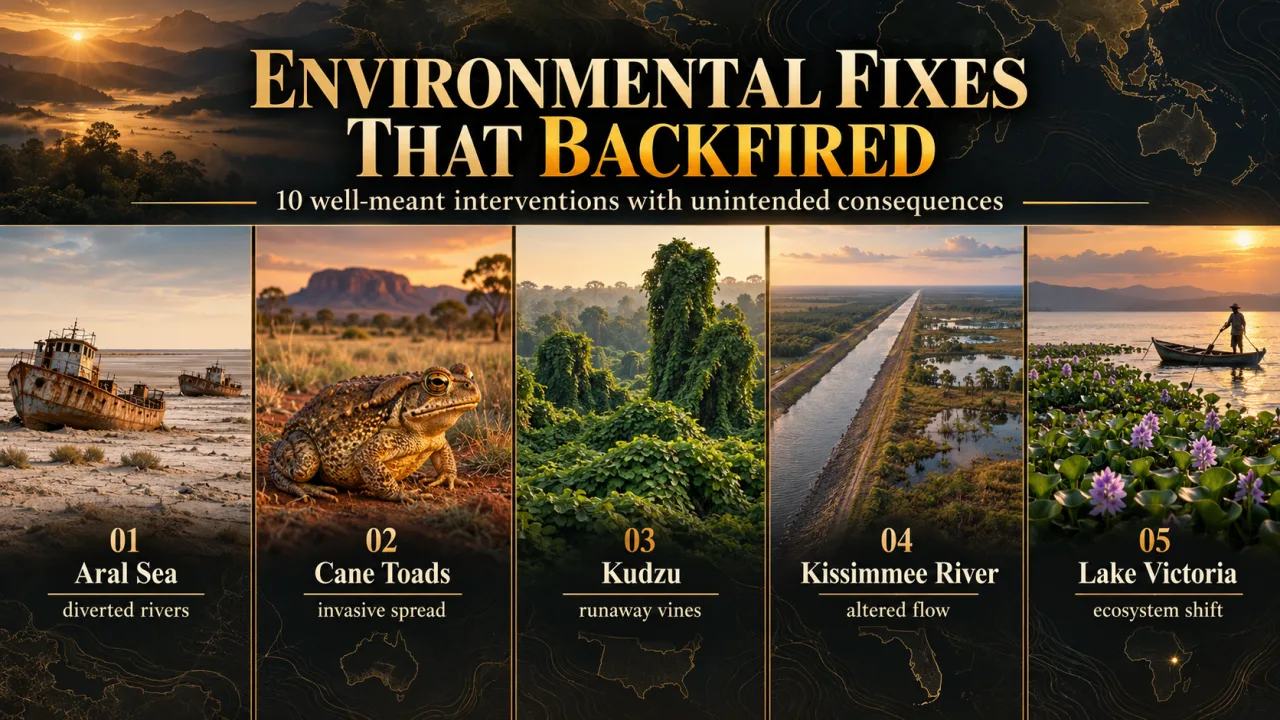
Environmental fixes can turn into crises when they ignore local food webs, species behavior, and the long-term effects of changing water or land.
A measure designed to solve one urgent problem can shift costs onto a river, island, farm, or community that was never part of the original calculation. The examples below range from species introductions to large engineering projects. They are not a claim that all intervention is harmful: they show why monitoring, local knowledge, and the ability to change course matter.
This ranking considers cases with a documented original goal and a substantial unintended ecological effect. Outcomes vary across places and over time, and some projects later inspired effective repair. Information is current to October 2026; the order is an editorial comparison rather than a scientific measurement.
How We Ranked Environmental Fixes That Backfired
Each case was compared on four dimensions. Ecosystem reach measures how many connected habitats or ecological relationships were affected. Severity considers the scale of documented harm. Persistence asks how long effects lasted or how difficult they are to reverse. The final measure, learning and repair, rewards cases where monitoring, management, or restoration has reduced damage. A high total means a consequential case with broad lessons, not a verdict on every later response.
- Ecosystem reach (1–5): the scale of connected waters, land, or food webs affected.
- Severity (1–5): the documented ecological change, including losses of habitat or native species.
- Persistence (1–5): how durable the effects are and how difficult recovery is.
- Learning and repair (1–5): whether the case reveals practical lessons and whether corrective work is possible. Here a higher score means a clearer recovery pathway, not a worse event.
When totals tied, we placed the case with broader ecological reach first, then considered whether evidence was well documented. Honourable mentions include interventions with important lessons but narrower or less certain outcomes.
The Scorecard
| Rank | Case | Reach | Severity | Persistence | Learning and repair | Total |
|---|---|---|---|---|---|---|
| 1 | Aral Sea irrigation diversion | 5 | 5 | 5 | 4 | 19 |
| 2 | Nile perch in Lake Victoria | 5 | 5 | 4 | 4 | 18 |
| 3 | Kissimmee River channelization | 4 | 4 | 4 | 5 | 17 |
| 4 | Cane toads in Australia | 4 | 4 | 4 | 4 | 16 |
| 5 | Stoats in New Zealand | 4 | 4 | 4 | 3 | 15 |
| 6 | Cat removal on Macquarie Island | 3 | 4 | 4 | 3 | 14 |
| 7 | Mongooses in Hawai‘i | 3 | 4 | 3 | 3 | 13 |
| 8 | Rosy wolfsnails on Pacific islands | 3 | 3 | 4 | 2 | 12 |
| 9 | Melaleuca planting in Florida | 3 | 3 | 3 | 3 | 12 |
| 10 | Kudzu planting in the United States | 3 | 3 | 3 | 2 | 11 |
Environmental Fixes at a Glance
| Rank | Intervention | Intended benefit | Unintended effect | Main lesson |
|---|---|---|---|---|
| 1 | River diversion to irrigate Central Asian farms | Grow crops in arid regions | Severe shrinkage of the Aral Sea and damage to fisheries and livelihoods | Account for basin-wide water needs |
| 2 | Nile perch stocking | Create a valuable fishery | Heavy predation on Lake Victoria's endemic cichlids | Assess food-web change, not only catch potential |
| 3 | Straightening the Kissimmee River | Flood protection and drainage | Floodplain habitat and wildlife declined | Measure ecological costs beside engineering benefits |
| 4 | Cane toads | Control sugarcane pests | Toxic animals spread and harmed susceptible predators | Test whether a control agent will attack the target |
| 5 | Stoats | Reduce rabbit numbers | Predation on native birds and other wildlife | Avoid broad predator introductions |
| 6 | Cat eradication | Protect seabirds | Rabbit numbers surged after predator removal | Plan for interactions among invasive species |
| 7 | Small Indian mongoose introduction | Reduce rats and snakes | Native wildlife faced a new predator | Match control timing to target activity |
| 8 | Rosy wolfsnail introduction | Suppress invasive giant African land snails | Native snails became prey | Check diet breadth and island endemism |
| 9 | Melaleuca planting | Drain wetlands and provide useful timber | A fast-spreading tree transformed habitats | Treat wetlands as functioning ecosystems |
| 10 | Kudzu planting | Limit erosion and restore soil | A vigorous vine spread beyond planted sites | Plan for long-term containment |
1. Aral Sea Irrigation Diversion
| Attribute | Details |
|---|---|
| Region | Kazakhstan, Uzbekistan, and surrounding Central Asia |
| Intervention | Diversion of the Amu Darya and Syr Darya river flows for irrigation |
| Goal | Expand agriculture in dry regions, especially cotton production |
| Major effect | The Aral Sea retreated and separated into smaller water bodies |
| Evidence | NASA satellite records document the shrinking shoreline and a dry eastern basin in 2014 |
The Aral Sea ranks first because a project aimed at increasing agricultural water supply changed the balance of an entire inland basin. The rivers that fed the lake were increasingly diverted to fields. The farms gained irrigation, while the lake lost much of the inflow that had sustained it. This was not a single accidental release or a local species problem; it was a long-lasting shift in the water budget of a large region.
Origins and History
During the Soviet period, large irrigation schemes redirected water from the Amu Darya and Syr Darya. The two rivers flow from distant mountain watersheds across arid lowlands. Their water was used to grow crops in areas where rainfall alone could not support comparable production. The scale of the withdrawals made the lake's decline a cumulative consequence of many canals and agricultural decisions, rather than one isolated event.
Satellite observations show how the shoreline changed. NASA's Earth Observatory compared images from 2000 and 2014, when the eastern lobe of the southern Aral basin had dried completely. Water levels in some portions later fluctuated; a brief refill or a restored local shore does not undo the basin-wide transformation. Conditions differ between the northern and southern parts because dams, river flows, and management choices differ.
Key Features
- A water allocation decision upstream affected a lake far downstream.
- The Aral was once among the world's largest lakes, but it fragmented as inflow declined.
- The exposed lakebed and receding shore altered the surrounding landscape.
- Fishery and port activities that depended on the former shoreline were disrupted.
- The northern basin and southern basins have followed different trajectories.
Significance
The case demonstrates that irrigation efficiency at a field level cannot by itself answer whether a basin has enough water to support farms, wetlands, cities, and lakes together. A canal can deliver crops a reliable supply while the cumulative withdrawals leave too little water for other parts of the system. Effective planning therefore needs a basin-wide water budget, transparent allocation rules, and environmental flows that are not treated as leftover supply.
It also warns against defining success solely by crop acreage or annual harvests. A project may satisfy a narrow production target and still create costs for fisheries, health, transport, and regional economies. These impacts require their own evidence and should not be compressed into a single claim. NASA's imagery is particularly useful because it allows readers to see the changing water footprint rather than relying only on retrospective descriptions.
Interesting Facts
- The Aral Sea is an inland lake, despite “sea” in its name.
- NASA recorded the eastern lobe of the South Aral Sea dry in an August 2014 image.
- The northern Aral has had a different management path from the southern basins.
- The two rivers feeding the former lake begin in mountain watersheds far from the coast.
2. Nile Perch in Lake Victoria
| Attribute | Details |
|---|---|
| Region | Lake Victoria, shared by Kenya, Tanzania, and Uganda |
| Intervention | Introduction of the large predatory Nile perch |
| Intended benefit | Develop a larger commercial fishery |
| Major effect | Predation and other pressures reshaped the lake's native fish community |
| Evidence | The American Museum of Natural History documents cichlid declines and food-web changes |
The Nile perch case ranks second because one economically attractive fish became a powerful new participant in a complex lake food web. Lake Victoria's cichlids were diverse and included species found nowhere else. Stocking a large predator promised a marketable catch, but the plan did not simply add a fish to a stable system. It altered which fish could survive, how local fishing worked, and how ecological relationships in the lake functioned.
Origins and History
Nile perch were introduced to Lake Victoria in the mid-twentieth century to support fishing. Their population remained relatively limited for a time and then expanded markedly. The change coincided with other pressures, including fishing practices, land runoff, and oxygen stress, so it would be misleading to assign every shift in the lake to a single species. Still, the perch's predatory role was a major part of the transformation described by the American Museum of Natural History.
The museum recounts that the lake once supported hundreds of cichlid species and that the perch became a much larger share of the fish biomass over the following decades. Many cichlids declined sharply; some may be extinct or close to extinction. These statements are estimates, not a final census of every species. The broader lesson is that introductions interact with existing stresses and that the conditions after an introduction may differ from the conditions at the time of stocking.
Key Features
- The introduction was intended to improve commercial fishing opportunities.
- Nile perch are much larger predators than many native lake fish.
- Lake Victoria's cichlids included many locally specialized species.
- Overfishing and nutrient runoff were additional stressors on the lake.
- A new fishery can generate income while also changing ecosystems and processing needs.
Significance
A target species can appear useful when evaluated by its expected market size, but fisheries planning must examine what it eats, where it reproduces, and how it may affect native species. Risk assessment should also ask whether the introduced animal can be controlled if its population becomes established. Once a predatory fish is widespread in a large lake, removing it selectively may be difficult and expensive.
The case also complicates simple narratives about conservation versus livelihoods. Fishers may depend on the new catch even when native biodiversity has fallen, and fishing communities are not responsible for the original stocking decisions. Management needs to protect food security and incomes while monitoring ecological conditions. Better catch records, conservation of native fish, and reduction of other pressures are parts of a longer response; no single measure restores a historic lake automatically.
Interesting Facts
- Lake Victoria borders three countries, so decisions about fisheries require cooperation.
- Cichlids are known for varied feeding strategies and parental behaviors.
- The perch fishery developed into a major commercial activity.
- Nutrient runoff and low oxygen complicated the ecological changes.
3. Kissimmee River Channelization
| Attribute | Details |
|---|---|
| Region | Central Florida, United States |
| Intervention | Construction of the C-38 canal through a naturally meandering river |
| Goal | Improve drainage and provide flood protection |
| Major effect | Floodplain wetlands and wildlife habitat were reduced |
| Recovery | The restoration project has reconnected sections of river and floodplain |
The Kissimmee River ranks third because the engineering objective was clear and the ecological tradeoff became measurable. Straightening and deepening the river helped move water away from developed areas, but it also disrupted the seasonal flooding that sustained a broad wetland floodplain. The South Florida Water Management District reports large declines in waterfowl and bald eagle nesting territories after channelization, and describes a long restoration effort to restore flow and habitat.
Origins and History
In the 1960s, engineers cut and dredged a straight channel called the C-38 canal through the river's curves. The project responded to flood-control demands in a growing region. Meanders and adjacent wetlands were not merely obstacles to faster drainage; they were part of the river's ecology. When the water was confined in the canal, the river no longer spilled across the floodplain in the same pattern.
According to the South Florida Water Management District, the transformation caused extensive habitat loss and changes in water quality and fish communities. The restoration effort began construction in 1999 and later backfilled portions of the canal, removed structures, and restored flow to remnant channels. The district describes restoration of dozens of miles of river and substantial wetland areas. These figures describe project scope, not a guarantee that every ecological function has returned to a pre-project state.
Key Features
- The original river meandered and periodically flooded its broad plain.
- The C-38 canal was deep and straight compared with the natural river.
- Flood protection and drainage were important goals for nearby communities.
- Channelization altered habitat and the timing of water across the floodplain.
- Restoration has involved coordinated work by state and federal agencies.
Significance
This example shows why infrastructure assessment should compare the full portfolio of benefits and costs. Flood protection is a real public need; wetlands also store water, support wildlife, and shape downstream flows. The planning challenge is to provide safety while preserving or rebuilding functions that engineering designs can remove. A project can meet its immediate construction target and still make later management much harder.
The recovery program provides a further lesson: ecological repair is possible but takes sustained funding, monitoring, land acquisition, and physical changes. Reconnecting water to a river corridor can support habitat recovery, yet success should be judged with measurements over time, not simply by miles excavated or canal filled. The project is a stronger example of learning when agencies publish outcomes and adapt water operations alongside construction.
Interesting Facts
- Channelization began in the 1960s to improve flood control.
- The C-38 canal replaced portions of the river's meandering path.
- The district reports a decline of more than 90 percent in waterfowl and 70 percent in bald eagle nesting territories after the change.
- Restoration backfilled sections of the canal and re-established river flow in remnant channels.
4. Cane Toads in Australia
| Attribute | Details |
|---|---|
| Region | Northeastern Australia, followed by spread into other parts of the continent |
| Intervention | Release of cane toads as biological control agents |
| Target | Insect pests affecting sugarcane |
| Major effect | The toads spread beyond the target area and their toxins threatened susceptible predators |
| Current response | Research, barriers, community reporting, and targeted management |
Cane toads rank fourth because the plan relied on a simple predator-prey assumption: a hungry animal would eat the crop pest and leave other relationships mostly unchanged. That assumption did not fit the toad's ecology. The species could disperse, reproduce, and consume a wide range of foods. Its toxic defenses also created a risk for predators that attempted to eat it. The case is often used to explain why biological control needs unusually careful testing before release.
Origins and History
Cane toads were introduced to Queensland in 1935 in an effort to control beetles damaging sugarcane. The hoped-for benefit was narrower than the biological traits of the animal. Toads do not remain confined to one field, and the target pests spend important parts of their life cycle in places the toads do not necessarily reach. The release therefore did not deliver the anticipated level of pest control, while the introduced population expanded into new landscapes.
The Australian Government's cane toad fact sheet describes the animals as toxic and notes that predators can be poisoned when they try to eat them. Local impacts differ by species and location; it is not accurate to say the toad has caused every predator decline or a documented extinction. Research and management continue to focus on preventing spread, reducing interactions, and protecting vulnerable wildlife. The history is a caution about the word “control”: a release is not a control program unless it can be measured and adjusted.
Key Features
- The original release aimed at sugarcane pests, not at every insect in the ecosystem.
- Toads can move away from the initial release site.
- Their skin glands produce toxins that can harm some predators.
- The species eats a varied diet and can establish in suitable habitats.
- Management requires local monitoring because predator susceptibility differs.
Significance
Biological control can reduce pesticide use and sometimes succeeds, but the agent must be studied for host range, dispersal, reproduction, and toxicity. A rigorous program tests the proposed control species under realistic conditions, identifies non-target organisms, and sets a stop rule before release. The cane toad case illustrates the cost of treating a complex landscape as a single crop problem.
Public reporting and research are still useful even when eradication is unrealistic. Mapping the invasion front, testing deterrents, and understanding which native predators can adapt support focused conservation. A careful article should distinguish between an established ecological threat and a claim that a named species has disappeared because of it. Scientific caution is part of the lesson, not a way to minimize the damage.
Interesting Facts
- Cane toads arrived in Australia in 1935.
- They were released in Queensland in connection with sugarcane pest control.
- Their spread across different habitats made a local release a continental management issue.
- Toxin exposure affects some predators more severely than others.
5. Stoats in New Zealand
| Attribute | Details |
|---|---|
| Region | New Zealand |
| Intervention | Introduction of stoats and other mustelids to reduce rabbits |
| Intended benefit | Limit rabbit damage to farms and pasture |
| Major effect | Stoats preyed on native birds and other wildlife |
| Current response | Predator control and landscape-scale conservation |
Stoats rank fifth because a predator brought in to control one invasive mammal became a serious hazard to native wildlife. New Zealand's birds evolved in ecosystems with relatively few land mammals, leaving some species and life stages especially vulnerable to introduced predators. The Department of Conservation identifies stoats as a major threat to native species, including kiwi chicks. The case demonstrates that controlling a pest with another generalist predator may simply add another ecological problem.
Origins and History
Stoats were brought to New Zealand in the late nineteenth century as part of attempts to reduce rabbit populations. Rabbits had become an agricultural concern, and settlers sought predators to suppress them. But stoats did not target rabbits alone. They are adaptable hunters and can take eggs, chicks, and adult birds, as well as other small animals. The original plan underestimated how an introduced predator would encounter wildlife that had not evolved alongside it.
The Department of Conservation's species material describes stoats as one of the biggest threats to kiwi chicks. Predation pressure varies with habitat, prey availability, and management, so one statistic cannot capture every local population. New Zealand's predator-free initiatives combine trapping, detection, and habitat work rather than relying on a newly introduced predator to solve the problem. That change in approach reflects a more detailed understanding of food webs and native species vulnerability.
Key Features
- Stoats were introduced in the 1800s to help with rabbit control.
- They are agile, opportunistic predators that can travel through varied habitat.
- Native birds may nest on or close to the ground.
- Stoat impacts are especially serious where prey lack defenses against mammalian predators.
- Conservation work uses targeted control and repeated monitoring.
Significance
The New Zealand story underlines the importance of evolutionary context. A predator that controls rabbits in its native range may find abundant, defenseless prey in an island ecosystem. The apparent “empty niche” is not empty; it may contain species whose adaptations make them vulnerable to a new hunter. Before introducing any control agent, ecological risk analysis must include prey beyond the intended target and the natural history of the receiving environment.
Long-term predator control can be expensive, but the alternative can be lasting damage to threatened species. Programs work best when monitoring guides where and when effort is applied. Community groups, government teams, and conservation organizations may all contribute to local trapping and reporting. The central lesson is not that every introduced species will behave identically, but that containment and reversibility should be tested rather than assumed.
Interesting Facts
- Stoats belong to the weasel family.
- They were introduced in New Zealand along with ferrets and weasels for rabbit control.
- The Department of Conservation identifies kiwi chicks among the wildlife at risk.
- New Zealand's conservation response now emphasizes coordinated predator suppression.
6. Cat Removal on Macquarie Island
| Attribute | Details |
|---|---|
| Region | Macquarie Island, subantarctic Australia |
| Intervention | Removal of feral cats to protect seabirds |
| Target pressure | Predation on seabirds by introduced cats |
| Unintended effect | Rabbit numbers increased after cats were removed |
| Later response | Integrated control addressed rabbits and other introduced species |
Macquarie Island ranks sixth because a conservation measure aimed at one invasive animal revealed how deeply invasive species can depend on one another. Feral cats preyed on seabirds, so eliminating cats appeared to offer an obvious benefit. But cats also preyed on rabbits. After cat eradication, rabbit numbers later rose as myxoma-virus control lost effectiveness; researchers describe a complex sequence rather than a single cause. High rabbit pressure then damaged vegetation. The result was not a reason to preserve cats; it was a reason to plan a whole-island program rather than remove one predator in isolation.
Origins and History
Cats arrived with people on the remote island and became established as predators. Rabbits were also introduced and spread. Management first targeted cats because seabird conservation was a major concern. After cat eradication, rabbit numbers later rose while myxoma-virus control was losing effectiveness; this sequence drove heavier grazing and added pressure to the island's vegetation. This chain illustrates a trophic cascade: changes at one level of a food web ripple to other organisms and habitats.
Australian Antarctic Program materials describe the eradication of rabbits, rats, and mice as a coordinated operation that followed earlier efforts against cats. The sequence matters. Removing a predator without assessing its role in controlling another introduced species can create a temporary surge in the latter. The later multi-species program paired eradication work with monitoring so that managers could detect unintended effects rather than assume a single removal had solved the ecosystem problem.
Key Features
- Cats were introduced by people and preyed on seabirds.
- Rabbits were a separate introduced herbivore on the island.
- Cat removal reduced one pressure but released another population from predation.
- Increased rabbit grazing threatened plant cover and slopes.
- Later management targeted multiple invasive species together.
Significance
The island case teaches that management targets can be connected even when agencies treat them as separate projects. Before removal, managers need to map food-web links, consider what will happen when predation ends, and plan to respond if another species increases. A short-term increase in a prey species may be predictable, but the ecological and operational consequences still need to be managed.
It also demonstrates why eradication plans should include measurable success criteria beyond the disappearance of a target animal. Vegetation recovery, seabird breeding success, and the abundance of other introduced animals all help show whether the ecosystem is moving in a healthier direction. On isolated islands, eradication can be feasible, but biosecurity after the project is essential to prevent accidental reintroduction.
Interesting Facts
- Macquarie Island is a remote subantarctic island administered by Australia.
- Cats and rabbits had different ecological roles and both were introduced.
- Rabbit control became central after cats were removed.
- Multi-species eradication programs need strong monitoring and biosecurity afterward.
7. Mongooses in Hawai‘i
| Attribute | Details |
|---|---|
| Region | Hawaiian Islands |
| Intervention | Introduction of small Indian mongooses |
| Intended benefit | Reduce rats affecting sugarcane and other interests |
| Major effect | Mongooses also preyed on native wildlife, including nesting birds |
| Key mismatch | Rats are often active at night; mongooses are mainly active by day |
Mongooses rank seventh because the intended target and the control animal were poorly matched in daily behavior. The small Indian mongoose was brought to Hawai‘i in the nineteenth century to reduce rats. Rats often forage at night, while mongooses are primarily active during daylight. That mismatch limited the hoped-for control and left the islands with a new predator capable of harming native animals, including ground-nesting birds and reptiles.
Origins and History
Plantation-era pest management relied on the idea that one predator could suppress another. Mongooses had already been introduced elsewhere as rat control, which likely made the strategy seem familiar. But success in one place does not guarantee success in a different climate or food web. Hawai‘i's native species evolved in isolation, and many did not develop defenses against mammalian predators. The introduced mongoose could therefore find prey beyond the agricultural target.
The precise consequences differ among islands, habitat types, and native species. For this reason, conservation sources describe a continuing threat rather than attributing every decline to mongooses alone. Other introduced predators, habitat alteration, and disease can also affect wildlife. The important historical point is that the biological-control plan addressed a pest problem without adequate attention to predator schedule, alternative prey, and the islands' ecological vulnerability.
Key Features
- Mongooses are mostly active during the day.
- Rats often forage at night, limiting direct encounter rates.
- The introduced predator can eat a broad range of small animals.
- Ground nests can expose eggs and chicks to mammalian predators.
- Island biosecurity and targeted trapping reduce future spread.
Significance
This case is a practical reminder that matching species names is not enough: managers must examine behavior and timing. A predator that rarely encounters its intended prey may still find plenty of other food. A credible biological-control proposal should compare activity periods, habitat use, and diet, and should consider local species that are at greater risk than the target pest.
It also shows why prevention matters. Once an introduced predator is established across inhabited islands, complete eradication can be difficult. Public education, port and cargo biosecurity, targeted removal near sensitive habitat, and long-term wildlife monitoring may offer a more realistic strategy. Those measures cannot undo every past introduction, but they can reduce new introductions and protect remaining vulnerable populations.
Interesting Facts
- Mongooses were introduced to Hawai‘i in the 1800s.
- Their daytime activity often differs from the nighttime habits of rats.
- Native Hawaiian wildlife developed in relative isolation from mammalian predators.
- Control efforts must account for other pressures affecting the same species.
8. Rosy Wolfsnails on Pacific Islands
| Attribute | Details |
|---|---|
| Region | Pacific islands, including locations in the Hawaiian archipelago |
| Intervention | Introduction of the predatory rosy wolfsnail |
| Intended target | Invasive giant African land snails |
| Major effect | Native land snails became prey for the introduced predator |
| Lesson | A control agent may consume non-target species that are harder to replace |
The rosy wolfsnail ranks eighth because it shows how a specialized-sounding solution can conceal a much broader appetite. The predatory snail was introduced to reduce invasive giant African land snails. Yet the predator also ate native snails, many of which had evolved on islands and occupied narrow habitat ranges. A biocontrol effort that was meant to suppress one pest therefore intensified the pressure on animals already vulnerable to habitat change and introduced species.
Origins and History
Giant African land snails were moved to Pacific islands and became damaging agricultural pests in some locations. The rosy wolfsnail was then introduced as a biological control. The predator's presence did not guarantee that it would distinguish the target pest from native mollusks. In island ecosystems with many endemic species, this distinction is critical: a non-target species may have no nearby population from which it can recolonize if it disappears locally.
Conservation accounts describe the rosy wolfsnail as a threat to native Hawaiian land snails. The exact degree of impact varies by species and site, and species declines often have several contributing causes, including habitat loss and other introduced predators. A careful summary should say that the predator contributed to pressure, rather than assigning all extinctions to one release. The case remains a clear example of the need for host-range studies before biological control.
Key Features
- The rosy wolfsnail is a carnivorous land snail.
- It was introduced to target an invasive giant snail.
- Native island snails could also be eaten.
- Endemic species may have small ranges and low population sizes.
- Monitoring non-target organisms is essential after any control release.
Significance
The case broadens the discussion of invasive species beyond mammals and insects. Biological control organisms can be predators, pathogens, or competitors, and each can affect organisms not included in the original plan. Testing should include local native species that are ecologically similar to the target, even if they are not economically important. The cost of overlooking them can be irreversible where island endemics have nowhere else to live.
Conservation practice now places strong emphasis on risk assessment, quarantine, and evaluating the full ecological community. The rosy wolfsnail illustrates why a control organism should not be released simply because it eats the target in a laboratory or another region. Effective management requires evidence that the proposed benefit outweighs risks to non-target species, plus a contingency if the agent spreads or changes its feeding behavior.
Interesting Facts
- The rosy wolfsnail is itself a snail predator.
- Giant African land snails were the target of its introduction.
- Several Hawaiian land snails occur nowhere else in the world.
- Island conservation programs must pay attention to even small invertebrates.
9. Melaleuca Planting in Florida
| Attribute | Details |
|---|---|
| Region | South Florida and the Everglades |
| Intervention | Planting of melaleuca trees in wet areas |
| Intended benefits | Drainage, windbreaks, and a useful timber source |
| Major effect | The tree spread rapidly and altered native wetland habitat |
| Current response | Herbicide, mechanical control, and biological control research |
Melaleuca ranks ninth because a tree promoted for practical land uses became invasive in a sensitive wetland landscape. Australian paperbark trees were planted in South Florida for drainage and windbreak purposes. They tolerate wet conditions, produce many seeds, and can form dense stands. Once established, they can change the vegetation structure and compete with native plants. The episode shows that “useful” and “ecologically safe” are separate questions.
Origins and History
Melaleuca quinquenervia is native to Australia and nearby parts of the region. It was introduced to Florida in the early twentieth century and planted in attempts to dry wet land and provide usable timber. The tree adapted well to the local climate and spread beyond the original plantings. In a wetland ecosystem, drainage is not a neutral improvement: seasonal water and native plant communities support distinctive wildlife and ecosystem functions.
The spread of melaleuca led to sustained control programs in Florida. Management combines several methods because cutting alone may not prevent regrowth or new seedlings. The aim is to reduce the invasive population and help native vegetation recover, while recognizing the scale and cost of treating widespread stands. Regional agencies and researchers continue to monitor the tree and evaluate control tools.
Key Features
- Melaleuca was introduced for land management and economic uses.
- It can tolerate wet conditions and disperse into suitable habitat.
- Dense growth can displace native wetland vegetation.
- A single control method may be insufficient in a large invasion.
- Restoration requires attention to water, plants, and ongoing reinvasion.
Significance
The Florida case connects invasive species management to wetland policy. Draining a wetland may appear to improve land for a narrow purpose, but it can reduce flood storage and alter habitat. Planting a non-native tree adds another ecological change, and later control can cost more than careful prevention. Land-use decisions therefore need to account for the long-term behavior of planted species and the ecosystem services already provided by wetlands.
The response also offers a lesson about persistence. Once a plant becomes widespread, eradication may be unrealistic; managers instead prioritize sensitive areas, prevent new seed sources, and measure whether native vegetation is returning. Integrating mechanical treatment, herbicides, biological controls, and restoration may be more effective than relying on any one technique. Continuous surveillance matters because seed movement can restart a local invasion.
Interesting Facts
- The tree is also called paperbark or broad-leaved paperbark.
- Its native range is outside Florida.
- The original motives included drainage and windbreaks.
- South Florida management focuses on limiting spread and restoring native plant communities.
10. Kudzu Planting in the United States
| Attribute | Details |
|---|---|
| Region | Southeastern United States |
| Intervention | Promotion and planting of kudzu as an erosion-control vine |
| Intended benefit | Stabilize soil and cover disturbed land |
| Major effect | The fast-growing vine spread beyond planned sites |
| Current response | Targeted treatment and repeated follow-up |
Kudzu ranks tenth because a plant promoted for soil protection became an emblem of unintended spread. The vine was introduced from Asia and promoted in the United States for ornamental planting and erosion control. It can grow rapidly in a warm climate, covering vegetation and structures. The problem was not simply that kudzu grows quickly; it was that the planting program underestimated maintenance, the vine's capacity to escape cultivated plots, and the difficulty of reversing widespread establishment.
Origins and History
Kudzu gained visibility at fairs and in agricultural promotion, then was planted on slopes and disturbed land. Its dense growth could help stabilize soil in some settings, which made it attractive where erosion was a concern. Over time, however, the vine spread into uncultivated areas. It can shade and smother other plants, reducing the light available to trees and shrubs. The same growth trait that made it useful for covering soil made it costly to manage after it expanded.
The United States Department of Agriculture lists kudzu among invasive plants and describes management approaches. Control generally requires more than one treatment because established plants can regrow. The useful lesson is not to treat every planting of a non-native species as inherently disastrous. Instead, evaluate the species' ability to reproduce and disperse locally, the availability of natural controls, and the resources needed for continuing maintenance.
Key Features
- Kudzu is a perennial vine introduced from Asia.
- It was promoted for erosion control and ornamental planting.
- In favorable conditions, it can grow over shrubs and trees.
- Follow-up control is needed to suppress regrowth.
- Prevention and early detection are less costly than managing a broad spread.
Significance
Kudzu demonstrates that project success should include an exit plan. A planting campaign should specify who maintains the plants, how long monitoring continues, and what happens if the species escapes. Erosion-control programs can select native species suited to the site and use engineering approaches that do not create long-term biological liabilities. Local testing and small pilot projects allow managers to observe spread before planting at landscape scale.
The vine's reputation can sometimes obscure the nuance of invasive plant management. Some locations are more heavily affected than others, and successful control is possible with persistent effort. The larger principle is to avoid confusing rapid coverage with ecological stability. Soil, native vegetation, and water conditions should be evaluated together so that a quick remedy does not create a larger maintenance burden.
Interesting Facts
- Kudzu's ability to grow across other vegetation helped make it visually conspicuous.
- It was promoted for erosion control before its long-term spread was fully understood.
- Repeated treatment is often needed where the vine is established.
- Early detection can limit the cost and area of later control.
Comparing the Ten Environmental Fixes
| Case | Type of intervention | Primary system affected | Hardest management question |
|---|---|---|---|
| Aral Sea | Water diversion | River basin and inland lake | How much water must remain for the whole basin? |
| Lake Victoria | Species introduction | Freshwater food web | How will a new predator change native fish communities? |
| Kissimmee River | Channel engineering | River and floodplain | Can flood protection coexist with seasonal wetlands? |
| Cane toad | Biological control | Terrestrial food webs | Can the agent be contained and kept on target? |
| New Zealand stoat | Predator introduction | Island wildlife | Which native species will be exposed? |
| Macquarie cats | Predator removal | Island food web | What population will increase when predation ends? |
| Hawaiian mongoose | Predator introduction | Island wildlife | Does the control animal encounter the target? |
| Rosy wolfsnail | Biological control | Island invertebrate communities | Are native relatives safe from predation? |
| Melaleuca | Planting and wetland alteration | Florida wetlands | Can spread and reinvasion be controlled? |
| Kudzu | Soil stabilization planting | Forest edges and disturbed land | Who will maintain the planting over time? |
The comparisons are qualitative. Local outcomes depend on climate, land use, other species, and the specific management regime.
Honourable Mentions
| Case | Intended benefit | Why it is notable | Why it missed the top ten |
|---|---|---|---|
| Mosquitofish introductions | Eat mosquito larvae | A familiar example of biological control that can affect native aquatic animals | Effects and priorities vary substantially by location |
| Signal crayfish in Europe | Create a food resource | The introduced crayfish can compete with native species and spread disease | The case is broad but region-specific and varied |
| Harlequin ladybirds | Control aphids | An introduced predator can compete with native ladybirds | Strong outcomes differ across regions |
| Fire suppression | Reduce immediate fire risk | Long periods without natural fire can alter fuel and habitat in fire-adapted ecosystems | Suppression is not always harmful; context and fire regime matter |
| Silver and bighead carp | Improve aquaculture and water quality | Escaped fish now affect connected rivers in North America | Control is ongoing and varies by waterway |
Frequently Asked Questions
What makes an environmental fix backfire?
A fix backfires when its unintended ecological effects outweigh or undermine its intended benefit. This can happen when planners focus on one target, such as a crop pest or floodwater, without considering other species, downstream users, or long-term maintenance. The phrase does not mean every intervention fails; it highlights the importance of testing assumptions and monitoring outcomes.
Are all invasive species introduced on purpose?
No. Species can arrive accidentally through cargo, travel, or escaped cultivation, while others are deliberately introduced for agriculture, hunting, erosion control, or biological pest management. Intent alone does not determine ecological effect. A deliberate release should receive especially careful review because people can assess the risks before the organism enters a new environment.
Can biological control still be responsible?
Yes. Biological control can help manage pests, but it requires evidence about the control organism's diet, reproduction, dispersal, and effects on non-target species. Authorities should test plausible risks, establish monitoring, and identify what action is possible if the agent spreads. A proposal that cannot be monitored or reversed deserves more caution than one with clear safeguards.
Why are islands especially vulnerable?
Islands often contain species with small geographic ranges and long evolutionary histories in relative isolation. Those species may not recognize or avoid introduced predators. If a local population disappears, nearby mainland populations may not exist to replenish it. Island projects therefore need strict biosecurity and a strong preference for preventing introductions before they become established.
Can damaged ecosystems recover?
Some can recover partly or substantially when the original pressure is reduced and habitat conditions are restored. Recovery may require decades, ongoing control of invasive species, and monitoring of water, vegetation, and wildlife. Outcomes are not guaranteed, and a return to an exact historical state may be impossible. The Kissimmee River restoration shows how active repair can improve conditions after major engineering change.
What should planners check before a large intervention?
They should define the problem, compare non-invasive alternatives, map affected ecosystems, and assess direct and indirect effects. Plans should include baseline measurements, clear targets, a budget for follow-up, and a way to stop or modify the intervention. Independent review and local knowledge can reveal risks that a narrow technical design may overlook.
Conclusion
These cases share a pattern: an intervention solves a visible problem while overlooking connections beyond the target. Rivers feed lakes, predators affect prey and plants, and a species introduced to one field can spread across a wider landscape. The strongest responses combine careful prediction with transparent monitoring and a willingness to adjust. Environmental management should compare near-term gains with long-term impacts across the whole system.
Readers interested in natural systems can also explore Finepedia's [animals that can live without food for months](https://finepedia.com/post/animals-that-can-live-without-food-for-months-top-10) and its overview of the [Grand Canyon's geological formation](https://finepedia.com/post/grand-canyon-a-geological-marvel-carved-by-the-colorado-river). Both topics show how organisms and landscapes respond to conditions over time.
- “20 Times Humans Tried to Fix Nature and Created a Much Bigger Problem,” HistorySnob, Eras category: https://www.historysnob.com/eras/20-times-humans-tried-to-fix-nature-and-created-a-much-bigger-problem
- NASA Earth Observatory, “The Aral Sea Loses Its Eastern Lobe”: https://science.nasa.gov/earth/earth-observatory/the-aral-sea-loses-its-eastern-lobe-84437/
- NASA Earth Observatory, “World of Change: Shrinking Aral Sea”: https://science.nasa.gov/earth/earth-observatory/world-of-change/aral-sea/
- American Museum of Natural History, “The Biodiversity Crisis: Lake Victoria”: https://www.amnh.org/learn-teach/curriculum-collections/biodiversity-crisis/the-biodiversity-crisis-lake-victoria
- South Florida Water Management District, “Kissimmee River”: https://sfwmd.gov/our-work/kissimmee-river
- New Zealand Department of Conservation, “Stoats”: https://www.doc.govt.nz/nature/pests-and-threats/animal-pests-and-threats/stoats/
- Australian Antarctic Program, Macquarie Island pest eradication information: https://www.antarctica.gov.au/news/2009/lessons-learned-from-devastating-effects-of-cat-eradication-on-macquarie-island/
- U.S. Department of Agriculture, National Invasive Species Information Center, kudzu resources: https://www.invasivespeciesinfo.gov/terrestrial/plants/kudzu
- Australian Government, cane toad threat abatement information: https://www.dcceew.gov.au/environment/invasive-species/publications/factsheet-cane-toad-bufo-marinus
- Hawai‘i Invasive Species Council, “Mongoose”: https://dlnr.hawaii.gov/hisc/mongoose-urva-auropunctata/
- Hawai‘i Department of Land and Natural Resources, “Threats to Snails – Rosy Wolf Snails”: https://dlnr.hawaii.gov/ecosystems/sepp/threats/
- University of Florida IFAS Extension, “Melaleuca quinquenervia”: https://edis.ifas.ufl.edu/publication/FR319

















Log in with