






 By
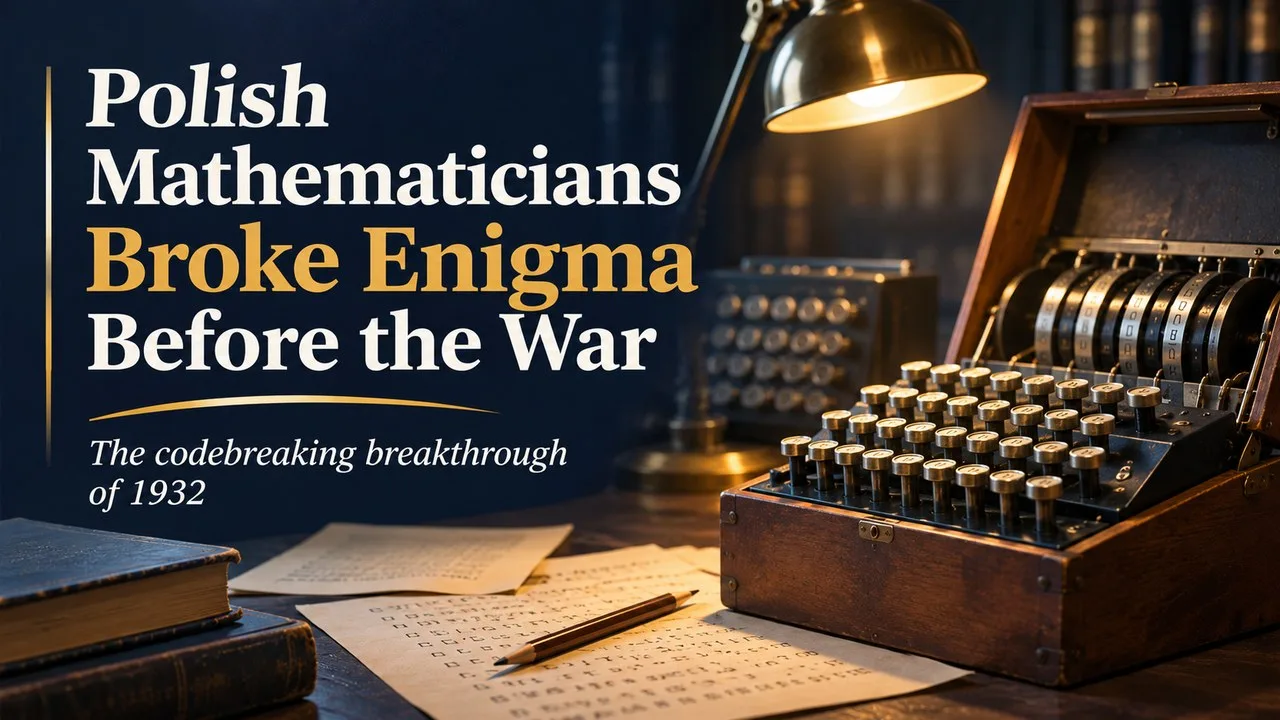
Polish mathematicians broke the German army's Enigma cipher machine in December 1932, almost seven years before World War II began in September 1939.[1][2]
This Finepedia guide, updated in November 2026, explains who the three Polish codebreakers were, how Marian Rejewski rebuilt a machine he had never seen, which tools the team built between 1933 and 1938, and why their work mattered to the Allies. It is number 1 in Top 20 World War II Facts: Little-Known Details.
Key Facts
| Attribute | Detail |
|---|---|
| What happened | Reconstruction of the military Enigma's rotor wiring and the first readings of its messages |
| When | Late 1932, with first messages read around the turn of 1932 to 1933 |
| Where | Cipher Bureau (Biuro Szyfrów), Saxon Palace, Warsaw, Poland |
| Lead mathematician | Marian Rejewski (1905 to 1980) |
| Colleagues | Jerzy Różycki (1909 to 1942) and Henryk Zygalski (1907 to 1978) |
| Key method | Permutation theory, a branch of abstract algebra |
| Outside help | German Enigma manuals and key sheets supplied by French intelligence |
| Devices built | Enigma replicas (1934), cyclometer (mid-1930s), bomba (1938) |
| Perforated sheets | Zygalski sheets, used to find the daily rotor order and positions |
| Setback | Two extra rotors added by the Germans on 15 December 1938 |
| Shared with allies | July 1939, near Warsaw |
| Formal honours | IEEE Milestone (2014); NSA Hall of Honor inductee (2014) |
Sources: Polish Foreign Intelligence Agency, Institute of National Remembrance, IEEE and NSA.[1][2][3][4]
Background: Poland and the German Cipher Machine
Poland had strong reasons to watch German military radio traffic. The country had regained its independence in 1918, and its Cipher Bureau had already gained experience reading Soviet signals during the Polish–Soviet War of 1919 to 1921.[4] In the 1920s the bureau kept monitoring German military exercises, which were broadcast by radio and could be picked up from Polish listening posts.
In mid-1928 those signals changed character. Rejewski later recorded that the first machine-enciphered messages from a German military station appeared on 15 July 1928.[5] The letters looked random, with none of the patterns that older hand ciphers left behind, and an early attempt to read them failed.[5][4]
The Enigma Machine
Enigma was invented by the German engineer Arthur Scherbius, who took out a patent on a rotor machine in 1918.[4] It looked like a typewriter with a lamp board. Each key press sent current through a set of rotating wired wheels and lit a different letter, and the rotors stepped forward after every letter, so the substitution changed continuously.[6]
The German navy adopted Enigma in 1926 and the army followed in 1928.[4] The military version added a plugboard that swapped pairs of letters before and after the rotors. Bletchley Park puts the number of possible starting arrangements at about 103 sextillion, while a BBC report gives about 158 million million million; the figure depends on how many rotors and plugboard leads are counted.[6][7]
The Mathematicians Behind the Breakthrough
The Polish approach was unusual. Codebreaking had long been treated as work for linguists, but the Cipher Bureau decided to test mathematicians who could read German.[1] Around 1928 to 1929 it ran a secret cryptology course at the University of Poznań, in western Poland, where German was widely spoken.[1][4] Sources disagree on its size: the Polish intelligence agency speaks of 20 students, while an Institute of National Remembrance profile gives 26.[1][2]
Three graduates stood out and were later hired by the bureau.
- Marian Rejewski was born on 16 August 1905 in Bromberg, now Bydgoszcz, and studied mathematics at Poznań, with a spell studying actuarial statistics in Göttingen.[2][8]
- Jerzy Różycki, the youngest, was born in 1909 and later devised the so-called clock method for identifying a rotor's position.[4]
- Henryk Zygalski, born in 1907, is remembered for perforated paper sheets that helped recover daily settings.[4][9]
The team first worked at a bureau branch in Poznań. When that office closed, the three moved to Warsaw, and Rejewski joined the German section, known as BS-4, in September 1932.[2][4] The NSA's profile dates the start of his Enigma work to October 1932, and notes that for security reasons he first studied the machine alone, after colleagues had gone home.[3]
How Rejewski Rebuilt Enigma
Mathematics Instead of Word Games
Earlier codebreakers relied mostly on letter frequencies and guessed words. Rejewski instead treated the machine as a sequence of permutations, the mathematical name for rearrangements of a set, and wrote equations describing how it scrambled the six-letter groups that opened each message.[4][8] The NSA calls him the first person to use a higher-algebraic attack against any cipher.[3]
Related: The Enigma Secret Was Shared Weeks Before the War
The key insight was that German operators enciphered each three-letter message key twice. That repetition created fixed relationships between the first and fourth letters, the second and fifth, and the third and sixth. By collecting many indicators from a single day, Rejewski could map those relationships as cycles and reason backwards towards the hidden wiring.[8][10]
Help From French Intelligence
The equations still had too many unknowns. Here espionage played a part. French military intelligence, under Captain Gustave Bertrand, had recruited a German cipher office employee, Hans-Thilo Schmidt, who sold operating manuals and key tables.[1][8] France passed the material to Warsaw, and documents giving the settings for September and October 1932 reached Rejewski in December 1932, most likely on 8 to 10 December.[1][4]
With those settings he could remove several unknowns and solve for the internal wiring of the rotors and the reflector.[4][8] Rejewski himself later judged that the French material should be regarded as decisive, although he also described a slower alternative route that relied more on chance.[8]
The First Messages Read
The Institute of National Remembrance states that the first messages were read between Christmas 1932 and New Year 1933, while the Polish Foreign Intelligence Agency gives 31 December 1932 at the Saxon Palace in Warsaw.[2][1] Either way, the military Enigma had been solved on paper within about three months of Rejewski's start.[2]
The timing mattered. Adolf Hitler came to power in Germany in early 1933, and Poland suddenly had a window into the communications of a neighbour whose intentions it feared.[1]
Tools the Polish Team Built
Rebuilding the machine was only the first step. To read traffic every day, the team still had to work out each day's settings, which the Germans changed regularly. Their main tools are summarised below.
Related: Bletchley Park Turned Codebreaking into Intelligence
| Tool | Approximate date | Main inventor or maker | Purpose |
|---|---|---|---|
| Enigma doubles | 1934 | AVA Radio Company, Warsaw | Working copies of the military machine |
| Clock method | 1930s | Jerzy Różycki | Identify which rotor sat in the fast position |
| Cyclometer and card catalogue | Mid-1930s | Marian Rejewski with AVA | Catalogue patterns for all 105,456 rotor positions |
| Zygalski sheets | 1938 | Henryk Zygalski | Find rotor order and positions using perforated sheets |
| Bomba | Late 1938 | Rejewski with AVA engineers | Search rotor positions automatically, six machines in all |
The AVA company, founded by radio engineers Edward Fokczyński and Antoni Palluth and later joined by Ludomir and Leonard Danilewicz, who were brothers, built the replicas and later machines.[4][1] The Polish agency says the bureau had about a dozen Enigma copies by 1934.[1]
Cyclometer and Catalogue
The cyclometer let the team record the cycle "characteristics" of every rotor position, and building the resulting catalogue took about a year.[4] Sources differ on the date of the device itself: the Institute of National Remembrance gives 1934, while the Polish intelligence agency gives 1936.[2][1] The catalogue became useless when the Germans changed their indicator procedure in September 1938.[4]
Bomba and Perforated Sheets
Rejewski answered that change with the bomba, an electromechanical device that combined three sets of Enigma rotors and searched for positions matching patterns in the day's indicators.[4] Six were built, one for each possible order of the three rotors.[4] Zygalski's perforated sheets, 26 for each rotor order, did a similar job by hand: when the sheets were stacked over a light, the positions where holes lined up pointed to the correct settings.[10][9]
The December 1938 Setback
The German army added two more rotors on 15 December 1938 to the set issued with each machine, so operators chose three out of five.[4][10] That meant 60 possible rotor orders instead of 6. Matching that with bombas would have needed 60 machines, more than the bureau could pay for, and after the change it could read only a small share of messages.[4][10]
The Polish team could still deduce how the new rotors were wired, so the problem was capacity rather than understanding.[10] These limits help explain why Poland chose to bring in Britain and France in mid-1939.
Timeline
| Date | Event |
|---|---|
| 1918 | Arthur Scherbius patents his rotor cipher machine[4] |
| 1926 to 1928 | German navy, then army, adopt Enigma[4] |
| 15 July 1928 | First machine-enciphered German military messages heard in Poland[5] |
| 1928 to 1929 | Cryptology course for mathematics students in Poznań[1][4] |
| September 1932 | Rejewski joins the German section in Warsaw[2][4] |
| December 1932 | French-supplied key tables reach Rejewski; wiring solved[1][4] |
| Turn of 1932 to 1933 | First Enigma messages read in Warsaw[1][2] |
| 1934 | AVA produces Enigma doubles[1][4] |
| September 1938 | Germans change indicator procedure[4] |
| Late 1938 | Bombas and Zygalski sheets introduced[1][4] |
| 15 December 1938 | Two extra rotors introduced, raising rotor orders to 60[4][10] |
| July 1939 | Poles share their results with Britain and France near Warsaw[11][1] |
Comparison With Later Allied Efforts
The Polish devices were the starting point for much larger work in Britain. Comparing them shows how the problem grew once war began.
Related: Midway Turned the Tide in the Pacific
| Feature | Polish Cipher Bureau (1932 to 1939) | Bletchley Park (1939 to 1945) |
|---|---|---|
| Main attack method | Patterns in repeated message keys | Guessed plaintext fragments, or "cribs" |
| Key machine | Bomba (6 built) | British Bombe, designed by Alan Turing with Gordon Welchman |
| Staff working on Enigma | A handful of cryptologists | Thousands of staff by 1945 |
| Vulnerability | Ended when Germans stopped doubling keys | Did not depend on doubled keys |
IEEE explains that the Polish machine looked for regularities in the message indicators, whereas the British Bombe looked for them in the text of the messages.[4] That difference meant the British approach kept working after the Germans stopped repeating message keys.
Key Figures
- 15 July 1928: date the first German machine-enciphered military signals were heard.[5]
- 3: Polish mathematicians at the core of the work.[1][4]
- About 3 months: time from Rejewski's start to the solved wiring.[2]
- 105,456: rotor positions recorded in the cyclometer catalogue.[4]
- About 1 year: time needed to build that catalogue.[4]
- 6: bombas built, one for each order of three rotors.[4]
- 60: rotor orders after December 1938, up from 6.[4][10]
- 2014: year of both the IEEE Milestone and the NSA Hall of Honor induction.[3][4]
Common Misconceptions
A popular belief holds that Enigma was first broken at Bletchley Park. In fact Bletchley Park itself states that the Poles had broken Enigma as early as 1932, and that the first British wartime breaks came in January 1940.[6]
Another misconception is that Rejewski worked from captured hardware. He never saw a military Enigma before rebuilding it; he worked from intercepted messages, a commercial model and documents passed on by France.[3][8] It is also wrong to say the Polish success was purely mathematical. Rejewski himself credited the French intelligence material as decisive.[8]
Legacy and Recognition
For decades the Polish role stayed little known, partly because Enigma intelligence remained secret long after 1945.[8][7] Rejewski returned to Poland in 1946, worked in modest jobs and died in Warsaw on 13 February 1980 at the age of 74.[2][8]
Recognition grew after his death. The NSA inducted him into its Hall of Honor in 2014, and the same year the IEEE dedicated a Milestone plaque in Warsaw to the Polish Cipher Bureau team.[3][4] Bletchley Park holds an annual Polish Day, and BBC coverage of it notes that experts think breaking Enigma could have cut as much as two years from the war, an estimate that historians still debate.[7]
Frequently Asked Questions
Who broke Enigma first?
Polish mathematicians at the Cipher Bureau in Warsaw were first. Marian Rejewski worked out the wiring of the military machine in late 1932, and messages were being read around the turn of 1932 to 1933. Jerzy Różycki and Henryk Zygalski then joined him in finding daily settings.[1][2]
Related: The UN Charter Was Signed Before Japan's Surrender
Did Rejewski ever see a military Enigma before solving it?
No. He reconstructed the machine on paper, using intercepted messages, a commercial version of the machine and documents that French intelligence had obtained from a German informer. The NSA describes his method as the first higher-algebraic attack on any cipher.[3][8]
What was the bomba?
The bomba was an electromechanical device built in late 1938 by the Polish team and engineers from the AVA company. Each one combined sets of Enigma rotors and searched for positions that matched patterns in the day's message keys. Six were built, one per rotor order.[1][4]
Why did the Poles stop reading most Enigma traffic?
The Germans added two rotors to each machine's set on 15 December 1938, so there were now 60 rotor orders instead of 6. Keeping up would have needed 60 bombas, which Poland could not afford, so only a small share of messages could still be read.[4][10]
How did the Polish work reach Britain?
In July 1939 Polish codebreakers met British and French experts near Warsaw, explained their methods and promised each a replica Enigma. GCHQ says the knowledge transformed the British approach to Enigma.[11]
Conclusion
The breaking of Enigma began not in an English country house but in a Warsaw office, where a young mathematician applied permutation theory to a problem that linguists had failed to crack. With help from French intelligence, Rejewski, Różycki and Zygalski read German army traffic for most of the 1930s and built some of the first machines designed to attack a cipher.
Their lead faded only when German changes in late 1938 outran Poland's resources. What they had already achieved gave Britain and France a head start that shaped the intelligence war that followed.
See all 20 in Top 20 World War II Facts: Little-Known Details
See also
- Top 20 World War II Facts: Little-Known Details
- Top 10 Real Intelligence Operations That Sound Like Fiction
- Top 10 Overlooked Events of World War II
- Top 10 Inventions That Changed Warfare: Chariots to Drones
- ^ [1] "Enigma decryption". Foreign Intelligence Agency (Agencja Wywiadu), Republic of Poland. Foreign Intelligence Agency: Enigma decryption
- ^ [2] "90 lat temu Polacy złamali szyfr Enigmy". Institute of National Remembrance (IPN). IPN: 90 years since Poles broke Enigma
- ^ [3] "Marian Rejewski: 2014 Hall of Honor Inductee". National Security Agency. NSA: Marian Rejewski
- ^ [4] "Milestones: First Breaking of Enigma Code by the Team of Polish Cipher Bureau, 1932-1939". IEEE / Engineering and Technology History Wiki. ETHW: IEEE Milestone
- ^ [5] "How Polish Mathematicians Deciphered the Enigma" (Marian Rejewski, 1981). Annals of the History of Computing, vol. 3, no. 3, IEEE. DOI 10.1109/MAHC.1981.10033
- ^ [6] "Enigma". Bletchley Park. Bletchley Park: Enigma
- ^ [7] "Bletchley Park remembers Polish code breakers". BBC News. BBC News
- ^ [8] "Marian Rejewski". Wikipedia. Wikipedia: Marian Rejewski
- ^ [9] "Marian Rejewski. Człowiek, który złamał Enigmę". Institute of National Remembrance (IPN). IPN: The man who broke Enigma
- ^ [10] "Cryptanalysis of the Enigma". Wikipedia. Wikipedia: Cryptanalysis of the Enigma
- ^ [11] "The Pyry Forest Meeting". GCHQ. GCHQ: The Pyry Forest Meeting


























Discussion
Log in with