






 By
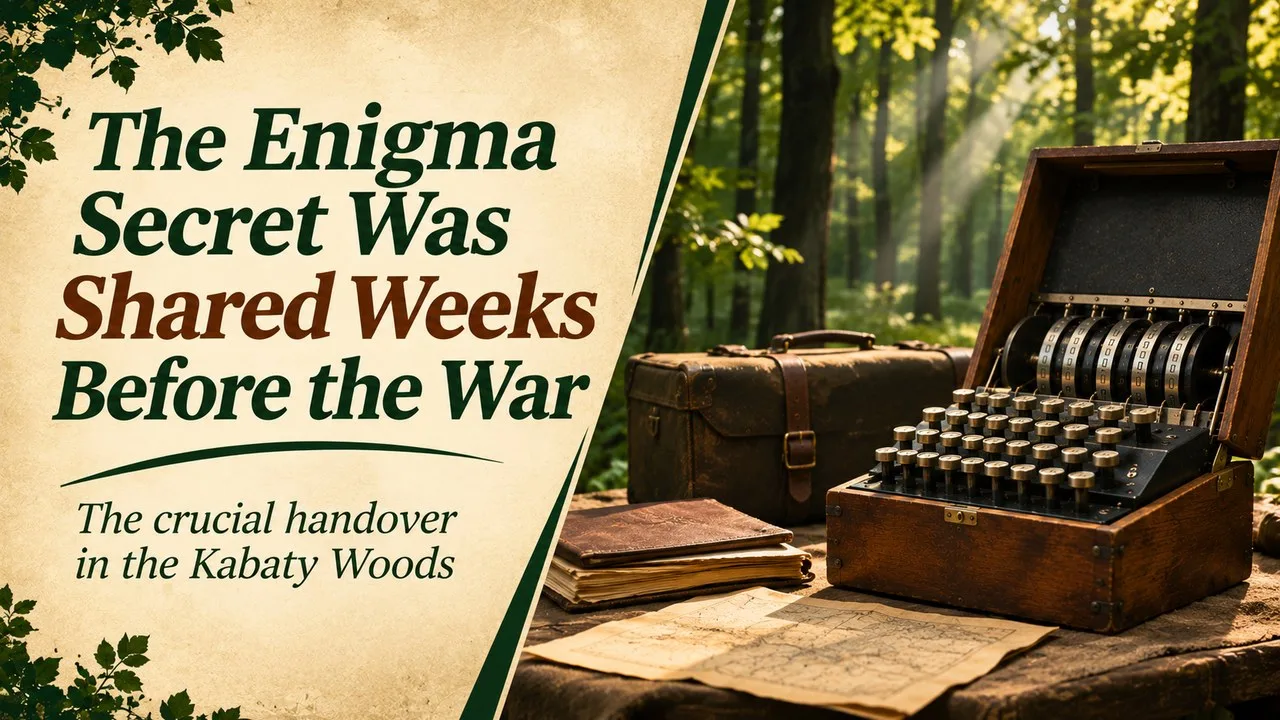
The Enigma secret was shared weeks before the war when Polish codebreakers showed British and French experts how they read German ciphers, in July 1939.[1][2]
This Finepedia guide, updated in November 2026, covers why Poland decided to give away its most valuable intelligence secret, what happened at the meeting in the Kabaty Woods near Pyry, how the gift reached Bletchley Park, and how the Polish team kept working in exile. It is number 2 in Top 20 World War II Facts: Little-Known Details.
Key Facts
| Attribute | Detail |
|---|---|
| Event | Trilateral Polish, French and British meeting on the Enigma cipher |
| Dates | Late July 1939; sources give spans from 24 to 27 July |
| Place | Cipher Bureau centre in the Kabaty Woods at Pyry, south of Warsaw |
| Polish hosts | Gwido Langer, Maksymilian Ciężki, Marian Rejewski, Jerzy Różycki, Henryk Zygalski |
| French guests | Gustave Bertrand and Henri Braquenié |
| British guests | Alastair Denniston, Dilly Knox and Humphrey Sandwith |
| What was given | A Polish-built Enigma replica for each ally, plus methods and device details |
| Earlier meeting | Paris, January 1939, where the Poles held back |
| Invasion of Poland | 1 September 1939, about five weeks later |
| First wartime breaks | January 1940, in Britain and in France |
| Main result | A head start for Bletchley Park's attack on Enigma |
Sources: GCHQ, the Polish Foreign Intelligence Agency and the Enigma Cipher Centre in Poznań.[1][3][4]
Background: Seven Years of Secret Success
By 1939 Polish cryptologists had been reading German Enigma messages since the early 1930s. Marian Rejewski rebuilt the military machine on paper in late 1932, and the Cipher Bureau went on to build working replicas and electromechanical aids called bombas.[3][5] None of this was known to Britain or France in detail.
In late 1938 the picture changed. The Germans added two new rotors in December, multiplying the number of rotor orders tenfold, to 60, and Poland could no longer afford the extra machines needed to keep pace.[5][6] The bureau still understood the machine, but it lacked the resources to read most of the traffic.
The Cautious Paris Meeting
Polish, French and British specialists first met in Paris in January 1939. GCHQ notes that neither the British nor the Poles were ready to share everything, and the Polish intelligence agency says the Poles revealed nothing of their six years of success.[1][3] The parties agreed to meet again only if one of them had something new to offer.[3]
Why Poland Decided to Share
Over the following months the political situation moved quickly. Germany occupied the rest of Czechoslovakia in March 1939, and Britain then guaranteed Poland's independence, with France also committed to Poland's defence.[2][1] With German pressure growing on Danzig, the Polish General Staff wanted closer ties with its western partners.[2]
GCHQ describes the July exchange as a two-way bargain. Britain and France had formally pledged to stand by Poland, and in return the Polish side was ready to explain its progress against Enigma.[1] The Polish centre in Poznań adds a practical reason: Poland wanted to concentrate its own resources on defence, and its allies had far greater means to continue the work.[4]
The Signal: "There Is Something New"
On 30 June 1939 the head of the Polish bureau sent his French counterpart a coded message announcing a new development, the phrase agreed in Paris as the trigger for another meeting.[2] The Enigma Cipher Centre gives the Polish version of the password as "Mamy nowiny", meaning "we have news".[4] The UK government's history blog stresses that the message did not signal a fresh technical breakthrough, only a decision to reveal what Poland already knew.[2]
Related: Polish Mathematicians Broke Enigma Before the War
Inside the Pyry Meeting
Who Was There
The delegations were small and senior. France sent Gustave Bertrand, its radio intelligence chief, and air force cryptologist Henri Braquenié.[3][4] Britain sent Alastair Denniston, head of the Government Code and Cypher School, the veteran cryptanalyst Dilly Knox and Humphrey Sandwith, who ran the Royal Navy's intercept stations.[1][7] On the Polish side were bureau chiefs Gwido Langer and Maksymilian Ciężki and the three mathematicians.[7][4]
What the Guests Saw
According to the Enigma Cipher Centre, Ciężki opened with a long lecture in German, the only language every participant shared, before the visitors were shown Polish Enigma replicas running alongside the bomba and Zygalski's perforated sheets.[4] The Polish intelligence agency adds that Langer demonstrated the decryption of a German message sent by an SS command.[3]
Knox's first question, as Rejewski later recalled, concerned the order in which the keyboard was wired into the machine's entry drum. The answer was simply alphabetical, a possibility Knox had already rejected, and the UK government blog notes that he was furious at missing it.[7][2]
The Gift
The Poles promised each ally a reconstructed Enigma and full documentation of their methods.[3][7] In return the British undertook to produce complete Zygalski sheet sets covering every one of the 60 rotor orders, a job too large for Polish resources at the time.[4][7] GCHQ says the visitors found the Poles far ahead of them, both in the volume of traffic read and in their machine-assisted methods.[1]
Dates and Accounts Compared
Sources agree on the substance of the meeting but not on its exact dates. The differences mostly reflect whether arrival day, the visit to Pyry itself and the follow-up talks are counted.
| Source | Dates given | Notes |
|---|---|---|
| GCHQ | 25 and 26 July 1939 | Official British account[1] |
| UK government history blog | 26 July 1939 | Date of the main disclosure[2] |
| Polish Foreign Intelligence Agency | 25 to 27 July 1939 | Visit to Pyry on 25 July[3] |
| Institute of National Remembrance | 24 to 27 July 1939 | Includes arrival in Warsaw[8] |
| Enigma Cipher Centre, Poznań | 24 to 27 July 1939 | Guests taken to Pyry on the morning of 25 July[4] |
From Warsaw to Bletchley Park
The Polish information arrived as Bletchley Park was expanding for war. The UK government blog, citing the historian Dermot Turing, says the Polish achievement saved Britain at least a year in its work against Enigma.[2] Gordon Welchman, one of Bletchley's leading codebreakers, later wrote that Ultra intelligence "would never have gotten off the ground" without the Polish disclosures.[7]
Related: Bletchley Park Turned Codebreaking into Intelligence
Bletchley Park dates the first British wartime breaks of Enigma to January 1940, made in the stable yard by Knox's research section.[9] An IEEE history gives 20 January 1940 for the first break, into a German army administrative key known as Green.[10] GCHQ also credits conversations between Alan Turing and Rejewski in France that month with shaping the design of the first British Bombe.[1]
Escape and Exile
Flight Through Romania
Germany invaded Poland on 1 September 1939, and the Soviet invasion from the east followed on 17 September.[4][6] The Cipher Bureau evacuated its staff, destroyed its equipment and documents on the way and crossed into Romania. The three mathematicians reached Bucharest and, with French help, travelled on to Paris by late September.[6][5]
PC Bruno and Cadix
By the end of October 1939 the Poles were working again at PC Bruno, a joint station at Gretz-Armainvilliers near Paris, in close contact with Bletchley Park.[5][6] Turing visited in January 1940 and brought the British-made Zygalski sheets, and on 17 January the team found the first wartime Enigma key solved in France, for 28 October 1939.[6][7] Wikipedia's summary of the period, drawing on Polish historians, says about 17 per cent of keys found up to June 1940 were solved at Bruno.[6]
After France fell in June 1940, the team went to Algeria and returned in autumn to a covert station called Cadix near Uzès, in the unoccupied south.[5][11] Różycki died on 9 January 1942 when the ship carrying him back from Algeria sank.[5][11] Cadix was evacuated in November 1942, shortly before German troops took over the area.[5][11]
Timeline
| Date | Event |
|---|---|
| December 1932 | Rejewski solves the military Enigma's wiring[3][5] |
| 15 December 1938 | Two extra rotors raise rotor orders to 60[5][6] |
| January 1939 | Cautious first meeting in Paris[1][3] |
| 30 June 1939 | Polish signal announces "something new"[2][4] |
| Late July 1939 | Meeting near Pyry; methods and replicas promised[1][3] |
| 1 September 1939 | Germany invades Poland[4][6] |
| 17 September 1939 | Soviet invasion; Cipher Bureau crosses into Romania[6][11] |
| October 1939 | Polish team resumes work at PC Bruno[5][6] |
| January 1940 | Turing visits PC Bruno; first wartime breaks in France and Britain[1][9] |
| June 1940 | Fall of France; team moves to Algeria[5][11] |
| 9 January 1942 | Jerzy Różycki dies at sea[5][11] |
| November 1942 | Cadix evacuated[5][11] |
Why the Exchange Mattered
The meeting saved the Allies time at the moment they needed it most. Britain already had capable cryptanalysts, but it did not know the military machine's internal wiring, and without that the first months of war could have passed without useful decrypts.[1][2] The Polish replicas and methods gave Bletchley Park a working model from the start.
The exchange also set a pattern for wartime cooperation. The UK government blog calls the collaboration the start of what one historian described as "the most consequential intelligence-sharing arrangement of World War Two".[2] Later partnerships, including British cooperation with American codebreakers, built on the same principle of pooling secrets against a common enemy.
Related: Midway Turned the Tide in the Pacific
Key Figures
- 3: Polish mathematicians who briefed the allies.[3][5]
- 2: Enigma replicas promised, one each for Britain and France.[3][7]
- 60: rotor orders for which Britain agreed to make Zygalski sheets.[4][7]
- About 5 weeks: gap between the Pyry meeting and the invasion of Poland.[4][7]
- At least 1 year: time the Polish material is said to have saved Britain.[2]
- 17 January 1940: first wartime Enigma key solved at PC Bruno.[6][7]
- About 17 per cent: share of keys found at PC Bruno up to June 1940.[6]
Common Misconceptions
One myth is that the Poles handed over their secret only after they had fled. In fact the disclosure came in July 1939, before the invasion, and each ally received a Polish-built replica as a result of that meeting.[3][5]
Another is that Britain needed the Polish gift because it had no codebreakers. GCHQ makes clear that Knox and his team were already working on Enigma; what they lacked was the wiring and the machine-assisted methods.[1] Finally, the gift was not a one-way favour. The British agreed to make the large sets of Zygalski sheets that Poland could not produce.[4][7]
Legacy and Recognition
The story stayed hidden for decades because the Allies kept Enigma intelligence secret long after 1945.[5][9] Bertrand's own book in 1973 helped bring the origins of Ultra into the open.[5]
Today the meeting is commemorated on both sides. Bletchley Park hosts an annual Polish Day, and BBC coverage of it quotes Bletchley's Polish expert John Gallehawk calling the disclosure "quite a magnanimous gift" from one country to another.[12] In Poland, the Enigma Cipher Centre in Poznań tells the story for new audiences.[4]
Frequently Asked Questions
When exactly did Poland share the Enigma secret?
In late July 1939. GCHQ gives 25 and 26 July, Polish sources give spans running from 24 to 27 July, and the UK government blog dates the main disclosure to 26 July. All agree that the meeting took place near Pyry, south of Warsaw, about five weeks before the German invasion.[1][2][4]
Who attended the Pyry meeting?
The Polish side included Gwido Langer, Maksymilian Ciężki and the mathematicians Rejewski, Różycki and Zygalski. France sent Gustave Bertrand and Henri Braquenié, and Britain sent Alastair Denniston, Dilly Knox and Humphrey Sandwith of the Royal Navy.[3][7]
Related: The War Ended on Different Dates in Europe and Asia
What did Britain and France receive?
Each received the promise of a Polish-built Enigma replica together with details of the Polish methods, among them Rejewski's bomba and Zygalski's perforated sheets. Britain agreed to produce sheets for all 60 possible rotor orders.[3][4][7]
Why did Poland wait until July 1939?
Poland had kept the secret for years to protect its own intelligence. By mid-1939 German changes had outrun its resources, Britain and France had pledged to support Poland, and war looked close, so sharing made strategic sense.[1][2][4]
What happened to the Polish codebreakers afterwards?
They escaped through Romania to France, worked at PC Bruno near Paris and later at Cadix in southern France. Różycki died at sea in January 1942, while Rejewski and Zygalski eventually reached Britain.[5][11]
Conclusion
The July 1939 meeting turned a Polish national secret into an Allied asset at the last possible moment. Poland gave away years of work because it could no longer keep pace alone and because war was coming, and Britain and France gained the wiring, the methods and a working replica.
The gift did not win the codebreaking war on its own, but it shortened the British learning curve and set a precedent for sharing intelligence among allies.
See all 20 in Top 20 World War II Facts: Little-Known Details
See also
- Top 20 World War II Facts: Little-Known Details
- Top 10 Real Intelligence Operations That Sound Like Fiction
- Top 10 Overlooked Events of World War II
- Top 10 Forged Documents That Saved Lives in World War II
- ^ [1] "The Pyry Forest Meeting". GCHQ. GCHQ: The Pyry Forest Meeting
- ^ [2] "What's the context? Polish cryptologists reveal they have cracked the Enigma code, 26 July 1939". History of Government blog, GOV.UK. GOV.UK History of Government
- ^ [3] "Enigma decryption". Foreign Intelligence Agency (Agencja Wywiadu), Republic of Poland. Foreign Intelligence Agency: Enigma decryption
- ^ [4] "Spotkanie w Pyrach". Centrum Szyfrów Enigma (Enigma Cipher Centre), Poznań. Enigma Cipher Centre: The Pyry meeting
- ^ [5] "Milestones: First Breaking of Enigma Code by the Team of Polish Cipher Bureau, 1932-1939". IEEE / Engineering and Technology History Wiki. ETHW: IEEE Milestone
- ^ [6] "Cryptanalysis of the Enigma". Wikipedia. Wikipedia: Cryptanalysis of the Enigma
- ^ [7] "Biuro Szyfrów". Wikipedia. Wikipedia: Biuro Szyfrów
- ^ [8] "90 lat temu Polacy złamali szyfr Enigmy". Institute of National Remembrance (IPN). IPN: 90 years since Poles broke Enigma
- ^ [9] "Enigma". Bletchley Park. Bletchley Park: Enigma
- ^ [10] "Milestones: Code-breaking at Bletchley Park during World War II, 1939-1945". IEEE / Engineering and Technology History Wiki. ETHW: Bletchley Park Milestone
- ^ [11] "Marian Rejewski". Wikipedia. Wikipedia: Marian Rejewski
- ^ [12] "Bletchley Park remembers Polish code breakers". BBC News. BBC News


























Discussion
Log in with